
Should You Buy Peanut Clusters or Make Them at Home?
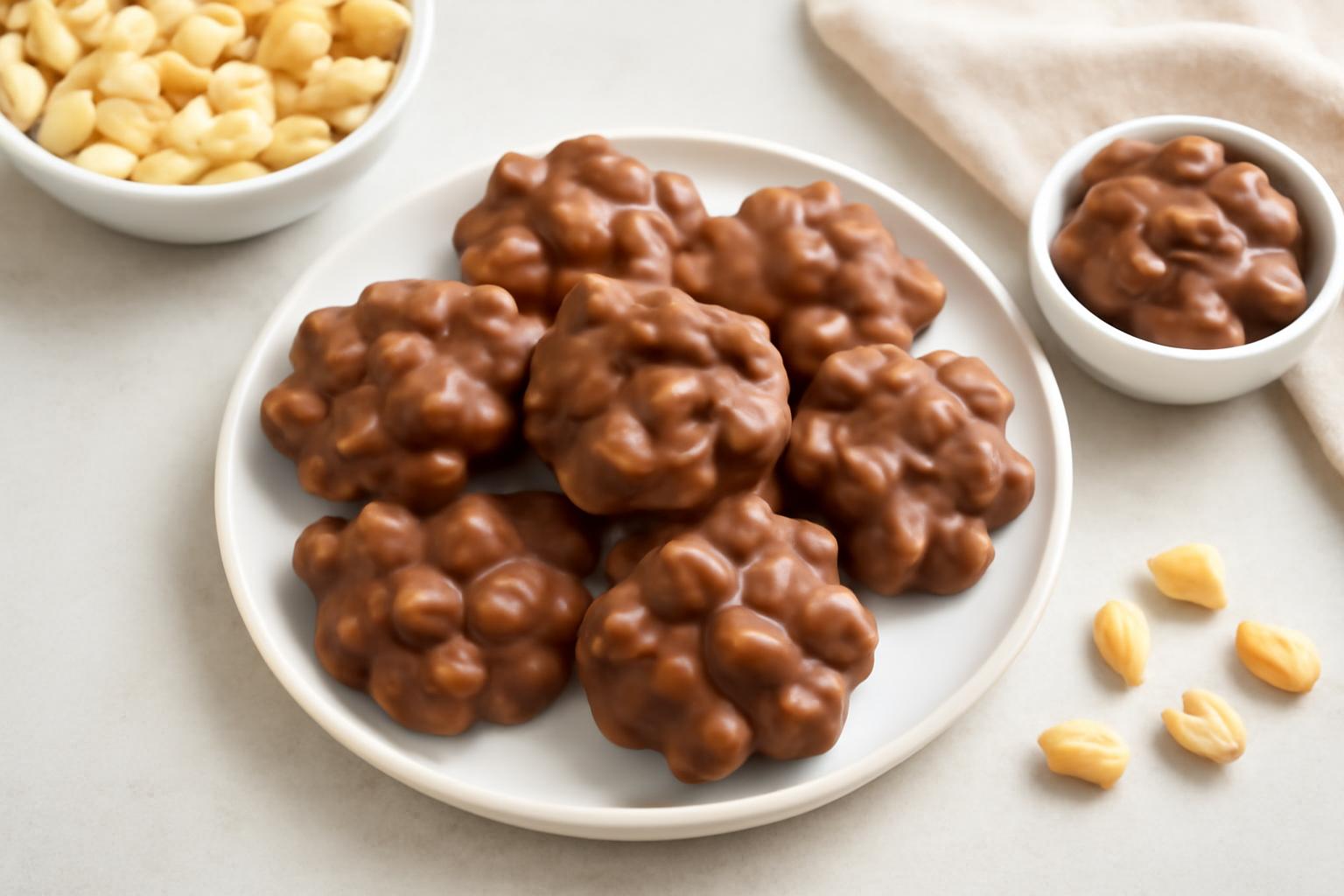
SunRidge Farms had the lowest calculated base price per ounce, but that price required buying 10 pounds. Shipping and cooling fees can change delivered value.
Milk chocolate peanut clusters are portions of peanuts coated or enrobed in milk chocolate. Some similarly named candies instead use a vegetable-fat coating described as “milk chocolatey.”
Choosing between packaged clusters and a homemade batch requires more than comparing sticker prices. The products reviewed here range from a 6-ounce box to a 10-pound bulk case and differ in coating, peanut type, packaging, ingredient disclosure, availability, shipping charges, and warm-weather policies.
The quick answer: what to compare before buying
Start with three distinct questions:
- Which product has the lowest base price per ounce?
- Which has the lowest delivered cost after shipping and cooling charges?
- Which package fits the purpose—personal snacking, bulk use, or gifting?
In this comparison, SunRidge Farms had the lowest calculated base price per ounce, but that price required buying 10 pounds. It is not directly comparable with a consumer bag, decorative box, or gift tin.
For a smaller purchase, Beulah’s Candyland had the next-lowest base price per ounce. Its destination-specific delivery charge substantially increased the example checkout cost. Gift buyers may instead accept a higher unit price for Malley’s decorative box or Whitley’s tin.
Before ordering, check:
- Net package weight
- Product price per ounce
- Shipping and warm-weather charges
- Minimum purchase quantity
- Exact coating description
- Complete ingredients and allergen statements
- Current seller and stock status
- Return or damaged-delivery policy
- Packaging appropriate for the intended use
Prices, availability, sellers, ratings, delivery charges, and seasonal policies can change. Customer reviews may provide context, but they cannot establish which product will taste best, arrive freshest, or offer the highest quality.
Packaged milk chocolate peanut clusters compared
Prices and availability checked July 30, 2026. The calculations divide the displayed product price by the stated net weight. They exclude tax, shipping, cooling charges, discounts, and possible bulk surcharges.
No products were purchased or taste-tested for this comparison. Product descriptions, ingredients, availability, and policies come from the cited seller or marketplace pages.
| Product | Package format | Captured base price | Calculated base price per ounce | Disclosed peanut type | Coating description | Seller or storefront | Captured availability | Major shipping caveat |
|---|---|---|---|---|---|---|---|---|
| Coblentz Milk Chocolate Peanut Clusters | 6-ounce box | $13.95 | $13.95 ÷ 6 = about $2.33 | Peanuts; type not stated | Milk chocolate | Coblentz Chocolates | Not shown in the captured page text | A $5 warm-weather handling fee may apply |
| Beulah’s Candyland Milk Chocolate Peanut Clusters | 16-ounce bag | $19.50 | $19.50 ÷ 16 = about $1.22 | Not stated | Listed as milk chocolate | Amazon offer sold and shipped by SomovSelect | Shown in stock | A $14.99 delivery charge appeared for the displayed Fairfax, Virginia destination |
| Malley’s Peanut Clusters | 1-pound decorative box | $22.95 | $22.95 ÷ 16 = about $1.43 | Salted Spanish peanuts | Described as real milk chocolate | Malley’s | Not captured; verify on the current page | Shipping details were not included in the captured text |
| SunRidge Farms Milk Chocolate Peanut Clusters | 10-pound bulk package | $143.80 | $143.80 ÷ 160 = about $0.90 | Roasted peanuts | Milk chocolate containing cocoa butter | SunRidge Farms storefront | Add-to-cart option displayed | Heavy bulk items may be subject to a surcharge |
| Whitley’s Milk Chocolatey Peanut Clusters | 24-ounce tin | $36.95 | $36.95 ÷ 24 = about $1.54 | Roasted Virginia peanuts | Milk-chocolatey vegetable-fat coating | Whitley’s Peanut Factory | Captured options were sold out | Warm-weather ordering is paused for part of the year |
SunRidge Farms is the lowest base-price option in the table, but only when a 10-pound order is practical. Someone who wants a modest quantity may spend less overall by choosing a smaller package, despite paying more per ounce.
There is no reliable piece-count comparison. The listings do not consistently state how many individual clusters are in each package. Ambiguous marketplace fields such as “one piece” should not be interpreted as one cluster when the listing otherwise describes a bag of clusters. Weight is the only common retail measure available.
Ratings also should not be used to rank flavor, freshness, or quality. They summarize subjective experiences and may reflect different sellers, order dates, destinations, or delivery conditions.
Base price is not the same as delivered value
Base price per ounce measures only the candy’s price before added charges. It does not identify the lowest delivered cost.
Use this formula when comparing current offers:
Delivered price per ounce = (product price + shipping + cooling surcharge) ÷ total ounces purchased
Include tax if it differs materially between offers. Apply a discount only if it is available to you and does not require buying an impractical quantity.
The captured Beulah’s offer illustrates the difference. Its 16-ounce bag was listed at $19.50, but the page also showed a $14.99 delivery charge for the displayed Fairfax, Virginia destination. That produces a pre-tax total of $34.49, or approximately $2.16 per ounce. The seller, destination, delivery window, stock status, and shipping amount can change, so this is an example rather than a universal delivered price. The listing also described the food item as generally non-returnable for food-safety reasons while allowing a possible refund or replacement for a damaged or defective arrival. Verify the current offer and remedy terms before ordering.
Coblentz uses a different warm-weather model. The seller says chocolates may require ice packs and coolers with a $5 handling charge, although it waives that fee when the destination is not experiencing warm weather. If the fee applies to one 6-ounce box, the product-plus-handling amount is $18.95 before ordinary shipping and tax, or approximately $3.16 per ounce. Current weather-handling terms appear on the product page.
Whitley’s uses a seasonal restriction rather than only adding a cooling fee. Its captured page said warm-weather ordering is paused approximately from mid-April through September, and its single-, two-, and 12-tin options were marked sold out. A favorable displayed price has limited practical value when a product cannot be ordered.
Package format matters as well. A decorative box or tin can suit a gift even when the candy costs more per ounce. A 10-pound case may make sense for an event, business, candy tray, or shared order but be excessive for one household.
Before purchasing, verify:
- Destination forecast
- Expected transit time and delivery date
- Whether the package could sit outdoors
- Seller identity, not merely the brand in the listing title
- Current stock status
- Shipping and cooling fees
- Final checkout total
- Return, refund, and damaged-arrival terms
- Whether the quantity is practical to store and use
The lowest displayed unit price is therefore not automatically the lowest delivered cost or the best value for a particular buyer.
Milk chocolate, milk chocolatey coating, and label differences
Products returned by the same search do not necessarily use the same coating. Read the exact product name and current ingredient list instead of assuming that milk chocolate, milk-chocolatey coating, chocolate chips, melting wafers, and confectionery coating are interchangeable.
SunRidge Farms provides the most detailed milk-chocolate disclosure among the commercial listings reviewed. Its milk chocolate lists cane sugar, unsweetened chocolate, cocoa butter, milk, soy or sunflower lecithin, and vanilla extract. Its roasted-peanut component lists peanuts with peanut, sunflower, and/or canola oil.
Malley’s describes salted Spanish peanuts enrobed in “real milk chocolate.” That wording distinguishes the product from one deliberately labeled chocolatey, but the captured Malley’s page does not include a complete ingredient list. The short product description cannot identify every ingredient or allergen.
Coblentz likewise calls its coating milk chocolate and describes the product as containing peanuts. Its captured product text does not reproduce a complete ingredient list or Nutrition Facts panel, although it directs shoppers to separate allergen information.
Whitley’s deliberately uses the expression milk chocolatey. Its disclosed coating includes sugar, palm-kernel and other vegetable oils, nonfat dry milk, cocoa, milk, soy lecithin, and additional ingredients. In this product, “chocolatey” is not merely a spelling variation: the listed fat system differs from the cocoa-butter-containing milk chocolate disclosed by SunRidge Farms.
Chocolate almond bark is another recipe-specific example. One peanut-cluster recipe explains that its almond bark is a vegetable-fat confectionery coating rather than chocolate containing cocoa butter. That coating may be chosen for a particular recipe, but it should not be presented as identical to milk chocolate. See the recipe’s almond-bark explanation.
The available evidence does not establish that bars, chips, wafers, almond bark, and chocolatey coatings melt, set, or taste the same.
A practical label checklist includes:
- Exact product and coating name
- Cocoa butter or vegetable oils
- Complete ingredient list
- Declared allergens
- Shared-equipment or facility wording
- Serving size in pieces and grams
- Net package weight
- Storage instructions
- Certification wording and certifying organization, if applicable
Allergens and gluten-related wording
Peanuts and milk are expected ingredients in this type of candy, but that expectation does not replace checking the current package. Soy may also appear in ingredients such as soy lecithin, while shared-equipment or facility statements can identify separate cross-contact concerns.
SunRidge Farms declares peanuts, milk, and soy and separately says the product is manufactured on shared equipment with tree nuts, wheat, and sesame. These statements should not be merged: the first identifies declared allergens in the product, while the second describes shared equipment. The page also identifies milk chocolate ingredients and the oils that may be used with its roasted peanuts. Check the current SunRidge Farms disclosure before purchase.
Whitley’s declares peanuts, milk, and soy and says its facility also uses tree nuts, wheat, and sesame. A facility statement describes the manufacturing environment; it is not proof that every batch intentionally contains all foods named in that statement.
Disclosure is less complete in the other captured listings:
- Coblentz directs shoppers to separate allergen information but does not reproduce it in the captured product text.
- The Beulah’s marketplace listing does not provide enough ingredient or allergen detail to assess soy, wheat, sesame, tree-nut, or other cross-contact concerns.
- Malley’s identifies salted Spanish peanuts and milk chocolate but does not provide a complete allergen statement in the captured text.
Missing information does not establish that an allergen is absent.
Whitley’s says its clusters are “made with gluten-free ingredients.” That wording is not the same as an independent gluten-free certification, and it should not be expanded into a guarantee about manufacturing cross-contact when the same page says wheat is used in the facility.
People managing allergies or medically necessary dietary restrictions should inspect the current package and contact the manufacturer when the label does not answer the relevant question. This article provides general information, not individualized medical or dietary advice.
Calories and serving sizes: what can actually be compared
Only one captured commercial listing provides usable serving-level nutrition, so the evidence does not support a calorie ranking across brands.
Whitley’s lists a serving as two pieces weighing 30 grams. That serving contains 180 calories, 12 grams of fat, 13 grams of carbohydrate, 10 grams of total sugar, and 6 grams of protein. The same page identifies the vegetable-fat coating and the product’s declared allergens. Those figures apply specifically to Whitley’s milk-chocolatey clusters.
They do not establish the nutrition in two Coblentz, Beulah’s, Malley’s, SunRidge Farms, or homemade clusters. Piece weight and the ratio of coating to peanuts may differ.
Recipe estimates show why per-piece comparisons are difficult. A Hersheyland recipe lists 90 calories for one 17-gram cluster, but the formula combines milk chocolate with dark or semisweet chocolate, includes shortening, and portions the batch into 24 candies. It is not a universal value for a milk-chocolate-only cluster. See the recipe and its serving information.
A different two-ingredient recipe uses 2 cups of chocolate chips and 1 cup of peanuts, reports a yield of 14, and estimates 188 calories per cluster. It does not establish that one cluster weighs the same as the 17-gram Hershey version or half of Whitley’s 30-gram serving.
Per-piece values can change with:
- Chocolate type and brand
- Chocolate-to-peanut ratio
- Added shortening or oil
- Peanut type and roasting oil
- Scoop size
- Uneven homemade portions
- Coating left in the bowl
- Number and size of peanuts in each mound
For packaged candy, use the current Nutrition Facts panel. If a label gives 180 calories per 30 grams and the portion eaten weighs 45 grams, the proportional calculation is:
180 × (45 ÷ 30) = 270 calories
That calculation assumes the weighed portion is representative of the labeled product. Weighing is particularly useful when cluster sizes vary.
For a homemade batch:
- Record the calories from the exact chocolate and peanut labels.
- Include any oil, shortening, chips, dried fruit, or other additions.
- Add the calories for the quantities used.
- Weigh the finished batch after it sets.
- Divide total batch calories by finished batch weight.
- Multiply that result by the weight of the portion eaten.
If all pieces are deliberately made equal, dividing the batch total by the number of pieces provides a reasonable per-piece estimate. Finished weight is more useful when portions vary.
How to make a milk-chocolate-only peanut cluster
A basic homemade version needs only milk chocolate and roasted or toasted peanuts. Salt is optional.
One published base formula uses:
- 1 pound milk chocolate
- 1¾ cups roasted or toasted peanuts
- Optional pinch of salt
The source permits milk chocolate alone and reports a yield of 24 clusters, although actual yield depends on portion size. It uses a tablespoon or ⅛-cup measure and allows microwave or indirect stovetop melting. See the complete source recipe.
This is a practical starting formula, not a scientifically optimized or universal ratio. Other recipes use substantially different proportions. A formula using 2 cups of chocolate chips and 1 cup of peanuts, for example, reports 14 larger portions.
Ingredients
- 1 pound milk chocolate, chopped if using bars
- 1¾ cups roasted or toasted peanuts
- Pinch of salt, optional
Use unsalted peanuts when you want more control over the final salt level. If the peanuts are already salted, taste the mixture before adding more; the optional pinch may be unnecessary.
Equipment
- Microwave-safe or heat-safe bowl
- Flexible spatula or spoon
- Baking sheets, trays, or large plates
- Parchment or wax paper
- Tablespoon or ⅛-cup measure
Basic method
- Prepare the trays. Line baking sheets, trays, or plates with parchment or wax paper.
- Melt the chocolate gently. Use short microwave intervals or an indirect stovetop method.
- Add the peanuts. Stir until evenly coated.
- Portion the mixture. Spoon tablespoon-size mounds onto the lined surface, or use a ⅛-cup measure for larger pieces.
- Add optional salt. Sprinkle a small amount on top before the coating sets.
- Let the clusters firm. Use room temperature or refrigeration according to the chocolate, room conditions, and recipe guidance.
- Store after setting. Transfer fully firm clusters to an airtight container.
Microwave method
Begin with a brief heating period, then use short bursts with thorough stirring between rounds. Published recipes commonly use 15- to 30-second increments after the initial heating.
Stop heating when the chocolate becomes fluid enough to coat the peanuts.
Indirect stovetop method
Place the chocolate in a dry, heat-safe bowl over gently simmering water. Heat the bowl indirectly and prevent water or steam from entering the chocolate.
Stir gently until smooth, then remove the bowl from the heat before adding the peanuts.
Chocolate bars can replace chips in at least one published method. Shortening is not necessarily required when the melted chocolate is already fluid enough. Oil and shortening should remain optional because the supplied recipes do not establish one ideal quantity for every milk-chocolate formula.
Variations after mastering the base version
Possible additions include:
- Flaky salt
- White-chocolate drizzle
- Coconut
- Dried fruit
- Crushed pretzels
- Peanut butter chips
- Cookie pieces
Dried fruit also changes the candy from a milk-chocolate-and-peanut-only cluster into a fruit-and-peanut cluster.
Setting, storage, and common chocolate problems
Published recipes do not agree on one setting condition or storage duration. Some chill clusters immediately, while others let them set at room temperature and treat refrigeration as optional.
Monitor texture rather than relying only on a timer.
Published examples range from approximately 10 minutes in the refrigerator or 30 minutes at room temperature to as long as two hours of resting. These are recipe-specific estimates, not guarantees.
If the chocolate is scorching
Use low heat, short microwave intervals, and thorough stirring.
Do not continue heating merely because a few pieces retain their shape. The supplied evidence does not support a dependable rescue method for chocolate that smells burned or has visibly scorched.
If the chocolate becomes thick or grainy
Keep water and steam away from chocolate during indirect melting. Use a dry bowl, dry utensils, and controlled heat.
Recipes differ on adding oil, shortening, or coconut oil, and the available evidence does not establish one correction suitable for every milk-chocolate formula.
If the clusters are slow to set
Consider the conditions before changing the formula:
- Is the room warm or humid?
- Are the clusters unusually large?
- Was oil or shortening added?
- Is the coating chocolate or a vegetable-fat confectionery coating?
- Is the mixture still warm from melting?
Refrigeration may make the clusters firm more quickly, but not every recipe requires it. If the pieces are still soft, move the lined tray rather than handling them individually.
If a white film appears
A pale surface film may appear after chocolate loses temper or experiences temperature changes. Recipe sources discuss it primarily as an appearance issue, but the evidence does not establish that refrigeration always prevents it or that every white mark has the same cause.
A flawlessly glossy finish should not be promised unless the chosen chocolate and method are designed to produce that result.
Storage
Recurring recipe instructions are to:
- Let the clusters set completely.
- Place them in an airtight container.
- Separate layers with parchment or wax paper.
- Follow the storage guidance for the exact recipe and coating used.
Storage recommendations vary considerably. One milk-chocolate-compatible recipe recommends an airtight container at room temperature for up to one week and presents refrigeration as an option for a firmer texture. Its instructions also warn that temperature changes may affect appearance.
Another two-ingredient recipe recommends refrigerated storage between parchment layers for up to one month and freezing for up to three months, with thawing in the refrigerator. These are the recipe author’s recommendations, not a universal shelf-life guarantee. Review the method before applying those durations to a batch.
An almond-bark-and-semisweet recipe instead recommends an airtight container with parchment or wax paper between layers, up to two weeks in a cool place, and about two months in the freezer. Those directions apply to that particular formula, not milk chocolate alone.
Because recipes use different coatings, added fats, peanuts, and storage conditions, no single duration should be treated as a guaranteed shelf life.
The bottom line
The better choice depends on how the candy will be used.
Bulk buyers may prioritize base price per ounce, making a 10-pound case more relevant than a gift package. Someone buying for a present may value a finished box or tin despite its higher unit price. Allergy-conscious shoppers need complete, current labels, while summer buyers must account for cooling charges, destination conditions, and seasonal shipping pauses.
Making clusters at home offers direct control over the chocolate, peanuts, salt, additions, and portion size. The core process is simple: melt milk chocolate gently, stir in roasted peanuts, portion the mixture onto a lined surface, let it set, and store it according to the selected ingredients and recipe guidance.
Frequently asked questions
Which milk chocolate peanut clusters have the lowest price per ounce?
SunRidge Farms had the lowest calculated base price per ounce in this snapshot, but it required a 10-pound purchase. See the cited comparison table for each calculation.
Base price does not include shipping, cooling fees, tax, discounts, or the practical cost of buying more candy than needed.
Is milk chocolatey coating the same as milk chocolate?
Not necessarily. In the products compared here, Whitley’s milk-chocolatey coating uses vegetable oils, while SunRidge Farms lists milk chocolate containing cocoa butter.
Chocolate almond bark is also described by its recipe source as a vegetable-fat confectionery coating. These products should not be assumed to have identical ingredients, texture, melting behavior, or setting characteristics.
How many calories are in two milk chocolate peanut clusters?
The only usable commercial example in this comparison is Whitley’s serving of two pieces. Its cited product page lists the serving weight and nutrition values in the calorie section above.
Two clusters from another brand or recipe may differ because their weights and chocolate-to-peanut ratios are not necessarily the same. Use the current package label and serving weight for the product being eaten.
Do homemade milk chocolate peanut clusters need to be refrigerated?
Not always. Some cited recipes allow room-temperature setting and storage, while others recommend refrigeration for faster setting, a firmer texture, or longer storage.
Follow the instructions associated with the exact chocolate and recipe used. Let the clusters set fully and place them in an airtight container before storage.
Can milk chocolate peanut clusters be shipped during summer?
Sometimes, but policies differ. The comparison found both a warm-weather handling fee model and a seasonal pause in ordering.
Before buying, check the destination forecast, delivery window, cooling charge, seller identity, current stock status, damaged-arrival policy, and final checkout total.