
Deglet Noor vs Medjool Dates: How They Compare for Calorie Tracking and Kitchen Use
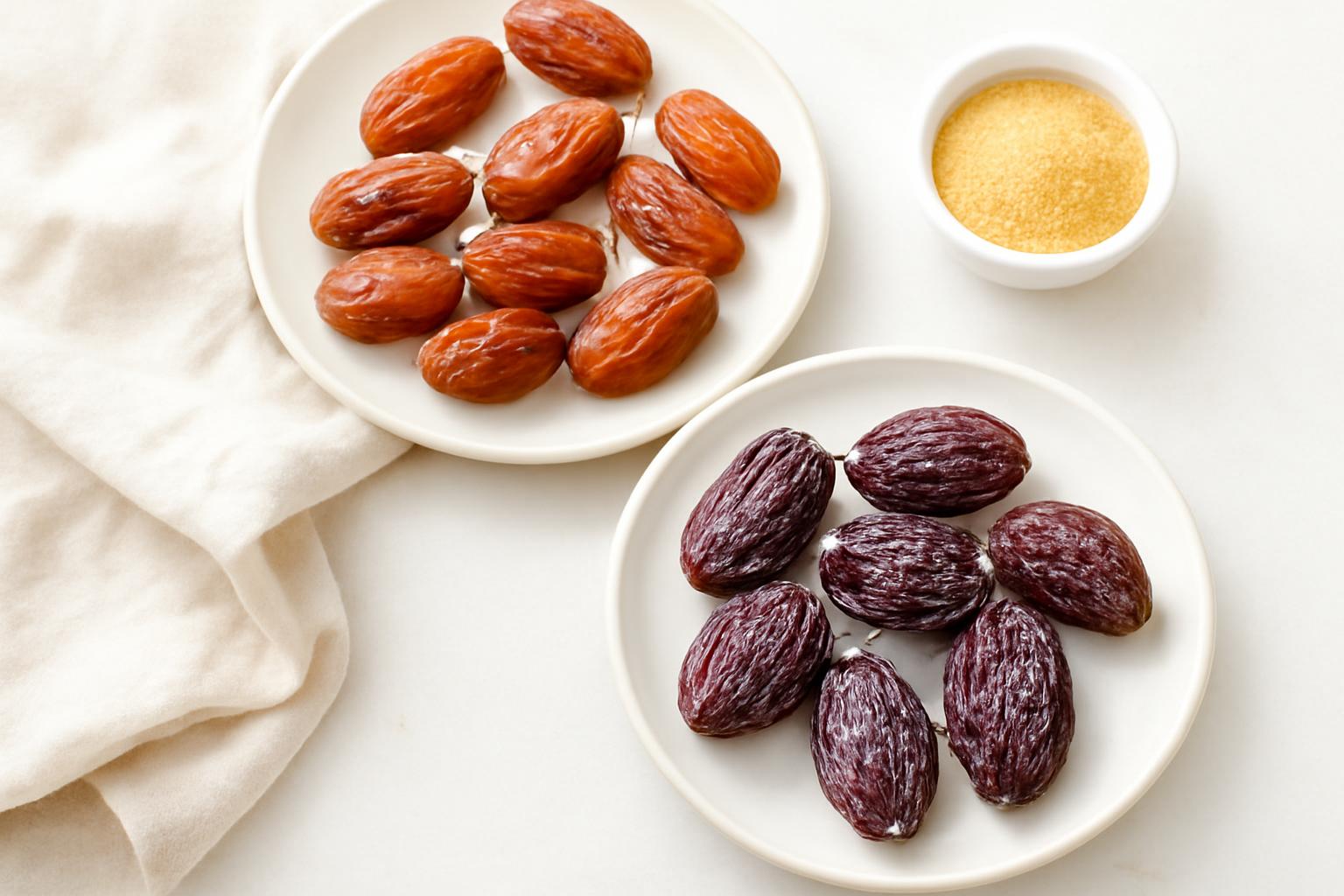
A typical 24-gram Medjool works out to roughly the familiar mid-60s calorie range, while a typical 7-gram Deglet Noor lands around 20 calories.
If you are comparing Deglet Noor dates vs Medjool for logging, the easiest mistake is treating them as interchangeable by piece count. They are much closer nutritionally by weight than by fruit. In practice, that means one Medjool can look like a very different snack from one Deglet Noor even when the per-100-gram numbers sit in roughly the same range.
That difference matters for anyone who tracks calories, builds recipes in an app, or wants repeatable portions. Medjool usually behaves like a larger, softer, richer snack date. So the useful question is usually not “which is healthier?” but “which one fits the job, and how should I log it?”
For calorie tracking, the headline is simple: compare them by weight first, then think about texture, flavor intensity, and how the portion looks on the plate. Once you do that, the Medjool-versus-Deglet Noor choice gets much clearer.
Origins and Growing Regions
Deglet Noor and Medjool are both cultivars of the date palm, Phoenix dactylifera, and retailer comparisons consistently place both within the broader tradition of date cultivation in hot, arid regions suited to commercial production today, not only in their original homes but across multiple desert-growing areas worldwide, including California and parts of the Middle East and North Africa (AYA Farms).
The standard origin summary is fairly consistent across the evidence pack. Medjool is traced to Morocco. Deglet Noor is traced to Algeria and Tunisia. Modern growing regions overlap more than many shoppers realize: Medjool is commonly associated with Morocco originally but is also sold from places such as California, Jordan, and Israel, while Deglet Noor is regularly associated with Algeria and Tunisia and is also widely grown in California.
For most buyers, origin is mainly useful as context. It helps explain why both dates show up in similar climates and why they share a lot of broad nutritional characteristics.
What matters more in the kitchen is what reached the store: variety, moisture level, storage, pack style, and whether you are buying whole snack dates or a firmer cooking format. So the practical takeaway is simple: both are established commercial varieties from the same species, and both are now part of a global date market rather than strictly local fruits.
Size, Appearance, and Texture Differences
For logging, size is the biggest operational difference. USDA-linked serving entries used by MyFoodData list a typical pitted Medjool date at 24 grams and a typical pitted Deglet Noor date at 7 grams (MyFoodData). That one fact explains most of the per-date calorie gap people notice in apps.
Descriptions of appearance and texture are also unusually consistent across retail comparisons. Medjool is typically described as larger, plumper, darker brown, and more wrinkled, with a softer, moister, stickier chew. Deglet Noor is usually described as smaller to medium, more elongated, more golden or amber, and firmer and drier in texture (AYA Farms).
That texture difference matters more than it may sound. If you want a date to disappear into a paste, filling, shake, or soft dessert mixture, that softness is an advantage. Deglet Noor usually behaves more like a structured ingredient.
This is also why the two varieties can feel different to portion even when the calorie math is similar by gram. One Medjool often looks like a complete single item. The same total weight in Deglet Noor may be spread across several smaller fruits. The calories still follow the scale, not the visual impression, but the visual impression changes how easy the portion is to estimate.
Another useful distinction is moisture. The evidence pack repeatedly describes Medjool as the moister fruit and Deglet Noor as the firmer, drier one. That does not make one inherently better. It just means they behave differently on the cutting board and in recipes.
Taste and Sweetness Profiles
Taste descriptions for dates are necessarily subjective, so it helps to treat them as culinary shorthand rather than lab results. That said, the pattern across the evidence pack is consistent: Medjool is usually described as richer, deeper, and more caramel-like, while Deglet Noor is usually described as milder, more honey-like, and somewhat nutty (Future’s Land Food).
In practical terms, Medjool tends to eat more like a dessert fruit. If what you want is a sweet standalone bite, Medjool is usually the variety that gets described that way. The larger size amplifies that effect, but so does the softer texture and stronger flavor impression.
Deglet Noor tends to be the quieter date. That is not a criticism. In many dishes, it is exactly the point. A more restrained sweetness can be useful when you want sweetness and chew without turning the whole recipe into a caramel-forward dish. In salads, grain dishes, cookies, tagines, and chopped mixtures, that lighter profile can make the rest of the ingredients easier to taste.
So the taste choice is usually less about objective superiority and more about role. If you want the date itself to be the event, Medjool is commonly described that way. If you want the date to support the dish rather than dominate it, Deglet Noor often makes more sense.
Individual brands, ripeness, and moisture levels can shift the experience. Still, the overall split is consistent enough to be genuinely useful when choosing between them.
Nutrition and Calories: Per 100g vs Per Date
This is the part that matters most for macro trackers, and it is also where a lot of confusion starts.
By weight, the two varieties are close. By fruit, they can look far apart.
Here is the quick-scan version:
| Measure | Medjool | Deglet Noor |
|---|---|---|
| Typical pitted date weight | 24 g | 7 g |
| Typical calories per date | about 66 kcal | about 20 kcal |
| Calories per 100 g | about 277 kcal | about 282 kcal |
| Carbs per 100 g | about 75 g | about 75 g |
| Fiber per 100 g | about 7 g | about 8 g |
| Typical texture | soft, moist, sticky-chewy | firmer, drier, chewy |
| Usual role | snacking, stuffing, blending | chopping, baking, savory cooking |
Single-date weights come from USDA-linked MyFoodData entries for pitted Medjool and pitted Deglet Noor dates (MyFoodData).
Per-100-gram calories, carbs, fiber, and the common texture/use descriptions match the side-by-side comparison values summarized by Ayoub’s (Ayoub’s).
The key implication is that per 100 grams, they are near peers. A 100-gram portion of Medjool and a 100-gram portion of Deglet Noor should land in broadly similar calorie and carbohydrate territory. That means variety name matters less than portion weight when the goal is accurate calorie arithmetic.
Per fruit, though, they look dramatically different because the fruits are dramatically different sizes. A typical 24-gram Medjool works out to roughly the familiar mid-60s calorie range, while a typical 7-gram Deglet Noor lands around 20 calories. That does not mean Medjool is dramatically more calorie-dense. It mostly means the standard fruit is dramatically bigger.
This is where app logging can go wrong. If your tracker says “1 date,” you still need to know what kind of date the entry assumes. “One date” is not a standardized calorie unit in any useful real-world sense. One Medjool and one Deglet Noor are not close enough in size to treat piece count as interchangeable.
Both varieties are also routinely described in the evidence pack as sources of fiber and minerals such as potassium and magnesium, but the pack does not support a strong claim that one variety is nutritionally superior overall. Small differences appear in retailer tables, yet those differences are not stable enough across the evidence set to justify a broad “best date” conclusion.
For precise logging, two rules matter more than almost anything else:
-
Compare dates by weight, not by count. If a recipe calls for 100 grams of dates, swapping Medjool for Deglet Noor will usually change texture and flavor emphasis more than calories.
-
Use weighed portions whenever the numbers matter. CaloriePages notes that label values can be off by up to about 20%, which is one more reason a kitchen scale is more trustworthy than eyeballing fruit size when you want tighter logs (CaloriePages About).
That leads to a practical logging workflow:
- If you eat dates whole as snacks, piece count can work only when you know the variety and the app’s assumed size.
- If you use dates in recipes, weigh the total grams before mixing.
- If you buy mixed brands, bulk-bin dates, or unusually large/small fruit, default to the scale.
A few simple examples show why this matters:
- 3 Medjools at roughly 24 g each is about 72 g total.
- 3 Deglet Noors at roughly 7 g each is about 21 g total.
- Those are not remotely equivalent portions, even though both entries might be logged as “3 dates.”
The reverse mistake happens in recipes too. If a bar recipe calls for “6 dates” but the author used Medjool, replacing that with 6 Deglet Noor dates will not just change texture. That is why recipe substitutions should start from grams.
For calorie trackers, that is the core answer in one line: the per-100-gram profiles are similar, but the per-date gap is mostly a size story.
Best Culinary Uses for Each Variety
The culinary split between these two dates is one of the more useful parts of the comparison. Once you understand the texture difference, the usual use cases make sense without much mystery.
Medjool is usually the better fit when you want the fruit to feel plush, sticky, and substantial. That is why it is so often recommended for direct snacking, stuffing, blending into smoothies, or turning into date paste or energy-ball mixtures. Deglet Noor is usually the easier fit when you want cleaner pieces and more structure, especially in baking and savory cooking (AYA Farms).
Think of Medjool as the date that likes to melt into the recipe. Its softness makes it useful in fillings, shakes, quick desserts, and any application where the fruit should bind ingredients together or read as an indulgent bite on its own.
Think of Deglet Noor as the date that likes to stay itself. In recipes where too much softness would turn the mixture gummy, that firmer texture becomes an advantage.
For baking and cooking, the most important substitution rule is the same one that matters in calorie tracking: swap by weight, not by count.
If a recipe uses 120 grams of Medjool and you only have Deglet Noor, use 120 grams of Deglet Noor if you want the calories and carbs to stay in roughly the same neighborhood. Then adjust technique, not portion math. You may want:
- a finer chop for Deglet Noor
That distinction is especially important in no-bake recipes. A Medjool-heavy mixture can bind oats, nuts, or cocoa with very little help because the fruit is soft and sticky. Deglet Noor can still work, but the texture may be less cohesive unless it is chopped more finely or softened first.
A short practical shorthand works well:
- Medjool: best when the date is a star ingredient
- Deglet Noor: best when the date is a supporting ingredient
That is not a rigid rule, and good cooks can push either variety outside its usual lane. But as a buying shortcut, it is much more useful than asking which one is universally better.
Price, Availability, and Shelf Life
On price, the broad pattern is clear even if exact numbers vary by region, brand, and package style. Comparison guides generally position Medjool as the pricier option and Deglet Noor as the more economical everyday date. They also describe Deglet Noor as more available year-round and more common as a routine pantry purchase rather than a premium snack fruit (Bump2Baby Nutrition).
That price pattern matches how shoppers often encounter them. Medjool is frequently sold as a prominent whole-fruit item: larger dates, premium packs, gift-style presentation, or snack-ready tubs. Deglet Noor is more often framed as a practical ingredient date: the kind you buy for baking, chopping, bulk use, or repeated everyday cooking.
Same food category, different portioning behavior.
Shelf life follows the moisture split. Softer, moister Medjool is generally described as having the shorter storage window, while firmer, drier Deglet Noor is generally described as keeping longer. Seller comparisons commonly recommend refrigeration for both, with Medjool lasting up to about 6 months refrigerated and Deglet Noor generally lasting longer under the same conditions (Ayoub’s).
Because storage claims vary across sellers, it is better to treat those numbers as approximate rather than universal. The conservative advice is simple:
- refrigerate either variety if you buy in bulk
- use texture and smell as your practical quality check
- expect Medjool to be the more perishable-feeling fruit
- expect Deglet Noor to be the less fussy long-haul pantry helper
From a value perspective, the better buy depends on what you want from the fruit.
If you mostly eat dates plain, the higher Medjool price may still feel reasonable because each piece is large and deliberate. If you mostly dice dates into oatmeal, couscous, baking, or lunch prep, Deglet Noor often makes more economic sense because it spreads easily across more uses.
So price and shelf life point in the same direction as texture: Medjool is the richer, more premium-feeling snack date; Deglet Noor is the more practical ingredient date.
Which to Choose for Calorie Tracking and Weight Management
If your main goal is calorie control, neither variety wins on a per-100-gram basis. The better summary is that they are similar by weight and different by typical fruit size. So the choice is usually about portioning style and intended use, not inherent nutritional superiority.
Choose Deglet Noor when you want:
- lower calories per individual piece
- smaller units for piece-based logging
- firmer fruit for chopping into meals
- an everyday cooking or baking date
- a generally cheaper option
Choose Medjool when you want:
- one larger, more obvious single-fruit portion
- a softer fruit for stuffing or blending
- a richer, dessert-like taste
- a date that works as a snack on its own
The important caution is not to turn those into claims of proven weight-loss effects. The evidence pack does not show that one variety is inherently better for fat loss. What it does support is a practical difference in portion shape.
Some people find smaller pieces easier to distribute and count. That is a personal logging style question, not a metabolic difference between varieties.
For trackers, a good rule set is:
- if you log by count, Deglet Noor is often easier because each fruit is smaller
- if you log by weight, either variety works about the same
- if you eat dates plain, Medjool often suits the “one piece” snack pattern
- if you use dates inside recipes, Deglet Noor often suits the “ingredient” pattern
That is why the cleanest advice is still the simplest: pick the date that fits the job, then weigh it.
If you want indulgent whole-fruit snacking, buy Medjool and log the grams or the verified entry. If you want repeatable chopped portions in meals and baking, buy Deglet Noor and weigh the total you use. Either way, the scale settles the argument better than the variety label does.
Are Medjool dates higher in calories than Deglet Noor?
Per date, yes. Typical comparisons put Medjool at about 66 calories and Deglet Noor at about 20 calories, largely because Medjool dates are much larger fruits, not because they are dramatically more calorie-dense by weight (Desert Sun Dates).
Can I substitute Deglet Noor for Medjool in recipes?
Usually yes, but the best substitution is by weight, not by count. Comparison guides consistently describe Deglet Noor as firmer and better for chopping, while Medjool is softer and stickier, so calories can stay broadly similar while texture changes. If a recipe depends on a paste-like texture, you may need to chop Deglet Noor more finely or soften it first (Bump2Baby Nutrition).
Which dates last longer in storage?
Deglet Noor usually does. Seller comparisons generally describe Medjool as the softer, moister fruit with the shorter refrigerated life, while Deglet Noor is described as firmer and more shelf-stable. Refrigerating either variety is the safer move if you buy more than you will eat quickly (Desert Sun Dates).
How many calories in one Medjool vs one Deglet Noor date?
Using USDA-linked serving sizes from MyFoodData, a typical pitted Medjool date is 24 g and a typical pitted Deglet Noor date is 7 g. Those entries work out to roughly 66 calories for one Medjool and about 20 calories for one Deglet Noor, which explains why piece-count logging can be so misleading if the app entry does not specify variety (MyFoodData).