
Medjool vs. Deglet Noor: Size, Calories, and Nutrition Differences for Accurate Tracking
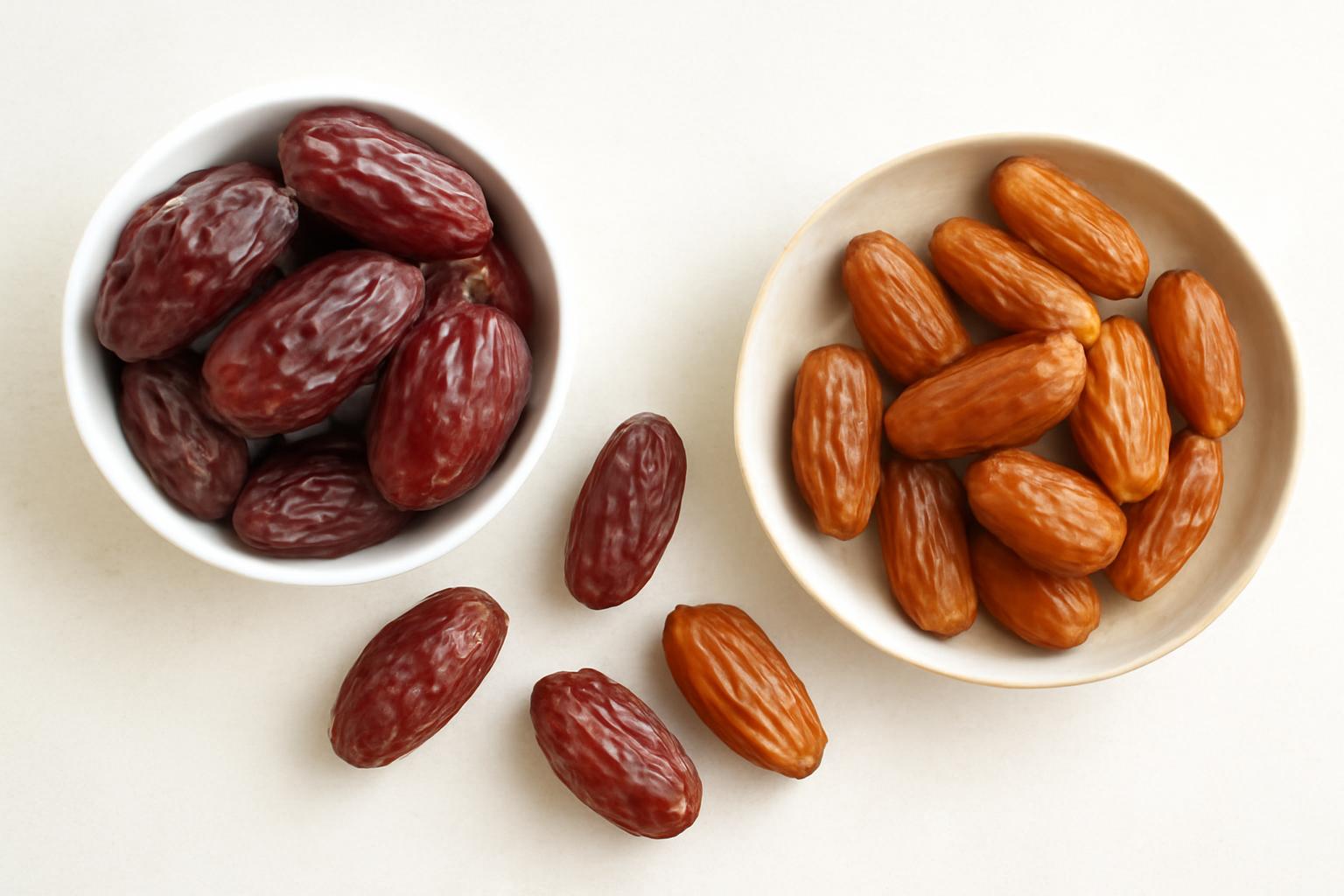
With 50g each of Medjool and Deglet Noor dates, the calorie difference is usually small enough to be practically irrelevant.
If you are comparing medjool dates vs deglet dates for calorie tracking, the main thing to know is simple: the answer changes depending on whether you compare them per 100 grams or per fruit.
Piece for piece, they are very different. A typical pitted Medjool is commonly listed at 24g and about 66 calories, while a typical pitted Deglet Noor is listed at 7g and about 20 calories. But comparison tables still place them at roughly 277 calories per 100g for Medjool and 282 calories per 100g for Deglet Noor (MyFoodData, Ayoub’s comparison).
That is why one person can log “1 date” as a roughly 20-calorie snack and another can log “1 date” as roughly 66 calories, and both can still be describing the food correctly. The missing detail is the variety and size, not the arithmetic.
For accurate tracking, that distinction matters more than most of the wellness talk around dates. Medjool dates are usually bigger, softer, and more often eaten as a standalone snack. Deglet Noor dates are usually smaller, firmer, and more often treated like an ingredient. If you are trying to line up intake with body-weight trends or your own TDEE estimate, that serving-size gap is the part that can quietly distort your log.
How Food Labels Calculate Calories (And Where the Number Can Be Wrong): Food labels use the Atwater system, not direct measurement. Here’s how the 4-4-9 factors work, why they allow a 20% margin of error, and what that means for tracking.
Size, Appearance, and Texture: Spotting the Differences
At a glance, Medjool and Deglet Noor are usually easy to tell apart. Grower and seller comparisons consistently describe Medjool as large, plump, dark brown, and soft, while Deglet Noor is described as smaller to medium, amber to golden, and firmer or semi-dry. The same comparisons also describe Medjool as moister and stickier, and Deglet Noor as drier, chewier, and better at holding its shape when handled or chopped (Desert Sun Dates).
Those texture differences explain most of the real-world eating experience. A Medjool often feels closer to a soft caramel bite: dense, glossy, and yielding. A Deglet Noor tends to feel more like a chewy dried fruit piece: still sweet, but a little firmer and more structured.
For tracking, though, the bigger clue is not color or softness. It is weight. USDA-backed serving-size entries commonly used in nutrition tools list 1 pitted Medjool date at 24g and 1 pitted Deglet Noor date at 7g (MyFoodData). That roughly three-to-one-plus gap is why Medjools look dramatically higher in calories per piece even though their calorie density is close to the same.
This is also why the label “1 date” is not very helpful on its own.
A practical way to think about it is this: variety predicts typical size, and size predicts per-date calories. So if what you care about is accurate intake tracking, identifying the variety is usually more useful than debating which date is supposedly healthier.
Taste Profiles: Caramel-Rich vs. Mildly Nutty
Taste descriptions are more subjective than calorie math, but the broad pattern is still consistent enough to be useful. Across comparison guides, Medjool is usually described as richer, deeper, and more caramel- or butterscotch-like, while Deglet Noor is usually described as lighter, milder, honey-like, or slightly nutty (AYA Farms).
In practical terms, Medjool is usually the variety that reads as the more dessert-like date. It is the one people often eat straight from the pack, stuff with nut butter or cheese, or blend into smooth, sweet sauces. Deglet Noor is more often framed as the everyday ingredient date: still sweet, but less intense, less sticky, and easier to chop into recipes without taking over the texture.
That does not mean Medjool is objectively tastier or that Deglet Noor is inferior. It just means the two varieties behave differently in common use. If you like dates mainly as a candy-like snack, Medjool often feels more satisfying. If you want sweetness in a salad, grain dish, baked good, or tagine without the fruit turning everything sticky, Deglet Noor often fits better.
For tracking purposes, taste matters indirectly. Foods that feel more indulgent may be easier to justify as “just fruit,” while smaller ingredient-style foods are easy to scatter into a recipe and forget to count. That is not a unique problem with dates, but dates are a good example of it because the same word—“date”—can refer to two very different piece sizes and eating contexts.
Origins and Growing Regions
Both Medjool and Deglet Noor are varieties of the same species, the date palm, Phoenix dactylifera. Comparison guides commonly summarize date cultivation as stretching back more than 6,000 years in North Africa and the Middle East, with commercial production now spread far beyond those original regions (Desert Sun Dates).
Their cultivar histories, however, are different. Medjool is generally associated with Morocco, while Deglet Noor is generally associated with Algeria, often alongside Tunisia in its historical story. Modern production is much broader. Medjool is commonly grown in places such as California, Jordan, and Israel, while Deglet Noor is also widely grown in California, especially in the Coachella Valley, alongside North African production (Food to Live).
For most shoppers, origin matters less nutritionally than it does commercially or horticulturally. A Medjool grown in California is still a Medjool, and a Deglet Noor grown outside North Africa is still a Deglet Noor.
That is useful context because people sometimes overread country of origin as if it must imply a major nutrition difference. The evidence in this comparison does not support that. The bigger recurring differences are variety, piece size, and moisture level.
Nutrition Per 100g: Surprisingly Similar Profiles
If you normalize by weight, the differences narrow fast. Published comparison tables commonly place Medjool at about 277 kcal per 100g and Deglet Noor at about 282 kcal per 100g, with both at roughly 75g carbohydrate per 100g. The same tables usually show Deglet Noor slightly higher in fiber and Medjool slightly higher in potassium, with sugars a little higher in Medjool (Ayoub’s comparison).
| Per 100g (approx.) | Medjool | Deglet Noor |
|---|---|---|
| Calories | 277 kcal | 282 kcal |
| Carbohydrates | ~75 g | ~75 g |
| Fiber | ~6.7 g | ~8 g |
| Sugars | ~66.5 g | ~63.4 g |
| Potassium | ~696 mg | ~656 mg |
These are approximate comparison values, not immutable numbers. But the pattern is steady enough to support the practical conclusion: there is no major per-gram calorie advantage to picking one variety over the other.
Protein differences are also minor.
This is the part many casual comparisons miss. If you weigh out 50g of Medjool dates and 50g of Deglet Noor dates, the calorie difference will usually be small enough to be practically irrelevant. The real-world difference is that 50g does not look like the same amount of food in each variety. It might be two large Medjools or a small handful of Deglet Noor.
That is why per-100g comparisons and per-date comparisons answer different questions:
- Per 100g tells you whether one variety is meaningfully more calorie-dense than the other.
- Per date tells you how easy it is to under- or over-log what you actually ate.
For accurate tracking, you need both views. The per-100g view prevents exaggerated “healthier date” claims. The per-date view prevents portion-size mistakes.
Calories and Macros Per Date: The Serving Size Trap
Per fruit, the numbers diverge sharply. A typical pitted Medjool date is commonly listed at 66 kcal, 18g carbohydrate, 1.6g fiber, and 16g sugar at 24g each, while a typical Deglet Noor date is commonly listed around 20 calories per piece because it is much smaller (NutriScan, Dates overview).
Here is the quick-scan version trackers usually need:
| Per date (typical, pitted) | Medjool | Deglet Noor |
|---|---|---|
| Weight | 24 g | 7 g |
| Calories | 66 kcal | ~20 kcal |
| Carbohydrates | 18 g | much lower per piece due to size |
| Fiber | 1.6 g | lower per piece due to size |
| Sugars | 16 g | lower per piece due to size |
| Rough calorie equivalence | 1 date | ~3 small dates |
The important part is not that every Medjool is exactly 66 calories or every Deglet Noor is exactly 20. The important part is that one Medjool often lands in the calorie range of three or more small Deglet Noor dates. That is the whole trap.
If you compare “one date versus one date,” Medjool appears far more calorie-dense. But most of that difference is simply fruit size, not a radically different calorie concentration. This is the same reason “one cookie” or “one banana” can be a poor unit unless you know how big the item is.
Serving format can distort perception even more. One USDA-backed comparison tool lists 1 cup chopped Deglet Noor dates as 147g and about 415 calories, while 1 pitted Medjool date on the same kind of entry is 24g and 66 calories. The numbers are not contradictory; the servings are just nowhere near equivalent (MyFoodData comparison tool).
That is why the safest tracking rule is: normalize by grams whenever you can. If you cannot weigh, then at least compare like with like:
- one date vs one date,
- three dates vs three dates,
- or better yet, one ounce vs one ounce.
A useful logging hierarchy looks like this:
- Best: weigh the edible portion in grams and use a grams-based entry.
- Good: use a variety-specific entry such as “Medjool, pitted” or “Deglet Noor, pitted.”
- Weakest: log “1 date” from a generic database entry with no variety or weight.
Also check whether the entry assumes pitted or unpitted fruit.
For people trying to calibrate maintenance, a small deficit, or a slow gain, these “little” errors matter more than they look. A few mislogged dates are not catastrophic, but repeated serving-size mistakes are exactly the kind of noise that makes it harder to tell whether your intake estimate is actually matching your results.
Culinary Uses: Snacking and Blending vs. Baking and Chopping
The texture split makes the cooking split pretty predictable. Medjool is usually the better choice for snacking, stuffing, smoothies, and date paste, while Deglet Noor is usually the better choice for baking, chopping into recipes, salads, grain dishes, and savory cooking where you want the fruit to hold its shape (Food to Live).
That does not mean the two are non-interchangeable. You can swap them. But the result often changes in ways that matter both for taste and for logging:
- Swap Medjool into a recipe written for Deglet Noor: the result may turn softer, stickier, and a little richer-tasting.
- Swap Deglet Noor into a recipe written for Medjool paste or a smooth blend: you may need more soaking or liquid because the fruit is firmer and drier.
- Swap by count instead of by weight: this is where calorie tracking usually drifts the most.
For recipe logging, the easiest rule is still swap by grams, not by number of dates. If a recipe asks for 100g of dates, use 100g of whichever variety you choose and log 100g of that variety. That keeps both the calorie math and the ingredient mass grounded.
If you do not have a scale, a rough fallback is that about 3 small Deglet Noor dates land near 1 Medjool date in calories. That is only an approximation, and it will vary with brand and size, but it is far closer to reality than assuming one large Medjool can be replaced with one small Deglet Noor without changing anything.
This is also why recipe databases can be misleading. “Four dates” is not a stable nutrition input unless the recipe developer specified the variety or the weight. Four Medjools and four Deglet Noor dates can produce very different results in both texture and calories.
Glycemic Index and Blood Sugar Considerations
Dates in general are often described in consumer nutrition summaries as low to medium glycemic index foods, with commonly cited ranges around 42 to 55. At the same time, variety-specific comparisons are much shakier, and the available commercial summaries do not provide a strong basis for declaring one clear winner between Medjool and Deglet Noor (NutriScan dates overview, Just Date GI article).
That matters because GI discussions can become more confident than the underlying evidence. It is reasonable to say that dates do not automatically behave like pure table sugar. It is not well supported here to say that Medjool or Deglet Noor is definitively superior for glucose control across all people and all portions.
For tracking purposes, the bigger issue is still serving size. A single Medjool often delivers more carbohydrate at once simply because it is a larger fruit. So even if two varieties are broadly similar gram for gram, eating one large Medjool may create a larger glucose load than eating one small Deglet Noor. That is a portion effect before it is a variety effect.
A practical rule of thumb is:
- compare equal weights if you want a fair nutritional comparison,
- compare per fruit if you want to predict real-world intake,
- and do not let GI discussion distract you from total grams eaten.
If blood sugar control is medically relevant for you, internet variety rankings are not a substitute for individualized guidance. The evidence here supports caution, portion awareness, and humility more than it supports a dramatic “best date for diabetes” claim.
Practical Factors: Storage, Availability, and Cost
In ordinary shopping, Medjool usually behaves like the higher-moisture, premium-snack option. Comparison guides commonly describe it as softer, moister, and more expensive, with some of that premium tied to handling and harvest. Deglet Noor is usually described as firmer, more shelf-stable, and more budget-friendly (AYA Farms).
That does not mean every Medjool is expensive or every Deglet Noor is cheap. It means the categories tend to sort that way in stores. Medjool is often sold in more presentation-focused packs and positioned as a standalone snack. Deglet Noor is more often the practical pantry option bought for baking or bulk use.
Storage follows the same pattern. Higher-moisture Medjool is generally described as less stable once opened, while firmer Deglet Noor is usually described as easier to keep in everyday pantry-style use. In practice, either variety benefits from being sealed well and kept away from heat, but Medjool tends to reward more careful storage because texture is a bigger part of why people buy it.
When buying either one, a few label checks help:
- Check the ingredient list. Plain dates should usually just list dates.
- Check the format. Whole, pitted, chopped, and paste versions are logged differently.
- Check the variety name. “Dates” is less useful for tracking than “Medjool” or “Deglet Noor.”
- Check the package weight. That gives you the best fallback for estimating intake.
- Check the condition. Moist, glossy dates and drier, firmer dates can behave differently in recipes even within the same variety.
The more useful question is what role you want the fruit to play. If you want a large, soft, candy-like snack you can eat one at a time, Medjool often fits better. If you want a lower-cost ingredient you can chop into recipes, Deglet Noor often makes more sense.
A premium snack date may be eaten one by one. A firmer baking date may disappear into a recipe or handfuls at a time. Same fruit family, very different logging situations.
If you want the shortest practical summary, it is this: Medjool and Deglet Noor are nutritionally similar per gram, but not per piece. Choose Medjool for softness and standalone snacking, choose Deglet Noor for firmer recipe use, and weigh either one if you want the cleanest calorie log.
How many calories are in one Medjool date vs. one Deglet Noor date?
A typical pitted Medjool date is about 66 calories, while a typical pitted Deglet Noor date is about 20 calories because the fruit is much smaller (NutriScan).
That is why “one date” is not a complete comparison. For rough tracking, 1 Medjool is often in the calorie range of about 3 small Deglet Noor dates.
Are Medjool dates nutritionally better than Deglet Noor?
Not overall. Per 100g, they are very similar in calories and carbohydrate. The commonly cited small differences are that Deglet Noor is a bit higher in fiber and Medjool is a bit higher in potassium (Ayoub’s comparison).
So the more honest answer is that neither is clearly “better” across the board. The better choice depends on what matters most to you: texture, recipe use, cost, or how easy the portion is to control.
Which is better for calorie tracking or weight management?
Usually Deglet Noor is easier to portion by piece because each fruit is smaller, but the best tracking option is whichever variety you weigh in grams.
If you are using piece counts instead of a scale, just remember that the typical serving sizes are far apart: about 24g for a pitted Medjool versus 7g for a pitted Deglet Noor (MyFoodData).
Can I use Medjool and Deglet Noor interchangeably in recipes?
Often yes, but not perfectly. Medjool is usually better for stuffing, blending, and pastes, while Deglet Noor is usually better for baking, chopping, and savory dishes because it is firmer and less sticky (Food to Live).
If you swap them, do it by weight, not by count. Replacing one Medjool with one Deglet Noor usually changes both texture and calories.
Do dates have a low glycemic index?
Dates are often described as low to medium GI, but that does not settle the practical question by itself because portion size still matters (NutriScan dates overview).
In real use, one large Medjool can deliver much more carbohydrate at once than one small Deglet Noor. If blood sugar control matters to you, focus on total portion and personal response rather than assuming one variety is automatically safe or superior.
This article is for general informational purposes only, not medical or dietary advice. Nutrition values can vary by brand, moisture level, ripeness, and serving definition. If you have a medical condition or need individualized guidance, consult a qualified professional.