
Medjool vs. Deglet Noor Dates: Size, Calorie Counts, Texture, and Tracking Tips
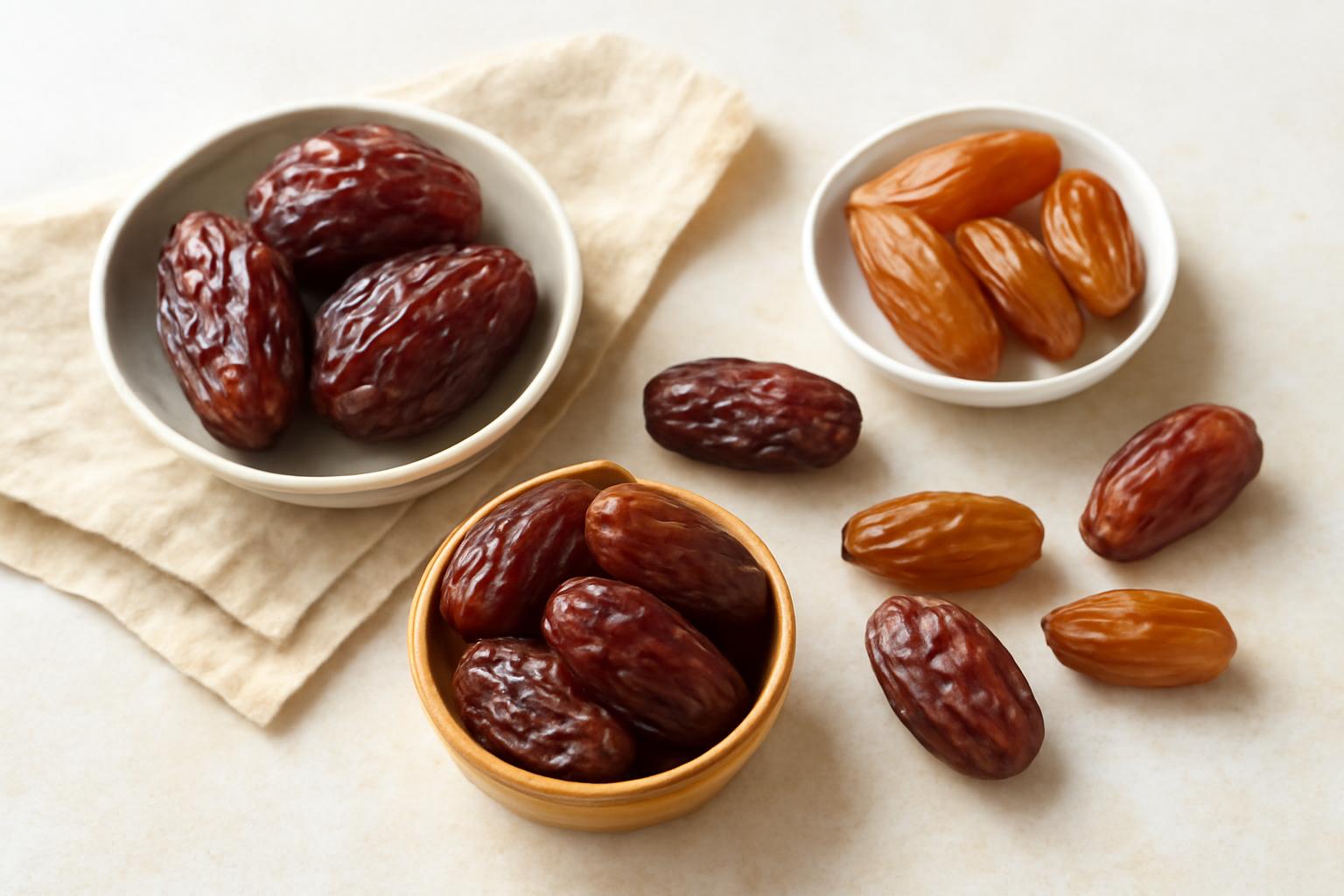
Equal weights remain nutritionally close. Medjool melts and mashes more easily, while Deglet Noor keeps its shape better.
If you are comparing medjool vs deglet dates for calorie tracking, the biggest mistake is assuming the choice is mainly a nutrition choice. Most of the time, it is not. The bigger difference is size per fruit: a typical pitted Medjool is about 24 g and 66 calories, while a typical pitted Deglet Noor is about 7 g and 20 calories (Desert Sun Dates).
Per 100 g, though, the two varieties are very close in calories and macros. So for practical tracking, the real question is not “which date is leaner?” but whether you are logging by piece or by weight. If you weigh them, the calorie gap mostly collapses. If you count them, Medjool can look much higher simply because one fruit is much bigger.
That distinction matters even more if you are using food logs to calibrate body-weight trends. Small recurring errors can blur the signal you are trying to compare against maintenance intake, which is the same broader problem discussed in our TDEE explainer.
How Food Labels Calculate Calories (And Where the Number Can Be Wrong): Food labels use the Atwater system, not direct measurement. Here’s how the 4-4-9 factors work, why they allow a 20% margin of error, and what that means for tracking.
Physical Size, Appearance, and Texture Breakdown
For portion estimation, Medjool and Deglet Noor are easiest to think of as two different packaging formats for nearly the same fuel.
A USDA-linked comparison tool lists a pitted Medjool date at 24 g and a pitted Deglet Noor date at 7 g (MyFoodData recipe calculator). That is a big enough size gap that a casual “I had two dates” entry can mean very different things.
Medjool’s softer feel is not just subjective language. NutriScan’s Medjool entry describes the variety as higher-moisture and gives a moisture figure of about 21%, alongside 66 calories per 24 g pitted fruit and 696 mg potassium per 100 g (NutriScan).
The weight math is where trackers usually get caught. Two Medjools come to about 48 g; to reach roughly the same weight with 7 g Deglet Noor dates, you need about seven pieces. Three Medjools are about 72 g, which is close to ten small Deglets by simple weight conversion (MyFoodData recipe calculator).
Visually, Medjool is the easier one to identify at a glance. Seller and grower guides consistently describe it as large, plump, dark brown, and wrinkled, while Deglet Noor is more often described as smaller, elongated, amber or golden, and semi-dry. AYA Farms also describes Medjool as soft, chewy, and moist, versus Deglet Noor as firmer, drier, and less sticky (AYA Farms).
For actual logging, though, appearance is less useful than hand feel and weight. Medjool behaves like a substantial single fruit. Deglet Noor behaves more like a smaller unit. That is why Medjool tends to create under-logged snacks, while Deglet Noor more often creates under-counted handfuls in recipes.
Texture also changes how the portion feels in real life. Medjool compresses easily, smears readily into paste, and disappears fast if you are eating it like a ready-made sweet. Deglet Noor keeps sharper edges when chopped, feels less sticky on the fingers, and is easier to treat as an ingredient rather than a treat.
A simple mental model helps: one Medjool is a serving-sized object; one Deglet Noor is a component. If you remember only that, you will avoid many of the piece-count errors that make dates seem nutritionally more different than they really are.
Flavor Profiles and Sweetness Levels
The flavor gap between the two varieties is real, but it is still mostly a flavor-and-texture story, not a calorie-density story.
Across seller comparisons, Medjool is repeatedly described as rich, caramel-like, butterscotch-like, and deeply sweet, while Deglet Noor is described as lighter, honey-like, mildly sweet, and sometimes nutty (AYA Farms). Those descriptors are subjective, but the pattern is consistent: Medjool tastes louder; Deglet Noor tastes quieter.
Part of that sensory difference may line up with sugar composition. In the USDA-linked MyFoodData comparison, a 24 g Medjool entry lists about 8.1 g glucose, 7.7 g fructose, and only 0.13 g sucrose, while the displayed 147 g Deglet Noor entry includes 35 g sucrose, 29.2 g glucose, and 28.8 g fructose before normalization (MyFoodData USDA comparison). That does not prove a precise flavor hierarchy by itself, but it fits the common impression that Medjool tastes denser and more dessert-like.
What that sugar mix does not prove is a major calorie advantage for either variety. A fruit can taste more intense without being materially more energy-dense per gram. That is especially easy to forget with dates because a soft, rich texture tends to feel “heavier” than a firmer chew.
Ripeness and storage complicate the picture even more. The usual descriptions are best treated as tendencies, not guarantees for every bag.
In practical terms, Medjool usually works better when you want the date to stand on its own as a snack or sweetener. Deglet Noor usually works better when you want the date to blend into something else without dominating the bite.
That is why flavor matters for tracking behavior. The calories are still there either way.
Calories and Macros: Per 100g vs Per Date
This is the section that matters most for calorie and macro trackers.
The clearest way to compare the two varieties is to separate equal weight from equal piece count. Using the USDA-linked MyFoodData entries, including normalized values for Deglet Noor’s displayed 147 g serving, the quick comparison looks like this (MyFoodData USDA comparison):
| Measure | Medjool | Deglet Noor | Why it matters |
|---|---|---|---|
| Per 100 g | 277 kcal, 75 g carbs, 6.7 g fiber, about 66 g sugars | about 282 kcal, about 75 g carbs, about 8 g fiber, about 63 g sugars | Very similar energy and carb density |
| Per typical pitted fruit | 24 g, 66 kcal, 18 g carbs, 1.6 g fiber, 16 g sugars | 7 g, about 20 kcal, about 5.3 g carbs, about 0.6 g fiber, about 4.4 g sugars | Piece count can be misleading |
| About 40 g total | roughly 2 Medjools | roughly 4 to 6 Deglets | Similar nutrition if weight is matched |
That table is the whole argument in miniature. If you compare the fruits gram for gram, they are close enough that variety usually does not matter much for a log. If you compare them fruit for fruit, they look far apart because one “unit” is much larger.
A generic 40 g serving of dates is listed by TODAY at about 120 calories, 30 g carbs, 3 g fiber, and 22 g sugar, which it describes as roughly 2 Medjool dates or 4 to 6 Deglet Noor dates (TODAY). That is a useful calibration point because it gives you a real-world portion size that can anchor recipes, snacks, and hand-estimated servings.
The practical logging rule is simple: use grams first, count only as a backup. Counting works only when the pieces are similar. Dates are not. A single large Medjool can equal more than three small Deglet Noor dates by calories, yet 100 g of either variety still lands in the same basic range.
That is also why dates can quietly distort maintenance estimates. A repeating habit of “two dates after dinner” might mean a modest small-fruit add-on or a much bigger Medjool snack. When you are trying to interpret scale trends, those recurring differences matter more than the variety name itself.
A few quick examples make the point clearer:
- 1 Medjool is about 66 calories (NutriScan; MyFoodData USDA comparison).
- 3 Medjools are about 198 calories by simple multiplication from the 66-calorie entry (NutriScan).
- 1 Deglet Noor is about 20 calories (Desert Sun Dates; MyFoodData USDA comparison).
- 7 Deglet Noor dates come out to about 140 calories by simple multiplication from the 20-calorie estimate or by USDA-linked normalization.
So yes, Medjool looks “higher calorie” when you count whole fruits. But that is mostly a serving-size effect. Switch the comparison to weight, and the dramatic gap largely disappears.
If you build recipes, the same logic applies. A recipe calling for 40 g chopped dates is mostly asking for 40 g of carbohydrate-dense dried fruit, not for a dramatically different macro profile depending on the variety.
Minerals, Vitamins, and Key Micronutrients
Micronutrient differences exist, but they are much smaller than the difference in fruit size.
NutriScan lists one 24 g pitted Medjool at 167 mg potassium, 13 mg magnesium, 0.2 mg iron, and 0.1 mg copper, with 696 mg potassium per 100 g (NutriScan). That makes Medjool easy to describe as a potassium-rich dried fruit.
Comparison pages usually place Deglet Noor in the same broad micronutrient neighborhood rather than treating it as nutritionally opposite. Food to Live and other side-by-side guides describe both varieties as good sources of minerals such as potassium, magnesium, and copper, while also emphasizing that the differences are not large enough to drive the choice on their own (Food to Live).
Fiber is the most label-relevant nutrient after total carbohydrate. Medjool commonly lands around 6.7 g fiber per 100 g, while side-by-side comparison pages put Deglet Noor around 8 g per 100 g or in a very similar range, depending on the entry used (NutriScan; Desert Sun Dates; WebMD).
That is useful because it highlights a common tracking confusion: fullness per fruit is not the same as fiber density per gram. That does not mean it is uniquely high-fiber relative to Deglet Noor on an equal-weight basis.
Sugars dominate the carb total in both varieties. These are naturally occurring fruit sugars, not added sugars in the usual packaged-food sense (TODAY). From a macro perspective, though, both still behave like concentrated carbohydrate sources. If you add dates to oatmeal, yogurt, granola, or trail mix, they are usually stacking extra carbs onto a meal rather than balancing it with much protein or fat.
That is also why it helps to think of dates as dried-fruit carbs first, micronutrients second. The potassium, magnesium, copper, and fiber are real. But for most trackers, the dominant variable is still total grams eaten.
Database values and package entries also describe average foods, not your exact handful. Date size varies by brand, moisture level, and handling. If you are trying to tighten your intake estimates, the kitchen scale will improve accuracy more than switching from one date variety to the other.
Glycemic Index Trends and Energy Release
On glycemic index, the evidence is much thinner than the calorie data, so the safest approach is to stay narrow.
Healthline cites a Medjool-specific glycemic index figure of 55.3, which falls in the low range for GI (Healthline). That supports a limited point: dates are not automatically equivalent to a pure high-GI candy source just because they taste very sweet.
Where the evidence gets weaker is in ranking Medjool against Deglet Noor. A seller-authored GI post argues that different date varieties may have different glycemic behavior, but it does not provide a matched Medjool-versus-Deglet Noor head-to-head number set under the same test conditions (Just Date). That is not strong enough evidence to make a firm medical or metabolic ranking between the two.
For real-world tracking, quantity still matters more than variety. A couple of large Medjools can deliver a substantial carb load quickly. So can a generous handful of Deglet Noor.
Context matters too. Dates eaten alone feel different from dates eaten as part of a mixed snack or meal. But even there, the practical question for most readers is still how much you ate, not whether the bag said Medjool or Deglet Noor.
So the most evidence-faithful summary is this: there is some general support for dates being not especially high on GI by default, but there is not strong supplied evidence for saying Medjool definitively spikes blood sugar faster than Deglet Noor.
Best Culinary Uses and Calorie-Tracking Swaps
The easiest way to choose between Medjool and Deglet Noor is to ask whether you want a snack or an ingredient.
Comparison guides consistently position Medjool as the better choice for snacking, stuffing, smoothies, and date paste, while Deglet Noor is better suited to baking, chopping into recipes, salads, couscous, and savory dishes (Food to Live). That tracks cleanly with the texture difference: Medjool melts and mashes more easily, while Deglet Noor keeps its shape better.
For calorie swaps, the useful unit is not “one fruit” but equal weight. A 40 g recipe portion will land in roughly the same calorie neighborhood whether it comes from about 2 Medjools or 4 to 6 Deglet Noor dates (TODAY). In most cases, you do not need a special macro adjustment beyond logging the correct weight and the correct database entry.
That makes practical substitutions simpler than people expect:
- Use Medjool when you want dates to mash, blend, or sweeten aggressively.
- Use Deglet Noor when you want chopped pieces that stay recognizable.
- Swap by grams, not by count.
- Expect texture changes before macro changes.
Medjool often gets chosen for date paste because it is easier to work into a smooth mass. Deglet Noor often gets chosen for cookies, grain dishes, and chopped applications because it is less sticky and more structured. Neither choice creates a major calorie surprise if the weight stays the same.
One more tracking point matters here: dates add sweetness and carbohydrates, but very little protein or fat. So they do not give you the same fullness-per-calorie profile discussed in our protein and calorie density guide. In mixed meals, that means dates usually function as a carb add-on, not a balancing macro.
Origins, Shelf Life, and Practical Buying Factors
If you buy dates in bulk, variety can affect storage habits almost as much as taste.
Seller comparison guides commonly trace Medjool to Morocco, with present-day production associated with places such as the U.S., Jordan, and Israel, while Deglet Noor is commonly linked to Algeria and Tunisia and is also grown in California. The same comparison lists refrigerated shelf life at up to 6 months for Medjool and up to 12 months for Deglet Noor (Desert Sun Dates).
Price discussions are softer than the calorie data, but seller guides generally frame Medjool as the more premium option and Deglet Noor as the more economical everyday option. That should be treated as a market tendency, not a fixed rule for every store.
For practical buying, the texture descriptions are more useful than the origin story. If you want a date that feels rich and ready to eat straight from the container, Medjool usually fits that job better. If you want dates for chopping, baking, and longer storage, Deglet Noor often makes portioning easier.
The good news for trackers is that the buying decision still does not change the math much. Equal weights remain nutritionally close. What changes is how easily the fruit fits your routine. Medjool makes a more obvious single-item snack. Deglet Noor makes a more controllable recipe ingredient.
That is the core takeaway of the whole comparison. Medjool vs. Deglet Noor is mostly serving math, not nutritional virtue. If you weigh what you eat, both fit a macro plan similarly well. If you guess by count, the larger fruit will fool you first.
How many calories in one Medjool date vs one Deglet Noor?
A typical pitted Medjool is about 66 calories at roughly 24 g, while a typical pitted Deglet Noor is about 20 calories at roughly 7 g (Desert Sun Dates; MyFoodData recipe calculator). That gap is mostly about fruit size, not a dramatic calorie-density difference per gram.
Are Medjool or Deglet Noor dates better for baking or snacking?
For snacking, Medjool is usually the better fit because it is larger, softer, and richer tasting on its own. For baking and chopped recipes, Deglet Noor is usually easier because it is firmer, drier, and holds its shape better (AYA Farms; Food to Live).
Do Medjool and Deglet Noor have the same nutrition per 100g?
Not exactly the same, but very close. Per 100 g, Medjool is commonly listed around 277 calories, 75 g carbs, and about 6.7 to 7 g fiber, while Deglet Noor lands around 282 calories, about 75 g carbs, and about 8 g fiber (MyFoodData USDA comparison; Desert Sun Dates). For most trackers, the bigger issue is still portion size, not variety.
Which dates store longer in the fridge?
Deglet Noor is generally described as the longer-storing option, often listed at up to 12 months refrigerated, versus up to 6 months for Medjool (Desert Sun Dates). Its firmer, drier texture fits that pattern.
What sugars make up Medjool vs Deglet Noor dates?
In the USDA-linked comparison entry, Medjool is mostly glucose and fructose with very little sucrose, while the displayed Deglet Noor serving shows a more balanced mix of sucrose, glucose, and fructose (MyFoodData USDA comparison).