
How to Choose the Right Rendered Fat for Frying, Roasting, or Baking
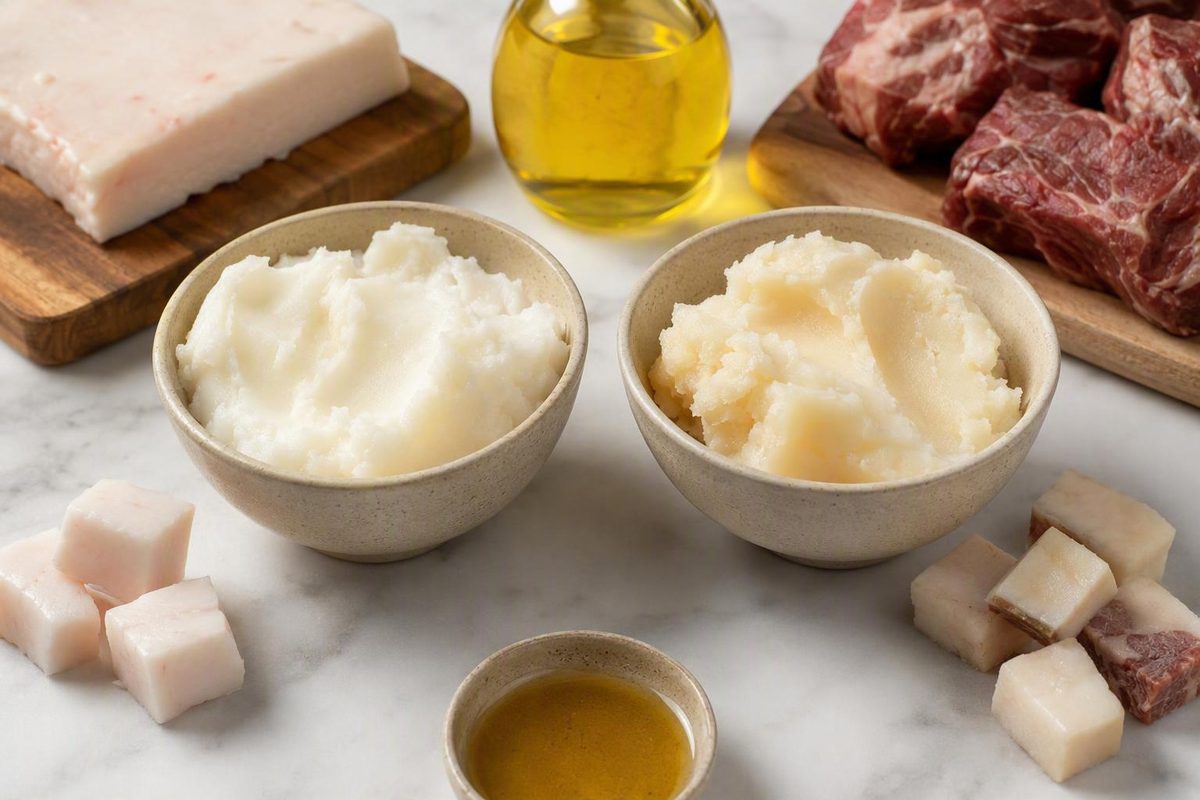
Tallow does not always mean beef fat: although beef tallow is common in cooking, it can also be rendered from sheep and other ruminants.
Lard and tallow are both rendered animal fats, but they differ in source, texture, flavor, fatty-acid pattern, and the jobs they perform most naturally in the kitchen. Lard comes from pork and is generally softer and milder. Tallow usually comes from beef or another ruminant and is generally firmer, waxier, and more savory.
That makes lard a conventional choice for pastry and soft doughs, while tallow often suits frying, searing, roasting, and beef-forward dishes. Neither is universally better, and substituting one for the other can change both flavor and texture.
The short answer: lard is pork fat; tallow is usually ruminant fat
The simplest difference between lard and tallow is the animal source:
- Lard is rendered pork fat.
- Tallow is usually rendered beef fat, although the term can also include rendered sheep, lamb, mutton, or other ruminant fat.
Both are made by heating fatty tissue so that the fat separates from connective tissue and other solids. The liquid fat is then strained and cooled. Both are generally solid at room temperature, but lard is usually softer and more pliable, while tallow is typically harder and waxier. Because “tallow” is not restricted in every usage to cattle fat, checking the label is more reliable than assuming it always means beef (Shady Grove Ranch’s terminology overview).
| Feature | Lard | Tallow |
|---|---|---|
| Animal source | Pig | Usually cattle; may be sheep or another ruminant |
| Common raw-fat source | Back fat or fat around the kidneys and loin | Often hard fat around a ruminant’s kidneys, although other deposits may be used |
| Room-temperature texture | Usually soft, creamy, and pliable | Usually firm, waxy, and sometimes brittle |
| Typical flavor | Mild when cleanly rendered; leaf lard is often especially mild | Savory; beef tallow may have a noticeable beef-like character |
| Relative fatty-acid pattern | Generally more mono- and polyunsaturated fat | Generally more saturated fat |
| Common uses | Pie crust, biscuits, pastry, tamales, empanada-style dough, sautéing | Frying, searing, roasting, savory pastry, beef dishes |
| Likely substitution effect | Usually makes a dish softer and milder | Usually makes a dish firmer and more savory |
These are tendencies rather than guarantees. Animal diet, breed, fat deposit, rendering temperature, filtration, age, and additional processing can all affect the finished product. A well-filtered beef tallow may have a restrained flavor, while strongly rendered lard may taste noticeably porky.
Neither lard nor tallow is vegetarian. If halal or kosher compliance matters, do not infer suitability from the word “tallow” alone. Verify the animal source, ingredient list, handling, and relevant certification on the specific product.
Rendering, suet, leaf lard, and other terms that matter
Rendering separates usable fat from animal tissue. In a basic kitchen process, chopped or ground fatty tissue is heated gently until the fat melts out. The liquid is strained to remove connective tissue and other solids, then cooled until it sets.
Several related terms are easy to confuse:
- Suet is raw, hard fat commonly found around the kidneys of cattle, sheep, and other ruminants.
- Tallow is the separated fat after rendering, straining, and cooling.
- Lard is rendered pork fat.
- Leaf fat is the leaf-shaped pork-fat deposit around the kidneys and loin.
- Leaf lard is lard rendered from that particular deposit.
Although “suet” and “tallow” are sometimes used loosely, they are not exact synonyms. Suet is the raw fatty tissue and may still contain membranes or connective material. Tallow is the finished rendered fat.
Lard can be made from several pork-fat deposits. Back fat, belly-area fat, and kidney-area leaf fat can differ in firmness and flavor. Leaf lard is conventionally described as milder and somewhat firmer than back-fat lard, so bakers often choose it for pie crust and other pastries in which a pronounced pork flavor would be distracting.
Package terminology also matters. “Lard” does not necessarily mean a minimally processed product containing only traditionally rendered pork fat. Some shelf-stable packaged lards are hydrogenated or otherwise processed to change firmness and storage behavior. A rendering-industry overview distinguishes rendered lard, kidney-area leaf lard, and more heavily processed lard (Baker Commodities’ comparison of lard types).
Read both the ingredient list and Nutrition Facts panel instead of assuming that homemade lard, butcher-rendered lard, refrigerated leaf lard, and shelf-stable packaged lard are equivalent.
The same caution applies to tallow. A jar labeled “beef tallow” identifies the animal but does not necessarily tell you which fat deposit was used, how hot it was rendered, how thoroughly it was filtered, or how strong it will taste. Mutton tallow may also taste different from beef tallow. The animal, tissue location, rendering method, purity, and processing all help explain why two products in the same category may cook differently.
Flavor and texture: mild and pliable versus firm and savory
At room temperature, lard is generally the softer of the two fats. It is commonly creamy, pliable, and relatively easy to spread or work into dough. Cleanly rendered lard is often mild, especially when made from leaf fat.
Tallow is generally harder, drier, and more waxlike. Depending on the temperature and processing, it may feel brittle when cut. Beef tallow commonly has a richer, savory, beef-like note, which can complement potatoes, roasted vegetables, meat pies, and beef dishes. Culinary comparisons typically describe lard as softer and milder and tallow as harder and more robustly flavored (Cooks of Crocus Hill’s culinary comparison).
Their representative fatty-acid patterns are consistent with these physical differences. Tallow generally contains a greater proportion of saturated fat, which is consistent with greater firmness at room temperature. Lard generally contains more monounsaturated and polyunsaturated fat, which is consistent with a softer texture. That relationship explains the broad pattern but cannot predict the exact consistency of every jar.
Variables that may change the result include:
- Animal and breed: Pork, beef, and mutton fats do not have identical sensory characteristics.
- Diet: What the animal ate may affect the fat’s composition and flavor.
- Tissue location: Kidney-area fat may differ from back fat or other deposits.
-
Rendering temperature: Gentler rendering generally limits browned or roasted notes.
-
Processing: Hydrogenation, blending, preservatives, and other processing can alter consistency.
For that reason, statements such as “lard is neutral” or “tallow tastes strongly of beef” should be treated as starting points, not universal rules. When using an unfamiliar product in pastry or another flavor-sensitive recipe, evaluate a small amount before committing the entire batch.
Which fat works best for each cooking task?
There is no single winner. Choose according to the texture, flavor, and cooking method the dish requires.
Pie crusts, pastries, and biscuits
For sweet or delicately flavored pastry, mild leaf lard is the conventional choice. Its pliability makes it relatively easy to work into dough, while its restrained flavor is less likely to compete with fruit, custard, or other fillings. It is also commonly selected when a tender texture is the goal.
Tallow can still work in pastry, especially savory pies, pasties, crackers, and biscuits. Expect the fat to be firmer and the finished flavor potentially more savory. That character may be unwelcome in a delicate fruit pie but appropriate in a beef pie.
Neither fat guarantees flaky or tender pastry. Ingredient temperature, mixing, hydration, rolling technique, and oven conditions also shape the result. Culinary guidance generally favors mild lard for neutral pastry and allows tallow for savory baking, but this is conventional practice rather than controlled proof that one fat always makes a better crust (Culinary Center of Kansas City’s baking comparison).
Tamales and empanada-style doughs
Lard is the more common recommendation for tamales and many empanada-style doughs. Its softer consistency blends readily into dough, and a mild product can add richness without overwhelming the filling.
Replacing it with tallow may make the dough feel firmer when cool and may introduce a beefier flavor. That can work with a savory beef filling, but it is not an invisible exchange. Test a small batch when dough handling or texture is important.
Frying
Clean, well-rendered tallow is a common frying choice when a savory flavor and firm coating suit the food. Potatoes, savory fried dough, and foods served with beef are natural candidates.
Lard can also be used for frying and may be preferable when a milder flavor is wanted.
Claims that one fat always creates crispier food are too broad.
Searing
Tallow is often a practical choice for searing beef because its flavor complements the meat and published comparisons generally assign it a higher smoke-point range than lard. Use only enough to coat the cooking surface and control the heat rather than treating visible smoke as a target.
Lard remains suitable for many stovetop applications. It may be the better fit for moderate sautéing or browning when a milder or pork-compatible flavor is wanted.
Roasting
Choose tallow for roasted potatoes, root vegetables, or meat when a beef-forward savory note is desirable. Choose lard when you want a milder result or when pork flavors fit the dish.
Both fats firm as food cools. Because tallow is generally harder and waxier, its texture may become more noticeable on food served lukewarm or cold. It often works best in dishes intended to be eaten hot.
Savory baking and meat cookery
Either fat can work in savory pies, crackers, biscuits, tortillas, or meat dishes. Let flavor and desired firmness guide the choice:
- Choose lard for a softer texture and a mild or pork-compatible profile.
- Choose beef tallow for greater firmness and a beef-compatible profile.
- Choose mutton tallow only when its particular source and flavor fit the recipe.
Some cooks blend lard and tallow to combine lard’s softer handling with tallow’s firmness and savory character. Culinary sources support blending as an option, but there is no evidence-based ratio that works for every recipe. Treat the blend as recipe development rather than a fixed formula.
Smoke point and high-heat cooking without false precision
Available comparisons generally place tallow’s smoke point above lard’s, which aligns with tallow’s common use for frying and searing. The published estimates are not consistent enough to treat as universal product specifications.
One supplied comparison lists approximately 420–480°F for beef tallow and 370–400°F for lard (NutriScan’s tallow and lard comparison). Other commercial comparisons place tallow closer to 400–420°F, illustrating how substantially published figures can differ (Pumpkin Creek Ranch’s comparison).
These figures should not be treated as guarantees for a jar of home-rendered or commercial fat. Smoke point may vary with:
- Refinement and filtration
- Residual proteins or browned solids
- Moisture
- Free fatty acids
- Age and oxidation
- Previous heating
- Blending or added ingredients
- Measurement method
Use the package’s temperature or cooking instructions when available. Heat the fat gradually and reduce the temperature if it begins smoking heavily rather than relying solely on a published number.
A higher smoke point also does not establish that a fat is nutritionally healthier. Smoke point describes cooking behavior. Nutritional suitability depends on the amount eaten, the fatty-acid pattern, what the fat replaces, and the broader diet. Nor does tallow’s frequent use at high heat mean that it outperforms every vegetable oil; plant oils differ widely in composition, refinement, flavor, and intended use.
Can you substitute lard for tallow—or tallow for lard?
In many savory dishes, lard and tallow can replace each other, but the substitution will usually be detectable.
Equal-weight comparison should not be mistaken for a validated one-to-one conversion rule for every recipe, particularly in baking.
| Task | Replace lard with tallow | Replace tallow with lard |
|---|---|---|
| Sautéing | May add a firmer mouthfeel and more savory or beef-like flavor | May produce a softer, generally milder result |
| Roasting | May add beef-like flavor and a firmer coating as food cools | May create a milder coating that remains softer |
| Frying | May alter flavor, practical heat tolerance, and crispness | May make the flavor milder and may change frying behavior |
| Pie crust | Dough may feel firmer or more brittle and taste more savory | Dough may feel more pliable and taste milder |
| Biscuits | May produce a firmer result with a savory note | May produce a softer result |
| Tamales or empanada-style dough | May stiffen the dough and change its flavor | May move the dough toward a softer, milder result |
| Meat dishes | Often complements beef | Often complements pork or dishes needing less beef flavor |
For a stew, sauté, roasted vegetable dish, or meat pie, the difference may be acceptable or even desirable. In a delicate fruit pie, laminated pastry, or carefully calibrated biscuit recipe, the swap may noticeably change dough handling, flavor, tenderness, and firmness after cooling.
The supplied evidence does not quantify how much substitution changes flakiness, browning, oil uptake, crispness, or tenderness. For a special meal or large bake, make a small test batch and keep the rest of the ingredients and method unchanged. That makes it easier to identify what the replacement actually changed.
Blending is another option. Combining the fats may moderate tallow’s firmness or lard’s softness, but there is no ideal ratio for every food.
Finally, bacon grease is not automatically equivalent to plain lard.
Calories and fat composition: what the numbers do and do not prove
A secondary nutrition comparison drawing on database values lists both beef tallow and lard at approximately 902 calories and 100 grams of total fat per 100 grams. It also reports the following representative fatty-acid values; these are examples rather than specifications for every product (NutriScan’s nutrition comparison).
| Per 100 g, representative values | Beef tallow | Lard |
|---|---|---|
| Calories | 902 kcal | 902 kcal |
| Total fat | 100 g | 100 g |
| Saturated fat | 49.8 g | About 39 g |
| Monounsaturated fat | 41.8 g | About 45 g |
| Polyunsaturated fat | 4 g | About 11 g |
The decimal precision in this table should not imply that every jar has the same composition. Species, breed, diet, tissue location, rendering, blending, hydrogenation, and the database entry selected can all change the result. When tracking a packaged product, use its Nutrition Facts label.
For calorie tracking, the practical conclusion is straightforward: replacing tallow with lard does not make a recipe low in calories. Both are essentially pure fat, and representative values place equal weights at the same energy level. Changing the amount used generally matters more than choosing between the two.
For a recipe in which the fat is fully incorporated, weigh the amount added and divide the recipe total by the number of servings.
The fatty-acid table also does not prove that one fat is categorically healthier. In the representative comparison, tallow contains more saturated fat, while lard contains more mono- and polyunsaturated fat. A broader health judgment still depends on portion size, frequency, what the fat replaces, and the rest of the diet.
Both lard and beef tallow supply saturated fat. Mayo Clinic recommends limiting saturated fat and replacing some of it with unsaturated fats from foods such as plant oils, nuts, seeds, avocados, fish, and seafood when cardiovascular health is the concern. It notes that some guidance suggests keeping saturated fat below 10% of total calories, while the American Heart Association target it reports is below 6% for people with heart-disease risk factors (Mayo Clinic’s dietary-fat guidance).
Those percentages are general guidance, not an individualized prescription. Dietary needs vary. This article provides general information rather than medical or dietary advice; people with health conditions or individualized nutrition questions should consult a registered dietitian or physician, consistent with the CaloriePages information boundary.
How to buy and store lard or tallow cautiously
Start by verifying the animal source. Lard is pork, while a product sold as tallow may be beef, mutton, or another ruminant fat. If the source matters for flavor, household preferences, allergy management, or religious practice, do not rely on appearance alone.
For lard, check:
- Whether it is leaf lard or general rendered pork fat
- Whether other fats are blended in
- Whether it is hydrogenated
- Whether it contains preservatives, antioxidants, flavorings, or salt
- Whether refrigeration is required after opening
- The serving size and saturated-fat listing
For tallow, check:
- The animal source
- Whether it is labeled for culinary use
- Whether ingredients other than rendered fat are present
- Whether the maker provides storage or high-heat instructions
- Whether the tissue source or expected flavor is identified
Choose leaf lard when mild flavor is especially important. Choose clearly identified beef or mutton tallow when the animal source and flavor pairing matter. These descriptions can narrow the choice, but they do not by themselves guarantee quality, purity, or cooking performance.
Home-rendered and commercial fats may behave differently. Neither category is automatically better; suitability depends on the recipe and the specific product.
Avoid universal shelf-life promises. Storage life varies with rendering quality, residual moisture, contamination, oxygen exposure, packaging, temperature, light, and handling. Commercial storage recommendations also vary, so package directions should take priority. Refrigeration is a cautious choice when the label requires it or when storage conditions are warm or uncertain; generalized commercial guidance likewise distinguishes storage according to product and temperature (Pumpkin Creek Ranch’s rendering and storage overview).
The supplied evidence does not establish comprehensive spoilage criteria, so appearance or odor should not be treated as a complete safety test. Follow the manufacturer’s storage and disposal instructions rather than relying on a universal date or informal rule.
Rendered animal fats also have nonculinary uses, including soap and candle making.
Frequently asked questions
Is tallow always beef fat?
No. In contemporary cooking, tallow commonly means rendered beef fat, but accepted usage may also include rendered sheep, lamb, mutton, or other ruminant fat. Check the ingredient list when the animal source matters.
Is leaf lard the same as regular lard?
Leaf lard is a specific type of lard made from the fat around a pig’s kidneys and loin. General lard may come from back fat or other pork-fat deposits, or it may be a blend. Leaf lard is typically described as milder and somewhat firmer, which is why it is commonly selected for pastry. Both products are rendered pork fat.
Can I use tallow instead of lard in pie crust?
Yes, but expect a change. Tallow is generally firmer and may add a savory or beef-like note. That can work in a meat pie but may be distracting in a delicate fruit or custard pie.
Compare the fats by weight, keep the remaining formula and method unchanged, and test a small batch. No universal substitution rule guarantees identical dough handling, flakiness, or tenderness.
Do lard and tallow have the same number of calories?
Representative nutrition figures place equal weights of lard and beef tallow at effectively the same calorie level because both are essentially pure fat. A specific product’s label is the better source when available, especially if the product contains additional ingredients. In practice, the amount used matters more to total calories than the choice between lard and tallow.
Is lard healthier than tallow?
Not categorically. Representative data place lard lower in saturated fat and higher in mono- and polyunsaturated fat than beef tallow, but that difference alone cannot determine whether an entire recipe or diet is healthy.
Both are calorie-dense fats that supply saturated fat. Consider portion size, frequency, what the fat replaces, and the broader dietary pattern. Seek individualized professional advice when cardiovascular risk or another health condition affects the decision.
The practical rule is task-based rather than a declaration of one winner. Choose softer, milder lard—especially leaf lard—when tenderness, pliability, and restrained flavor matter. Choose firmer, more savory tallow when frying, searing, roasting, or beef-forward flavor is the goal. For calorie tracking, equal weights are effectively equivalent in energy, so portion size drives the total. Treat substitutions as experiments, check labels for animal source and processing, and place either saturated-fat-rich option in the context of the overall diet.