
How to Choose Pitaya by Texture, Ingredients, Calories, and Use
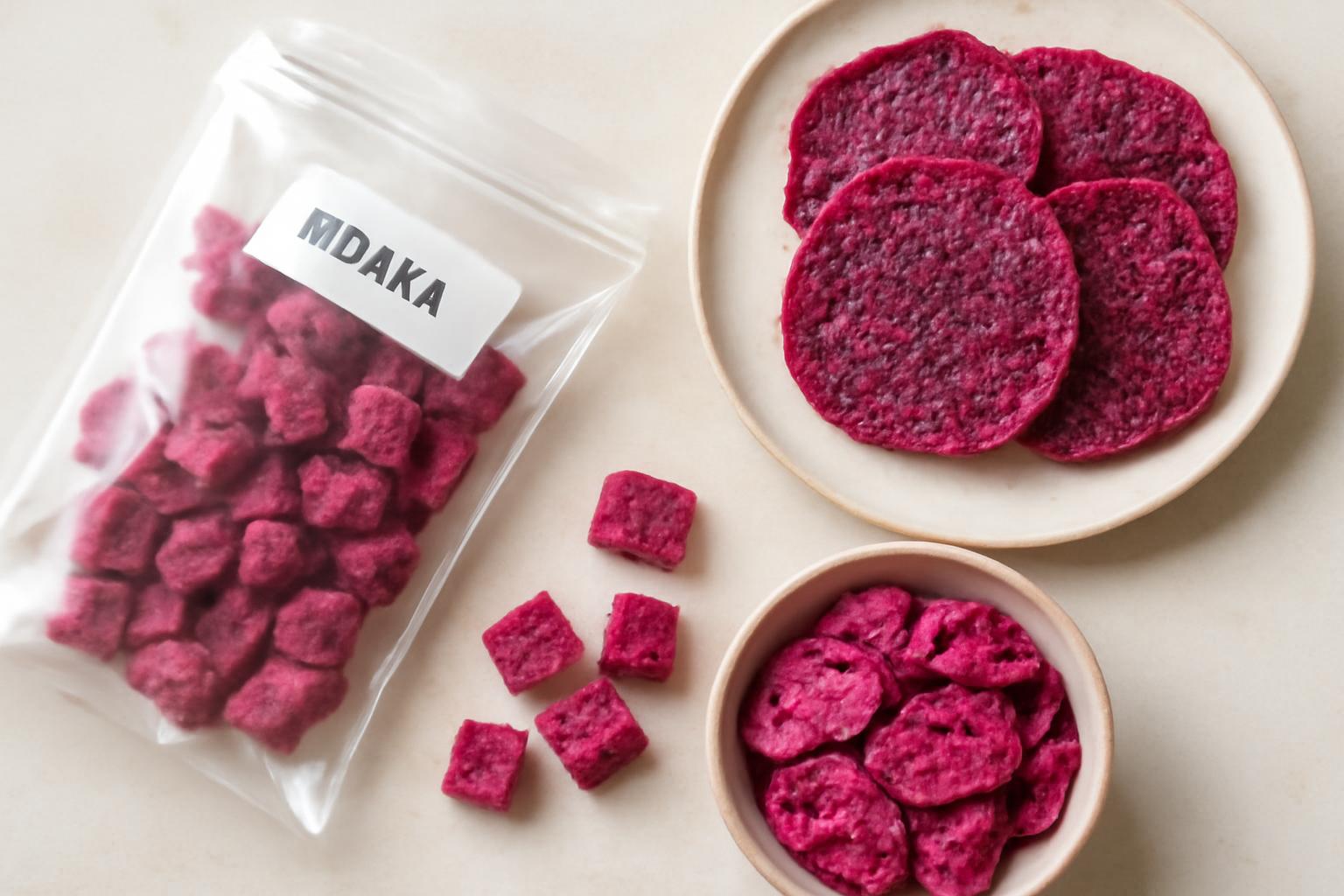
Choose freeze-dried pieces for crispness, dehydrated or soft-dried fruit for chewiness, and powder for even mixing. The format alone does not prove quality.
Dried dragon fruit is not one standardized food. A bag labeled “pitaya” might contain brittle freeze-dried cubes, pliable dehydrated slices, soft-dried pieces, or fine powder.
The practical way to choose is to start with the result you want. Consider freeze-dried pieces for crisp snacking or garnishing, dehydrated or soft-dried fruit for a chewy snack, and powder for even mixing. Then inspect the ingredient list, use the product’s own serving information for calorie tracking, compare prices by weight within the same format, and follow the storage directions printed on that package.
What counts as dried dragon fruit?
Dragon fruit is also called pitaya. It is a cactus fruit commonly associated with Hylocereus species. Red- and white-fleshed species are documented in scientific literature, while retail listings also include yellow dragon fruit products. A 2024 review describes Hylocereus undatus as having red peel and white flesh and Hylocereus polyrhizus as having red peel and red flesh, although botanical and commercial terminology can vary.1
“Dried dragon fruit” is an umbrella retail category rather than a precise processing description. It can include:
- Freeze-dried crisps, cubes, chunks, or slices
- Conventionally dehydrated slices or wheels
- Soft-dried pieces
- Freeze-dried powder
- Diced bulk pieces for foodservice
- Occasionally products that are not dried at all
One marketplace category mixed freeze-dried crisps, powder, dehydrated wheels, soft-dried fruit, and a frozen dragon fruit product on the same page.2 A category heading therefore does not establish what is inside an individual package.
The form determines how the product is intended to be used. Crisp cubes can work as a snack or visible garnish. Chewy slices provide a different eating experience and retain distinct pieces in a mixture.
Use the listing terminology as a starting point, then confirm the description, photographs, ingredient list, net weight, and serving information.
| Listing terminology | Observed or seller-described texture | Common shape | Likely use |
|---|---|---|---|
| Freeze-dried crisps | Crisp, brittle, or crunchy | Thin slices or irregular pieces | Direct snacking, cereal, trail mix, garnish |
| Freeze-dried cubes or pieces | Crisp | Cubes, dice, or chunks | Snacking, yogurt, beverages, toppings |
| Dehydrated dragon fruit | Dry, pliable, leathery, or chewy | Slices, strips, or wheels | Chewy snacking, chopping into mixes |
| Soft-dried dragon fruit | Soft or chewy, according to the listing | Pieces or strips | Direct snacking |
| Freeze-dried pitaya powder | Fine and dry | Powder | Smoothies, batters, sauces, icing |
| Diced bulk dragon fruit | Often described as crisp when freeze-dried | Small uniform dice | Foodservice, drinks, commercial recipes |
These descriptions identify intended texture, not quality or safety. “Crisp” does not prove that a package is fresh or correctly sealed. Likewise, “soft-dried” does not identify one universal process or ingredient formulation.
Freeze-dried, dehydrated, soft-dried, or powdered: choose by outcome
The easiest comparison begins with texture.
Retailers commonly describe freeze-dried dragon fruit as crisp. Products may appear as delicate slices, bite-size cubes, small dice, or irregular pieces. That description helps shoppers choose a style of snack, but it remains a seller characterization rather than independent evidence of freshness, processing quality, nutrient retention, or safety.
Conventionally dehydrated fruit targets a different result. The home-drying method examined for this article describes finished slices as dry to the touch and pliable rather than crisp. They bend before breaking instead of snapping immediately.3 Commercial dehydrated products may vary, but shoppers seeking a chewy texture should examine these listings before buying freeze-dried crisps.
Soft-dried fruit is another marketplace format. The name suggests a softer eating experience, but it does not disclose how that texture was produced. Check the ingredient list instead of assuming that every soft-dried product is untreated fruit with more moisture.
Powder is the practical choice when intact texture is unnecessary. Finely ground freeze-dried pieces may serve a similar purpose. That is use-based guidance, not a claim that powder is nutritionally superior.
| Desired outcome | Format to consider | Why it fits | What to verify |
|---|---|---|---|
| Crisp snack | Freeze-dried crisps, slices, or cubes | Intended to have a brittle or crunchy texture | Seal, ingredients, serving size |
| Decorative garnish | Freeze-dried pieces or cubes | Provides recognizable pieces and contrasting color | Piece size, breakage, resealability |
| Chewy snack | Dehydrated or soft-dried fruit | More likely to be pliable than brittle | Sweeteners, preservatives, portion size |
| Smooth blending | Pitaya powder or ground pieces | Distributes more evenly than intact fruit | Ingredients, clumping, serving information |
| Baking or sauce color | Powder or finely ground pieces | Easier to spread through a mixture | Recipe performance, added ingredients |
| Foodservice drinks | Diced bulk freeze-dried pieces | Uniform pieces simplify portioning | Case weight, storage directions, cost per gram |
| Rehydrated applications | Pieces specifically sold for rehydration | Intended to add fruit solids without fresh fruit | Brand instructions and expected texture |
The available evidence does not support detailed rankings by water activity, nutrient retention, processing efficiency, or shelf stability. Those comparisons would require matched products, defined processing conditions, laboratory measurements, and comparable storage tests. The retail format name alone cannot supply that information.
Calories, carbohydrates, sugar, and fiber: how to read the numbers
There is no single reliable calorie count for every dried dragon fruit product.
One unidentified MyNetDiary entry lists a 40-gram serving of freeze-dried dragon fruit as containing 160 calories, 34 grams of carbohydrate, 19 grams of total sugar, 7 grams of fiber, 3 grams of protein, and 1 gram of fat.4 It is a useful arithmetic example, but not a category-wide nutrition profile.
The entry does not identify a brand, cultivar, ingredient statement, testing method, or original Nutrition Facts label. It also concerns freeze-dried fruit, not necessarily dehydrated slices, soft-dried products, or powders.
For that specific entry:
160 calories ÷ 40 grams = 4 calories per gram
A 20-gram portion would therefore contain an estimated 80 calories:
4 calories per gram × 20 grams = 80 calories
That estimate works only if the portion has the same composition as the database entry. It should not be transferred to another product merely because both packages say “freeze-dried dragon fruit.”
For a labeled product, use:
Calories per gram = labeled calories ÷ labeled serving grams
Then calculate the weighed portion:
Estimated portion calories = calories per gram × portion weight in grams
Suppose a package lists 120 calories per 30 grams:
- Divide 120 by 30 to get 4 calories per gram.
- Weigh the portion.
- If it weighs 18 grams, multiply 4 by 18.
- The estimated portion contains 72 calories.
Use grams when possible.
Several factors can change the nutrition numbers:
- Fruit variety and ripeness
- Amount of water removed
- Processing method
- Added sugar, syrup, juice concentrate, oil, or other ingredients
- Proportions of flesh, seeds, and rind
- Labeled serving size and rounding
- Differences between intact fruit and formulated soft-dried products
Dragon fruit contains naturally occurring sugars, which can still contribute to the total-sugars value. Treat the phrase as a formulation claim and check the product’s ingredient list and nutrition panel for the information actually disclosed.
Fresh-fruit values should not be substituted for dried-fruit values. Harvard Health, for example, reports 82 calories and 2 grams of fiber for a 3.5-ounce serving, but that article concerns fresh dragon fruit rather than dried products.5 Removing water changes how much fruit is represented by a given weight or volume. The supplied evidence does not provide matched fresh and dried samples from which to calculate a universal concentration ratio.
For calorie and macro tracking, use this priority order:
- Nutrition information on the package being eaten
- The labeled serving weight in grams
- The weight of the actual portion
- A clearly identified brand entry reproducing the same label
- A generic database entry only as a rough fallback
The label audit: ingredients and claims worth checking
Begin with the ingredient list rather than the largest promotional words on the front of the package.
Phrases such as “natural,” “clean-label,” “superfood,” “organic,” and “no sugar added” communicate what a seller wants to emphasize. They do not replace product-specific details such as the listed ingredients, serving weight, package weight, storage instructions, or visible certification information.
The captured Big Green Food listing names “Dragon Fruit” as its ingredient. Arctic Farms says its cubes are made from organic dragon fruit without fillers or additives and claims no added sugar or preservatives. Fierce Fruit identifies red dragon fruit pieces as its ingredient.6
These examples apply only to those products. They do not prove that every dried dragon fruit product is single-ingredient, unsweetened, or preservative-free. That is particularly important when comparing soft-dried or chewy products, whose ingredients cannot be inferred from texture alone.
The available package information serves different practical purposes:
- Ingredient list: Shows the ingredients the seller or package identifies as being used.
- Nutrition panel: Provides serving-based calories, carbohydrate, sugars, fiber, protein, fat, and other displayed values.
- Net weight: Shows how much product the package contains.
- Claims and certifications: Describe attributes such as organic status or dietary suitability, with strength depending on the supporting information shown.
Use this checklist before buying:
- [ ] Ingredient list: Is dragon fruit the only listed ingredient?
- [ ] Sweetening ingredients: Are sugar, syrup, juice concentrate, honey, or other sweeteners listed?
- [ ] Serving size: Is it stated in grams?
- [ ] Servings per container: Does the bag contain one serving or several?
- [ ] Net weight: Can it be compared with competing products?
- [ ] Fruit form: Is it freeze-dried, dehydrated, soft-dried, or powdered?
- [ ] Fruit variety: Is it red, white, yellow, or unspecified?
- [ ] Storage directions: What does the package say about handling after opening?
- [ ] Allergen information: Does the package disclose relevant facility or cross-contact information?
- [ ] Origin: Is the fruit’s origin or processing location disclosed?
- [ ] Certification details: If organic status matters, is a certifier or recognizable seal visible?
- [ ] Package design: Is the bag resealable?
- [ ] Best-by information: Is product-specific dating printed on the package?
Treat “organic,” “gluten-free,” “vegan,” “non-GMO,” “additive-free,” and “no added sugar” as product or seller claims unless the listing or package displays the documentation needed for your purchasing decision. Do not assume that these phrases have identical evidentiary strength.
A single-ingredient statement also does not answer every allergy question. Someone managing a food allergy may still need facility or shared-equipment information from the package or manufacturer.
Common gaps in the captured online listings include absent or unreadable nutrition panels, unclear certification details, missing fruit origin, missing allergen information, and nutrient-retention claims without product-specific testing. If a listing provides vivid marketing but omits the information needed to calculate calories or verify ingredients, treat that omission as a purchasing limitation.
Best uses for snacks, breakfasts, baking, and drinks
There is no overall best dried dragon fruit. The better question is which format fits the task.
For direct snacking, choose according to texture. Seller-described freeze-dried pieces are the crisp option. Dehydrated or soft-dried fruit is the more plausible choice for a pliable or chewy bite. Check the serving weight because a small, lightweight bag can contain more than one labeled serving.
For yogurt, oatmeal, cereal, and trail mix, intact pieces preserve a distinct fruit component. Cubes or slices provide visible pieces and localized texture, while powder distributes color and flavor more evenly.
For smoothies, powder is convenient because the fruit does not need to retain its shape. Ground freeze-dried pieces can also work. Intact pieces may be suitable when a blender will pulverize them or when the seller specifically describes them as appropriate for rehydration.
For baking, choose according to the intended effect. Powder or ground fruit is easier to distribute through batter, dough, icing, or filling. Chopped chewy fruit can create distinct pieces. Because performance may differ by formulation and recipe, test a small amount before committing to a large package.
For sauces, preserves, and frozen desserts, powder, ground pieces, or products sold for rehydration are practical starting points. Results may still vary with particle size, ingredients, fruit variety, and moisture exposure.
For drinks, Tiki Breeze recommends four to six cube-cut freeze-dried pieces—approximately 1 to 1.5 grams—per beverage.7 Treat that as one seller’s starting point, not a universal serving or independently validated recipe. Piece size, drink volume, steeping time, variety, and other ingredients can change the result.
Seller-suggested applications across the category include:
- Lemonades and refreshers
- Sparkling drinks
- Tea
- Cocktails and brewing
- Yogurt and oatmeal
- Cereal and trail mix
- Pastries
- Sauces and preserves
- Smoothies
- Frozen desserts
- Decorative garnishes
Fierce Fruit says its pieces may be used directly, rehydrated, or ground. That establishes the intended versatility of that product, not equivalent performance across every brand.
Taste is less predictable than appearance. Seller and customer descriptions range from subtly sweet, tangy, floral, and tropical to earthy or bland. The Arctic Farms page, for example, displayed mixed customer opinions from a small set of reviews, while the home-drying blogger found the white-fleshed fruit used in that project disappointing.8 These subjective observations do not establish that red, white, or yellow fruit is universally better.
If taste is the main concern, begin with a small package. If color matters, confirm the flesh color instead of relying on the general term “dragon fruit.” For commercial drinks or baking, test a weighed amount in the actual formulation before buying a case.
How to compare price without being misled by package size
Headline price is a poor comparison when one listing is a 20-gram snack bag, another is a multipack, another is powder, and another is a one-pound foodservice package.
Use:
Price per gram = total price ÷ total grams
or:
Price per ounce = total price ÷ total ounces
Keep powders and intact pieces in separate comparison groups. Although both may contain dragon fruit, they serve different tasks and may have different packaging, processing, and portion patterns.
Prices, availability, promotions, and stock may change.
| Product and format | Captured price and weight | Calculated unit price | Important context |
|---|---|---|---|
| Tiki Breeze freeze-dried cubes7 | $66.95 for 600 g | About $0.112/g | Foodservice case containing twelve 50 g packs |
| Fierce Fruit freeze-dried pieces9 | $45.95 for 1 lb | About $2.87/oz | One-pound option was displayed as sold out |
| Pitaya powder marketplace listing2 | $14.99 for 3.5 oz | About $4.28/oz | Compare with other powders, not automatically with snack pieces |
The Tiki Breeze calculation is:
$66.95 ÷ 600 grams = $0.1116 per gram, rounded to $0.112 per gram
The Fierce Fruit calculation is:
$45.95 ÷ 16 ounces = $2.8719 per ounce, rounded to $2.87 per ounce
The powder calculation is:
$14.99 ÷ 3.5 ounces = $4.2829 per ounce, rounded to $4.28 per ounce
These calculations normalize package price by weight. They do not measure ingredient documentation, flavor, shipping damage, recipe suitability, or overall quality.
Do not calculate a unit price when the displayed price cannot be clearly paired with a package size. The captured Arctic Farms page showed more than one price and several bag sizes without a sufficiently clear price-to-size association. Similarly, the displayed Big Green Food price should not be assumed to apply to every multipack and bulk option.
Before choosing the lowest unit price, account for:
- Shipping charges and free-shipping thresholds
- Promotions or subscription pricing
- Stock status
- Powder versus intact fruit
- Snack packaging versus foodservice packaging
- Ingredient and nutrition documentation
- Resealable packaging
- Expected breakage during shipping
- How much can realistically be used
- Whether the package size could create waste
A one-pound bag may have a lower unit price but still be poor value for an occasional snacker. A smaller resealable bag may justify a higher unit price if it reduces waste. Individually packaged portions may cost more per ounce but simplify portioning.
Compare like with like: powder against powder, crisp pieces against crisp pieces, and chewy fruit against chewy fruit. The evidence does not support a universal cheapest or best-value ranking across these formats and sales channels.
Storage after opening: protect texture, but follow the package
Separate unopened shelf-life claims from after-opening handling.
An unopened package retains its original seal. Once opened, it is exposed to household air, humidity, and repeated handling. An unopened shelf-life claim should therefore not be converted into a universal after-opening period.
Big Green Food directs buyers to keep its freeze-dried product in a cool, dry place.6 That is guidance for the listed product, not an expiration rule for the entire category.
Fierce Fruit lists an unopened shelf life of up to 24 months from manufacture when its product is kept away from sunlight in a cool, dark place. After opening, the seller recommends tightly sealing and refrigerating it.9 Those directions apply to that product. Another manufacturer may provide different instructions.
Texture should not, however, be treated as a complete safety test or proof that the package was handled correctly.
Prioritize:
- Storage directions printed on the package
- Best-by and lot information
- Whether the original seal is intact
- Product-specific directions for handling after opening
- Any package instructions concerning included inserts
- Visible package damage or moisture intrusion
Be skeptical of shelf-life claims extending for many years or decades when the seller does not provide product-specific testing conditions. Such statements should not be converted into household storage guidance.
There is no evidence-based universal instruction such as “consume within 30 days” for every dried dragon fruit product. Powder, crisp pieces, dehydrated slices, and soft-dried products may behave differently after opening. Follow the package and contact the manufacturer when the directions are missing or unclear.
How to dehydrate dragon fruit at home, with evidence limits
The only dragon-fruit-specific home-drying method in the supplied evidence comes from an affiliate-supported personal food-preservation blog. It is not a validated regulatory, university-extension, or laboratory protocol.
Accordingly, the details below describe what that source recommends; they should not be treated as a verified preservation process or a guarantee of safe long-term storage. Anyone needing authoritative food-preservation guidance should consult a qualified food-safety professional or an appropriate public food-preservation authority before proceeding.
Preparation described by the source
The blog’s method calls for washing the whole fruit, removing or retaining the rind according to preference, and cutting the fruit into slices about one-quarter inch, or 6 millimeters, thick.3
The source permits several preparation approaches: scooping out the flesh before slicing, peeling before drying, drying with the rind attached, or peeling after drying. These are presented as handling preferences rather than validated safety controls.
Dehydrator method described by the source
The blog specifies 135°F, or 57°C, for 8 to 12 hours or longer.3 It also indicates that the time is approximate.
Actual drying time may differ with:
- Slice thickness
- Fruit ripeness
- Initial moisture
- Dehydrator design
- Tray position and loading
- Airflow
- Ambient temperature and humidity
Because the source is not a validated protocol, the temperature and elapsed time should not be interpreted as proof that a batch has reached a defined safety threshold.
Oven method described by the source
The same blog describes an oven approach using approximately 170°F, or 76°C, or the oven’s lowest setting, for roughly four to six hours, with close monitoring and the door cracked.10
The source warns users to monitor the fruit to avoid burning.
This is an account of the blog’s method, not authoritative safety guidance for oven dehydration.
How the source judges dryness
The blog describes finished slices as:
- Dry to the touch
- Pliable rather than crisp
- Able to bend before breaking
- Free from obviously wet or sticky areas
That target differs from seller-described freeze-dried crisps. A conventionally dehydrated slice is not expected to snap like a commercial freeze-dried cube.
These sensory observations do not measure water activity or validate microbiological safety. They describe the source’s preferred texture only.
Conditioning described by the source
After cooling, the blog recommends loosely placing the dried pieces in a glass jar, shaking the jar daily for one week, and watching for sticking or moisture buildup. If either appears, it recommends returning the fruit to the dehydrator and checking it again after further drying and cooling.10
The purpose of this step, as presented by the blog, is to reveal uneven residual moisture among the pieces. It is not a laboratory safety test.
Storage and troubleshooting
The blog advises placing dried and conditioned fruit in an airtight container in a cool, dark, dry location. It also gives an estimate of up to one year, but the supplied page provides no product testing to support that duration. That estimate should not be treated as a guaranteed shelf life.
| Observed problem | Possible explanation | What the blog-style method suggests |
|---|---|---|
| Some slices are dry while others remain sticky | Uneven thickness or airflow | Separate pieces and continue drying the thicker ones |
| Pieces stick during conditioning | Residual moisture | Return them to the dehydrator |
| Moisture appears inside the jar | Uneven drying or packing while warm | Redry and cool before reassessing |
| Pieces become hard and brittle | Thin slices or extended drying | Adjust thickness or time in a future batch |
| Edges brown in the oven | Excess heat or insufficient monitoring | Reassess the temperature and monitor more closely |
| Flavor seems weak | Variety, ripeness, or preference | Try another fruit or use the dried pieces in a mixture |
Because no authoritative dragon-fruit preservation protocol appears in the evidence pack, this section deliberately avoids promising long-term safety or a fixed storage period. This article provides general information rather than individualized food-safety, medical, or dietary advice; the site’s broader limitations are described in its Terms of Use.
Health and nutrient-retention claims: what the evidence can actually support
Dragon fruit contains fiber and documented classes of plant compounds. A 2024 review identifies phenolic acids, flavonoids, betalains, and anthocyanins among the compounds discussed in the literature.1
That finding does not establish a representative composition for commercial dried dragon fruit. The review examines dragon fruit broadly rather than analyzing a representative selection of identifiable dried products. It also does not demonstrate that eating dried pitaya produces a specific clinical outcome.
The review’s authors call for further clinical trials and additional research into processing and post-harvest handling. That matters when evaluating dried-fruit claims because variety, processing conditions, storage, light, oxygen, temperature, and packaging can affect the finished product.
“Superfood” is not a standardized scientific category. Dragon fruit can be a nutritious food, but the supplied evidence does not show that dried dragon fruit prevents, treats, or reduces the risk of diabetes, cancer, cardiovascular disease, digestive disorders, or another medical condition.
Claims that freeze-drying preserves a particular percentage of nutrients deserve scrutiny unless they identify:
- The tested product and fruit variety
- The nutrients or compounds measured
- The fresh comparison sample
- Processing conditions
- Storage duration and conditions
- Analytical method
- Product-specific or independent results
It is also too broad to say that freeze-drying simply “prevents degradation.” Different compounds may respond differently to processing and storage. A vivid color does not quantify nutrient content, and an attractive product can still lack adequate nutrition documentation.
For purchasing and tracking decisions, trust the most specific information first:
- A complete product-specific ingredient list
- A readable nutrition panel
- A defined serving weight
- Relevant certification details
- Product-specific storage directions
- Transparent testing for any specialized nutrient claim
Treat broad therapeutic, “detox,” antioxidant, nutrient-retention, and extended shelf-life language as marketing unless suitable evidence directly supports the product and claim.
Frequently asked questions
Is dried dragon fruit healthy?
It can fit into a varied diet, but the answer depends on the product, ingredients, portion, and individual needs. Dragon fruit contains fiber and documented plant compounds, but the supplied research does not prove therapeutic effects from commercial dried products.
Use the package’s nutrition information to evaluate calories, carbohydrate, sugar, and fiber. Do not substitute fresh-fruit values or assume every dried product matches a generic database entry.
Does dried dragon fruit contain added sugar?
Sometimes, but not necessarily. Several captured listings identify only dragon fruit or claim no added sugar, but those statements apply only to the products concerned.
Check the ingredient list and nutrition panel. “No added sugar” does not mean the fruit contains no naturally occurring sugar or that it is necessarily low in total sugar.
What is the difference between freeze-dried and dehydrated dragon fruit?
The clearest consumer-facing difference is texture. Sellers commonly describe freeze-dried pieces as crisp or crunchy. The cited home-dehydration method targets pieces that are dry and pliable and bend before breaking.
Those terms do not independently establish nutrient retention, safety, shelf life, or quality. Check the individual product rather than relying on the format name alone.
How many freeze-dried dragon fruit pieces should I add to a drink?
One beverage supplier recommends four to six cube-cut pieces, approximately 1 to 1.5 grams, per drink.7 Use that only as a starting point.
For repeatable results, weigh the fruit and record the amount that works with your specific piece size, drink volume, and recipe.
How long does dried dragon fruit last after opening?
There is no universal after-opening period supported for every format and brand. Follow the package’s storage directions and best-by information.
Reseal freeze-dried fruit promptly to limit humidity exposure, but do not use crispness alone as a safety test. Contact the manufacturer if the after-opening directions are absent or ambiguous.
The final decision rule
Choose freeze-dried pieces for crispness and garnishing, dehydrated or soft-dried fruit for chewiness, and powder for even mixing. Then verify the ingredient list, calculate calories from the product’s own serving information, compare prices by weight within the same format, and follow that package’s storage instructions.
A transparent label with specific ingredients, serving data, and storage directions is more useful than an impressive but unsupported superfood, nutrient-retention, or extended shelf-life claim.