
Ube vs Taro: Differences in Flavor, Color, Texture, Uses, and Substitutions
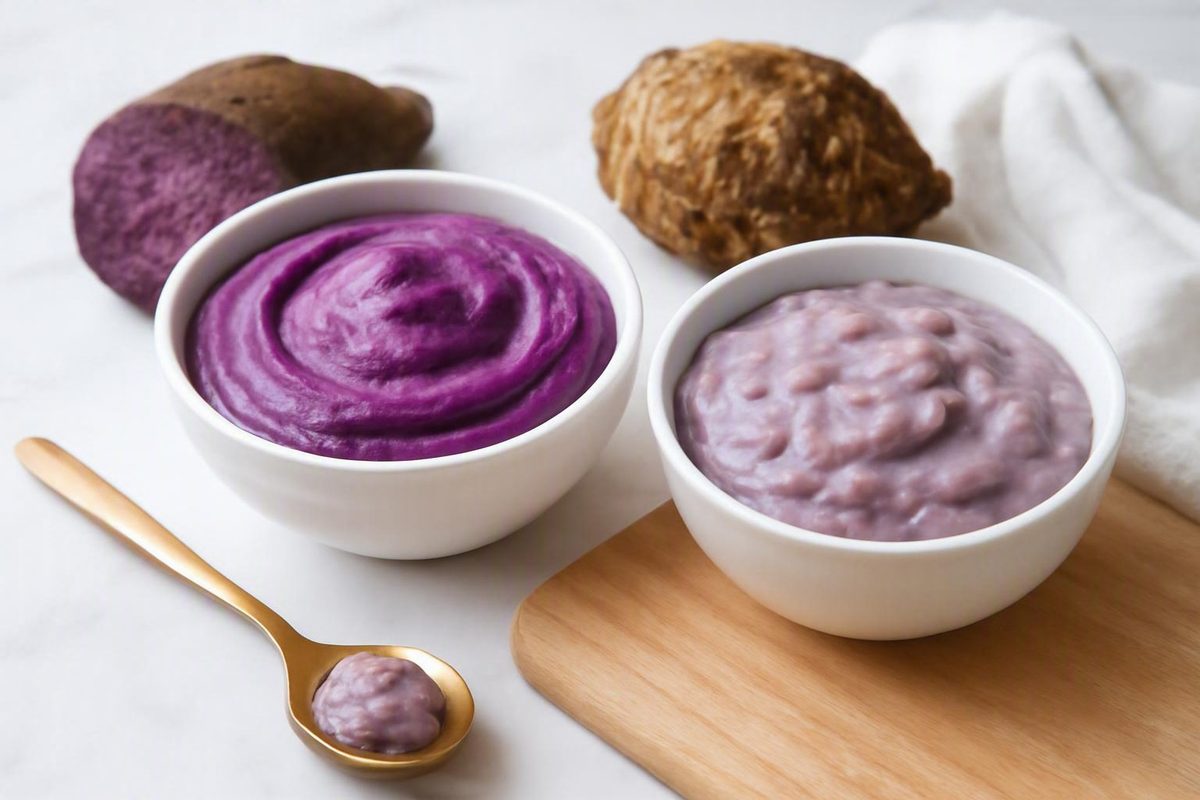
A vivid purple drink may get its color from added coloring, ube or another purple ingredient, so appearance alone cannot tell taro from ube.
Overview
Ube and taro are different ingredients, not two names for the same thing. Ube is typically sweeter, creamier, and a deeper purple, while taro is generally milder, earthier, paler, and starchier. The deciding factor for your recipe is the result you want: vivid purple sweetness points to ube, while a neutral, versatile starch points to taro.
That distinction matters most when you meet these ingredients through desserts and drinks rather than whole roots. A bright purple “taro” bubble tea can look almost identical to an ube dessert, which is where confusion begins. As several culinary comparisons note, commercial taro powders may add sugar, flavoring, or color, so a finished drink’s appearance does not reliably prove which ingredient is inside. The sections below compare their natural properties side by side, help you choose by the result you want, explain the purple-drink question, and set realistic expectations for substitution.
Ube and taro compared side by side
Ube and taro differ across identity, natural color, flavor, and cooked texture, and the table below summarizes the commonly reported contrasts. Treat these as typical tendencies rather than absolute rules: cultivars and preparation methods vary, and a specific root or powder may sit slightly outside the general pattern.
The clearest recurring distinction is sensory. One culinary comparison summarizes it directly: ube is “often creamier, sweeter, and deeper purple, while taro is earthier, more neutral, and lighter in color” (bigmoca.nl). Another describes taro as “slightly earthy, reminiscent of chestnut, with a more mealy texture and higher starch content than ube” (yoyofoods.fr).
| Attribute | Ube | Taro |
|---|---|---|
| Identity | Purple yam (Dioscorea alata), described in culinary sources as belonging to the yam family (Dioscoreaceae) | Root corm (Colocasia esculenta), described in culinary sources as belonging to the arum family (Araceae) |
| Typical natural flesh color | Deep, vivid purple throughout | Generally white to cream, often with faint purple flecks or pale lavender tones |
| Flavor | Sweeter and dessert-like, sometimes described as vanilla-like | Milder, nuttier, and earthier; more neutral |
| Cooked texture | Creamy when cooked or blended | Denser and starchier, more mealy |
| Typical culinary role | Primarily desserts and baked goods | Both drinks and savory cooking |
On identity, the culinary sources here agree that ube and taro are “completely different plants,” with ube described as a yam and taro as an arum-family root corm (myubebae.com). These are commercial culinary sources rather than a botanical authority, so treat the family and storage-organ labels as the commonly cited framing; notably, none of the reliable material here supports calling either plant a member of the sweet-potato family.
On color, the useful nuance is that taro is not simply “purple” or “not purple.” Ube is typically a vivid violet throughout, while taro tends toward pale flesh “with specks of purple” (purplepotionscoffee.com) — so taro can show lavender tones or flecks without naturally matching ube’s saturated color. That difference is why finished appearance alone can mislead, a point the drink section returns to.
Choose by the result you want
Pick your ingredient by the sensory result you’re targeting, not by assuming one is universally better. Ube leans sweet, creamy, and vividly purple; taro leans mild, earthy, and starchy. Ube is used primarily in desserts and baked goods, while taro is “more versatile and used in both sweet and savory dishes” (purplepotionscoffee.com).
The matrix below translates those tendencies into a direct choice. It applies to whole ingredients and pure powders; sweetness and color added by a commercial mix are a separate question covered later.
| Choose ube if you want… | Choose taro if you want… |
|---|---|
| A vivid purple color that comes from the ingredient itself | A pale, neutral base that you can color or sweeten as needed |
| A naturally sweeter, dessert-like flavor | A milder, earthier, nuttier flavor |
| A creamy, velvety body in desserts or lattes | A denser, starchier texture |
| A purple dessert or sweet drink where color and sweetness matter | An ingredient that works in both sweet and savory cooking |
For beverages specifically, both can work, and the right pick depends on taste preference rather than a default rule. One vendor guide frames it well: for the “purple dessert experience — the vivid color plus the vanilla-sweet flavour,” reach for ube; if you need “a mild, neutral starch base for savoury or lightly sweetened dishes, taro is the right choice” (vovanglobal.de). A reader who prefers a milder, earthier latte is well served by taro even though many seller pages promote ube by default. For savory dishes, taro is the more natural fit given its neutral, starchy profile.
Fresh taro requires verified preparation guidance
If you are cooking with fresh taro rather than a powder or prepared drink, treat preparation as something to confirm with an authoritative food-safety source before proceeding. One vendor guide states that “raw taro is not edible because of its calcium-oxalate crystals and must always be cooked” (vovanglobal.de), but this article cannot supply a validated method, time, temperature, or doneness endpoint. The only controlled study available here measured oxalate reduction in taro leaves — reporting, for example, that boiling reduced soluble oxalates by 36% (PubMed) — which does not establish a safe preparation method for the taro corm. Consult jurisdiction-appropriate food-safety guidance for corm-specific handling.
Why taro drinks can look vividly purple
A taro drink can look far more purple than the ingredient itself because commercial products may add color, sweetness, or creaminess. Natural taro produces a pale result — one source describes it as “a very pale beige or grayish-purple drink” — and notes that “to meet customers’ visual expectations, many taro powders contain coloring agents” (yoyofoods.fr). This does not mean every taro drink is dyed, but it explains why some are.
The practical takeaway is that vivid purple is not reliable proof of what’s inside. A finished drink’s color can come from added coloring, from ube, or from another purple ingredient, so appearance alone cannot confirm identity. As one comparison puts it, taro powders for bubble tea often “contain sugar, flavoring, and sometimes added color,” which “makes the final drink look more purple than pure taro normally is” (bigmoca.nl).
This also matters when you compare flavors. If you taste a sweet, creamy, brightly purple “taro” drink and conclude taro is naturally sweet and vivid, you may be responding to sugar, creamer, and coloring rather than the root. To compare like with like, separate the ingredient’s natural profile — mild, earthy, pale — from the sweetness, creaminess, and color a formulation can introduce.
How to read an ube or taro product label
The most reliable way to know what you’re buying is to read the ingredient list rather than trusting the product name or the finished color. A product labeled “taro” can be a pure root powder or a sweetened, colored premix, and only the ingredient list tells you which.
- Look for the root or pure powder first. A more ingredient-focused product lists ube or taro (or its flour/powder) near the top with few additions.
- Watch for added sweeteners and flavoring. Sugar and flavoring are commonly present in bubble-tea powders and shift the taste away from the natural root (bigmoca.nl).
- Check for added color. Coloring agents are what make many taro powders look more purple than the root naturally is (yoyofoods.fr).
- Note creamers. One guide advises checking “for the possible presence of non-dairy cream” and whether any colorings are of natural origin (yoyofoods.fr).
If your goal is the color and flavor of the ingredient itself, choose a pure powder or whole root; if convenience and a specific sweetened, colored drink are the goal, a premix may be exactly what you want — just buy it knowingly.
Can ube and taro substitute for each other?
You can sometimes swap them in sweet recipes, but the result will not be equivalent. Rather than asking whether a substitution “works,” it’s more useful to anticipate the specific changes. As one culinary source puts it plainly, “you cannot substitute one for the other and get the same result” (myubebae.com).
The limited swap applies mainly to sweet applications. One vendor guide notes that in sweet recipes “for example in a cake, a cream or a latte — ube and taro can be swapped at a pinch, but the result changes noticeably: with ube everything turns vividly purple and much sweeter, with taro it stays pale and you have to add sweetness” (vovanglobal.de). Treat that as directional guidance, not a conversion formula — the evidence here does not support exact ratios or precise moisture adjustments.
When you make the swap, expect changes across four dimensions:
- Color: Ube brings vivid purple; taro stays pale, so replacing ube with taro loses the violet look.
- Sweetness: Ube is naturally sweeter, so switching to taro typically means adding sweetness yourself.
- Flavor: You trade ube’s sweeter, dessert-like character for taro’s milder, earthier, nuttier profile — or the reverse.
- Starchiness and texture: Taro is denser and starchier, while ube blends creamier, which can alter the body of a cake, cream, or latte.
Because these shifts are predictable, decide first which attributes matter most for your dish. If vivid purple and built-in sweetness are essential, taro is a poor stand-in for ube without added color and sugar. If you want a milder, more neutral base and are willing to sweeten to taste, taro can stand where ube would otherwise go — with a paler, earthier result.