
Lean Meats: U.S. Labels, Cuts, Shopping, and Cooking Guide
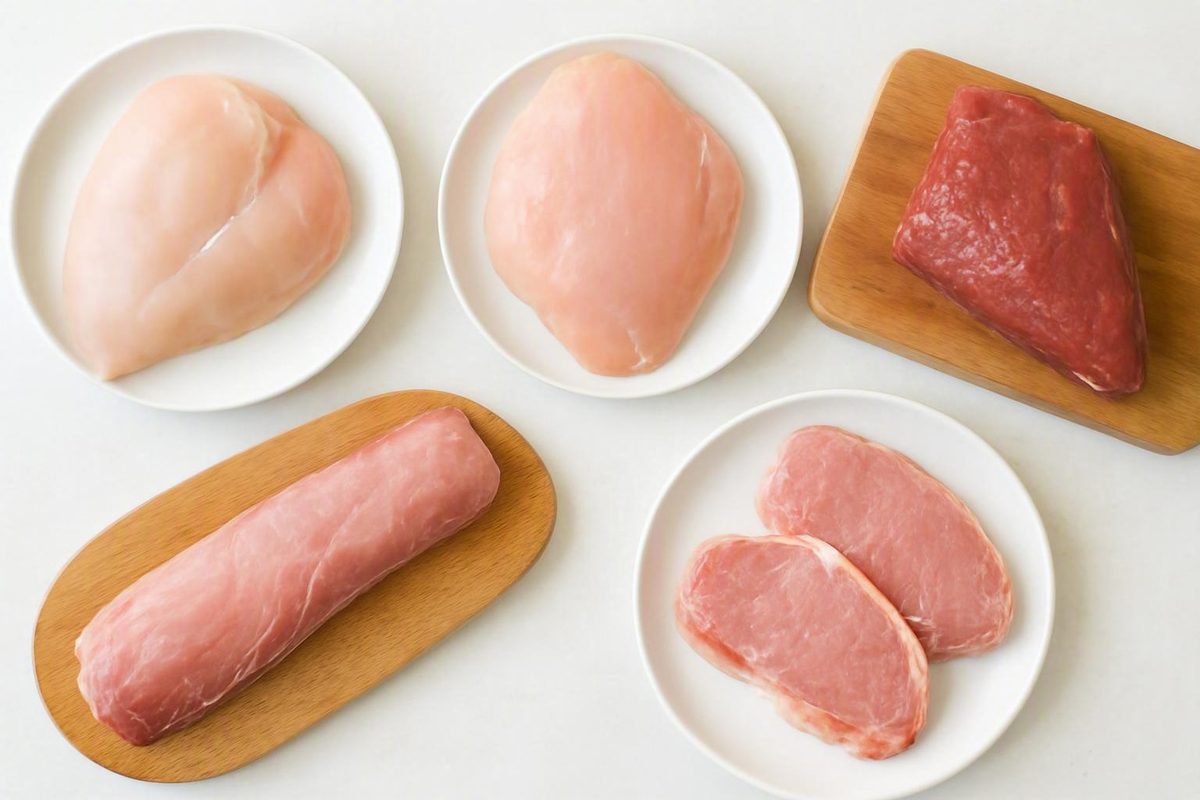
Whether a package qualifies depends on its cut, skin status, label claim and preparation, not the animal alone. Those four checks simplify package comparisons.
Overview
Lean meats include skinless chicken and turkey breast, beef cuts with “round” or “loin” in the name, pork tenderloin and loin chops, and white-fleshed fish such as cod and tilapia. Whether a specific package qualifies depends on the cut, skin status, label claim, and how you prepare it — not on the animal alone.
That last point is the one most shopping lists miss. The American Heart Association points shoppers toward skinless chicken and turkey with visible fat discarded and toward beef and pork labeled “loin” and “round,” because those cuts have the least saturated fat. Healthline notes that white-meat poultry is low in fat only if you remove the skin before or after cooking, and that lean pork means specific cuts — tenderloin, loin chops, top loin — rather than pork in general.
This guide covers what “lean” and “extra lean” mean as regulated U.S. label terms, named examples by category, a repeatable package-reading process, cooking methods that preserve the lean profile, and the things a lean label does not tell you.
What “lean” and “extra lean” mean
“Lean” has two meanings worth separating. Informally, people use it to describe any relatively high-protein, lower-fat food. On U.S. meat, poultry, and egg product packaging, however, “lean” and “extra lean” are regulated nutrition claims with specific numeric thresholds.
According to the USDA Food Safety and Inspection Service’s guide to federal food labeling requirements, the terms are defined as follows:
- Lean: less than 10 grams of fat, 4.5 grams or less of saturated fat, and less than 95 milligrams of cholesterol per reference amount and per 100 grams.
- Extra lean: less than 5 grams of total fat, less than 2 grams of saturated fat, and less than 95 milligrams of cholesterol per reference amount and per 100 grams.
For a main dish or complete meal to be labeled “lean,” the same fat, saturated fat, and cholesterol levels must be met per 100 grams and per labeled serving. Mayo Clinic explains the same thresholds in shopper-friendly terms — a lean cut of beef is a 3.5-ounce (about 100-gram) serving under those limits — and notes that the U.S. Department of Agriculture regulates whether beef can carry these labels.
Two boundaries matter here. First, these numbers are U.S.-specific labeling thresholds; other countries define and regulate claims differently, so don’t treat them as universal. Second, a regulated “lean” claim describes fat and cholesterol content only. A food can be lean and still be high in sodium, heavily processed, or served in an oversized portion. The practical takeaway: when a U.S. package says “lean” or “extra lean,” it has met a defined federal standard — and when it doesn’t carry the claim, you can still judge the product using the cut names, skin cues, and percentages covered below.
Lean meat examples by category
The most useful way to shop is by category and cut, because leanness varies more within an animal than between animals. A pork tenderloin and a pork sausage are entirely different decisions. Mayo Clinic lists eye of round, round tip, top round, bottom round, top sirloin, top loin, and chuck shoulder and arm roasts as the leanest beef cuts, while Ohio State University Extension adds flank steak, pork loin and tenderloin, boneless skinless chicken breast, and turkey cutlets to the lean roster.
The matrix below pairs each category’s supported examples with the shopping cue that identifies the lean version and the caveat that most often trips shoppers up.
Lean meat decision matrix
| Category | Named lean examples | Shopping cue | Caveat |
|---|---|---|---|
| Poultry | Boneless, skinless chicken breast; turkey breast and cutlets | “Skinless” and white breast meat; remove skin at home if buying skin-on | Skin-on preparations and higher-fat cuts don’t share the breast’s low-fat profile |
| Beef (whole cuts) | Eye of round, top/bottom round, round tip, top sirloin, top loin, chuck shoulder and arm roasts, flank steak | “Round” or “loin” in the cut name; check for a lean/extra lean claim | The same cut can carry different names — a boneless top loin steak may be sold as a strip or New York strip |
| Ground meats | Ground beef labeled 90% lean or higher (reserve “extra lean” for products carrying the regulated claim); low-fat ground chicken or turkey breast | The lean percentage on the label — 90%, 93%, or 95% | “Ground turkey” without a percentage isn’t automatically lean; pick the highest lean percentage available |
| Pork | Pork tenderloin, pork loin chops, top loin and sirloin roasts, center loin, ham | “Loin” or “tenderloin” in the cut name | Only specific cuts qualify; pork as a category is not uniformly lean |
| Fish | Cod, haddock, grouper, halibut, tilapia, bass | White-fleshed fillets; small cans of fish | Breading and frying add the fat back; salmon is a different case (see below) |
| Game and other red meats | Lean cuts of lamb, veal, goat, kangaroo | Trimmed cuts with little visible fat | Listed as lean red meats in Australian dietary guidance; trim any visible fat |
One warning about comparison shopping: don’t rank these options against each other numerically unless the numbers share the same basis. Nutrient values differ between raw and cooked meat — Australia’s Eat for Health guidelines illustrate this by defining a red-meat serve as 65 g cooked but 90–100 g raw — so a “per 100 g raw” figure and a “per 100 g cooked” figure are not comparable. Every row in this table can be a sound choice; the deciding factors are the cue on the package and what happens in your kitchen afterward.
How to shop for lean meat
The reliable shopping rule is that cut, skin, visible fat, and label percentage matter more than the animal name. “Chicken” includes both skinless breast and fried skin-on thighs; “beef” includes both eye of round and heavily marbled ribeye. In practice, run four quick checks on any package: look for a regulated “lean” or “extra lean” claim, scan the cut name for “round” or “loin,” check whether poultry is skinless (or plan to remove the skin), and read the lean percentage on ground meat. The two subsections below turn each of these checks into a repeatable habit.
Cut names, skin, and visible fat
Cut names are the fastest cue on the package. Ohio State University Extension’s fact sheet advises shoppers to look for the words “round” or “loin” in the name of the cut, and the American Heart Association gives the same guidance for beef and pork because those cuts carry the least saturated fat. That single habit covers most of the lean beef list — eye of round, top round, bottom round, top sirloin, top loin — and the lean pork list of tenderloin, loin chops, and loin roasts.
For poultry, the cue is skin. Healthline notes that white-meat chicken and turkey, particularly the breasts, are rich in protein and low in fat if you remove the skin either before or after cooking. That means a skin-on or bone-in breast can still end up as a lean meal: buy it, then discard the skin and all visible fat before cooking, as the American Heart Association recommends.
Visible fat is the third cue. Choose cuts with the least fat you can see, and trim off any solid fat before cooking. Mayo Clinic adds a final step many people skip: remove any remaining visible fat before eating, not just before cooking. Together, these three checks — name, skin, trim — identify the leaner version of almost any fresh meat without needing a nutrition panel.
Ground-meat percentages and beef grades
Ground meat is labeled with a lean-to-fat ratio, and the number is the whole story. The American Heart Association recommends choosing 90% or more lean ground beef for hamburgers or meat loaf, and Mayo Clinic suggests picking the lowest fat percentage available — look for labels that say 93% or 95% lean. Treat 90% as the sensible floor and higher percentages as progressively lower-fat choices. The same logic applies to ground poultry: Ohio State University Extension points to low-fat ground chicken or turkey, or ground breast meat, rather than assuming any ground poultry is lean by default.
Beef packages also display grades — Prime, Choice, and Select — and these are easy to confuse with lean labeling. They are not the same thing. As Mayo Clinic explains, grades describe marbling, the flecks of visible fat within the muscle: Prime has the most marbling, Choice has less, and Select has the least. A grade answers “how much intramuscular fat does this cut have?” while a regulated “lean” or “extra lean” claim answers “does this product meet the federal fat and cholesterol thresholds?” The two can point in the same general direction — Mayo Clinic suggests choosing Choice or Select over Prime because Prime often has more fat — but a Select grade is not a lean claim, and a lean claim is not a grade. When both appear on a package, use the lean claim for the fat question and the grade for the marbling-and-tenderness question.
Cooking methods that keep lean meat lean
A lean purchase can stop being a lean meal in the kitchen. Mayo Clinic puts it plainly: even the leanest cuts of beef can be bad for your weight and health if you prepare them in unhealthy ways. The goal of lean cooking is simple — don’t add substantial fat back, and remove the fat that renders out.
Start before the heat. Trim solid visible fat and discard poultry skin before cooking. Then choose a method that adds little or no fat. The American Heart Association names several:
- Baking, broiling, or roasting
- Grilling
- Air frying
- Slow cooking
- Poaching (a low-fat moist-heat option for fish and poultry)
After cooking, deal with rendered fat. Mayo Clinic’s three-step routine for beef is practical: trim solid fat before cooking, drain cooked ground meat in a strainer and rinse it with hot water, and chill cooked beef juices so the hardened fat can be skimmed off before the juice goes into soups, stews, or gravy.
The failure modes are just as specific. Ohio State University Extension advises skipping or limiting breading on meat, poultry, or fish, because breading soaks up calories and fat during cooking. Deep frying is the largest single change you can make to a lean cut — one comparison source estimates it can double the calories of the same cut. Heavy cream sauces, generous cooking oil, and butter-basting work the same way in kind if not always in degree: they add fat the label never accounted for. A useful mental check before serving is to ask what has been added since the package was opened. If the answer is mostly heat, seasoning, and perhaps a light oil, the lean choice you made at the store is still on the plate.
What a lean label does not tell you
A regulated lean claim answers exactly one question: whether the product’s fat, saturated fat, and cholesterol fall under defined thresholds. It says nothing about sodium, degree of processing, beneficial fats such as omega-3s, appropriate portion size, or how the food fits into a varied week of eating. Treating “lean” as a complete health verdict is the most common category error in this topic — it leads shoppers to dismiss salmon for having too much fat and to wave through deli meat without checking the sodium panel. The three subsections below cover the caveats with the strongest evidence behind them: higher-fat fish, processed lean meats, and portion conventions that vary by country.
Salmon and other higher-fat fish
Salmon does not fit a strict lean-fat framework, and that is not a mark against it. Healthline draws the contrast directly: white-fleshed fish such as cod and halibut are excellent sources of hunger-satisfying protein with little fat and relatively few calories, while other fish, such as salmon, have higher amounts of healthy omega-3 fats. In other words, the very attribute that pushes salmon above a lean threshold — its fat content — includes the omega-3 fats that make it nutritionally distinctive.
The practical framing is to treat “lean” as one selection tool rather than the only one. If your immediate goal is minimizing total fat in a meal, cod, haddock, grouper, halibut, tilapia, or bass are the technically lean picks. If you’re choosing fish across a week of meals, salmon’s higher fat content serves a different purpose, and “not technically lean” should not be read as “unhealthy.” The two kinds of fish answer different questions, and a good shopping list can include both.
Lean deli meat, sodium, and processing
Deli meat shows why “lean” and “healthy” are separate assessments. Sliced turkey, chicken, roast beef, and ham can genuinely be lean by the fat-based definition — Ohio State University Extension lists all four among lean luncheon meat options, and deli producers market lean lines on that basis. But the fat thresholds say nothing about how the meat was made or how much salt it contains.
Australia’s dietary guidelines make the processing point explicitly: smoked, salted, and preserved meats such as ham, bacon, and salami are usually higher in saturated fat and salt, and contain preservation-related chemical properties that may be responsible for increased health risks — which is why that guidance places most of them in the discretionary food group and recommends limiting them. The workable habit at the deli counter is to run two separate checks: use the fat content or lean claim to answer the leanness question, then read the sodium figure and the ingredient list to answer the processing question. A slice can pass the first check and still deserve scrutiny on the second.
Portions and dietary variety
Even a verified lean cut can be undermined by portion size. The most widely used U.S. visual is simple: a portion of cooked meat is about 3 ounces, roughly the size of a deck of cards or the palm of your hand — a comparison used by both the American Heart Association and Mayo Clinic. Mayo Clinic adds a weekly frame from the Dietary Guidelines for Americans: adults should eat no more than a total of 26 ounces of meat, poultry, and eggs per week.
Treat the deck-of-cards image as a practical estimating tool, not a universal prescription. Formal serving definitions vary by food category and by country. Australia’s Eat for Health guidelines, for example, define one serve as 65 g of cooked lean red meat (about 90–100 g raw), 80 g of cooked lean poultry (100 g raw), or 100 g of cooked fish fillet (about 115 g raw), and recommend a maximum of around 7 serves of lean red meat per week. Note that these figures also distinguish cooked from raw weight — a distinction worth applying whenever you compare portion numbers from different sources.
Finally, variety matters more than perfecting any single choice. Mayo Clinic suggests thinking of beef as a side dish rather than a main dish and rotating among protein foods — skinless poultry, fish, beans, lentils and peas, nuts and seeds, and soy products. A lean label identifies a good option; a varied week of proteins is what puts it in context.