
Do Dates Need to Be Refrigerated? Storage by Type and Conditions
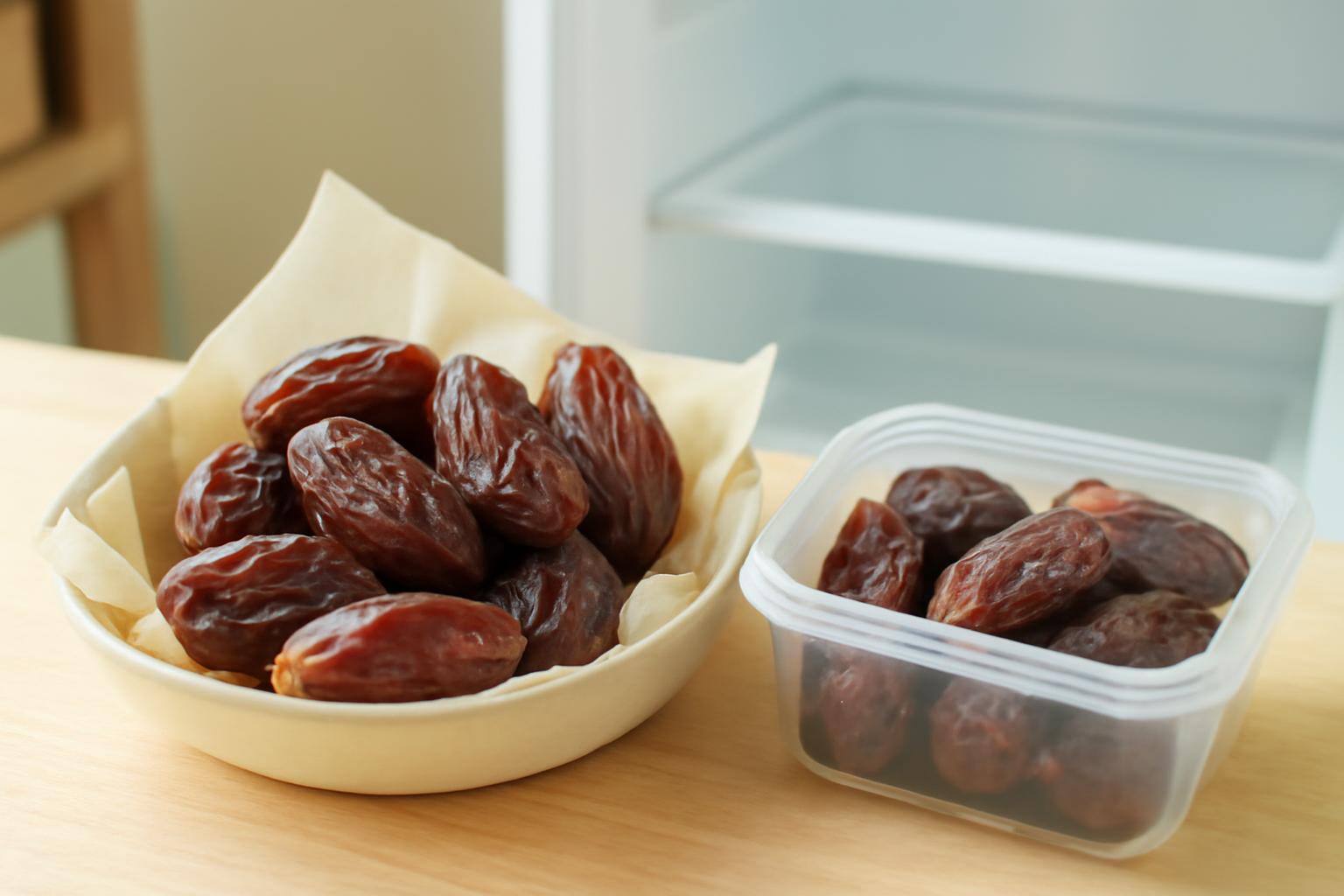
UC Davis reports semi-soft dates such as Deglet Noor may keep up to one year at 0°C, eight months at 4°C, three months at 15°C and one month at 21°C.
Overview
Most packaged Medjool and semi-dry dates do not need refrigeration when they will be eaten soon and can remain sealed in a cool, dry pantry. Refrigeration is the better choice for longer storage, bulk purchases, or warm and humid conditions. Product labels and perishable fillings can change the recommendation.
Natural Delights supports pantry storage for Medjool dates intended for quick use, while UC Davis shows that colder temperatures substantially extend the storage life of both soft and semi-soft cultivars. Refrigeration is therefore primarily a way to preserve quality for longer, not a universal requirement for every package.
The practical decision depends on the type and moisture level of the dates, how much was purchased, room conditions, and when the fruit will be eaten. Package-specific directions should take priority over generic advice, particularly when the dates are sold fresh, prepared, or filled.
Pantry, refrigerator, or freezer: how to choose
Choose the storage location by matching it to the expected storage period and household conditions. A pantry is convenient for suitable dates being eaten soon, a refrigerator provides more stable long-term storage, and a freezer is useful for an unusually large quantity or extended storage.
| Storage location | Best fit | Important conditions | Main limitation |
|---|---|---|---|
| Pantry | Packaged Medjool or semi-dry dates intended for short-term use | Keep the package sealed in a cool, dry, dark place. Avoid a pantry that becomes warm or humid. | Heat and humidity can shorten storage life. Soft, moist dates generally deteriorate sooner than drier varieties. |
| Refrigerator | Longer storage, bulk purchases, soft dates, or homes with warm or humid conditions | Use sealed packaging that protects the dates from moisture, condensation, and strong odors. | Generic refrigerator estimates differ by cultivar and source, so the package date and condition of the fruit still matter. |
| Freezer | Long-term storage or a bulk quantity that will not be used soon | Seal the dates well before freezing. Thaw only the quantity needed, either in the refrigerator or at room temperature. | Published duration claims vary, so freezing should not be treated as an unlimited guarantee of peak quality. |
For context, Mighty Medjool recommends refrigeration for larger quantities or warm homes and estimates refrigerated Medjool storage at 6 to 12 months. Natural Delights gives a more conservative estimate of up to 6 months. These are retailer estimates, not universal limits.
Controlled postharvest guidance also varies by cultivar and temperature. UC Davis reports that semi-soft dates such as Deglet Noor may keep for up to one year at 0°C, eight months at 4°C, three months at 15°C, and one month at 21°C. Soft cultivars such as Medjool keep for about half as long under those conditions. Those figures illustrate the effect of temperature, but they do not replace the directions printed on a retail package.
Storage recommendations vary by date type
The most useful distinctions are moisture level and cultivar, not the marketing term printed on the front of the package. Retailers use “fresh,” “semi-dry,” and “dried” inconsistently, so a product’s texture, variety, label directions, and packaging provide better storage clues than any one category name.
Medjool is a soft cultivar. Its comparatively moist, soft texture is one reason it generally has a shorter controlled storage life than semi-soft cultivars. UC Davis identifies Deglet Noor and Halawy as semi-soft dates with longer storage lives than soft Medjool and Barhi dates. For a household reader, that means moist Medjool dates are stronger candidates for refrigeration when they will not be eaten promptly.
Deglet Noor is a semi-soft cultivar and can tolerate longer storage under controlled conditions. A published study of Tunisian Deglet Nour dates examined storage at −18°C, 0°C, 2°C, and 4°C over 3, 6, and 9 months, identifying 2°C as suitable for preserving that cultivar’s quality. The result applies specifically to Deglet Nour under the study conditions, not automatically to every retail date product.
Higher-moisture dates tend to deteriorate faster than drier dates. Bateel similarly distinguishes higher-moisture fresh dates from dry dates and recommends colder storage for longer keeping. When the package gives no clear classification, a conservative approach is to refrigerate very soft, moist dates intended for later use while keeping suitable sealed, drier dates in a cool pantry for near-term use.
Filled or stuffed dates
Filled dates should be stored according to the most perishable ingredient, not according to the plain fruit alone. Bateel notes that dates filled with cream cheese will not keep as long as dates filled with almonds. This comparison supports a condition-based rule, but not one universal storage duration for every filling.
Cheese-filled dates require greater caution than plain dates or dates containing a shelf-stable nut filling. Nut butter, chocolate, or other preparations may also have product-specific requirements that the evidence here does not define. Refrigerate stuffed dates, including those filled with nut butter or cheese, in an airtight container. Follow package or recipe instructions for the applicable storage duration.
Why date shelf-life estimates vary
Shelf-life figures differ because they measure different products under different conditions. Cultivar, moisture content, processing, packaging, temperature, humidity, and the endpoint being measured all affect the result. An estimate for peak softness or flavor is also not necessarily a validated food-safety limit.
The UC Davis postharvest guidance provides the clearest controlled comparison in the evidence. It gives a range of 6 to 12 months at 0°C depending on cultivar, with semi-soft dates lasting longer than soft dates. Its more detailed guidance estimates up to one year at 0°C for semi-soft cultivars and about six months for soft cultivars. The same source recommends −18°C for longer storage and notes that dates can absorb moisture at higher relative humidity unless protected by moisture-resistant packaging.
A study published in LWT adds a cultivar-specific example. Researchers compared Deglet Nour dates stored at −18°C, 0°C, 2°C, and 4°C for 3, 6, and 9 months across two harvest years. They found year-to-year variation in chemical composition and identified 2°C as the preferred temperature among the tested refrigerated conditions. This helps explain why even controlled findings should not be reduced to one number for all dates.
Retail estimates are much less consistent. Natural Delights states that refrigerated Medjool dates last up to 6 months, Mighty Medjool gives 6 to 12 months, and freezer estimates across retailers range from roughly one year to as much as three years. These figures may still help with planning, but they are not interchangeable because the products, packages, and quality criteria may differ.
The supplied evidence also does not establish separate, validated limits for opened and unopened retail packages. After opening, keeping the package tightly sealed is supported, but assigning a universal new expiration period is not. The printed storage instructions and best-before date remain the most relevant product-specific checks.
How to store dates properly
Proper storage means controlling exposure to air, moisture, heat, light, condensation, and strong odors. The same handling principles apply whether the dates are placed in a pantry, refrigerator, or freezer.
Use these practical measures:
- Close the original package tightly, or transfer the dates to a sealed container.
- In the pantry, choose a cool, dark, dry location protected from direct sunlight.
- In the refrigerator, keep the container sealed to reduce condensation and odor absorption.
- Keep dates away from onions, garlic, and other strongly scented foods.
- Avoid repeated temperature changes that could encourage moisture to condense on the fruit.
Natural Delights specifically warns that Medjool dates can absorb odors from foods such as onions and garlic. UC Davis likewise notes that rutab- and tamar-stage dates readily absorb aromas and recommends avoiding temperature fluctuations because condensation may encourage decay-causing microorganisms.
Packaging matters most when surrounding air is humid. UC Davis reports that dates can absorb moisture from the air at higher relative humidity unless the container provides a moisture barrier. This is why an unsealed refrigerator container is not automatically better than a properly sealed pantry package. Cold storage works best when paired with appropriate containment.
How to tell whether dates have gone bad
The strongest spoilage signs are visible mold, sour or fermented odors, insects, or severe abnormal deterioration. A date that has merely become firmer or drier may have lost eating quality without necessarily showing the same evidence of spoilage.
Mighty Medjool identifies a fermented or alcoholic smell as a warning sign. Bateel lists mold, small insects, and a strong offensive aroma as evidence that dates have deteriorated. UC Davis also describes yeasty fermentation as a cause of souring in dates with moisture content above 25%, which supports treating an unexpectedly sour or fermented smell as more significant than ordinary drying.
Color and texture need context. The Kitchn recommends discarding dates that have developed mold or become much darker inside or outside. In contrast, Ayoub’s describes drying and hardening primarily as losses of expected flavor and texture rather than automatic evidence that the fruit is unsafe. A firm date with no mold, pests, offensive smell, or abnormal flavor therefore presents a different situation from one showing several spoilage signals together.
The supplied sellers disagree about what to do when only one date in a shared package is moldy. The evidence does not support a definitive instruction to discard only that fruit or automatically discard the entire package. Do not eat the visibly moldy date. Inspect the remaining fruit and packaging carefully, and use the product label or applicable local food-safety guidance when deciding what to do with the rest.
Sugar crystals versus mold
White marks are not automatically mold. Natural Delights explains that a whitish coating on Medjool skin can be crystallized natural sugar, while Mighty Medjool distinguishes dry, powdery sugar crystals from fuzzy or colored mold.
Use several observable traits together. Sugar crystallization is generally dry and powdery and may wipe away easily. Mold is more likely to look fuzzy, appear in colors beyond a simple dry white coating, or occur alongside an unpleasant smell. Location alone is not decisive because either change may appear on the fruit’s surface.
When the mark is ambiguous, color should not be the only test. Check its texture, whether it wipes away like powder, whether growth appears fuzzy, and whether the date smells fermented or offensive. Discard fruit with convincing mold growth or accompanying spoilage signs rather than assuming every pale surface mark is harmless sugar.