
What to Check Before You Buy, Plant, or Eat Moringa Seeds
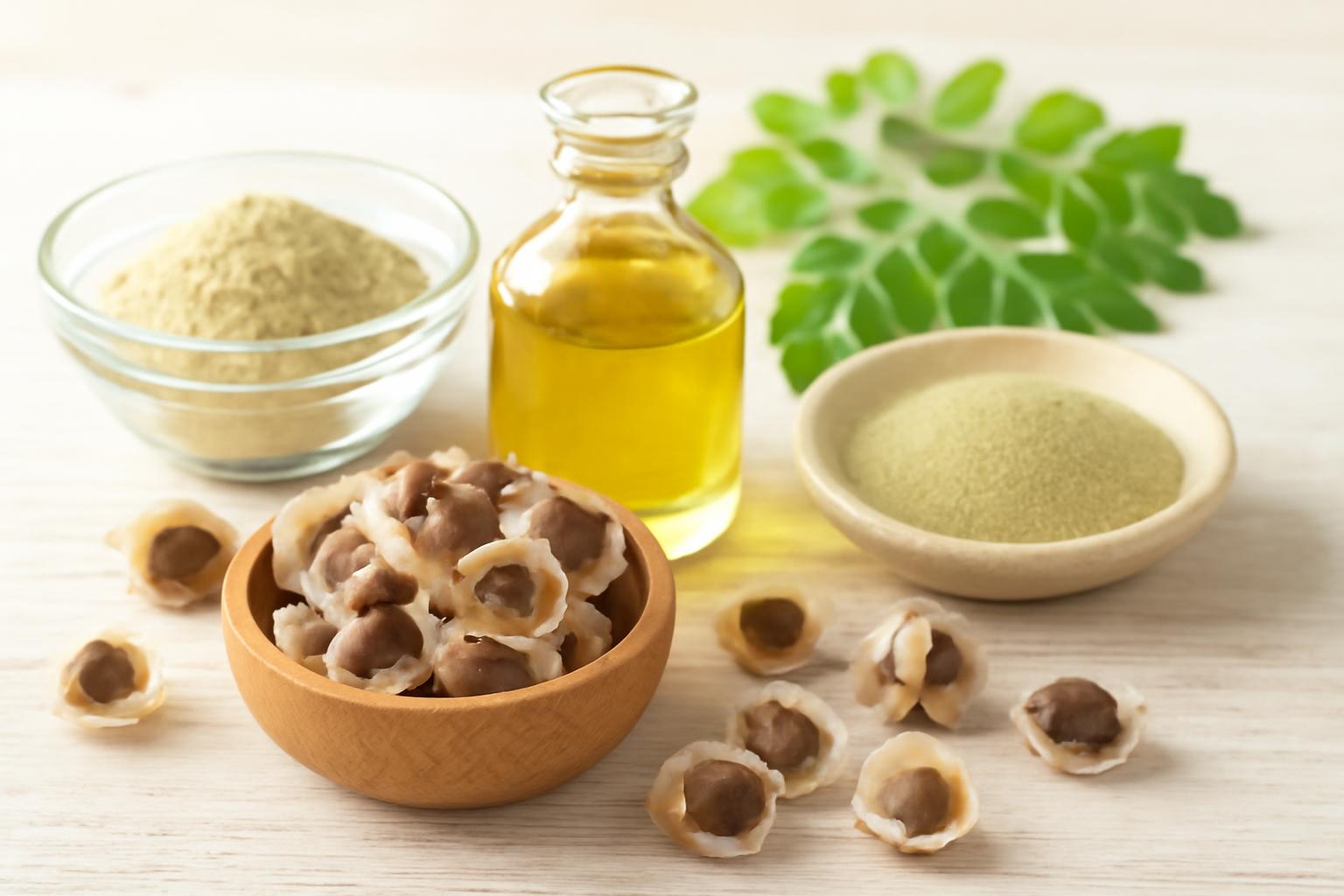
Whole seeds, oil, full-fat flour, and defatted flour are different products, and a packet sold for planting is not automatically documented as food-grade.
Moringa seeds are sold as planting material, promoted as food, pressed into oil, milled into flour, and discussed as a water-treatment coagulant. Those uses require different evidence. A seed packet suitable for sowing is not automatically documented as food-grade, and a nutrient analysis of defatted seed flour cannot tell you whether an old packet will germinate.
For planting, package size and sticker price are only the beginning. Lot age, storage history, origin, and a dated germination test are more informative than badges or customer ratings. For food use, the form and processing method matter, and the available composition data do not establish medicinal benefits or a universally safe serving.
Commercial details below come from the supplied listing-page snapshots. Because no documented retrieval time accompanies those extracts, prices, inventory, package options, taxes, and return terms should be rechecked immediately before publication or purchase.
What Moringa Seeds Are—and Why the Intended Use Matters
Moringa oleifera is a species in the Moringaceae family. Retailers commonly call it the moringa tree, drumstick tree, horseradish tree, or ben oil tree. It is native to northwestern India and associated with tropical and subtropical growing conditions. Common names can help identify listings, but the scientific name is the more reliable purchasing check.
Before comparing products, decide which of three paths applies:
- Buying viable seed for planting. Species identity, lot age, storage, germination testing, and growing conditions matter most.
- Choosing a cultivation system. A container plant, densely sown leaf bed, and widely spaced tree require different amounts of seed and space.
- Evaluating a seed-derived food. Whole seeds, seed oil, full-fat flour, and defatted flour differ in composition and processing.
These categories are not interchangeable. A horticultural packet may contain viable seeds but provide no information about food-grade handling. Oil has a different nutrient profile from the whole seed. Defatted flour has had much of its oil removed, increasing the proportion of protein by weight without making it equivalent to an intact seed.
The same distinction applies to research. Evidence about moringa leaves, leaf powder, roots, bark, or vaguely described “moringa extracts” should not be transferred automatically to seeds. Even seed research must be read closely: an experiment involving isolated oil, fermented flour, or a laboratory extract does not necessarily describe the effects of eating a whole seed.
One marketplace listing advertises its seeds as PKM1. That is a seller description, not genetic verification. The supplied listing does not establish that the seeds are authentic PKM1 or perform better than unspecified Moringa oleifera. Treat named-variety language as a question to investigate, not proof of identity or quality.
Retail Comparison: Quantity, Nominal Cost, and Missing Disclosures
The table is a comparison of the supplied listing-page snapshots, not a live inventory check. “Nominal cost per seed” means package price divided by the advertised or estimated count. It does not account for shipping, tax, dead seed, or seedlings that fail after germination.
| Seller | Species or advertised variety | Package size and approximate count | Listed price | Nominal cost per seed | Stock wording in supplied page | Refund terms shown | Important missing or conflicting information |
|---|---|---|---|---|---|---|---|
| True Leaf Market | Moringa oleifera | 10 g; 1 oz, estimated at about 85 seeds; 4 oz; 1 lb; 5 lb | $5.09; $11.86; $30.16; $90.56; $347.97 | About $0.14 for the 1 oz option, based on the seller’s estimate | Not documented in supplied details | Not stated | No harvest date, origin, dated germination result, or lot-specific viability figure |
| Amazon/Bumble Love Nursery | Moringa oleifera, advertised as PKM1 | 100 advertised seeds | $9.95 | About $0.10 | “In stock” | 30-day refund or replacement | No germination percentage or test date, origin, harvest date, treatment disclosure, traceable certification, or variety verification |
| Moringa Farms | Moringa oleifera; no variety stated | Approximately 90 seeds per ounce; visible 2 oz and 4 oz choices | $15–$25 | Cannot be determined by package size from the displayed range | Not documented in supplied details | Not stated | Additional information also mentions 8 oz, conflicting with the visible selector; no origin, harvest date, certification, or germination result |
| Mary’s Heirloom Seeds | Moringa oleifera | 15, 50, or 100 seeds | Starting at $2.50 | Not dependable because size-specific prices are unclear | “Sold out,” “unavailable,” and backorder wording all appear | Not stated | Unclear availability and price by packet; no dated germination result, origin, or harvest date |
| Onszaden | Moringa oleifera | 10 seeds | €3.50, including stated 21% Dutch VAT subject to checkout adjustment | €0.35 before delivery | Both “In stock” and “The product is not in stock” | Not stated | Contradictory inventory messages; no harvest date, seed origin, or lot germination result |
True Leaf Market’s one-ounce option works out to approximately $11.86 ÷ 85, or $0.14 per nominal seed. The count is an estimate derived from package weight, not a promise that each ounce contains exactly 85 seeds or that every seed will grow. The larger weight options cannot be compared fairly without considering whether the buyer can use or store the quantity before viability declines.
The Amazon listing’s 100 advertised seeds for $9.95 equal approximately $0.10 per nominal seed. That appears cheaper at package level, but the listing provides no dated germination percentage, harvest date, origin, or verification of the advertised PKM1 identity. Its “high germination,” organically grown, and non-GMO descriptions remain seller claims rather than independently documented quality measures.
Moringa Farms displays a $15–$25 range and estimates approximately 90 seeds per ounce. Its visible selector offers 2- and 4-ounce packages, while the additional-information area also refers to an 8-ounce size. Because the displayed range is not clearly tied to each option, a reliable size-specific unit price cannot be calculated.
Mary’s lists three packet quantities with a starting price of $2.50. Dividing $2.50 by the smallest packet would be misleading because the page does not clearly establish which size receives that price. The simultaneous sold-out, unavailable, and backorder language also makes purchasability uncertain.
Onszaden’s €3.50 price for 10 seeds equals €0.35 per advertised seed before delivery. The displayed amount includes 21% Dutch VAT, with the applicable rate subject to checkout adjustment. Currency conversion would be necessary for comparison with US-dollar listings, and the contradictory inventory messages require direct confirmation.
There is no durable “best value” winner. A defensible comparison would require delivered prices checked at the same time, including shipping, taxes, and currency conversion, followed by a measured germination result from each current lot. The cheapest nominal seed can become the most expensive viable seed if it is old or poorly stored.
Retail ratings do not resolve that uncertainty. Reviewers use different temperatures, moisture levels, soils, and storage practices. Reviews can identify questions worth asking, but neither a high average rating nor one successful report functions as a controlled, dated germination test.
A Buyer Checklist Focused on Verifiable Seed Quality
A useful listing should help you assess the seed lot, not merely describe the species. Before ordering, ask the seller for:
- Species confirmation: Is the product specifically Moringa oleifera?
- Named-variety documentation: If the packet says PKM1 or another variety, what records support that identity?
- Harvest or packing date: When were the seeds collected or sealed?
- Origin: In what country or region was the seed grown?
- Storage history: Was it stored in cool, dry conditions?
- Seed treatment: Has it been coated, chemically treated, disinfected, scarified, or otherwise processed?
- Latest germination test: When was the test performed, how many seeds were tested, and what percentage germinated?
- Certification: Can the seller provide traceable records for “organic” or “non-GMO” claims?
- Quantity basis: Is the packet an exact count, a minimum count, or a weight converted to an estimated count?
- Commercial terms: What are the current stock status, shipping cost, replacement policy, refund conditions, and bulk-order terms?
The distinction between count and weight matters when planning a bed. Seller estimates in the comparison cluster around the high eighties per ounce, which is adequate for rough planning but not an exact conversion. Individual seed weights vary, so a package sold by weight may contain more or fewer seeds than estimated.
Certification language also requires care. A product page can say “organically grown,” “organic,” or “non-GMO” without displaying an independently traceable certificate. If certification matters, request the certifying organization, certificate number, covered product or operation, and validity dates rather than relying on a badge.
When provenance and viability are undocumented, a modest test order is generally more informative than an immediate bulk purchase. Bulk pricing matters only if enough of the seed is viable and the buyer has an appropriate climate or protected growing setup.
A simple lot check
A small home test can provide a rough estimate for one packet:
- Select 10 seeds without deliberately choosing only the largest.
- Sow them at the same depth in the same medium.
- Keep all 10 under the same temperature, light, and moisture conditions.
- Count the seeds that have germinated after 14 days.
- Multiply the count by 10.
If seven seeds germinate, the small-sample result is 70%. If three germinate, it is 30%. This is simple arithmetic, not a laboratory certification.
A 10-seed trial has substantial limitations. It characterizes only that sample under that setup. It does not establish seller-wide quality, separate dead seed from unsuitable conditions, or diagnose why a particular seed failed. Even so, it can help determine whether to sow the remainder of a packet or contact the seller about a replacement.
How to Germinate Moringa Oleifera Seeds
A cautious starting method is to sow moringa seeds approximately 2–2.5 cm deep in a warm, well-drained medium kept moist but not saturated. That range reconciles a scholarly review’s approximately 2 cm planting depth with a retailer’s one-inch guidance. A review reports germination in about 5–12 days, while seller guidance extends the practical window to approximately 3–14 days; neither range guarantees emergence for every viable seed. The review describes the species’ growing region, planting depth, and reported germination period.
1. Decide whether to soak
Soaking is an optional retailer-recommended method, not a guarantee of improved germination. The supplied seller guidance suggests either an overnight soak in lukewarm water or soaking for up to 24 hours. If seeds are soaked, the guidance supports planting them promptly rather than extending the soak indefinitely.
When comparing two lots, use the same preparation method for both. Changing soaking time, depth, temperature, and medium simultaneously makes the outcome difficult to interpret.
2. Use a free-draining medium
The supplied retailer guidance recommends sowing mix, sandy soil, or sandy loam. The medium should retain moisture around the seed without remaining waterlogged, and any container used for sowing should allow excess water to drain.
“Moist” should not be interpreted as continuously saturated. Excess water can make it impossible to tell whether poor emergence reflects seed viability or unsuitable growing conditions.
3. Provide warmth
One retailer recommends a germination temperature of 20–25°C and a consistently moist but not wet medium. That is a practical seller recommendation rather than proof of one universally optimal temperature. It is nevertheless consistent with the species’ association with tropical and subtropical conditions. Onszaden provides the temperature, soaking, soil, light, and moisture guidance used here.
Conditions should be observed where the seed container is located rather than inferred solely from a thermostat elsewhere in the building.
4. Allow for variable timing
A seed that has not emerged at the end of a reported range is not automatically dead, but continued waiting does not prove that it remains viable.
If emergence is poor, review the factors documented by the available guidance: seed age where known, temperature, depth, drainage, and moisture consistency. The supplied evidence does not support a specific fungicide or detailed damping-off treatment protocol.
5. Separate germination needs from mature drought tolerance
Retail descriptions often call moringa drought tolerant. That label should not be used to infer that germinating seeds or newly established seedlings should be allowed to dry out. The supplied germination guidance calls for consistent moisture without waterlogging, while drought-tolerance descriptions concern the plant more generally.
Choose a Growing System: Container, Leaf Bed, or Full-Size Tree
Moringa spacing recommendations vary because growers are pursuing different outcomes. Someone repeatedly cutting tender leaves can use a dense system. Someone seeking a larger tree or pod production needs more room. A container grower may prioritize mobility and frost protection rather than maximum size.
Container or seasonal plant
Containers can be practical where moringa must be moved or protected before freezing weather. Use a free-draining medium and plan the plant’s protected location before cold conditions arrive.
Moringa should be treated as frost sensitive. One retailer lists a minimum temperature of 0°C while separately warning that plants in temperate climates need frost protection. That specification is not evidence that the species tolerates frost. The same listing says the tree can reach up to 12 meters in nature, but that is contextual seller information, not a forecast for a container-grown plant.
Intensive leaf bed
For leaf production, True Leaf Market recommends plants 4–6 inches apart, with rows approximately 3 feet apart. This is a production-oriented density, not spacing intended to let every seedling develop into a full-sized tree. The retailer’s planting page provides these intensive leaf-production measurements.
Moringa Farms describes other intensive arrangements, including planting four or five seeds per irrigated hole and placing several hundred seeds in a 4-by-8-foot raised bed for repeated harvest. These are seller-described methods, not independently compared cultivation systems.
Dense sowing changes the economics of an order. A packet sufficient for one container may be inadequate for an intensive leaf bed. Conversely, buying hundreds of seeds makes little sense if the grower has room to protect only one container during winter.
Widely spaced tree
The same seller contrasts this system with its intensive methods. Moringa Farms describes both the widely spaced and dense planting approaches.
Seller-stated mature-size descriptions provide context but should not be treated as promises. One listing gives a potential height of approximately 25–35 feet, while another says the species can reach 12 meters in nature.
Light and climate
The listings do not establish one universally optimal exposure. The Amazon page specifies partial sun, while Onszaden recommends full sun. The sources do not resolve whether those differences reflect seedling stage, local heat, container conditions, or seller preference.
Avoid basing a purchase on promised maturity time, rapid growth, drought performance, pod yield, or final height. Even when a listing supplies such figures, actual performance depends on lot quality, climate, season length, water, root space, and management.
Nutrition: Why One Number Cannot Describe Every Moringa Seed
Moringa seeds can contain substantial protein and oil, but no single percentage represents every seed source or ingredient form. A 2019 review found marked variation among the studies it summarized.
For whole seeds, the tabulated studies reported approximately:
- 18.9% to 37.2% protein
- 13.4% to 45.8% lipids
The review abstract reported mean values of 19% protein and 31% lipids, but those averages should not be applied as label values to an untested packet. Defatted seed material—what remains after much of the oil is removed—had a reported protein range of approximately 32% to 62.8%. Removing a large portion of one component increases the percentage represented by what remains. The 2019 review summarizes whole-seed, oil, and defatted-flour composition.
The review also identifies fiber, vitamins, minerals, micronutrients, flavonoids, saponins, sterols, phytates, and trypsin inhibitors in seed material. The presence of those compounds does not by itself establish either benefit or harm at an unspecified intake. Quantity, bioavailability, processing, and the overall diet all matter.
Methionine, lysine, valine, and tryptophan are identified as limiting amino acids. A seed ingredient’s protein content therefore should not be converted into a claim that it supplies nutritionally complete protein in every use.
Moringa seed oil has been reported to contain oleic, linoleic, and linolenic acids. Identifying those fatty acids is a compositional observation; it does not demonstrate that the oil treats high cholesterol or prevents cardiovascular disease.
Whole seeds from one growing region need not match seed flour from another, and neither necessarily matches a commercial oil.
Protein and lipid percentages are also insufficient for a dependable calorie calculation. A product-specific estimate would require a defined serving weight and fuller composition data, including the remaining digestible components. Applying review averages to an unlabeled handful would produce a speculative value rather than a reliable calorie count.
Food Processing, Flavor, and Safety Uncertainty
The question “Can moringa seeds be eaten?” is too broad to answer without identifying the product form. At minimum, distinguish among:
- Whole seeds, which retain their original oil and other constituents
- Seed oil, which is primarily the extracted lipid fraction
- Full-fat flour, made without removing most of the oil
- Defatted flour, which contains less oil and a higher proportion of protein by weight
Research has investigated roasting, boiling, germination, fermentation, and defatting. These studies show that processing changes the ingredient; they do not establish a universal home recipe, serving size, or medical dose.
Reviewed studies found increased measured amino-acid levels after fermentation and germination. That compositional result should not be translated into a claim that eating fermented or germinated seeds produces superior clinical outcomes.
Defatted seed flour has been studied in cakes, cookies, burgers, and infant porridges. Lower substitution levels were generally more acceptable in formulated foods, while higher inclusion could increase bitterness. More of an ingredient does not necessarily make a food more palatable, even if the ingredient contributes protein or oil. The seed-nutrition review discusses processing methods, food applications, and acceptability.
Phytates and trypsin inhibitors may be nutritionally relevant, but the supplied evidence does not quantify their effect in a typical serving. It also does not establish how much boiling, roasting, germination, or fermentation would reduce them in a particular home preparation.
Most importantly, the evidence does not establish:
- A safe seed-specific serving size
- A safe frequency or duration of use
- One universally safe preparation method
- That raw seeds are suitable for everyone
- That planting seed meets food-grade standards
- That processing removes all potentially concerning constituents
A medically reviewed consumer source illustrates the unresolved safety picture. It recommends choosing leaf products because roots, bark, and seeds may contain higher concentrations of toxic compounds, yet elsewhere reports no known side effects associated with leaves and seeds. Those statements do not establish seed safety. The source also raises possible interactions involving levothyroxine, diabetes medicines, blood-pressure medicines, and drugs processed by the liver, while noting that more research is needed. Its overview discusses these cautions and the limits of the evidence.
Pregnant or breastfeeding readers, people with health conditions, and anyone taking medication should consult a qualified healthcare professional before consuming moringa seed products. The medication concerns above are general moringa cautions from a consumer health source, not demonstrated seed-specific interactions or proof that an interaction will occur.
CaloriePages content is for general informational purposes and does not constitute medical or dietary advice. Its terms advise consulting a registered dietitian or physician before changing your diet, especially if you have a health condition. Read the informational-use notice.
Health and Water-Treatment Claims: What the Evidence Does Not Prove
Composition and treatment evidence answer different questions. Finding protein, oil, fatty acids, flavonoids, or other compounds in moringa seeds does not prove that eating them prevents or treats disease.
The supplied sources do not establish anti-inflammatory, antiviral, antifungal, antidepressant, anticancer, antidiabetic, antimicrobial, or cholesterol-lowering effects from moringa seeds in humans. Some sources discuss laboratory bioactivity, animal research, traditional use, or moringa generally. Others focus mainly on leaves, powders, or extracts. None of those categories proves therapeutic benefit from whole seeds.
This distinction also applies to dosage. Even if a laboratory study identifies an effect from an extract, it does not follow that a corresponding quantity of whole seed is effective or safe. Extraction changes concentration and exposure, while the composition of the seed itself varies.
Reviews also describe Moringa oleifera seed as a natural coagulant used in water treatment. The supplied review does not provide a validated household dose, contact time, treatment sequence, contaminant-removal guarantee, or proof that the resulting water is potable. The review identifies moringa seed’s coagulant use but does not establish a household potability protocol.
Accordingly, clearer-looking water should not be treated as proven safe based on this evidence. The appropriate treatment for questionable water depends on the actual hazards, and the evidence supplied here does not support prescribing a universal moringa-based procedure.
The evidence is strongest when kept within its boundaries:
- Cultivation: Practical guidance exists, but much of it is retailer-derived and should be adapted to local conditions.
- Nutrition: Scientific reviews support the conclusion that seeds can contain substantial protein and oil, but composition varies widely.
- Food use: Several processing methods and formulated foods have been studied, but no universal serving or preparation has been established.
- Health: Seed-specific therapeutic efficacy and dosing in humans remain unproven.
- Water treatment: Coagulant use is documented, but potability and a validated household protocol are not established by the supplied evidence.
Frequently Asked Questions
How long do Moringa oleifera seeds take to germinate?
Reported windows overlap: one retailer gives approximately 3–14 days, while a scholarly review reports about 5–12 days. These are practical expectations, not guarantees. Old seed, poor storage, unsuitable temperature or moisture, and low lot viability can delay or prevent emergence.
For a small home lot check, keep conditions consistent and assess the sample after 14 days. A poor result should prompt a review of depth, temperature, drainage, moisture, and any available storage history.
How many moringa seeds are in one ounce?
One seller estimates approximately 85 seeds per ounce, while another gives a similar estimate in the high eighties. Treat either figure as a planning estimate rather than an exact conversion.
At the 85-seed estimate, a 4-ounce package would nominally contain about 340 seeds. Actual counts can differ because individual seed weights vary, and an estimated count says nothing about how many will germinate.
Can Moringa oleifera seeds be grown in containers or cold climates?
Moringa can be started and managed in a container, but the supplied retailer information describes it as frost sensitive. In a cold climate, movable containers or seasonal cultivation may therefore be more practical than expecting an unprotected outdoor tree to survive winter.
Use a free-draining medium, provide the warmth described in the germination guidance, and arrange protection before freezing conditions. Do not interpret a retailer’s 0°C minimum specification as proof of frost tolerance.
Are Moringa oleifera seeds safe to eat?
The available evidence does not establish universal safety, a seed-specific serving size, or one preparation suitable for everyone. Whole seeds, oil, full-fat flour, and defatted flour are different products, and a packet sold for planting is not automatically documented as food-grade.
Safety guidance is also internally uncertain: the medically reviewed source cited above warns that seeds may contain higher concentrations of toxic compounds while separately reporting no known seed side effects. People who are pregnant or breastfeeding, have health conditions, or take medication should seek individualized professional advice before consuming seed products.
Can moringa seeds make contaminated water safe to drink?
The supplied evidence does not establish that they can. Reviews describe moringa seed as a natural coagulant, meaning it can be used in a clarification process involving particle aggregation. They do not provide a validated household recipe, contaminant-removal guarantee, or proof that clarification makes water potable.
Do not infer safety from improved appearance alone. The appropriate response to questionable water depends on the hazards involved, which are not determined by moringa treatment or visual clarity.
A Practical Decision Framework
For planting, prioritize species identity, a dated germination result, harvest or packing date, origin, storage history, seed-treatment information, and climate fit. Compare delivered cost only after accounting for shipping, taxes, currency conversion, and the proportion of the current lot that actually germinates.
For food use, first identify whether the product is a whole seed, oil, full-fat flour, or defatted flour. Confirm that it was sold and handled as food rather than merely packaged for planting. Recognize that nutrient composition varies and that the available evidence does not establish a universal serving, preparation, frequency, or therapeutic dose.
For health or water-treatment claims, stay within the evidence. Retailer language does not prove medical efficacy, and seed-based coagulation does not prove that water is potable. The most defensible purchase is not the packet with the largest promise; it is the product whose identity, handling, intended use, and quality can be verified.