
When Protein Ends a Fast—and What That Actually Means
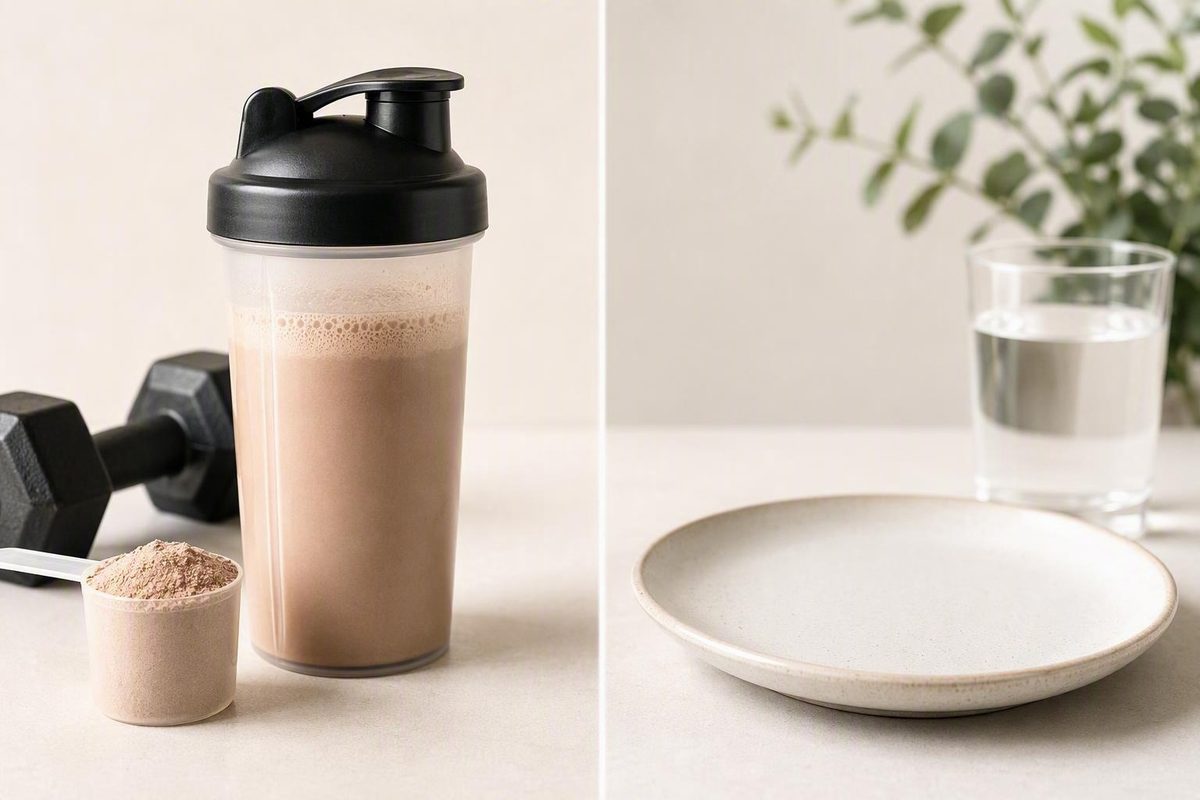
Under a strict calorie-free rule, a protein shake ends the fasting window. It does not erase completed fasting hours or necessarily end ketosis.
The short answer: yes, a protein shake breaks a strict fast
Under a strict no-calorie definition of intermittent fasting, a conventional protein shake breaks the fast. Protein powder supplies calories, so the fasting window ends when you consume it.
Mixing the powder with water does not change that answer. Water adds no calories, but it does not cancel the calories in the powder. The same applies to protein coffee: black coffee may fit a calorie-free fasting window, but adding protein powder makes the finished drink caloric. Nebraska Medicine applies this calorie-based definition to protein coffee and 16/8 fasting.
This answer applies to ordinary time-restricted eating when the fasting period is intended to contain no calories. On a 16/8 schedule, for example, a person might eat during an eight-hour window and avoid calories during the remaining 16 hours. A shake consumed during those 16 hours ends that fasting window.
It does not erase the hours already completed. If you stop eating at 8 p.m. and drink a shake at 10 a.m., you still completed 14 hours without caloric intake. The shake begins your eating period at 10 a.m.; it does not retroactively eliminate the preceding fast.
The technical answer should also be kept separate from broader physiological questions. Consuming calories is straightforward to identify. Whether a particular shake changes ketosis, appetite, later food intake, or proposed cellular processes by a specific amount is a different—and often less certain—question. An insulin response alone does not prove that every effect associated with fasting stops completely and instantly.
The practical rule is:
- For a strict calorie-free fast: save the shake for the eating window or use it to end the fast.
- For a modified fasting plan: follow that plan’s stated calorie and timing rules.
- For weight management or training: consider the shake’s calories, ingredients, timing, and place in the overall diet rather than treating fasting status as the only relevant factor.
Why water-only, zero-sugar, and low-carb shakes still count
“Sugar-free” and “calorie-free” are not interchangeable.
A shake can carry a zero-sugar label while still supplying calories from protein or fat. Similarly, “low carb” and “keto-friendly” describe carbohydrate content or how a product is positioned; neither term establishes that the drink contains no calories.
This principle covers the main categories of protein drinks:
- Whey protein mixed with water
- Casein mixed with water
- Soy, pea, rice, hemp, or another plant-protein powder
- Clear protein drinks
- Protein coffee
- Collagen and other amino-acid-containing powders
- Ready-to-drink protein beverages
If a serving supplies protein and calories, it breaks a strict calorie-free fast. A low-carbohydrate product may have different implications for ketosis than a sugar-heavy drink, but it remains caloric. Healthline likewise distinguishes technically breaking a fast from remaining in ketosis.
Ready-to-drink shakes may also contain milk, oils, carbohydrates, or other caloric ingredients. Those additions can raise the drink’s total energy content, but they are not necessary for the answer to be “yes”: the protein powder already contributes calories.
Appearance and texture are not reliable guides. A transparent “clear protein” drink is not calorie-free merely because it looks like flavored water. Nor do terms such as “lean,” “clean,” “fasting-friendly,” or “ketogenic” settle the question.
Use the nutrition information rather than the front-of-package marketing. Check:
- Serving size: Does the panel refer to one scoop, two scoops, half a bottle, or the whole bottle?
- Calories per serving: Account for the number of servings actually consumed.
- Protein: Protein confirms that the product is not simply noncaloric flavored water.
- Total carbohydrate: This includes more than sugar alone.
- Added sugar: Useful for comparing formulas, but not a test of whether the drink is calorie-free.
- Total fat: Fat can add substantial energy to a ready-to-drink shake or smoothie.
- Product category: Is it a protein supplement, snack shake, or formulated meal replacement?
- Ingredients added during preparation: Milk, yogurt, fruit, nut butter, cream, and caloric sweeteners change the finished drink.
There is no supported universal rule under which an arbitrary number of calories “does not count” during a strict fast. Some named modified-fasting programs permit limited intake, but that allowance belongs to those protocols. It does not turn a conventional shake into a calorie-free drink.
Breaking a fast is not the same as ending ketosis or preventing weight loss
Four different ideas are often compressed into the phrase “break a fast”:
- Consuming calories
- Remaining in ketosis
- Managing total energy intake over time
- Influencing proposed cellular processes such as autophagy
For a fast defined as calorie-free, the first point is clear: a protein shake supplies calories and ends the fasting window. The other questions cannot be answered from that fact alone.
Ketosis and fasting are not identical. A caloric, low-carbohydrate drink can technically break a fast without necessarily ending ketosis at that moment. However, the available evidence here does not establish how any particular shake will affect an individual’s ketone production. That depends on the actual product and cannot be inferred merely from the word “keto.”
This distinction does not make a low-carbohydrate shake fasting-compatible. It means only that “calories were consumed” and “ketosis ended” are separate claims.
Long-term weight change is also a separate issue. A shake contributes to total intake, but one shake does not determine a long-term outcome by itself. Its practical role differs depending on whether it replaces another food, supplements an existing meal, or changes later intake. Ending a fast earlier than planned does not automatically make weight loss impossible, just as completing a long fasting window does not guarantee weight loss.
Claims about autophagy require particular caution. The supplied evidence does not establish a universal human calorie or protein threshold at which autophagy switches on or off. Amino acids indicate that nutrients have been consumed, but that does not justify claiming that a small serving immediately stops every related process throughout the body.
The useful conclusions are therefore limited:
| Goal or protocol | Does a conventional shake technically fit? | What can be concluded confidently? | What remains uncertain or individual? |
|---|---|---|---|
| Strict calorie-free fasting | No | A shake containing protein and calories ends the fasting window when consumed. | The magnitude and duration of downstream physiological effects. |
| Modified fasting protocol | Possibly | The named protocol’s rules determine whether limited caloric intake is allowed. | Whether a particular product fits without reviewing both the protocol and label. |
| Weight-management scheduling | It may fit the overall plan, but it still ends the fast | The shake becomes part of total intake; ending a fast does not make weight loss impossible. | Whether the shake replaces food, improves adherence, or increases total intake. |
| Ketosis | It breaks a strict fast but may not necessarily end ketosis | Fasting status and ketosis are not interchangeable. | What a particular shake does to an individual’s ketosis. |
| Autophagy-focused fasting | It does not fit a strict calorie-free approach | Protein and amino acids mean nutrients have been consumed. | A universal human dose at which autophagy starts, stops, or changes by a defined amount. |
Some modified regimens allow limited calories on specified restricted days. That is a protocol-specific rule, not a loophole for a strict fast. Follow the named plan rather than importing its allowance into a calorie-free 16/8 window. The Healthy’s overview similarly distinguishes strict fasting from modified protocols.
What can you drink during a strict fasting window?
Under the calorie-free definition used here, the simplest options are:
- Plain water
- Plain carbonated water
- Black coffee
- Unsweetened tea
“Plain” matters. Adding protein powder, milk, cream, sugar, honey, or another caloric ingredient changes the finished drink.
Protein coffee is a clear example. Black coffee may fit a calorie-free window. Coffee containing whey, casein, plant protein, collagen, or another caloric powder does not.
Flavored drinks and supplements require a label check. Do not assume that “zero sugar,” “keto,” “clean,” or “fasting-friendly” answers the calorie question. Review the serving size, calorie declaration, ingredient list, and number of servings in the bottle.
This is a classification based on calorie status. It does not mean that every noncaloric ingredient has identical effects on hunger, taste preferences, digestion, glucose response, or adherence. Those are separate questions and may matter when choosing a personal fasting approach.
Where protein shakes fit in an intermittent-fasting schedule
If maintaining a strict fasting window is the priority, put the shake inside the eating window. It can serve as:
- The first intake that ends the fast
- Part of a meal
- A snack between meals
- A post-workout option
- A supplement to a meal that would otherwise be low in protein
Consider an eating window from noon to 8 p.m. A shake consumed at noon, 3 p.m., or 7:30 p.m. falls within that window. A shake consumed at 9 a.m. ends the fast at 9 a.m. and moves the start of that day’s eating period earlier.
There is nothing inherently inconsistent about using a shake to end a fast. It simply means the eating window has begun. If maintaining an eight-hour eating period still matters, an earlier start may require an earlier finish.
Protein shakes are conveniences, not fasting requirements. Eggs, dairy foods, fish, meat, soy foods, beans, lentils, and other foods can also contribute protein. A shake may be useful when work, travel, training, appetite, or food preparation makes a conventional meal inconvenient.
For many people, total protein intake and the overall dietary pattern may matter more than drinking a shake at one exact minute. Timing can still be adjusted around training and practical needs, but the available evidence does not support a single compulsory shake schedule for everyone. Simple’s medically reviewed guidance likewise places shakes inside the eating window and treats them as optional.
Avoid assigning one universal protein target. Needs vary with body size, age, activity, training demands, total energy intake, food choices, and health status. It is also inaccurate to reduce protein use to a fixed per-meal “absorption limit”; digestion, absorption, and use for a particular purpose are different questions.
A workable schedule can be built in three steps:
- Define the rule. Decide whether the fasting window is strictly calorie-free or governed by a named modified protocol.
- Place regular meals first. Identify where practical, balanced meals fit.
- Add a shake only when it solves a problem. It might fill a gap after training, during a commute, or between meals, but fasting itself does not make powdered protein necessary.
Fasted workouts: choose between fasting purity and earlier protein
Training before the eating window creates a practical tradeoff rather than one universally correct answer.
Option one: preserve the strict fast. Finish the workout, continue with calorie-free drinks, and wait until the eating window opens before consuming protein.
Option two: consume protein after training. Drink the shake and accept that the eating window starts at that time. This prioritizes earlier nutrition over the original fasting endpoint.
The choice may reasonably take account of:
- Workout intensity and duration
- Strength, endurance, or competition goals
- Recovery demands
- Time until the next meal
- Comfort and performance while training without food
- Ability to meet energy and protein needs later
- Work, sleep, and family schedules
- The importance placed on preserving the fasting window
The evidence supplied for this article does not establish a mandatory narrow post-workout period in which everyone must drink a shake. It also does not prove that delaying protein by a specified number of hours is harmless for every athlete. A walk, an ordinary gym session, and prolonged high-intensity training should not automatically receive identical advice.
Instead of relying on an unsupported physiological promise, adjust the schedule:
- Move the eating window earlier on training days.
- Train closer to the start of the existing window.
- Use the shake as the first intake after training and close the eating window earlier.
- Plan protein-containing meals across the eating period.
- If training support matters more than fasting purity, deliberately end the fast rather than searching for a non-fast-breaking protein product.
Competitive athletes and people with demanding or individualized performance goals should seek guidance from a qualified sports dietitian or appropriate sports-medicine professional. General fasting guidance cannot account for a complete training plan, recovery status, medical history, and competition schedule.
How to use a shake to break the fast without mistaking it for a complete meal
A protein shake can be the first intake after fasting. Whether it is also an adequate meal depends on its formulation.
A basic protein powder is generally intended primarily to supply protein. Mixed with water, it may provide little fiber, fat, carbohydrate, or micronutrient variety. A meal replacement is a different product category designed and labeled for a broader nutritional role.
Before treating a shake as a meal, review:
- Total calories
- Protein, carbohydrate, and fat
- Fiber
- Vitamins and minerals
- Serving size
- Ingredient list
- Preparation instructions
- Whether it is described as a protein supplement or meal replacement
Many ordinary shakes primarily supply protein and should not automatically be treated as complete meals. Welltech’s fasting guide makes the same distinction and advises against long-term reliance on shakes alone.
Two practical patterns are available:
1. A basic shake with a balanced meal
Drink protein powder mixed with water or another chosen liquid, then eat a meal containing foods that meet the rest of your nutritional needs. The shake provides convenience without being expected to replace the whole meal.
2. A more substantial smoothie
Combine the protein with foods suited to your needs and preferences. Fruit, chia seeds, yogurt, oats, or nut butter are possible additions. Depending on the ingredients, these can add fiber, fat, carbohydrate, energy, and micronutrient variety.
These additions are optional. Fat and fiber may make the drink more substantial or satisfying for some people, but they are not required to break a fast. Protein alone already ends a strict calorie-free fasting window.
Ordinary protein shakes should not become the sole long-term diet unless a qualified professional has reviewed the exact formulation and plan. A high protein number does not by itself establish that a product supplies adequate overall nutrition.
Amino-acid supplements, special fasting rules, and safety limits
Branched-chain amino acids, or BCAAs, are not a calorie-free workaround. They are amino acids and are inconsistent with a strict no-calorie fasting window. If preserving that window is the goal, place them inside the eating period.
That conclusion should remain narrow. The supplied material does not establish the dose-specific effects of a small BCAA serving on insulin, ketosis, fat oxidation, or human autophagy under every condition. BCAAs are also not nutritionally identical to a complete protein shake, so claims about one should not be mapped directly onto every effect of the other. A supplement manufacturer’s discussion acknowledges both that BCAAs technically break a strict fast and that dose-specific metabolic effects remain uncertain; its commercial interest should be kept in mind. See the BCAA fasting discussion.
Different uses of the word “fasting” must also remain separate:
- Medical tests, anesthesia, surgery, and procedures: Follow the treating clinician’s or facility’s instructions exactly. Do not substitute intermittent-fasting rules for procedure-specific directions.
- Religious fasting: Check the rules with an appropriate authority in the relevant tradition.
- Modified fasting: Follow the named protocol’s calorie and timing rules.
- Prolonged fasting: Do not treat general time-restricted-eating guidance as individualized clinical advice.
Informational-only note: Fasting may not be appropriate for every person or circumstance. Anyone with diabetes or blood-sugar concerns, medication-related questions, pregnancy or breastfeeding, an eating-disorder history, kidney disease, or another health condition should consult a physician or registered dietitian before beginning or materially changing a fasting plan. General fasting sources in the evidence pack also recommend professional consultation for health conditions and individualized concerns. CaloriePages separately states that its content is general information rather than medical or dietary advice. Read the site’s health-information notice.
Source quality matters here. Several widely available articles about protein and fasting are published by companies selling protein powders, amino-acid supplements, fasting apps, meal replacements, or weight-management services. Such pages can document how those publishers define fasting or describe their products, but repetition among commercially interested sources is not independent scientific confirmation. This is especially important when assessing precise claims about autophagy, insulin thresholds, workout timing, or a supposedly ideal shake.
The durable decision rule is simple: if the goal is a strict calorie-free fast, save the protein shake for the eating window or use it to end the fast. Water, zero-sugar labeling, and low carbohydrate content do not remove the calories supplied by protein. At the same time, ending the fasting window does not automatically end ketosis, prevent weight loss, or erase the value of the preceding calorie-free hours. Match the timing to the actual protocol, training schedule, and health context—and let clinician, facility, or religious instructions take priority when applicable.
Does protein powder mixed only with water break a fast?
Yes. Under a strict calorie-free definition, protein powder mixed with water breaks the fast because the powder supplies calories. Water adds none, but it does not cancel the powder’s energy content.
The fast ends when you consume the shake. The calorie-free hours completed beforehand still occurred.
Does a zero-sugar or keto protein shake break a fast?
Yes, if it contains protein and calories. A zero-sugar label does not establish that a product is calorie-free, and “keto” or “low carb” does not mean “noncaloric.”
Check the nutrition panel, serving size, and ingredients rather than relying on marketing terms.
Can a protein shake break a fast without stopping ketosis?
Potentially. Breaking a calorie-free fast and leaving ketosis are separate questions. A caloric shake ends the strict fast, but the evidence here does not establish what every low-carbohydrate shake will do to every person’s ketosis.
That uncertainty does not make the shake fasting-compatible; it only means the two outcomes should not be treated as identical.
Do BCAAs break a strict fast?
Yes. BCAAs are amino acids and are inconsistent with a strict calorie-free fasting window.
That answer does not establish an exact dose at which ketosis, fat oxidation, insulin, or autophagy changes by a defined amount. It means only that BCAAs are not a zero-calorie substitute for remaining fully fasted.
Can I use a protein shake as the first meal after fasting?
Yes. A shake can end the fast and may be convenient after training, during a commute, or when a conventional meal is not immediately available.
Whether it is a complete meal depends on the formulation. Protein powder and water may supply substantial protein while providing little fiber, fat, carbohydrate, energy, or micronutrient variety. Check the full label, then either pair a basic shake with a balanced meal or add suitable foods when a more substantial smoothie fits your needs.