
Which Protein Powder Fits Your Goal—and What Does the Label Actually Show?
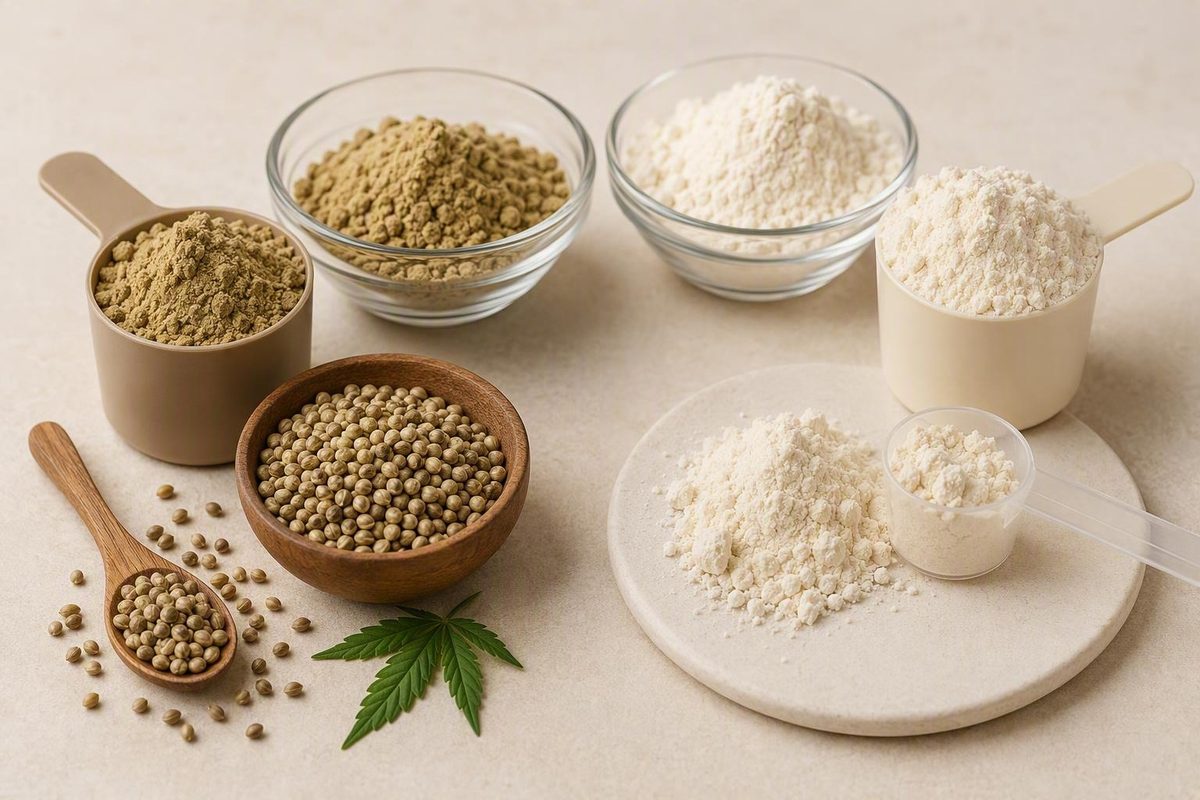
The short answer: choose by goal, not by a universal winner
Neither hemp protein nor whey protein is best for everyone. Whey generally fits shoppers who prioritize concentrated protein and muscle-focused use. Hemp fits vegan or dairy-free diets, milk-protein avoidance, and people who want a powder that retains fiber and seed-derived fats.
| Your main priority | Usually the better fit | Why |
|---|---|---|
| More protein from less powder | Whey | Generally more protein-dense by weight |
| Muscle-focused use | Whey | More leucine and stronger supporting research, although direct hemp-versus-whey trials are lacking |
| Vegan eating | Hemp | Plant-based; whey comes from milk |
| Milk-protein avoidance | Hemp or another verified non-dairy powder | Whey isolate and hydrolysate remain milk proteins |
| More fiber in the powder | Hemp | Many hemp powders retain substantial seed fiber |
| Low appetite or a small shake | Whey | A smaller amount often supplies the intended protein dose |
| Lactose intolerance | Hemp or a low-lactose whey isolate | Suitability depends on residual lactose and individual tolerance |
| Milk-protein allergy | A verified non-dairy powder | Low lactose does not make whey milk-free |
| Protein needs already met through food | Possibly neither | Powder is mainly a convenient supplement |
Lactose intolerance and milk-protein allergy require different decisions. Whey may cause digestive symptoms when it contains enough lactose, while any whey product remains unsuitable as a general milk-free recommendation because it is derived from milk protein. Medically reviewed consumer guidance discusses both lactose-related digestive effects and dairy-allergy reactions.
A useful category-level estimate is about 10–15 grams of protein per 30 grams of hemp powder versus 20–25 grams per 30 grams of whey. These are reported ranges rather than standards, and they come from a commercial retailer comparison. The exact product label should override them. See the reported 30-gram protein ranges and the source’s product-variation caveats.
The difference matters when the goal is to obtain substantial protein with minimal powder or drink volume. It does not prove that whey is universally healthier. Hemp’s retained fiber and fats may be useful in one diet and inconvenient in another. Whey’s concentration may help someone with a high protein target but add little value for someone already meeting that target through food.
Calorie efficiency must be calculated from the specific labels. Whey is generally more protein-dense by powder weight, but formulations differ in calories, flavorings, sweeteners, fats and carbohydrates. A category-level protein range cannot establish that every whey product supplies more protein per calorie than every hemp product.
The central evidence limitation is equally important: the supplied evidence contains no matched-dose human intervention trial directly comparing hemp with whey for muscle gain, recovery, strength, satiety or body composition. One commercial manufacturer review explicitly reports that it found no head-to-head supplementation studies, but that is not equivalent to a documented systematic literature search. The review describes the direct-comparison gap and discloses the publisher’s commercial interest in whey.
That leaves several conditional decisions:
- Vegan eating: whey is excluded; hemp is one possible plant protein.
- Milk-protein avoidance: choose a verified non-dairy product rather than any form of whey.
- Lactose intolerance: hemp avoids dairy, while some people may tolerate a low-lactose isolate.
- Sensitivity to large fiber portions: concentrated whey may be easier to fit, although individual response varies.
- Low appetite: whey commonly provides more protein in less powder.
- Adequate food intake: neither supplement is automatically necessary.
What hemp and whey powders are—and why the subtype matters
Hemp protein is made from hemp seeds after pressing or removing much of their oil. The remaining material is milled and may be sifted or concentrated further.
Those origins help explain the broad nutritional difference. Hemp powder may retain seed fiber and fat alongside protein. Whey processing is generally intended to concentrate milk proteins while removing varying amounts of water, lactose, fat and other material.
Whey concentrate, isolate and hydrolysate
Whey concentrate retains more non-protein material than isolate. Its protein percentage and its lactose, carbohydrate and fat content vary, so the word “concentrate” does not fully describe the finished product.
Whey isolate is filtered more extensively. Sources in the evidence pack commonly describe isolate as containing at least 90% protein by weight, with relatively little lactose, fat or carbohydrate. A flavored finished powder may be less protein-dense after sweeteners, flavorings and other ingredients are added. A reviewed commercial health article describes whey isolate as more than 90% protein while distinguishing it from concentrate and hydrolysate.
Whey hydrolysate has undergone partial enzymatic breakdown into smaller protein fragments. It is often described as “pre-digested,” but that processing feature does not guarantee better results or tolerance for every user.
The front of a tub is therefore not enough. “Whey isolate” does not mean every gram in the package is protein or that the product is free from lactose, flavors, gums or sweeteners. Check the serving weight, Nutrition Facts or supplement panel, allergen statement and complete ingredient list.
Hemp is not one uniform ingredient
Hemp powders can differ according to:
- whether the seeds were hulled;
- how thoroughly the oil was removed;
- whether the material was simply milled or further concentrated;
- how much hull and fiber remain;
- the amount of heat used during processing; and
- the ingredients added to the finished powder.
The former may provide more fiber but less protein per gram.
Processing can also change measured protein quality. A 2023 experiment compared defatted hemp hearts with two hemp protein concentrates using amino-acid analysis, a rodent bioassay and a laboratory digestion method. One concentrate had lower true protein digestibility, while a different concentrate had a lower protein efficiency ratio. The researchers also found that laboratory and animal PDCAAS results were strongly correlated across the three samples, although the two digestibility measurements were not significantly related. The peer-reviewed experiment reports the methods, product differences and statistical results.
The study is useful because it shows why one value should not be assigned to every hemp powder. Its limits are substantial: it examined only three hemp ingredients, used rats for the in vivo work and included no whey comparator. It cannot establish which powder produces better human training, recovery or body-composition outcomes.
Compare the label three ways: powder weight, calories and equal protein
Comparing only “protein per serving” can reward whichever manufacturer chose the largest serving.
Start with a reusable worksheet:
| Label item | Hemp product | Whey product |
|---|---|---|
| Serving weight (g) | ||
| Calories | ||
| Protein (g) | ||
| Fiber (g) | ||
| Total carbohydrate (g) | ||
| Fat (g) | ||
| Added sugar (g) | ||
| Servings per container | ||
| Package price | ||
| Protein percentage by weight | ||
| Protein per 100 calories | ||
| Powder needed for 25 g protein | ||
| Calories for 25 g protein | ||
| Cost for 25 g protein |
Then compare the products in three ways.
1. Protein percentage by powder weight
Use:
Protein percentage = protein grams ÷ serving weight in grams × 100
Suppose Product A provides 15 grams of protein in 30 grams of powder:
15 ÷ 30 × 100 = 50% protein by weight
Suppose Product B provides 24 grams in 32 grams:
24 ÷ 32 × 100 = 75% protein by weight
Product B is more protein-concentrated regardless of whether one manufacturer calls its serving “one scoop” and another calls it “three tablespoons.”
Protein percentage is not an overall health score. A lower percentage could reflect fiber, fat, carbohydrate or other ingredients that you may value. The calculation answers one narrow question: How much of the powder’s weight is protein?
2. Protein per 100 calories
Use:
Protein per 100 calories = protein grams ÷ serving calories × 100
If a serving has 15 grams of protein and 150 calories:
15 ÷ 150 × 100 = 10 grams of protein per 100 calories
If another has 24 grams and 120 calories:
24 ÷ 120 × 100 = 20 grams per 100 calories
This metric is useful when calories are constrained or when you already obtain enough fiber and fat elsewhere. It does not measure total nutritional value. A powder can be less protein-efficient while contributing fiber, or highly protein-efficient while containing ingredients you do not want.
Do not infer protein-per-calorie performance from the words “hemp,” “whey,” “concentrate” or “isolate.” Calculate it from each finished product.
3. Calories and powder for an equal protein dose
To calculate the powder needed for 25 grams of protein:
25 ÷ protein per serving × serving weight
To calculate calories for the same dose:
25 ÷ protein per serving × serving calories
For a hypothetical label with 12 grams of protein per 30-gram serving:
25 ÷ 12 × 30 = 62.5 grams of powder
If that serving contains 120 calories:
25 ÷ 12 × 120 = 250 calories
This converts unequal manufacturer servings into an equal-protein comparison.
Using the reported hemp range of 10–15 grams of protein per 30 grams of powder:
- At 10 grams per 30 grams, a 25-gram protein dose requires 75 grams of powder.
- At 15 grams per 30 grams, it requires 50 grams of powder.
Some hemp products within that reported range could therefore require roughly 50–75 grams of powder to provide 25 grams of protein. The figures are arithmetic based on the cited category range; calories, fiber and cost still have to be calculated from the chosen label.
If the powder retains substantial fiber, it can also increase the fiber consumed at that dose. That may be desirable for one person and uncomfortable or impractical for another.
Compare price per equal protein, not price per tub
Use:
Cost per 25 g protein = package price ÷ total grams of protein in the package × 25
Calculate total package protein as:
Protein per serving × servings per container
For example:
- Package price: $30
- Protein per serving: 20 grams
- Servings per container: 25
- Total package protein: 500 grams
- Cost per 25 grams: $30 ÷ 500 × 25 = $1.50
This method adjusts for different tub sizes, serving sizes and protein concentrations. Cost per scoop does not.
Prices and formulations change. A comparison between one hemp product and one whey product cannot represent either category. Repeat the calculation for products you can actually buy, then decide whether dietary fit, fiber, taste, additives or certification justify a price difference.
Complete protein does not mean equal protein quality
A complete protein contains all nine essential amino acids—the amino acids that must be supplied by the diet. Both hemp and whey meet that basic definition, but complete-protein status does not mean they contain the same proportions of those amino acids.
Hemp generally contains lower proportions of lysine and leucine than whey. Evidence reviews also describe its measured protein quality as lower or more variable. Healthline’s hemp overview identifies hemp as complete while discussing relatively low lysine, mixed quality assessments and processing-related variation.
“Complete” is therefore a yes-or-no description, not a ranking. It does not tell you:
- how much of each essential amino acid is present;
- whether the proportions align well with human requirements;
- how digestible the protein is;
- how much protein one serving provides; or
- how effectively the digested amino acids can be used.
Whey generally contains more leucine and branched-chain amino acids than hemp. The supplied evidence does not support one universal leucine threshold for every person, meal and training context, nor does it justify a fixed hemp-to-whey conversion.
Protein quality asks whether indispensable amino acids are present in usable amounts after digestion, not simply whether all nine appear on a label. Laure Herreman and colleagues calculated digestible indispensable amino-acid scores (DIAAS) for 17 protein sources from published amino-acid and standardized ileal-digestibility data. In their pooled source comparison, whey fell in the FAO “high-quality” range (75–99) and hemp below 75, the technical “no quality claim” category. That category does not mean hemp supplies no useful protein; it means the tested amino-acid profile and digestibility did not meet that scoring threshold.
The comparison sharpens the practical point but has limits. The authors found substantial within-source variation, and their hemp estimate rested on a single growing-pig dataset that lacked tryptophan measurements. Processing and ingredients can change a powder’s profile. Do not assign the paper’s average score to a specific tub or read it as a human muscle-gain trial.
This helps explain an apparent contradiction. Some summaries report 91%–98% digestibility for protein in ground hemp seed, while broader quality assessments characterize hemp as moderate quality. These statements can coexist because digestibility and overall protein quality are not identical concepts, and ground seed is not necessarily equivalent to every processed commercial powder. The hemp review reports the 91%–98% ground-seed range while noting mixed findings and processing effects.
A larger hemp portion can supply more total protein and amino acids. Other foods can also contribute amino acids across the day. Depending on dietary pattern, those sources might include legumes, soy, pea protein, grains, nuts, seeds, eggs, dairy, meat or fish.
That is a practical dietary strategy, not proof that hemp and whey produce identical training outcomes under controlled conditions. The evidence pack also does not establish that hemp users require standalone BCAA supplements.
Muscle gain and recovery: what the evidence supports—and what it does not
Whey is generally the more evidence-backed choice when muscle gain or preservation is the dominant goal. The case rests on several related points:
- typical whey powders contain more protein per gram of powder;
- whey generally contains more leucine and branched-chain amino acids;
- whey has higher measured protein quality; and
- the supplied evidence describes a larger body of whey-specific human research.
These points do not all carry the same evidentiary weight.
Level 1: Direct hemp-versus-whey trials
No matched-dose human trial in the supplied evidence directly tests hemp against whey for muscle gain, strength, recovery or body composition.
More specifically, the evidence pack contains no trial that controls total protein, calories, leucine and the other essential amino acids and then shows greater muscle growth from whey. The claim that whey is strategically better positioned is therefore based on composition, protein-quality measurements and separate whey research—not on a direct, fully controlled hemp-versus-whey outcome trial.
The absence of such a trial does not prove that hemp is equally effective. It also does not prove that hemp cannot support muscle maintenance or growth.
Level 2: Whey-specific human research
The supplied commercial reviews describe whey as having substantially more human research related to muscle-focused use than hemp. That supports a cautious conclusion that whey is better studied, but it does not allow every claimed outcome or effect size to be independently verified from the evidence pack.
The manufacturer review summarizes research concerning whey and exercise while acknowledging both its commercial interest and the absence of direct hemp-versus-whey studies. It is therefore best treated as secondary context rather than decisive proof of hemp’s inferiority.
Rapid digestion is another feature commonly used to position whey after exercise. It can provide amino acids in a concentrated, low-volume serving. Faster digestion is not automatically superior for every person, meal or goal.
Level 3: Inferences from hemp composition and quality
Hemp supplies protein and all nine essential amino acids, so it can contribute to the materials required for muscle maintenance and growth. The practical concern is efficiency: a typical hemp powder may provide less protein and leucine from the same powder weight while having lower measured protein quality.
That supports an inference that a larger serving or additional protein sources may be needed to match the protein supplied by a concentrated whey serving. It does not establish that hemp cannot support progress.
The DIAAS comparison above supports a protein-quality difference between the studied hemp and whey sources, while a separate 2023 hemp-quality study shows that different hemp ingredients rank differently by method. Neither is a matched-dose human training trial. The animal and laboratory methods cannot establish how much more hemp a particular person must consume to obtain the same muscle outcome as whey. The 2023 study describes its product-specific methods and limits.
In practice:
- If you want 25 grams of supplemental protein in a small drink, whey will often make that easier.
- If you use hemp, calculate the required amount from the label rather than assuming one scoop matches a whey serving.
- If the hemp portion becomes impractically large, split the intake or use other protein-containing foods.
- If you eat vegan, consider protein intake across the whole day rather than judging one shake in isolation.
- If you have a low appetite, a large, fiber-rich serving may be difficult to finish.
- If food already supplies enough protein, neither powder is obligatory.
Calories, fullness and weight management
There is no evidence-based universal winner for weight loss. The supplied sources include no calorie- and protein-matched hemp-versus-whey trial measuring hunger, food intake or long-term weight change.
Instead, the powders have competing label characteristics:
- Hemp commonly supplies fiber and some seed-derived fat.
- Whey commonly supplies more protein per gram of powder and little or no fiber.
- Matching the protein in a whey serving may require substantially more hemp powder.
- A larger hemp portion may also supply more calories, fiber and volume, depending on the label.
Fiber may affect fullness, and protein itself can also be satiating. But a plausible mechanism is not the same as a demonstrated comparative outcome. The evidence does not establish that hemp is more filling because it contains fiber, or that whey is more filling because it is more protein-dense.
Normalization changes the comparison. Suppose Hemp A supplies 12 grams of protein and substantial fiber per serving, while Whey B supplies 24 grams of protein and no fiber. A scoop-to-scoop comparison reflects the serving sizes selected by the manufacturers. An equal-protein comparison requires two servings of Hemp A against one serving of Whey B, changing the calories, fiber and volume. An equal-calorie comparison may yield another result.
For weight-management purposes, calculate:
- protein per 100 calories;
- fiber per 100 calories;
- calories at the protein dose you intend to use; and
- whether the shake replaces another food or is added to your usual intake.
Adding any shake without accounting for its calories can increase total energy intake. Protein powder does not independently cause fat loss. It may make a calorie target easier or harder to follow depending on portion size, hunger, taste and what it replaces. Medically reviewed guidance similarly cautions that shakes can add excess calories when they are simply added to an existing diet. It also advises checking the exact protein, sugar, fat and additive content.
For more detail on the arithmetic, see CaloriePages’ guide to protein and calorie density. That page provides general calculation context; it is not independent evidence that hemp or whey produces better comparative outcomes.
Vegan diets, lactose intolerance, milk allergy and digestive tolerance
Hemp is plant-based, vegan and dairy-free. Whey concentrate, isolate and hydrolysate are all derived from milk. Processing changes the composition, but not the source.
Lactose intolerance is not milk-protein allergy
Lactose intolerance concerns difficulty digesting lactose, the sugar in milk. Because whey isolate is more extensively filtered and commonly contains relatively little lactose, some people with lactose intolerance may tolerate it better than whey concentrate. The residual amount and individual tolerance still matter.
Milk-protein allergy is different. It involves a reaction to milk protein, and whey isolate remains milk protein even when its lactose content is low. It should not be treated as milk-free or assumed safe for someone with a diagnosed or suspected milk-protein allergy.
Follow individualized clinical guidance rather than testing a whey product based on “low lactose” or similar front-label language.
Hemp is not automatically free from every allergen or contaminant
The word “hemp” does not guarantee that a finished product is:
- hypoallergenic;
- gluten-free;
- soy-free;
- free from cross-contact;
- manufactured on dedicated equipment; or
- free from contaminants.
Check the complete ingredient list, “contains” statement, precautionary allergen language and relevant certification. Flavored powders may contain ingredients that are not present in the base protein.
Each powder has a different digestive tradeoff
Lactose-containing whey may cause digestive symptoms in a person who does not tolerate lactose. Hemp avoids lactose, but its retained fiber can create a different issue, particularly when a larger portion is used to reach an intended protein dose.
Hemp-focused consumer guidance notes that its fiber may cause digestive symptoms such as diarrhea in some users. The same source advises beginning with a smaller amount when assessing ordinary digestive tolerance.
Neither powder is categorically easier to digest. Ask:
- How much residual lactose does the whey product contain?
- How much fiber is in the actual hemp portion you intend to use?
- What sweeteners, gums or other additives are present?
- How do you respond to that portion and preparation?
Starting with a smaller serving may help assess ordinary digestive tolerance. It is not an appropriate method for testing a suspected allergy.
This article provides general information, not individualized medical or dietary advice. People with allergies, health conditions, medication concerns or persistent digestive symptoms should consult an appropriate physician or registered dietitian, consistent with CaloriePages’ health-information notice.
Taste, mixing and the final buying checklist
Taste and texture are subjective, but common descriptions differ. Hemp is often characterized as earthy, nutty, grassy, gritty and less soluble. Whey is commonly described as more neutral, creamy and easier to dissolve.
Hemp often works well where its texture can become part of the food:
- blended fruit smoothies;
- oatmeal or overnight oats;
- pancakes and waffles;
- homemade bars or bites;
- muffins and other baked goods; and
- thicker blended shakes.
Whey may be more convenient in a simple powder-and-water shake, especially when low volume matters. An unflavored whey can still taste milky, while flavored products may rely on sweeteners and thickeners. The relevant test is how the exact product works in the preparation you intend to use.
Final label checklist
Before buying either powder, check:
- Serving weight: How many grams of powder are in the stated serving?
- Protein: How many grams does that serving supply?
- Protein percentage: Protein grams ÷ serving grams × 100.
- Protein per 100 calories: Does the product fit your calorie target?
- Fiber: Is it useful at the intended dose or likely to be excessive?
- Added sugar: Does sweetness add a meaningful calorie load?
- Other carbohydrate and fat: Do they fit your goal?
- Ingredients: Are there gums, sweeteners, flavors or blends you want to avoid?
- Allergens: Does the product contain milk or carry relevant cross-contact language?
- Servings per container: Is the package size meaningful after normalization?
- Cost per 25 grams of protein: Package price ÷ total package protein × 25.
- Storage instructions: Follow the manufacturer’s directions, especially for powders retaining seed fats.
- Independent certification: Consider a reputable program when contaminant or banned-substance exposure matters.
It does not guarantee that a supplement is risk-free, effective or suitable for every user.
Do not assume hemp is always more sustainable. A defensible environmental comparison would need product-specific evidence addressing cultivation or dairy-system allocation, processing, transport, packaging and usable protein yield. “Plant-based” alone does not complete that analysis.
A practical decision tree
Choose whey when:
- concentrated protein by powder weight is the main objective;
- you want a substantial protein dose from a small amount of powder;
- the better-developed muscle-focused evidence matters;
- you tolerate milk-derived ingredients; and
- you do not need fiber from the shake.
Choose hemp when:
- you eat vegan;
- you need a dairy-free powder;
- you want retained fiber;
- its flavor and texture fit your intended use; and
- you accept that matching a typical whey protein dose may require more powder.
Compare whey isolate with hemp when:
- the issue is lactose intolerance rather than milk-protein allergy;
- you can verify the whey product’s composition;
- you want to compare residual lactose with hemp’s fiber load; and
- you can assess ordinary digestive tolerance safely.
Choose neither when:
- your usual food already meets your protein needs;
- you dislike the taste, cost or digestive effects;
- the powder would simply add unwanted calories; or
- another food or protein source fits your diet better.
The conditional verdict is straightforward: whey generally provides more protein per gram of powder and scored higher than hemp in the cited digestible-amino-acid comparison; its muscle-focused human evidence is also better developed. Hemp remains a useful vegan and dairy-free option that can contribute fiber and seed-derived fats. Compare actual labels and the rest of the day’s diet before deciding how much powder to use.
Whether whey also provides more protein per calorie must be checked product by product. Matching its protein dose with hemp may require more powder and can increase calories, fiber and volume depending on the exact label. No supplied matched-dose human trial directly establishes comparative training or body-composition outcomes.
Frequently asked questions
Is hemp protein a complete protein?
Yes. Hemp contains all nine essential amino acids and is therefore classified as a complete protein. That does not make it nutritionally identical to whey: hemp generally contains lower proportions of lysine and leucine, and its measured protein quality varies with processing and assessment method.
Complete-protein status also says nothing about serving size. A product can contain every essential amino acid while supplying relatively little total protein per serving. Check protein grams, serving weight and the rest of your diet rather than treating “complete” as a comprehensive quality guarantee.
How much hemp powder would provide 25 grams of protein?
Use:
25 ÷ protein per serving × serving weight
If a hemp powder supplies 10 grams of protein per 30 grams:
25 ÷ 10 × 30 = 75 grams of powder
If it supplies 15 grams per 30 grams:
25 ÷ 15 × 30 = 50 grams of powder
The result is roughly 50–75 grams of powder for products within the reported 10–15-gram-per-30-gram range. That range is a category estimate from a commercial comparison, not a standard for every hemp powder. Calculate calories, fiber and cost separately from the chosen label.
Can hemp protein build muscle as effectively as whey?
Hemp can contribute protein and essential amino acids needed for muscle maintenance and growth. It generally supplies less protein and leucine per gram and has lower measured protein quality than whey, so a larger serving or other protein sources may be needed.
Whether it builds muscle as effectively remains uncertain because the supplied evidence contains no matched-dose human comparison controlling total protein, calories, leucine and other essential amino acids. Whey is the more efficiently packaged and better-researched choice, but that does not establish that hemp cannot support progress.
Is whey isolate suitable for lactose intolerance or milk allergy?
For lactose intolerance, possibly. Whey isolate commonly contains relatively little lactose, and some people may tolerate it better than concentrate. Product composition and individual tolerance vary.
For milk-protein allergy, whey isolate should not be treated as a milk-free option. It remains milk-derived protein even when lactose is minimal. A person with a diagnosed or suspected milk-protein allergy should use an appropriately verified non-dairy alternative and follow clinical guidance. A commercial health comparison distinguishes dairy avoidance and lactose concerns while noting that whey remains milk-derived.
Which is better for weight loss, hemp or whey protein?
Neither is a universal winner. The supplied evidence includes no calorie- and protein-matched hemp-versus-whey trial establishing superior weight loss or satiety.
Whey commonly supplies more protein from less powder, while hemp commonly contributes fiber and seed-derived fat. Those characteristics can affect calories, volume and eating satisfaction differently. Compare protein per 100 calories, fiber at the actual dose and whether the shake replaces another food or is added on top of your usual intake.