
What Not to Eat at Subway: Orders to Limit and Store-Specific Concerns
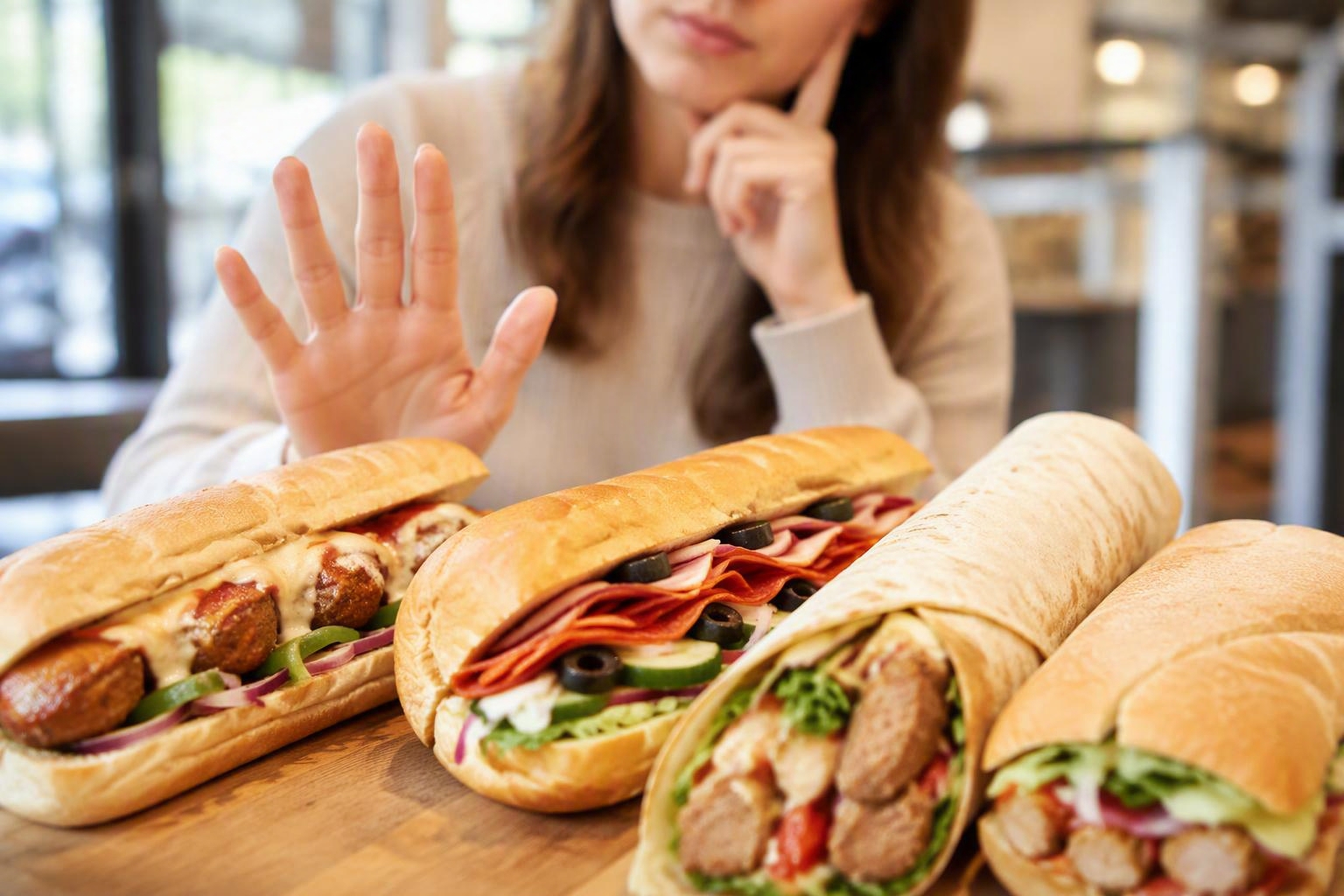
A footlong Ultimate B.M.T. reaches 1,640 calories and 4,860 mg sodium. Subway Series wraps use a footlong meat portion. Freshness concerns vary by store.
Overview
The Subway orders most worth avoiding or limiting are footlong versions of already heavy sandwiches, Subway Series wraps (which carry a footlong meat portion by default), processed-meat-heavy builds like the Ultimate B.M.T., and stacked add-ons such as creamy sauce plus cheese plus a cookie. The deciding factor is your goal: calorie and sodium concerns are supported by Subway’s own nutrition data, while freshness warnings are location-specific.
Subway is not automatically healthy or automatically unhealthy. The chain’s own U.S. Nutrition Information guide (November 2024) shows why: the same menu spans a 6-inch Rotisserie-Style Chicken that Clean Eatz Kitchen cites at 310 calories and 750 mg of sodium, and a 6-inch Ultimate B.M.T. entry listed at 820 calories and 2,430 mg of sodium. Portion size, protein choice, cheese, sauce, and sides determine the result, not the brand name on the door.
The matrix below separates the patterns backed by nutrition data from the complaints that rest on anecdotes or a single documented inspection, and pairs each with a more controlled move.
| Order pattern | Reason to limit | Evidence type | Better move |
|---|---|---|---|
| Footlong of a heavy build | The November 2024 Subway guide instructs readers to double all 6-inch values; one footlong equals two 6-inch servings | Official nutrition data | Order the 6-inch |
| Subway Series wraps | The same guide states wrap values include a footlong meat portion; Clean Eatz Kitchen notes several wraps in the 800+ calorie range | Official nutrition data plus editorial synthesis | A 6-inch on regular bread |
| Processed-meat-heavy subs (e.g., Ultimate B.M.T.) | Listed at 820 calories and 2,430 mg sodium in the Subway guide excerpt | Official nutrition data | A simpler single-protein sandwich |
| Stacked creamy sauce, cheese, chips, cookie | Clean Eatz Kitchen describes creamy sauces as calorie-dense and cheese as adding calories and sodium | Editorial nutrition synthesis | One deliberate sauce, skip defaults |
| Meatballs or tuna at an unfamiliar store | A 2018 inspection at one Michigan location found holding-temperature violations; workers report variable handling | Location-specific inspection plus anecdote | Check visible condition, ask what was made recently |
| Lavash or wrap with saucy fillings | Employee accounts in The Takeout describe chalky texture and poor sauce absorption | Anecdote | Regular bread |
The rest of this guide explains each row, including where the evidence stops.
Decide what “avoid” means for your goal
An avoid list is only useful once you define what you are avoiding. The sources behind this guide use at least seven different criteria, and an item can fail one while passing the others.
Calories are the first criterion, and they respond mostly to portion size and add-ons. Subway’s November 2024 nutrition guide lists a 6-inch Veggie Patty sandwich at 640 calories, higher than several meat-based 6-inch entries in the same document, which shows that “vegetarian” and “low calorie” are not the same test. Sodium is a separate criterion: the #15 Titan Turkey is listed at 500 calories but 1,330 mg of sodium in the same guide, so a moderate-calorie sandwich can still be a poor fit for someone limiting sodium.
Saturated fat is tracked separately in the official guide (the Ultimate B.M.T. entry lists 17 g), and processed-ingredient concerns are different again. Advocacy writing such as 100 Days of Real Food objects to nitrates and forms of MSG in processed meats regardless of the calorie count, which is an ingredient-standard argument, not a nutrition-data argument.
Allergens are a fourth category with their own official document, covered later in this guide. Freshness, texture, and value are experiential criteria: The Takeout’s compilation of Subway worker accounts flags items for mess, unpleasant texture, and inconsistent handling rather than for any nutrient value.
These criteria do not rank against each other. A low-calorie condiment can still contain ingredients a minimally-processed eater rejects, and a nutritionally reasonable sandwich can still be poorly assembled at one store. Before ordering, pick the one or two criteria that matter to you, then apply only the sections of this guide that use them. Treating all seven as a single blacklist produces the misleading conclusion that everything at Subway should be avoided, which the evidence does not support.
The biggest calorie and sodium traps
The recurring nutrition problems at Subway are patterns, not individual cursed menu items. A complete, current ranking of every menu item in its standard sold configuration is not something the available evidence supports, but the November 2024 U.S. nutrition guide and Clean Eatz Kitchen’s analysis of it converge on the same mechanisms: portion doubling, default meat portions in wraps, processed-meat density, and add-on stacking.
The scale of the spread is worth stating with the guide’s own numbers. Among 6-inch entries in the excerpted document, the Ultimate B.M.T. appears at 820 calories and 2,430 mg of sodium, while Clean Eatz Kitchen cites the 6-inch Rotisserie-Style Chicken at 310 calories and 750 mg of sodium. That is a difference of 510 calories and 1,680 mg of sodium between two sandwiches from the same counter, before any size, cheese, or sauce decision has been made.
Sodium deserves particular attention because it is less visible than calories. Clean Eatz Kitchen notes that processed-meat-heavy builds and meatball-style subs push sodium up quickly, and that some wraps carry sodium that can approach common daily limits in one meal. Even items that read as light sides carry meaningful loads: the Subway guide lists the Footlong Pretzel at 330 calories but 1,340 mg of sodium, and the Pepperoni & Cheese Dipper at 470 calories and 1,250 mg.
The two subsections below cover the mechanisms that matter most: how portions get larger than they look, and how optional components stack.
Footlongs and wraps can be larger than they look
A footlong is not a slightly bigger sandwich; per Subway’s own November 2024 nutrition guide, one footlong equals two 6-inch servings, and all listed 6-inch values must be doubled for footlong nutrition. Clean Eatz Kitchen states the same convention plainly: a footlong is literally two 6-inch portions. Applying that to the guide’s own figures, a footlong Ultimate B.M.T. works out to 820 × 2 = 1,640 calories and 2,430 × 2 = 4,860 mg of sodium. Anyone reading a 6-inch nutrition line while eating a footlong is undercounting by half.
Wraps have a less obvious version of the same problem. The Subway guide states that wrap values “include wrap, select fresh vegetables and footlong meat portion.” A wrap is therefore closer to a footlong’s worth of meat than a 6-inch’s worth, even though it looks like a single compact item. Clean Eatz Kitchen reports that several of Subway’s Series wraps land in the 800+ calorie range with sodium that can approach common daily limits in one meal, and concludes that wraps are often not the lighter choice people assume.
This also resolves an apparent contradiction in the sources. One favorable attribute does not make a wrap better overall: where sugar sits in a bread’s ingredient list, a question raised in community discussion on Quora, answers a different question than total calories, sodium, or portion size. A wrap could plausibly win on one attribute and lose on the other three.
Lavash-specific complaints are a separate, weaker category of evidence. Worker accounts compiled by The Takeout describe the bread as feeling “like chalk,” turning cracker-like when toasted, and failing to absorb marinara sauce. Those are texture and mess anecdotes, not nutrition facts, and they should be weighted accordingly.
Processed meats, cheese, sauces, and sides stack quickly
The name on the menu board is only the starting value of an order; each component you add or accept moves the total, and the components compound. Clean Eatz Kitchen’s summary of the mechanism is direct: creamy sauces are calorie-dense, cheese adds both calories and sodium, and extras are “the quickest way to turn a decent sandwich into a calorie-heavy meal without adding much fullness.”
Subway’s November 2024 guide makes the component math checkable. Shredded Monterey Cheddar is listed at 50 calories and 85 mg of sodium per 14 g serving, and plain Flatbread at 140 calories and 220 mg of sodium. Small numbers individually, but they sit on top of a base that may already be high: the #99 Homerun Ham 6-inch is listed at 510 calories and 1,350 mg of sodium. Critically, the guide states that listed sandwich values “do not include dressing or cheese unless noted,” so the number a diner looks up is often lower than the sandwich actually handed over.
A typical heavier order accumulates through four decisions, each of which feels minor at the counter:
- Doubling to a footlong, which per the official guide doubles every value
- Choosing a processed-meat-dense filling, which Clean Eatz Kitchen identifies as the fastest sodium driver
- Accepting cheese plus a creamy sauce, neither of which appears in the base listing unless noted
- Adding chips, a cookie, or a pretzel side (the guide lists the Footlong Pretzel alone at 1,340 mg of sodium)
None of these choices is individually disqualifying. The practical takeaway is to treat the sandwich name as an incomplete number, count the size decision as a doubling decision, and consciously choose which one or two add-ons are worth their cost rather than accepting the defaults.
Freshness warnings are location-specific, not chainwide facts
Warnings about Subway’s meatballs, tuna, chicken, and produce circulate widely, but the available evidence supports concerns about individual stores, not a chainwide verdict against any menu item. Treating those warnings correctly changes the decision from “never order meatballs anywhere” to “assess the store in front of you.”
Two distinct types of evidence exist here, and they should not be blended. The first is employee-derived reporting. The Takeout compiled firsthand accounts from Subway staff, and the pattern in those accounts is variability, not uniform failure. Some branch managers reportedly toss unused meatballs at the end of the day while others allegedly hold them longer than they should. Workers describe tuna salad quality as depending on the individual branch. Past workers have complained about produce quality, though The Takeout notes that employees did not specifically single out the Veggie Delite itself. These are anecdotes gathered from forums and articles. They establish that handling differs between franchises; they cannot establish how common poor handling is.
The second type is documented but narrow. A routine inspection report from the St. Clair County Health Department for Subway #417 in Port Huron, Michigan, dated July 6, 2018, recorded four priority violations: an employee not properly washing hands, meatballs hot-held at 125°F (below the required 135°F), tuna cold-held at 45°F (above the required 41°F), and unapproved pest control products stored on site. Notably, all violations were corrected during the inspection, with the tuna discarded and the meatballs reheated to 165°F. This report is real evidence that the commonly warned-about items, meatballs and tuna, are temperature-sensitive foods that can be held incorrectly. It is evidence about one store on one date in 2018. It says nothing about the store near you today, and a single dated inspection cannot establish prevalence across roughly a whole chain.
The same skepticism applies in both directions: the absence of chainwide evidence of a problem is not proof that every location handles food well. Because the honest answer is “it varies by store,” the useful response is store-level verification rather than item-level avoidance. Subway’s assembly-line format makes this practical. The produce is displayed behind glass, so you can look at the lettuce, tomatoes, and spinach before committing, which is exactly the check The Takeout suggests for produce-heavy orders. For hot-held items like meatballs, a neutral question about when the batch was prepared costs nothing and gives you information the menu board cannot.
Forum reports about food safety, shelf life, or post-meal symptoms belong in the same anecdote category as the employee accounts. They can prompt a question at the counter; they cannot settle whether an item is safe or fresh at any given location.
Additives and ingredients require a different test
Deciding what to avoid based on additives and ingredient quality is a legitimate but separate exercise from counting calories or sodium, and it needs different evidence, most of which is only partially available. Three distinct questions get collapsed together in public discussion of Subway’s ingredients, and separating them is the main value a careful reader can add.
The first question is about added sugars, which the official data does track. Subway’s November 2024 nutrition guide includes an Added Sugars column for every item; the #99 Homerun Ham 6-inch, for example, lists 4 g of added sugars. A Quora contributor separately claimed that sugar appeared as the fourth ingredient in several Subway breads, including the 9-Grain Wheat and Italian. That is a community claim about ingredient-list position at the time it was written, and formulations change; the current nutrition guide’s added-sugars figures are the checkable version of the same concern. Ingredient-list position and grams per serving are also different measurements, and neither alone establishes that a bread should be avoided.
The second question is about nitrites, nitrates, and preservatives in processed meats. The advocacy site 100 Days of Real Food asserted that several Subway sandwiches are “comprised of processed meats and filled with nitrates and forms of MSG.” That piece is dated and should not be carried forward as proof of current formulations. What can be verified currently is narrower: Subway’s own U.S. Allergy and Sensitivity Information document (November 2024) includes an “Added Nitrites/Nitrates” column, which lets a reader identify which specific current items carry that flag rather than relying on older third-party claims. What the supplied evidence does not include is authoritative health guidance connecting a particular nitrite or preservative amount to an avoid-or-limit threshold, so this guide does not assert one.
The third question is about ingredient minimalism versus nutrition numbers, and it explains why sauce advice conflicts between sources. Clean Eatz Kitchen frames sauces in calorie terms, advising readers to avoid ranch, mayo, and Chipotle Southwest as what it calls calorie bombs. An ingredient-standard eater applies a different test: a condiment can be low in calories and still fail a strict minimally-processed standard, and a calorie-dense sauce like olive oil blend can pass it. Neither source is wrong; they are scoring different criteria. Decide which test is yours before deciding which sauces to skip, and treat product-specific claims older than the current official documents as historical examples rather than current facts.
Better Subway orders and practical swaps
Every warning in this guide has a corresponding move that keeps you at the counter rather than walking out. The evidence supports directional swaps, not a single perfect order, because as the goal-setting section showed, “better” depends on which criterion you are optimizing.
The swaps map directly onto the trap patterns. Against portion doubling, order the 6-inch instead of the footlong; per Subway’s November 2024 guide this literally halves every listed value. Against the wrap trap, choose bread, since the guide states wraps include a footlong meat portion by default. Against processed-meat sodium, choose a simpler single protein: Clean Eatz Kitchen cites the 6-inch Rotisserie-Style Chicken at 310 calories and 750 mg of sodium, and The Takeout notes that the Rotisserie-Style Chicken has been recommended on social media as one of the chain’s better meat options, an unusual point of agreement between a nutrition source and worker-adjacent reporting. Against add-on stacking, load vegetables freely and treat cheese and sauce as deliberate, counted choices rather than defaults.
Against location variability, the swap is behavioral rather than culinary: inspect the displayed produce and ask what was prepared recently, per the practical checks discussed earlier. No swap on this list satisfies every goal simultaneously; someone avoiding gluten or a listed allergen needs the allergen guide covered below, not a calorie swap. The two builds that follow show how these principles combine in practice.
A more controlled 6-inch build
A controlled build starts from a modest base, adds volume through vegetables, and spends its calorie and sodium budget deliberately. Where currently available, the 6-inch Rotisserie-Style Chicken is the clearest supported anchor: Clean Eatz Kitchen lists it at 310 calories and 750 mg of sodium, which leaves substantial room in a day’s intake compared with the Ultimate B.M.T.’s listed 820 calories and 2,430 mg. Turkey-based 6-inch builds are the other commonly cited direction, with the caveat that named Subway Series versions can carry more than expected; the guide lists the #15 Titan Turkey 6-inch at 500 calories and 1,330 mg of sodium, so even within turkey, the specific configuration matters.
From that base, the build follows three rules derived from the evidence already covered. First, keep the 6-inch size, because the official guide’s doubling convention means the footlong decision is the single largest number on the ticket. Second, fill with vegetables: the guide’s wrap listings show that lettuce, spinach, tomatoes, onions, green peppers, cucumbers, and olives are the standard vegetable set, and they add bulk without materially moving the totals. Third, choose one sauce in a deliberate amount rather than accepting cheese plus a creamy sauce plus “extra sauce,” the accumulation Clean Eatz Kitchen identifies as the fastest way to make a reasonable sandwich heavy. Remember that the guide’s listed sandwich values exclude dressing and cheese unless noted, so whatever you add sits on top of the printed number.
Skip the automatic sides unless they are the point of the visit. The guide’s own listings, 1,340 mg of sodium for a Footlong Pretzel, make clear that sides are not rounding errors.
A vegetable-only order is a tradeoff
A Veggie Delite-style vegetable-only sandwich is a legitimate low-calorie, low-sodium choice on paper, but it is not automatically the best alternative, because three separate evaluations apply to it and they do not all point the same way.
The first evaluation is the listed nutrition profile, where a vegetables-on-bread order sits at the light end of the menu by construction. The second is protein adequacy, where it sits at the opposite end. The supplied evidence does not include a current protein figure for the Veggie Delite specifically, so this guide will not assert one, but the structural point stands without it: a sandwich with no protein portion cannot deliver what the meat and patty entries deliver, and the Subway guide lists even the Veggie Patty option at 22 g of protein alongside 640 calories, illustrating that plant-based and high-protein and low-calorie are three different attributes that rarely align in one item.
The third evaluation is entirely local: produce quality. The Takeout reports that while employees have not singled out the Veggie Delite itself, past workers have complained about the chain’s produce, and its practical advice is to check the freshness of your location’s produce visually before ordering. A vegetable-only sandwich concentrates all of its quality risk in exactly the ingredients those complaints target, which makes the glass-case inspection more important for this order than for any other.
The conclusion is not that a vegetable order should be avoided. It is that “lowest listed calories” answers one question, and a diner who also needs protein or is standing in front of tired-looking produce may be better served by the controlled protein build above.
For allergies and dietary restrictions, use the current guide
For allergies, the correct source is Subway’s own U.S. Allergy and Sensitivity Information document, dated November 2024, not blog lists or this article. That document maps menu items against egg, fish, milk/lactose, peanuts, sesame, shellfish, soybeans, tree nuts, wheat and gluten-containing ingredients, sulfites, and added nitrites/nitrates, using a filled marker for “contains” and a separate marker for “may contain.”
The guide’s entries show why item-level checking matters more than category-level assumptions. Tuna Salad carries multiple allergen markers, not only fish. Sweet Onion Teriyaki Sauce is flagged for several allergens and explicitly noted as containing poppy seeds. Grilled chicken’s allergen profile changes depending on whether it is ordered with Buffalo sauce or Sweet Onion Teriyaki Sauce, which means the same protein can be acceptable in one configuration and not in another. Breads and wraps, cheeses, and condiments each have their own rows, so a sandwich must be screened component by component, the same way its calories accumulate component by component.
Two caveats in the document itself should shape how much weight it carries. First, Subway states the list is compiled from information provided by its approved food manufacturers and that “ingredient changes and substitutions may occur before this list is updated.” A downloaded PDF can lag reality. Second, the document instructs customers to notify the sandwich artist about any food allergy, which is the mechanism for addressing what the table cannot show: conditions at the individual store.
Equally important is what the supplied evidence does not establish. The sensitivity document identifies listed allergens; it does not, on its own, resolve celiac-level gluten safety, vegan status, religious-diet suitability, or the degree of cross-contact risk on a shared prep line where the same gloves and surfaces touch many ingredients. A reader with a severe allergy or a strict dietary requirement should treat the guide as a screening step, then confirm current ingredients and preparation practices directly with Subway or the specific store before ordering, rather than inferring safety from an allergen table alone.
Can Subway ingredients explain why I feel unwell after eating it?
Published documents can identify plausible contributors, but they cannot establish why a specific person felt unwell after a specific meal. Anecdotal accounts exist, such as a forum post describing feeling “restless yet tired” starting 20 to 30 minutes after eating at Subway and speculating about a large sodium dose, but a self-report plus speculation is not evidence of cause.
What the official documents can do is narrow the investigation. Subway’s November 2024 nutrition guide shows that a single footlong of a heavy build can carry several thousand milligrams of sodium once 6-inch values are doubled, which makes intake worth reviewing. The November 2024 sensitivity guide can reveal whether an order contained a listed allergen or sulfites the person did not expect. Neither document diagnoses anything, and repeated or significant symptoms after eating are a question for a clinician, ideally with a record of exactly what was ordered.