
Why the Nitro Label Alone Cannot Tell You the Caffeine
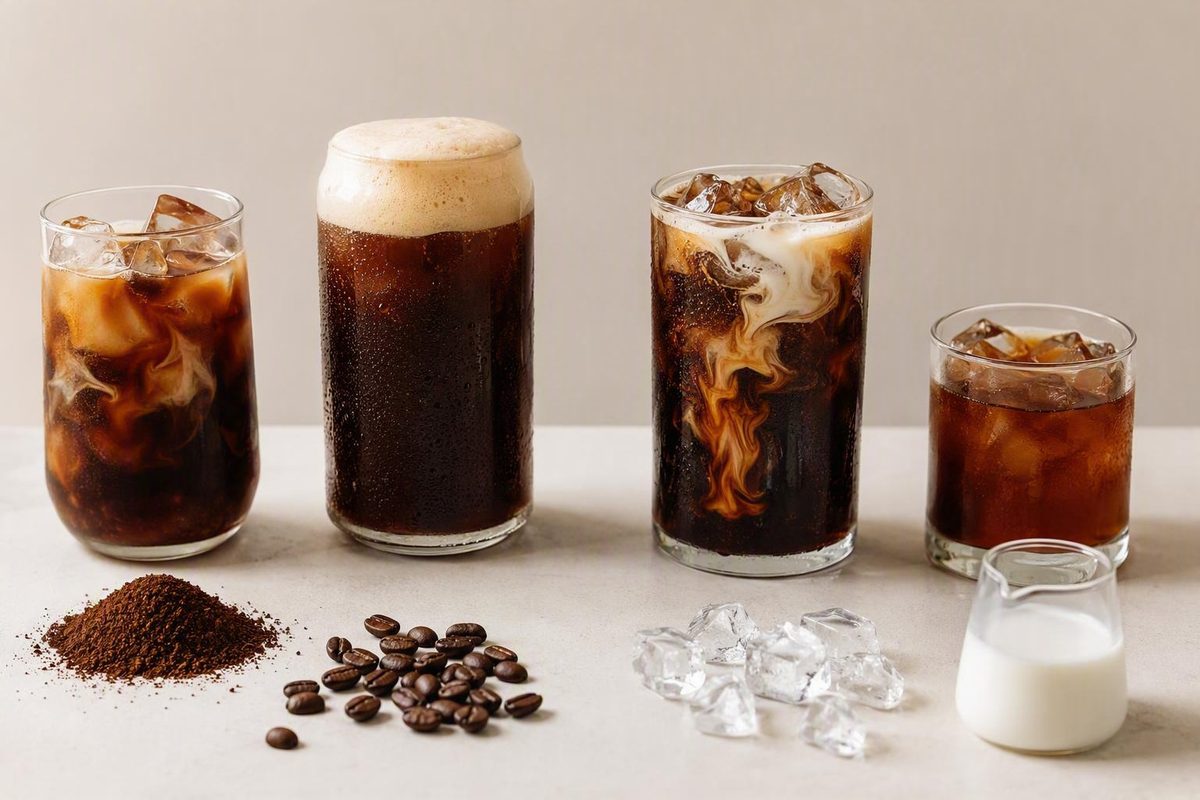
The exact recipe and portion decide. Check official caffeine disclosures, then compare total milligrams per serving and per fluid ounce across sizes.
Nitro cold brew can contain more caffeine than regular cold brew, iced coffee, or hot coffee, but “nitro” alone does not tell you how much. The reliable answer comes from the exact recipe and portion: check the official caffeine disclosure, keep total milligrams per serving visible, and calculate milligrams per fluid ounce when comparing drinks of different sizes.
The short answer: sometimes, but not because it is called nitro
Each comparison requires product-specific numbers:
- Nitro versus regular cold brew: Compare the coffee base, final dilution, and liquid serving volume.
- Nitro versus traditional iced coffee: Account for the different brewing recipes and any ice that displaces liquid coffee.
- Nitro versus hot coffee: Compare both equivalent volumes and total caffeine per serving.
Coffee-vendor guides describe nitro cold brew as finished cold brew infused with nitrogen. According to Fathom Coffee’s guide, nitrogen changes the texture and appearance of the drink but does not add caffeine; the caffeine figure instead follows the coffee base, preparation, dilution, and portion. The guide was published May 7, 2021, and last reviewed July 23, 2026. (Fathom Coffee)
That is vendor guidance, not independent proof that every otherwise identical nitro and non-nitro cold brew has exactly the same caffeine. It supports a narrower conclusion: nitrogenation is not, by itself, a reliable reason to predict a higher caffeine number.
The same limit applies when comparing nitro with iced or hot coffee. A particular nitro may have more caffeine, but the drink names do not establish the result. Without matched disclosures for the products and portions being compared, the exact difference remains unknown.
What actually determines the caffeine in the cup
Commercial coffee sources identify several variables that can affect a finished drink’s caffeine:
- Coffee dose
- Coffee-to-water ratio
- Coffee species or variety
- Grind and extraction conditions
- Concentrate strength
- Dilution with water, milk, or another ingredient
- Final liquid serving volume
These factors can be set during brewing, dilution, dispensing, or final preparation. They should not be treated as a universal production sequence.
Cold brew may be produced as a concentrate and then diluted before serving. Starbucks likewise explains that caffeine depends on preparation, coffee-to-water ratio, the complete beverage recipe, and serving volume. Its April 30, 2026, explanation also notes that a stronger-tasting drink is not necessarily the most caffeinated. (Starbucks Coffee Science)
For that reason, the strength of an undiluted concentrate does not reveal how much caffeine the finished drink provides. You also need to know how much concentrate is used, how much it is diluted, and the final serving volume.
Ice can affect the comparison too. As a bounded example, two cups may both be labeled 16 fluid ounces while one contains ice and the other is a no-ice nitro pour. The drinks could contain different volumes of liquid coffee, so their total caffeine could differ even if the coffee itself had a similar caffeine concentration. The size of that difference cannot be calculated without product-specific measurements.
Texture is no better as a shortcut. Nitrogen can give coffee a creamy mouthfeel and cascading appearance, but neither characteristic supplies a caffeine measurement. Flavor intensity also depends on the coffee and recipe, so a stronger taste does not prove a higher caffeine content.
Compare caffeine per serving and per ounce
Two figures answer different questions:
- Total caffeine per serving is how many milligrams you consume if you finish the drink.
- Caffeine per fluid ounce describes concentration and makes differently sized servings easier to compare.
Use this calculation:
Caffeine per fluid ounce = total caffeine in milligrams ÷ ready-to-drink volume in fluid ounces
Record the numbers and preparation context together:
| Comparison field | Drink A | Drink B | What to verify |
|---|---|---|---|
| Product and serving | ___ fl oz | ___ fl oz | Exact product and ready-to-drink volume |
| Total caffeine | ___ mg | ___ mg | Milligrams in the full serving |
| Caffeine concentration | ___ mg/fl oz | ___ mg/fl oz | Total milligrams divided by fluid ounces |
| Preparation and source | ___ | ___ | Ice, dilution, concentrate status, and source date |
Use the actual liquid volume when it is available, rather than assuming that the cup’s nominal capacity equals the amount of coffee. Vendor guidance specifically identifies dilution, ice, and serving size as reasons two cold-brew servings may differ. (Fathom Coffee)
Also confirm what the disclosed caffeine number describes. A figure for undiluted concentrate cannot be compared directly with a ready-to-drink nitro unless you know the amount of concentrate used and the final diluted volume.
When checking source dates, record whichever information is available: publication date, last-updated date, label date, or the date you checked the page. Recipes and product listings can change.
Worked example: Starbucks Grande Nitro Cold Brew
Starbucks lists approximately 280 milligrams of caffeine for its Grande 16-fluid-ounce Nitro Cold Brew. The company states that caffeine is approximate, nutrition information is calculated from standard recipes, and customization can change the finished drink. The product page was checked September 13, 2026. (Starbucks Nitro Cold Brew nutrition)
The concentration calculation is:
280 mg ÷ 16 fl oz = 17.5 mg per fl oz
| Measure | Amount |
|---|---|
| Total caffeine in the serving | Approximately 280 mg |
| Caffeine per fluid ounce | Approximately 17.5 mg/fl oz |
These figures apply to one listed Starbucks product and size prepared from its standard recipe. They do not define a typical nitro cold brew, and they do not establish that Starbucks Nitro Cold Brew has more caffeine than the company’s regular cold brew without a matched official value for that comparison.
A quick checklist before ordering or logging a nitro
- Find the exact product. Use the package label or café’s official nutrition page rather than relying on the word “nitro.”
- Match the serving size. Confirm that the caffeine disclosure applies to the size you are ordering or drinking.
- Record total milligrams. This is the amount consumed if you finish the serving.
- Calculate milligrams per ounce. Use this figure to compare drinks of different sizes.
- Check the serving format. Note whether the drink is served over ice, without ice, diluted from concentrate, or packaged ready to drink.
- Confirm the disclosure type. Make sure the number describes the finished beverage rather than undiluted concentrate.
- Keep the source date. Record when the label or nutrition page was published, updated, or checked.
- Avoid category averages. Commercial estimates such as 150–300 milligrams per serving are rough, unsupported ranges—not a universal rule for nitro cold brew.
If no official caffeine value is available for the exact product and portion, report the amount as unknown rather than assigning a category average. The menu name is a description of the drink, not a caffeine measurement.