
The Caffeine in Yerba Mate Depends on What You Call a Serving
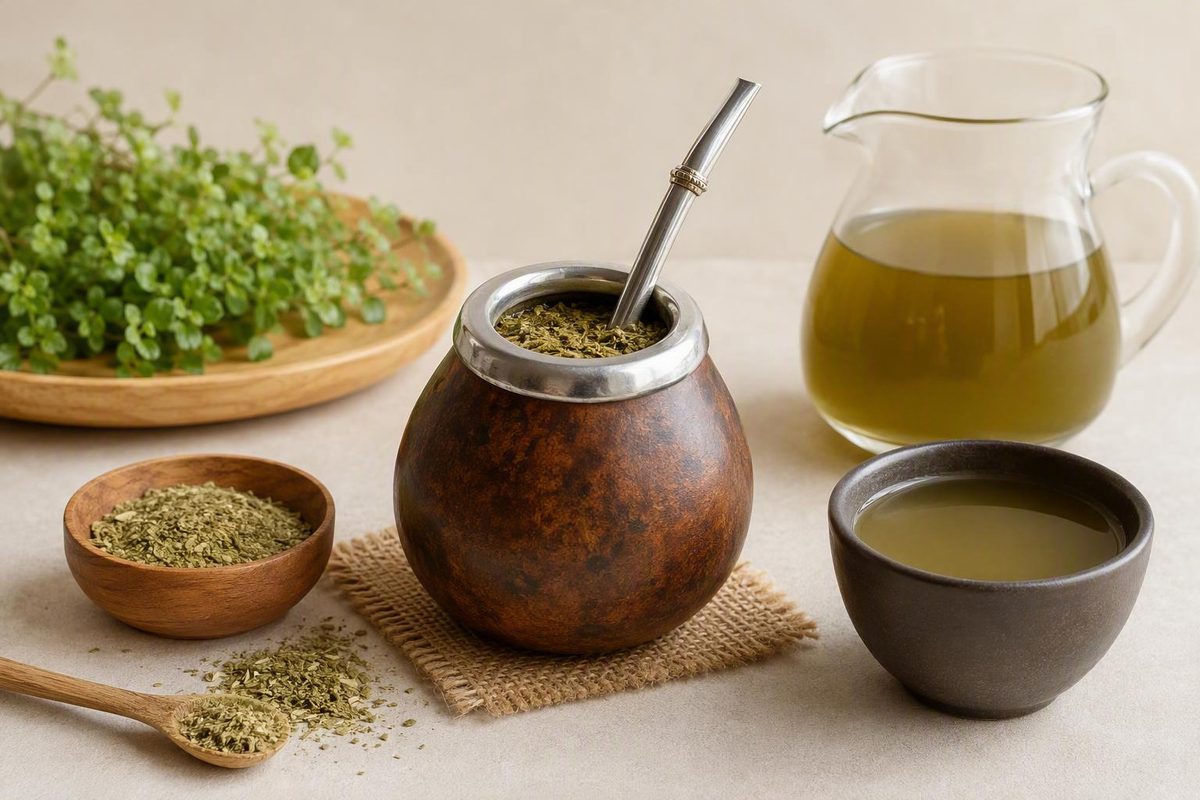
Repeated pours continue extracting caffeine from the same yerba, and later pours may still contribute even when the flavor has weakened.
Yerba mate does not have one dependable category-wide caffeine value. The answer changes depending on whether “a serving” means a tea bag, an 8-ounce loose-leaf cup, a packaged drink, one small pour from a gourd, or an entire traditional session made by repeatedly infusing the same leaves.
For a conventionally brewed 8-ounce cup, one commercial tea seller reports approximately 70–85 milligrams of caffeine. That is a rough planning range—not a universal laboratory measurement—and the seller does not provide product-specific test results for it. YBTCO reports the 70–85 mg estimate and its 8-ounce serving basis.
The most important distinction is this:
A traditional-session estimate is the cumulative caffeine extracted from one batch of yerba across many refills. It is not the caffeine in each pour.
The short answer: caffeine by mate format
Identify the format before choosing a number. The estimates below come from commercial or enthusiast sources, not a standardized independent comparison, and should not be treated as equally reliable.
| Mate format | Serving definition | Reported caffeine | Evidence type | Main limitation |
|---|---|---|---|---|
| ECOTEAS tea bag | One ECOTEAS yerba mate tea bag | 25 mg | Manufacturer disclosure | Product-specific; no brew volume, steeping conditions, analytical method, or independent test report is supplied |
| Conventional loose-leaf brew | One 8-ounce brewed serving | About 70–85 mg | Commercial tea-retailer estimate | Not a universal measurement; product, leaf quantity, and brewing conditions are unspecified |
| Mateina ready-to-drink brew | One Mateina ready-to-drink container | 120 mg | Manufacturer webpage disclosure | Applies only to the named product; the current package should still be checked |
| Traditional gourd session | One batch of yerba infused repeatedly | About 150–260 mg total across reported commercial scenarios | Retailer summary of approximate cup and session ranges | The underlying scenarios do not use one standardized leaf mass, water volume, blend, or method |
| Higher traditional-session scenario | About 50 g of Argentine con palo yerba with 1–1.5 L of water | About 250–300 mg total | Enthusiast-author synthesis | An assumption-dependent synthesis, not the direct result of one clearly defined experiment |
Another commercial source gives a much broader 30–180 mg per cup range. Because that “cup” is not consistently defined, the range mainly demonstrates how unreliable an unspecified serving can be rather than establishing a useful concentration.
The practical answer is therefore format-specific:
- For a tea bag, use the manufacturer’s value for that exact bag and preparation.
- For an unlabeled 8-ounce loose-leaf cup, the commercial 70–85 mg range can serve as a provisional estimate, not a verified dose.
- For a can or bottle, use the caffeine disclosure for the exact product and container.
- For a traditional gourd, count the complete series of refills as one cumulative session. Do not apply the session total to every pour.
Why “one cup” is not a complete serving definition
A useful caffeine estimate needs more than the word “cup.” At minimum, it should identify:
- Finished beverage volume
- Dry-leaf quantity
- Product, blend, or regional style
- Water temperature
- Steeping or infusion method
- Whether the value covers one infusion or all refills
Without those details, two “cups” can represent very different preparations.
For example, the commercial 70–85 mg estimate is tied to 8 ounces, or approximately 240 mL. A different retailer quotes approximately 78 mg in 150 mL, while also noting that the underlying account does not clearly establish how much dry yerba was used. Yerba Mate Lab presents the 78 mg-per-150 mL estimate through an indirectly quoted study.
Those figures cannot be treated as measurements of the same recipe. The volumes differ, and the available descriptions do not show that the product, dry-leaf mass, temperature, infusion time, or filtration method matched.
Three units are frequently blurred together:
- Milligrams per serving: caffeine assigned to a defined portion, such as one prepared 8-ounce drink.
- Milligrams per container: caffeine in an entire can or bottle.
- Milligrams per session: cumulative caffeine extracted from one batch of yerba through multiple pours.
Traditional mate makes the third distinction especially important. A gourd may be refilled repeatedly, but the dry yerba is not replaced after every pour. Each refill continues the extraction from the same batch.
That also makes a full gourd session a poor direct comparison with one cup of coffee. Even when the reported totals are accurate, the preparations can differ in total beverage volume and the period over which they are consumed. An equal-volume comparison should use the same finished volume. A session comparison should state the full water volume and distinguish it from a single serving.
The editorial rule is simple:
Never use a mate caffeine number without attaching its serving and preparation context.
If a source omits the cup volume, dry quantity, or brewing conditions, its figure belongs in a broad estimate—not a precise calculation.
Tea bags, loose leaf, and ready-to-drink mate are not interchangeable
That may make one bag easier to count than an unweighed scoop of loose yerba, but it does not make all mate tea bags equivalent.
ECOTEAS also reports 50–65 mg from one tablespoon of its loose yerba. The company does not provide the spoon’s gram weight, finished beverage volume, water temperature, steeping time, testing method, or an independent analytical report. The figure is therefore a vendor-provided estimate for that product, not a general tablespoon conversion. ECOTEAS supplies both its tea-bag and tablespoon figures on its caffeine page.
Relevant differences include:
- particle size and shape;
- the proportion of leaves and stems;
- powder content;
- settling and moisture;
- whether the spoon is level, rounded, or packed.
A gram measurement is more repeatable than a tablespoon, but grams alone still do not reveal how much caffeine reaches the drink. That also depends on the product’s caffeine content and the extraction conditions.
Ready-to-drink mate solves a different part of the problem. A sealed beverage gives the manufacturer a clearly defined container to describe. Mateina states that each of its ready-to-drink energy brews contains 120 mg per container. That is a manufacturer webpage disclosure for the named product, not a category-wide value for canned mate.
For tracking, distinguish the source of the number:
- One ECOTEAS tea bag: use the company’s product-specific value shown in the summary table.
- One Mateina ready-to-drink container: record 120 mg if the current package agrees with the manufacturer’s online disclosure. Mateina states 120 mg per ready-to-drink energy brew.
- One unlabeled loose-leaf cup: use only a broad estimate because no product-specific value is available.
Neither a tea bag nor a can is inherently representative of its entire format. A bottled tea, carbonated mate, energy brew, or concentrated drink can use a different formulation.
How caffeine adds up across a traditional gourd session
Traditional mate is not prepared like an ordinary tea mug. A relatively large amount of dry yerba is placed in a gourd and repeatedly infused with fresh water. The same yerba remains in the vessel while the drinker consumes a series of smaller pours through a filtered straw, or bombilla.
That creates one cumulative process:
dry yerba → first pour → later pours → total caffeine consumed during the session
It does not create a fresh full dose each time water is added. If a source estimates a session total, that number applies across the stated series of infusions—not separately to the first, fifth, or final pour.
The supplied sources describe three materially different scenarios:
| Reported scenario | Reported caffeine | Evidence type | Correct interpretation |
|---|---|---|---|
| 50 g of loose yerba infused 15 times | 150–200 mg total | Manufacturer estimate | Cumulative estimate for all 15 infusions, not each pour |
| 500 mL prepared and consumed traditionally | About 260 mg or more | Study estimate quoted indirectly by a retailer | Dry-leaf quantity and full preparation method are not clearly reported |
| About 50 g with 1–1.5 L of water | About 250–300 mg total | Enthusiast-author synthesis | Assumption-dependent estimate for a whole session |
Mateina supplies the first scenario. Yerba Mate Lab reports the second through an indirectly quoted study and flags the missing dry-leaf quantity. Matexperience supplies the third as an author synthesis rather than a result from one clearly described experiment. Matexperience explains the assumptions behind its 250–300 mg session estimate.
These scenarios should not be blended into one supposedly standard dose. They differ in leaf mass, total water, blend, regional preparation, number of infusions, and assumptions about extraction.
Later pours can continue contributing caffeine even as flavor intensity declines. Commercial accounts say that hotter water extracts caffeine faster and repeated infusions continue extracting it, but the supplied evidence does not provide a dependable refill-by-refill curve. Yerba Crew summarizes these preparation factors and the continued contribution of repeated pours.
Two tracking shortcuts should therefore be avoided:
- Do not treat weak-tasting later refills as caffeine-free. Flavor is not a caffeine measurement.
- Do not multiply an ordinary cup estimate by the refill count. A small gourd refill is not a new batch of dry yerba and may be much smaller than an 8-ounce cup.
Instead, record the gourd as one session. Note the dry weight loaded, the approximate total water consumed, and the preparation style. If no product-specific analysis exists, use a scenario-based range and label its assumptions rather than assigning a precise amount to every pour.
What changes caffeine extraction from loose yerba
The relevant variables fall into two groups: product factors and preparation factors.
Product factors
The plant material does not begin with one uniform caffeine concentration. The supplied commercial and enthusiast sources identify growing conditions, climate, origin, harvest, regional style, and processing as possible contributors to product differences.
The physical blend also matters:
-
Leaf-to-stem ratio: A stem-heavier blend contains a smaller proportion of caffeine-containing leaf material at the same total dry weight.
-
Powder content: Fine, powder-rich yerba may extract more strongly than a coarser or stem-heavier blend under otherwise similar conditions.
These differences help explain why equal spoon volumes do not necessarily represent equal dry masses or equivalent preparations.
Preparation factors
How the yerba meets the water can also change extraction:
- Dry quantity: More yerba places more caffeine-containing material into the preparation, although the final amount consumed remains extraction-dependent.
- Water volume: Passing more water through the same batch can alter cumulative extraction.
-
Water temperature: Commercial accounts report that hotter water extracts caffeine faster.
-
Repeated infusions: Additional pours can continue removing caffeine from the same material.
Extraction rate and total extraction are not the same. A method that extracts caffeine faster does not, by that fact alone, establish the final amount consumed. Likewise, continued infusion does not show how much caffeine enters each successive pour.
The evidence supports direction and variability, not precise percentage changes. It does not justify promises that cooler water, a different cut, or fewer refills will reduce intake by a particular percentage.
For practical tracking, use this hierarchy:
- Exact packaged product: use its current container or serving disclosure.
- Defined brewed measurement: use a value tied to a named product and reproducible recipe.
- Defined home recipe: record grams, water volume, temperature, and infusion method.
- Retail estimate with a defined serving: use only for rough planning.
- Undefined cup or gourd: assign a broad, explicitly uncertain estimate.
This is a hierarchy of usefulness for tracking. For a general scientific claim, transparent independent testing under defined conditions would be stronger evidence than either a retail estimate or an unsupported package disclosure.
Dry-leaf caffeine is not the same as caffeine in the drink
Three quantities are often treated as though they were interchangeable:
- Caffeine present in the dry material
- Caffeine extracted into the liquid
- Caffeine actually consumed across the pours
They are related, but they are not equal.
Matexperience describes one cited review as placing caffeine at approximately 1%–2% of dry leaf weight. That is a dry-material estimate, not a finished-drink value. It does not show that all of the caffeine in a weighed portion enters the water.
Commercial yerba may also include stems, so a percentage measured in leaf material does not automatically describe the same proportion in a retail leaf-and-stem blend.
If someone multiplies dry grams by a dry-leaf caffeine percentage, the result is only a theoretical estimate of caffeine present in the material under the assumed percentage. It does not establish:
- how much the chosen temperature and contact time extracted;
- how much remained in the wet yerba;
- how extraction changed over repeated pours;
- whether all prepared liquid was consumed;
- whether the retail blend matched the material behind the percentage.
That is why dry grams cannot be converted directly into a dependable consumed dose using the supplied evidence.
Tablespoons introduce still more uncertainty. A precise calculation would require the spoon’s actual gram weight for that product, a relevant caffeine analysis, and an extraction rate for the chosen brewing method. Those inputs are generally not available for a home preparation.
A defensible framework is:
- Start with a product-specific disclosure, if one exists.
- Confirm whether it refers to dry material, brewed liquid, one serving, or the whole container.
- Match the stated preparation and serving to what was consumed.
- Apply the value only to that defined unit.
- If the home recipe differs, widen the uncertainty instead of adding decimal-level precision.
The supplied evidence does not establish a universal extraction rate, so it cannot support a reliable calculator that converts dry grams or tablespoons directly into milligrams consumed.
Mate versus coffee, black tea, and green tea
Comparisons are clearest when every drink uses the same finished volume. The following ranges are one tea retailer’s illustrative commercial estimates for 8-ounce servings, not the results of a standardized laboratory comparison.
| Beverage | Approximate caffeine per 8 ounces |
|---|---|
| Green tea | 20–45 mg |
| Black tea | 40–70 mg |
| Yerba mate | 70–85 mg |
| Drip coffee | 95–200 mg |
YBTCO publishes these equal-volume ranges while noting that preparation affects caffeine.
The cautious directional conclusion is that, at equal 8-ounce volumes, this commercial comparison places mate:
- above green tea;
- often above black tea;
- below drip coffee.
These are tendencies within one retailer’s ranges, not fixed rankings. The ranges overlap at their boundaries, and stronger or weaker preparations can reverse the expected order.
A traditional gourd session does not belong in the same ranking. It may involve many refills, much more total liquid, and a longer consumption period. Comparing its cumulative total with one 8-ounce coffee answers a different question from comparing equal beverage volumes.
The same warning applies to espresso. A small shot and a complete gourd are different serving units. Listing their totals without clearly labeling their volumes confuses concentration with cumulative dose.
Caffeine totals also cannot predict exactly how a person will feel. The supplied evidence does not establish claims that mate produces “cleaner energy,” steadier focus, fewer jitters, improved endurance, or no crash. Those promotional descriptions are therefore not used as comparative outcomes here.
How to estimate and track caffeine from your own mate
A consistent, format-specific log is more useful than a falsely exact universal number.
Step 1: Identify the exact product
Record the brand, product name, flavor, and format. “Yerba mate” is not specific enough for a formulated drink, flavored blend, or tea bag.
Step 2: Read the caffeine statement and its basis
Look for wording such as:
- per tea bag;
- per prepared serving;
- per 8 ounces;
- per can or bottle;
- per container;
- per dry quantity.
Do not assume “per serving” means the whole package. Check the package’s serving count and compare it with the amount you actually consumed.
Step 3: Record the beverage volume
For a brewed cup, note the finished volume consumed. For a packaged beverage, record the container size. If you drank only part of a labeled container, use the corresponding fraction of its disclosed caffeine, assuming the drink was evenly mixed.
Step 4: Measure loose yerba when relevant
A kitchen scale provides a more repeatable recipe than tablespoons. The gram weight still does not reveal the exact caffeine dose, but it makes your own preparations easier to compare.
Step 5: Define the tracking unit
For a mug brewed once, record one brewed serving. For a gourd repeatedly refilled from the same leaves, create one session entry rather than a separate full-dose entry for each pour.
Worked example 1: Manufacturer-disclosed tea bag
You prepare one ECOTEAS tea bag according to the product instructions.
Tracking entry: ECOTEAS yerba mate tea bag — 25 mg, manufacturer disclosure
If you use two of the same bags, the direct product-based estimate is 50 mg. That multiplication should not be transferred to another brand whose bag weight or formulation may differ.
Worked example 2: Manufacturer-disclosed ready-to-drink container
You drink one Mateina ready-to-drink energy brew for which the manufacturer states 120 mg per container.
Tracking entry: Mateina ready-to-drink yerba mate — 120 mg, manufacturer webpage disclosure
Check the current package before logging it. If the container in hand gives a different value, use the current package rather than the online example.
Worked example 3: A 50 g multi-refill session
You load 50 g of loose yerba and infuse the same batch 15 times. Mateina estimates 150–200 mg total for that specific scenario.
Tracking entry: Traditional gourd — 50 g, 15 infusions — 150–200 mg total, manufacturer scenario
Keep that range tied to those assumptions. A separately reported estimate of approximately 260 mg or more for 500 mL cannot automatically be assigned to the same 50 g recipe because its dry-leaf quantity and full method are unclear. Yerba Mate Lab explains that limitation in its account of the 500 mL estimate.
Do not log the full-session range and then add a separate cup estimate for every refill. The session entry already represents cumulative extraction from the same batch.
If you have only an unlabeled 8-ounce cup
A commercial 70–85 mg estimate may be used provisionally.
Uncertainty warning: This is not a measurement of your product. Your blend, dry quantity, water temperature, and infusion method may produce a different result.
Include other caffeine sources
Mate may be only one part of daily caffeine intake. Use the most specific available disclosure for each item.
Do not treat a general population benchmark as a personalized target. This article is general information, not medical or dietary advice; consult a qualified healthcare professional if you have individual intake concerns.
How much confidence should you place in these numbers?
The evidence is broad enough to show why mate caffeine varies, but it is not strong enough to establish one precise category-wide value.
Most figures available in the supplied material come from:
- yerba mate manufacturers;
- tea or beverage retailers;
- enthusiast or review sites;
- commercial pages quoting research indirectly.
A manufacturer is an appropriate source for what it states about its own product. A retailer estimate can also provide a practical starting point. Neither is equivalent to transparent independent testing performed under defined and reproducible conditions.
Several pages repeat an average near 80 mg per cup, but repetition among commercial pages is not independent confirmation—especially when “cup” is undefined or the pages may rely on the same underlying material. One commercial summary reports both an average near 80 mg and a much broader 30–180 mg per-cup range, illustrating how little precision the average provides without a standardized serving. Cafely presents those commercial average and range estimates.
Commonly missing details include:
- exact product identity;
- dry-leaf mass;
- leaf-to-stem ratio;
- finished beverage volume;
- water temperature;
- infusion time;
- number and size of refills;
- total water used;
- analytical method;
- whether the figure describes dry material or brewed liquid.
Two separate evidence ladders are useful.
For tracking the exact item consumed:
- Current disclosure on the exact package
- Manufacturer disclosure for that exact product and container
- Product-specific brewed measurement with defined conditions
- Retail estimate tied to a defined serving
- Broad category estimate
For making a general scientific claim:
- Transparent independent measurement under defined conditions
- Reproducible product-specific testing
- Clearly documented secondary synthesis
- Manufacturer or retailer estimate
- Anecdote or unsupported extrapolation
Despite the limitations, several conclusions remain useful:
- Product and preparation matter.
- A full traditional session is not equivalent to one cup.
- Repeated refills create cumulative intake from the same batch.
- An exact packaged-product disclosure is more useful for tracking that item than a generic mate average.
- Unlabeled loose yerba cannot be calculated precisely from tablespoons or refill count alone.
Promotional claims about health benefits, smooth stimulation, improved endurance, reduced crashes, or special balancing effects from other compounds are excluded because the supplied evidence does not establish them.
The decision rule is straightforward: use a commercial cup estimate only as a provisional planning tool, use the exact product disclosure for a tea bag or packaged drink, and treat a traditional gourd as one cumulative multi-refill session—not as a new full dose with every pour.
How much caffeine is in an 8-ounce cup of yerba mate?
One commercial estimate places an 8-ounce cup at 70–85 mg, but another commercial account reports a much broader 30–180 mg per-cup range across variable preparations. Cafely reports the broader range and an average near 80 mg.
Use a product-specific value when available. Otherwise, treat the narrower range only as a rough planning estimate.
How much caffeine is in a yerba mate tea bag?
There is no universal tea-bag value. ECOTEAS states 25 mg per bag for its product, but the company does not provide independent testing details or defined brewing conditions for that figure.
Use the disclosure for the exact bag. Bag weight, blend, particle size, water volume, and steeping method can differ across products.
Does each refill of a mate gourd contain the same amount of caffeine?
The supplied evidence does not establish an equal or predictable amount for every refill. Repeated pours continue extracting caffeine from the same yerba, and later pours may still contribute even when the flavor has weakened.
Count the gourd as one cumulative session. Do not assign the full session estimate to every pour or multiply an 8-ounce cup estimate by the number of small refills.
Is yerba mate more caffeinated than coffee?
In one equal-volume commercial comparison, yerba mate is estimated at 70–85 mg per 8 ounces, while drip coffee is estimated at 95–200 mg per 8 ounces. YBTCO supplies those illustrative equal-volume ranges.
That makes mate lower in the cited comparison, but it is not an absolute rule. Both drinks vary with product and preparation. A complete gourd may have a higher cumulative total than one coffee while also involving more liquid and many refills.
Can I calculate mate caffeine from tablespoons of dry yerba?
Not reliably. The dry weight represented by a tablespoon changes with cut, stems, powder, settling, and packing density. Even an exact gram weight does not show how much caffeine enters the liquid.
Weighing yerba can make a recipe more repeatable, but without a product-specific analysis and a dependable extraction rate, it cannot produce a precise consumed dose.