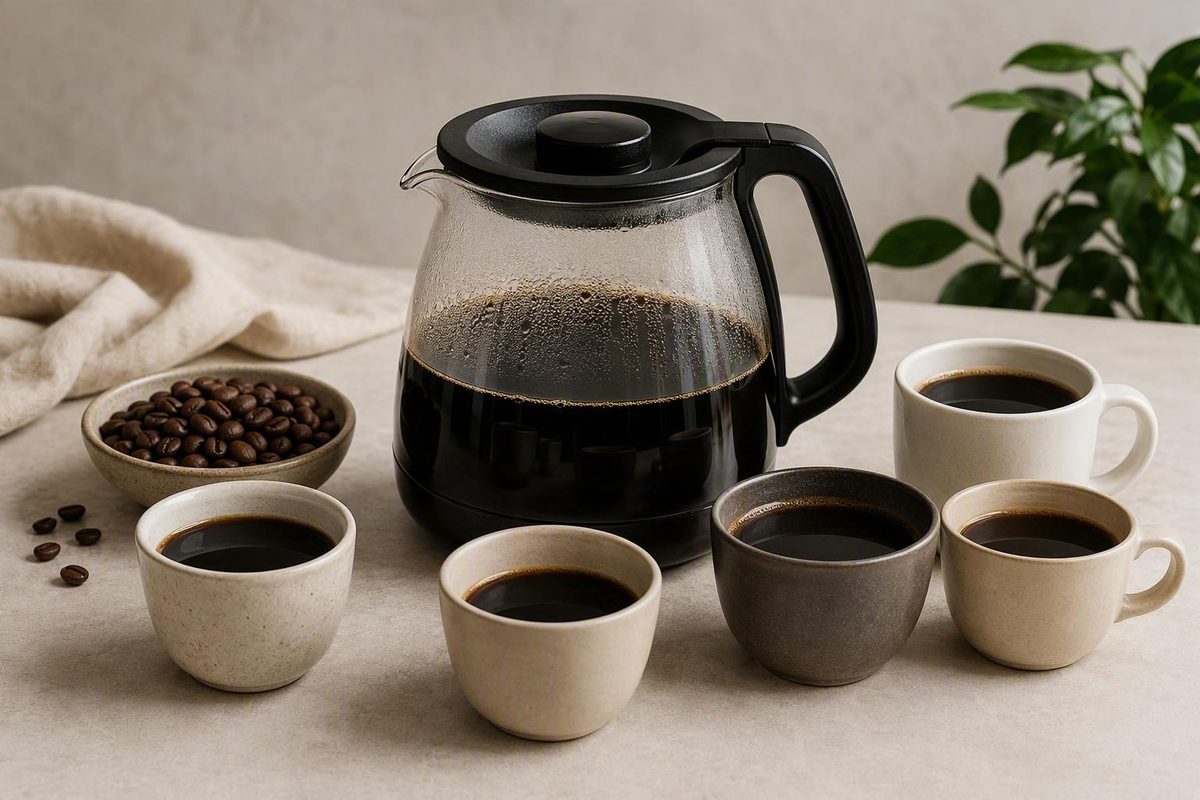
Understanding how much caffeine is in a pot of coffee

There is no single caffeine amount for “a pot of coffee.” The practical answer is:
Total caffeine in the pot = finished coffee volume ÷ reference serving volume × caffeine per reference serving
To calculate it accurately, identify the pot’s finished volume and use a caffeine value that matches the coffee, recipe, and brewing method as closely as possible. Do not rely on the machine’s cup count alone, and do not confuse caffeine in the entire pot with the amount one person actually drinks.
What how much caffeine is in a pot of coffee means
A “pot” is not a standardized serving. It can mean a full carafe, a partially filled brewer, or simply the amount prepared in one batch. Likewise, a brewer’s numbered cup markings may not match the drinking mug you use.
The question therefore contains three separate quantities:
- The volume brewed: How much finished coffee is actually in the carafe?
- The caffeine concentration: How much caffeine is present per ounce, milliliter, or stated serving?
- The amount consumed: What share of the pot does one person drink?
Keeping these quantities separate prevents the most common mistake: finding a caffeine figure for one serving and treating it as the figure for the entire pot.
For example, suppose a verified label or database entry reports 100 milligrams per 8-ounce serving for the coffee you are using. If the finished pot contains 64 ounces, the arithmetic would be:
64 ÷ 8 × 100 = 800 milligrams in the pot
That is an illustration of the calculation, not a universal estimate for brewed coffee. A different coffee, recipe, serving definition, or finished volume can produce a different result.
How how much caffeine is in a pot of coffee works
Caffeine in a brewed pot depends on both the ingredients and the preparation. Relevant variables include the amount and type of coffee, the amount of water, grind, brew method, and extraction conditions. That is why pot capacity alone cannot determine the answer.
Start with a caffeine value expressed in a usable unit. It might be listed as:
- Milligrams per serving
- Milligrams per fluid ounce
- Milligrams per 100 milliliters
- Milligrams for a specific prepared product or recipe
Then convert the pot and the reference value to matching units.
If your source provides caffeine per serving:
Pot caffeine = (finished pot volume ÷ source serving volume) × caffeine per serving
If your source provides caffeine per ounce:
Pot caffeine = finished ounces × caffeine per ounce
If your source provides caffeine per 100 milliliters:
Pot caffeine = finished milliliters ÷ 100 × caffeine per 100 milliliters
Use the finished beverage volume rather than automatically using the amount of water poured into the brewer. Some water may remain in the grounds or brewing system, so those two measurements are not always identical.
After calculating the full-pot total, calculate personal intake separately:
Personal caffeine intake = pot caffeine × proportion of pot consumed
If three people split a pot unevenly, dividing the total by three will not describe any one person’s intake accurately. Measuring each mug is more useful.
The main approaches
The best approach depends on whether you want a quick estimate, a repeatable household number, or a precise measurement.
| Approach | What you need | Best use | Main limitation |
|---|---|---|---|
| Serving-based calculation | Finished volume and caffeine per serving | Quick estimate | Depends on how closely the reference matches your coffee |
| Recipe-specific estimate | Coffee amount, water, method, and matching reference | Regular home brewing | Brewing differences still create uncertainty |
| Product-specific value | Information for the exact prepared coffee | Packaged or standardized products | May not apply after changing the recipe |
| Laboratory measurement | A sample from the brewed batch | Highest-confidence answer | Usually impractical for routine use |
For most readers, the serving-based calculation is the sensible starting point. Its quality depends on selecting the right reference. A value for an unrelated brewing method, restaurant drink, concentrate, or ready-to-drink product should not automatically be transferred to a home drip-coffee pot.
A recipe-specific estimate is better when you brew the same coffee repeatedly. Record the exact bean or blend, amount of grounds, water, brewer settings, and finished yield. This will not eliminate uncertainty, but it makes comparisons between batches more meaningful.
If the exact number matters because you are following individualized medical guidance or responding to unusual symptoms, a generic online estimate is not an adequate substitute for advice from a qualified healthcare professional.
A practical process
Use this process to estimate both the pot total and your own intake.
1. Measure the finished pot
Brew coffee normally, then determine how much drinkable coffee the batch produced. Use fluid ounces or milliliters rather than relying only on the carafe’s cup numbers.
If you do not want to transfer hot coffee into a measuring vessel, check the brewer manual for the capacity represented by its markings. Use instructions for the exact model rather than assuming that another machine defines a cup in the same way.
2. Identify the exact coffee and recipe
Record enough detail to avoid mixing unlike products:
- Regular or another caffeine formulation
- Ground coffee amount
- Water amount
- Brewing method
- Brand, blend, or bean type when known
- Any concentrate-to-water dilution
The objective is not to model every extraction variable. It is to choose a reference that resembles what you actually brewed.
3. Find a compatible caffeine value
Prefer a value for the exact prepared product. If that is unavailable, use the closest credible match and preserve its serving size.
Do not copy only the number of milligrams. A figure without its corresponding volume cannot be converted into a pot total.
4. Calculate a range when needed
If credible references provide different values, calculate a low and high scenario rather than averaging them without explanation.
For a 60-ounce finished pot, for example:
| Scenario | Reference concentration | Calculation | Pot total |
|---|---|---|---|
| Lower assumption | 10 mg per ounce | 60 × 10 | 600 mg |
| Higher assumption | 15 mg per ounce | 60 × 15 | 900 mg |
These figures demonstrate range arithmetic only; they are not recommended default concentrations. Replace them with values appropriate to your coffee.
5. Calculate what you drank
Measure your mug or use its known capacity. Then multiply caffeine per ounce by the ounces consumed. If you refill the mug, count every refill.
This final step usually matters more than the full-pot figure. A carafe shared by several people does not represent one person’s exposure.
Common mistakes and tradeoffs
Treating “12 cups” as twelve drinking mugs. Brewer markings and household mugs may represent different volumes. Confirm the carafe’s actual capacity.
Using water added instead of coffee produced. The finished yield may be lower than the starting water volume. Measure the brewed coffee when practical.
Using a generic serving without its size. “Caffeine per cup” is incomplete unless “cup” has a defined volume.
Mixing preparation methods. A caffeine value for a concentrate, café beverage, or another brewing system may not describe your pot.
Assuming identical results from every batch. Even when the nominal recipe stays constant, changes in grounds, grind, timing, or yield can affect the result. A calculated answer should be treated as an estimate unless the finished batch has been measured.
Confusing the pot total with personal consumption. Estimate your share based on actual ounces consumed, not an equal division unless the pot truly was divided equally.
There is also a tradeoff between convenience and precision. A generic reference produces a quick answer but carries more uncertainty. A tightly documented recipe improves repeatability but requires more work. Laboratory analysis offers the strongest measurement of a particular batch, but it is rarely necessary for ordinary household decisions.
False precision does not improve an estimate. If the inputs are approximate, report a rounded total or a range rather than an exact-looking figure.
How to choose the next step
For a practical household estimate, take these three actions:
- Measure or verify the finished pot volume.
- Find a caffeine-per-serving value that matches the prepared coffee.
- Apply the formula, then calculate the amount you personally drank.
If you only need to compare two brewing habits, consistency may be more valuable than an exact laboratory result. Use the same measuring method and the same type of reference for both batches.
If you are deciding whether to reduce your intake, track all servings rather than focusing on the coffee pot alone. Record the size and number of mugs you consume, along with caffeine from any other products you choose to include. When caffeine intake is being managed for a health condition, pregnancy, medication use, or clinician-directed limit, ask the relevant healthcare professional what limit and measurement method apply to you.
The concrete next step is simple: measure your usual finished batch in ounces or milliliters. Once you have that number and a matching caffeine value, the full-pot calculation takes one line.
What should a beginner know about how much caffeine is in a pot of coffee?
A beginner should know that “pot” and “cup” are not sufficiently precise measurements. Start with the finished volume of coffee, then multiply it by a caffeine concentration that matches the coffee and brewing method.
Keep the whole-pot total separate from personal intake. If you drink two mugs from a shared carafe, calculate those two mugs rather than assigning yourself the entire pot.
What are the main risks of how much caffeine is in a pot of coffee?
The main calculation risks are underestimating the pot’s volume, using a caffeine figure with an undefined serving size, applying data from a different preparation method, and assuming the whole pot was consumed by one person.
There is also a decision-making risk in treating an estimate as an exact measurement. Use a range when the source value or brewing conditions are uncertain. Seek individualized professional guidance when your caffeine intake is subject to a medical limit.
How do you evaluate how much caffeine is in a pot of coffee options?
Compare options using the same units and the same finished volume. For each coffee or brewing method, note:
- Caffeine per defined serving
- Reference serving volume
- Finished pot volume
- Recipe and brewing method
- Your actual portion of the batch
A useful option is not necessarily the one with the most precise-looking number. It is the one whose caffeine value most closely matches the coffee you prepare and whose assumptions you can verify.