
How Much Lactose Is Really in Parmesan Cheese—and Can You Eat It?
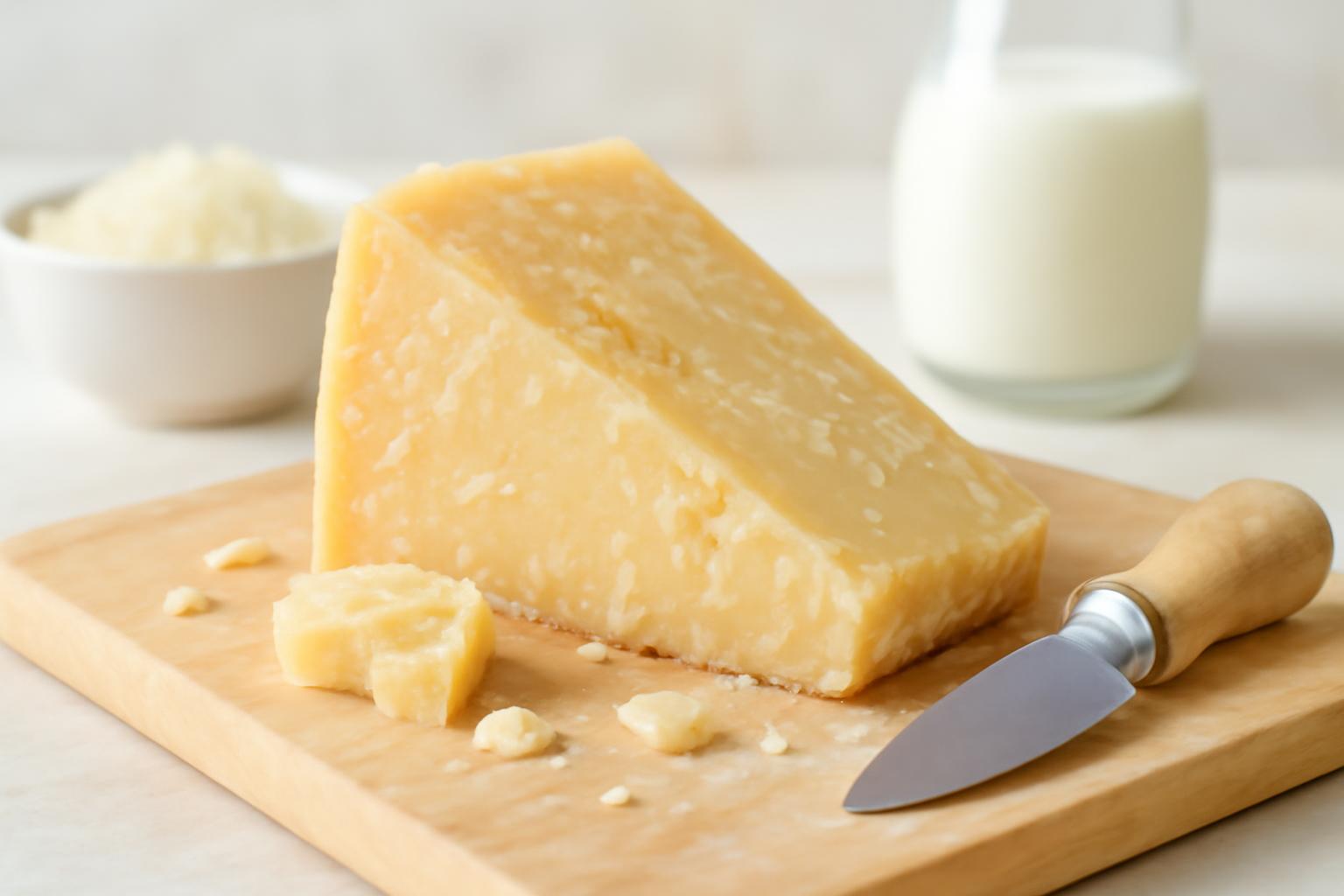
Even after aging, Parmesan products differ by brand, process, moisture and testing, so the exact lactose amount remains product-specific.
Yes—Parmesan cheese does come from milk, so it begins life with lactose. But aged Parmesan is widely reported to contain very little lactose because most of that milk sugar leaves with the whey during cheesemaking, and much of the remainder is broken down during aging. That is why many people with lactose intolerance can eat aged Parmesan without symptoms.
The catch is that the exact amount is not settled across all products. Different consumer tables and brand-backed guides report everything from 0 g per 30 g serving to broader ranges such as 0.1 to 1 g per 100 g or even 0 to 3 g per 100 g. Those differences reflect serving size, aging time, rounding, and the fact that much of the available information comes from rough tables or commercial sources rather than brand-by-brand lab testing.
So the practical answer is this: aged Parmesan is usually a low-lactose cheese, but not a universally zero-lactose one. If you are lactose intolerant, the most reliable approach is to favor well-aged products, read the label carefully, and test your own tolerance with a small portion.
What Is Lactose and Why Check Parmesan?
Lactose is the natural sugar in milk and dairy foods. To digest it properly, your small intestine needs enough of the enzyme lactase. When lactase levels are low, lactose is not fully broken down in the small intestine. It passes into the large intestine, where gut bacteria ferment it. That is what can lead to bloating, gas, cramps, and diarrhea.
Several sources in the evidence pack describe the same basic mechanism, including the Canadian Digestive Health Foundation, IQWiG’s consumer guidance published through NCBI Bookshelf, and other lactose-intolerance education resources. They also agree on one important point: tolerance varies a lot from person to person. One consumer resource says many people tolerate around 6 to 12 g of lactose in one sitting, while another says many tolerate up to 10 g without major symptoms. Those numbers are useful as broad context, not as a guarantee.
Why does this matter for Parmesan specifically?
Because cheese is not all the same. Hard, aged cheeses are very different from fresh dairy foods when it comes to lactose. Milk is naturally high in lactose. Fresh cheeses and soft cheeses generally keep more moisture and more of the milk sugar. Parmesan, by contrast, is a hard, aged cheese. It loses whey early, dries out over time, and undergoes long fermentation and maturation.
That makes Parmesan relevant to two groups at once:
- People with lactose intolerance who want to know whether it is likely to trigger symptoms.
- Macro and calorie trackers who are trying to decide whether Parmesan is worth keeping in rotation rather than avoiding dairy altogether.
It is also worth checking because lactose is usually not declared directly on food labels. You may see calories, fat, protein, carbohydrate, sugars, and ingredients—but not a dedicated lactose line. That means you often have to infer risk from a combination of clues: cheese type, age, ingredient list, and your own reaction.
A few practical points follow from that:
- Parmesan is often eaten in small amounts, which may make it easier to tolerate than a big glass of milk.
- But “small amount” is not the same thing as “zero risk.”
- If you are very sensitive, even trace amounts can matter.
- If you are tracking food intake, it is better to treat Parmesan as probably low lactose, but product-dependent, rather than assuming every Parmesan is identical.
There is also an important distinction between lactose intolerance and milk allergy. This article is about lactose, the sugar in dairy—not milk-protein allergy. If you have a diagnosed milk allergy, Parmesan is still a dairy product and should not be treated as automatically safe.
How Aging Reduces Lactose in Parmesan
The reason Parmesan is usually lower in lactose than milk or fresh cheese is not mysterious. It is built into how cheese is made.
Cheesemaking separates milk into curds and whey. Multiple sources in the evidence pack—including GoodRx, Cabot Creamery’s lactose education page, and Gardners Wisconsin Cheese—make the same point: most of the lactose stays in the whey, which is drained off early in the process. That means the curds start with much less lactose than the milk they came from.
From there, aging does the rest.
Parmesan is a long-aged cheese. Several sources describe Parmesan as typically matured for about 12 to 36 months, while authentic Parmigiano-Reggiano must be aged for at least 12 months. During this period, bacteria and enzymes continue to act on the cheese. Residual lactose is converted into lactic acid and other compounds associated with flavor and texture.
That is why older cheeses tend to be easier for lactose-intolerant people than younger ones. The pattern shows up repeatedly across the evidence pack:
- GoodRx explains that longer aging means more lactose breakdown.
- The Canadian Digestive Health Foundation says hard aged cheeses like Parmesan generally contain less lactose than soft cheeses.
- Cabot’s educational guide says cheeses aged 8 months or longer are likely safer choices for lactose intolerance.
- Consumer-oriented Parmesan articles describe the cheese as “very low,” “minimal,” or “negligible” in lactose after long aging.
That does not mean every Parmesan-style product lands at the same numeric level. Aging helps, but products still differ by brand, process, moisture, and how specifically the manufacturer defines and tests the product.
It also explains why Parmesan behaves differently from fresher cheeses. Compare the general pattern in the evidence:
- Fresh or soft cheeses: more lactose retained
- Hard, aged cheeses: less lactose retained
- Longer-aged hard cheeses: generally least lactose
This is the most reliable big-picture takeaway in the entire source set. Even when the exact numbers disagree, the direction of the effect does not. Parmesan is low in lactose mainly because of two steps happening together:
- Whey removal
- Extended aging and bacterial breakdown
That is also why aging information matters so much more than marketing shortcuts. If you know a cheese is genuinely long-aged, you have a stronger reason to expect low lactose. If you only know it says “Parmesan-style” or comes pre-shredded in a tub, you know less.
Some consumer sources go so far as to call aged Parmesan “naturally lactose-free” or “virtually lactose-free.” Those phrases capture the real trend, but they can overstate certainty. Since other sources still report small nonzero amounts, the safer editorial wording is: aged Parmesan is usually very low in lactose, often at trace levels, but exact amounts vary.
Reported Lactose Levels in Parmesan: A Range Comparison
This is where the topic gets tricky.
If you search for a single number for Parmesan lactose, you will find several different answers. The evidence pack itself contains a broad spread of reported figures. Rather than hiding that disagreement, it is better to show it clearly.
| Source | Reported lactose figure for Parmesan | Basis | Important caveat |
|---|---|---|---|
| Tummy MOT | Less than 0.01 g | Per 100 g | No underlying analysis cited |
| Gardners Wisconsin Cheese | Less than 0.1 g | Per serving | Serving size not specified |
| Gardners Wisconsin Cheese | Typically below 0.1 g | Per 100 g after 12+ months | Commercial cheese seller |
| IQWiG / InformedHealth via NCBI Bookshelf | 0 g | Per 30 g serving | Presented as a rough estimate table |
| Food Intolerance Diagnostics | 0.1 to 1 g | Per 100 g | Range, not product-specific lab data |
| Arla UK cheese chart | 0 to 3 g | Per 100 g | Broad range across products and processes |
| U.S. Dairy lactose guide | Less than 1 g | Per 1.5 oz serving, “hard or grated” Parmesan | Applies to natural cheese category, not every individual product |
At first glance, these numbers look contradictory. In reality, they are usually describing different things:
- different serving sizes
- different rounding rules
- different cheese ages
- different production methods
- different data quality
For example, 0 g per 30 g serving in a consumer table does not necessarily prove a product is chemically free of lactose. It may mean the amount is below the table’s reporting threshold, rounded down, or simply estimated as negligible for that portion size. IQWiG’s own presentation is consumer guidance, not a brand-by-brand analytical database.
On the other end, 0 to 3 g per 100 g is a wide category range. It likely includes differences in maturation and product type rather than implying that a well-aged wedge of Parmesan routinely behaves like a fresher cheese.
The weaker figures also deserve to be called out honestly. One low number—less than 0.01 g per 100 g—appears in a consumer article that does not cite the lab basis for that exact value. Another source gives less than 0.1 g per serving without defining the serving. Those numbers may be directionally useful, but they are not strong enough to treat as universal facts.
So how should a careful reader interpret all this?
The best-supported synthesis is:
- Aged Parmesan is usually low in lactose
- Longer aging generally means less lactose
- Small servings are often reported as zero or trace
- Per-100-gram values vary across sources
- No single number should be assumed for every Parmesan product
That is why this article avoids derived math like “therefore a 20 g serving must contain X grams of lactose.” The source set simply is not precise enough for that kind of calculation.
If you want one practical takeaway from the comparison, it is this: Parmesan belongs in the low-lactose cheese category, but the exact figure depends on the product and source you trust.
Authentic Parmigiano-Reggiano vs. Generic Parmesan
Many readers are not just asking whether Parmesan has lactose. They are asking whether real Parmigiano-Reggiano is a safer bet than generic Parmesan.
Here, the evidence supports a careful answer—not a sweeping one.
Authentic Parmigiano-Reggiano follows a protected production system. The evidence pack notes that it must comply with legal restrictions related to region, production method, and aging, and that it is aged for at least 12 months. Some sources aimed at Italian cheese enthusiasts recommend older Parmigiano-Reggiano—often 24 months or more—for people who are lactose intolerant.
What that tells you is not that Parmigiano-Reggiano is automatically lower in lactose than every generic Parmesan. The evidence does not establish that as a guaranteed comparative fact. What it does tell you is that authentic Parmigiano-Reggiano gives you clearer aging standards. That makes it easier to infer that extended maturation has taken place.
Generic “Parmesan” is a broader category. It may be excellent or mediocre. It may be aged a long time or a shorter time. It may be sold as a solid wedge, a pre-grated shaker cheese, or a shredded blend. Because the category is less tightly defined, lactose predictability is lower unless the package gives you more detail.
That is the real distinction:
- Parmigiano-Reggiano: clearer standards, minimum aging known
- Generic Parmesan: more variable, so label details matter more
What about grated versus block Parmesan?
The evidence here is limited but useful. Arla’s lactose guide says grating itself does not change lactose content, and the U.S. Dairy lactose guide groups Parmesan (hard or grated) together at less than 1 g lactose per 1.5 oz serving. That suggests the physical act of grating is not the key issue.
But that does not mean every pre-grated Parmesan product is nutritionally identical to every block. The bigger concerns are:
- what cheese was used
- how long it was aged
- whether other dairy-derived ingredients were added
- whether anti-caking agents or blends make the product less transparent
So if your goal is the lowest-lactose, easiest-to-evaluate choice, a simple aged wedge is often the clearest purchase—not because blocks are proven lower in lactose, but because the ingredient list and product identity are usually easier to assess.
If you are shopping for authentic Parmigiano-Reggiano, look for the official designation and any aging information the package provides. The value there is traceability, not a blanket guarantee.
Is Aged Parmesan Safe for Lactose-Intolerant Trackers?
For many people, yes—aged Parmesan is one of the better dairy choices to test.
Several sources in the evidence pack say that many lactose-intolerant people can tolerate aged hard cheeses such as Parmesan, cheddar, and Gouda. GoodRx lists Parmesan among low-lactose cheeses. The Canadian Digestive Health Foundation notes that most lactose-intolerant people can handle aged cheeses better than soft ones. Cabot’s low-lactose cheese guide includes Parmesan on its recommended list. Consumer-oriented Parmesan articles make similar claims, usually with the caveat that individual tolerance differs.
That caveat matters.
“Many people tolerate it” is not the same as “everyone will.” Aged Parmesan is a good candidate, not a guarantee. The main reasons it often works are the same ones already discussed:
- most lactose leaves with the whey
- long aging reduces what remains
- portions are often small
For a macro tracker, there is a practical advantage here. Parmesan is usually used as a measured add-on—grated over pasta, salads, eggs, vegetables, or soups—rather than consumed in a large standalone serving. That makes it easier to test in a controlled way.
A good self-test looks like this:
- Pick an aged Parmesan product with a simple ingredient list.
- Start with a small portion, ideally with a meal rather than on an empty stomach.
- Log the brand and amount you used.
- Track symptoms over the next several hours.
- If that goes well, repeat on another day before assuming broad tolerance.
This kind of portion-and-symptom testing is more useful than relying on internet absolutes. It also fits how calorie and macro trackers already think: specific food, specific portion, repeatable observation.
Relative to other dairy foods, Parmesan is usually a better bet than:
- milk
- cream cheese
- ricotta
- cottage cheese
- fresh mozzarella
- soft spreadable cheeses
And it is broadly comparable, as a low-lactose category choice, to other aged cheeses such as cheddar, Gouda, and Swiss.
One more caution: if you are not just lactose intolerant but highly sensitive, or if past reactions have occurred even with aged cheeses, do not let the phrase “virtually lactose-free” lull you into assuming safety. Some people react to very small amounts, and the available data are not precise enough to promise symptom-free use.
Reading Labels for Parmesan Lactose and Calories
Food labels can help, but they have limits.
According to IQWiG’s shopping guidance, packaged foods are required to show ingredients and nutrition information such as calories. CaloriePages’ own about page also notes that nutrition labels are measured numbers, not perfect truths, and that calorie counts can be off by up to 20%. For tracking purposes, the label is still your best practical tool—you just should not treat it as laboratory certainty.
What the label can tell you
For lactose questions, the most useful parts of the package are:
- product name
- ingredient list
- serving size
- nutrition panel
- any statement about aging
- any explicit lactose-free claim, if present
What the label usually cannot tell you
In many countries, lactose does not have to be listed as a separate line item. That means you may know total carbohydrate or sugars, but not exactly how much of that is lactose.
That is why the ingredient list matters so much.
Both IQWiG and clinical patient handouts in the evidence pack recommend checking packaged-food labels for dairy-derived ingredients that may signal lactose-containing components. Examples include:
- milk
- cheese
- milk solids
- nonfat milk solids
- powdered milk
- whey
- whey solids
- whey protein concentrate
A useful nuance from the Arnold Palmer Hospital handout: some milk-derived ingredients do not contain lactose, including:
- casein
- lactalbumin
- lactate
- lactic acid
So “contains a milk-derived word” is not always the same as “contains lactose.”
Is the carbohydrate line helpful?
Sometimes—but only as a rough screening clue.
Very low total carbohydrate or sugar numbers can support the idea that a hard aged cheese is low in lactose. But this is not a perfect verification method because:
- labels round
- carbohydrate conventions vary
- lactose may not appear clearly on the panel
- different serving sizes can make tiny numbers look like zero
So use the carb line as a secondary hint, not the decisive test.
What to prefer if you are lactose intolerant
The most reader-useful label strategy is usually:
- choose a hard, aged Parmesan
- prefer a simple ingredient list
- be cautious with products that add whey, milk solids, or other dairy blends
- use the package’s serving size for your own tracking
- if possible, choose products that state aging or clearly identify themselves as authentic Parmigiano-Reggiano
What about calorie tracking?
Because serving sizes differ so much—a light sprinkle versus a heavy shave can be very different—the label on your actual package is more useful than a generic internet number. And since labels can carry known error, consistency matters more than false precision. If you always use the package value for the same product and weigh your portion, your log will be more useful than chasing a universal “true” Parmesan calorie count.
Parmesan in Low-Lactose Diets: Macros and Serving Tips
If your goal is to keep lactose low while still tracking food accurately, Parmesan can fit well—but only if you treat it as a specific product, not a generic idea.
The evidence pack does not support one universal calorie or macro number for all Parmesan products, so the most defensible advice is practical rather than abstract: use the package you bought.
Here is how to make Parmesan easier to fit into a low-lactose tracking system.
1. Start with realistic serving sizes
Parmesan is often used in modest amounts. The evidence pack includes lactose figures for 30 g servings and 1.5 oz servings, but daily use is often smaller than that. That makes it a sensible food to test gradually.
A reasonable approach is:
- start with a light sprinkle or small weighed portion
- if tolerated, move to the amount you actually use in meals
- keep the brand consistent while testing
The point is not that one magic serving is safe. It is that smaller, measured portions make feedback clearer.
2. Log the actual product, not a random database entry
Because lactose reporting varies so widely, database entries for “Parmesan cheese” can hide important differences. Better options are:
- scan or enter the exact branded product if available
- match serving size to the package
- note whether it is a wedge, grated product, or Parmigiano-Reggiano
- keep your own notes on tolerance
For someone balancing symptom management and calorie tracking, this is much more useful than a generic app average.
3. Rotate within the aged-cheese category if needed
If Parmesan works for you, great. If not, the evidence pack suggests other aged cheeses may still be options. Sources describe aged cheddar, Gouda, Swiss, and other hard cheeses as low-lactose choices too.
Here is a reader-friendly comparison based only on the evidence provided:
| Cheese type | Reported lactose pattern in the evidence | Practical takeaway |
|---|---|---|
| Parmesan | Reported from 0 g per 30 g to ranges up to 0–3 g per 100 g | Usually low lactose, but exact amount varies |
| Aged cheddar | Reported as very low, including 0.1 g per 100 g in one consumer source and less than 0.1 g per 1 oz in another | Good comparison point for aged hard cheese tolerance |
| Swiss | Reported as 0 g per 30 g in one table and 0–1 g per 100 g in another chart | Another common low-lactose hard cheese |
| Gouda | Listed among lower-lactose aged cheeses; one chart gives 0–2 g per 100 g | Often worth testing if Parmesan does not suit you |
| Fresh mozzarella | One source gives 0.9 g per oz | Useful reminder that not all cheese behaves like Parmesan |
The useful lesson is not that every aged cheese is identical. It is that age and firmness usually matter more than the cheese name alone.
4. Use symptom tracking alongside food tracking
This is especially important if you are testing a borderline food. A note as simple as this can be enough:
- product:
- portion:
- meal:
- symptoms:
- time after eating:
That turns a vague impression into something actionable.
5. Do not confuse low lactose with low calorie
These are separate questions. A cheese can be low in lactose and still contribute meaningful calories. That is another reason to rely on the actual package label rather than the phrase “aged Parmesan” as if it answers everything.
Caveats: When Parmesan Might Not Work
Even though aged Parmesan is often a good option for lactose intolerance, there are several reasons it may still cause problems.
1. Not all Parmesan products are aged the same way
This is one of the biggest reasons the numbers vary. Some products are clearly long-aged. Others are not transparent about age. If aging is shorter, lactose may be higher.
2. Processed or blended products can change the picture
A hard wedge with a simple ingredient list is easier to evaluate than a shelf-stable grated product or processed cheese blend. If whey, milk solids, or other dairy components are added, lactose risk may be less predictable.
3. Grating is not the main issue—product type is
The limited evidence suggests grating itself does not meaningfully change lactose. But grated products may still differ because of added ingredients, different source cheese, or unclear aging.
4. “Lactose-free” is not a universal standard
Arla’s guidance notes that the definition of “lactose-free” can differ by country. So even if a phrase sounds reassuring, check the local label and do not assume every market uses the same threshold.
5. Your tolerance may be much lower than the average
Broad tolerance guides are just that—broad. Some people handle aged cheese easily. Others react to much smaller amounts. Repeatedly pushing a food because it is “supposed” to be tolerated is not useful if your own body says otherwise.
6. Lactose intolerance is not the only reason cheese can cause symptoms
If Parmesan bothers you, lactose may not be the only explanation. Total fat, portion size, other foods in the meal, or non-lactose digestive issues can also matter. And again, milk allergy is a different issue entirely.
This article is for general informational purposes only and does not constitute medical or dietary advice. If you have significant symptoms, a diagnosed condition, or uncertainty about whether you are dealing with lactose intolerance, a milk allergy, or another digestive issue, speak with a physician or registered dietitian.
Does Parmesan cheese have zero lactose?
Not reliably as a universal claim. Some consumer tables list Parmesan at 0 g per 30 g serving, while other sources report small nonzero amounts, including ranges such as 0.1 to 1 g per 100 g or 0 to 3 g per 100 g. The safest conclusion is that aged Parmesan is usually very low in lactose, but not proven to be zero across all products.
How much Parmesan can a lactose-intolerant person eat?
There is no one safe amount for everyone. Some lactose-intolerance resources say many people tolerate roughly 6 to 12 g of lactose in a sitting, or around 10 g, but Parmesan-specific tolerance still depends on the product and on your own sensitivity. A practical approach is to start with a small measured portion, take it with a meal, and track symptoms before increasing the amount.
Is grated Parmesan higher in lactose than block?
The limited evidence does not suggest that grating itself raises lactose. One lactose guide says grating does not change lactose content, and a U.S. Dairy guide groups hard or grated Parmesan together. But that does not make all grated products equivalent to all blocks, because age, ingredients, and processing can differ. The more important question is what cheese is in the package and what else was added.
What is the calorie count for Parmesan per serving?
There is no single evidence-backed number that fits every Parmesan product and every serving size in the source pack. Packages list calories per serving and per 100 g, but serving sizes differ, and nutrition labels can carry known error. For tracking, the best answer is: use the calories on your actual package and weigh the amount you eat.
How to spot low-lactose Parmesan on labels?
Look for a hard, aged Parmesan with a simple ingredient list. Aging information or authentic Parmigiano-Reggiano identification is helpful because it makes long maturation more likely. Be cautious with products listing whey, milk solids, or dairy blends. A very low carb or sugar line can support the picture, but it is only a rough clue because lactose is not always declared separately and labels can round small amounts.
Aged Parmesan is one of the stronger low-lactose candidates in the cheese world, but the honest evidence-based answer is not “always zero” or “safe for everyone.” It is this: long-aged Parmesan is usually low in lactose, many people with lactose intolerance tolerate it, and the smartest way to use it is to verify the product, read the label, and test your own response.