
Elephant Ear Mushroom: Identification and Uncertain Edibility
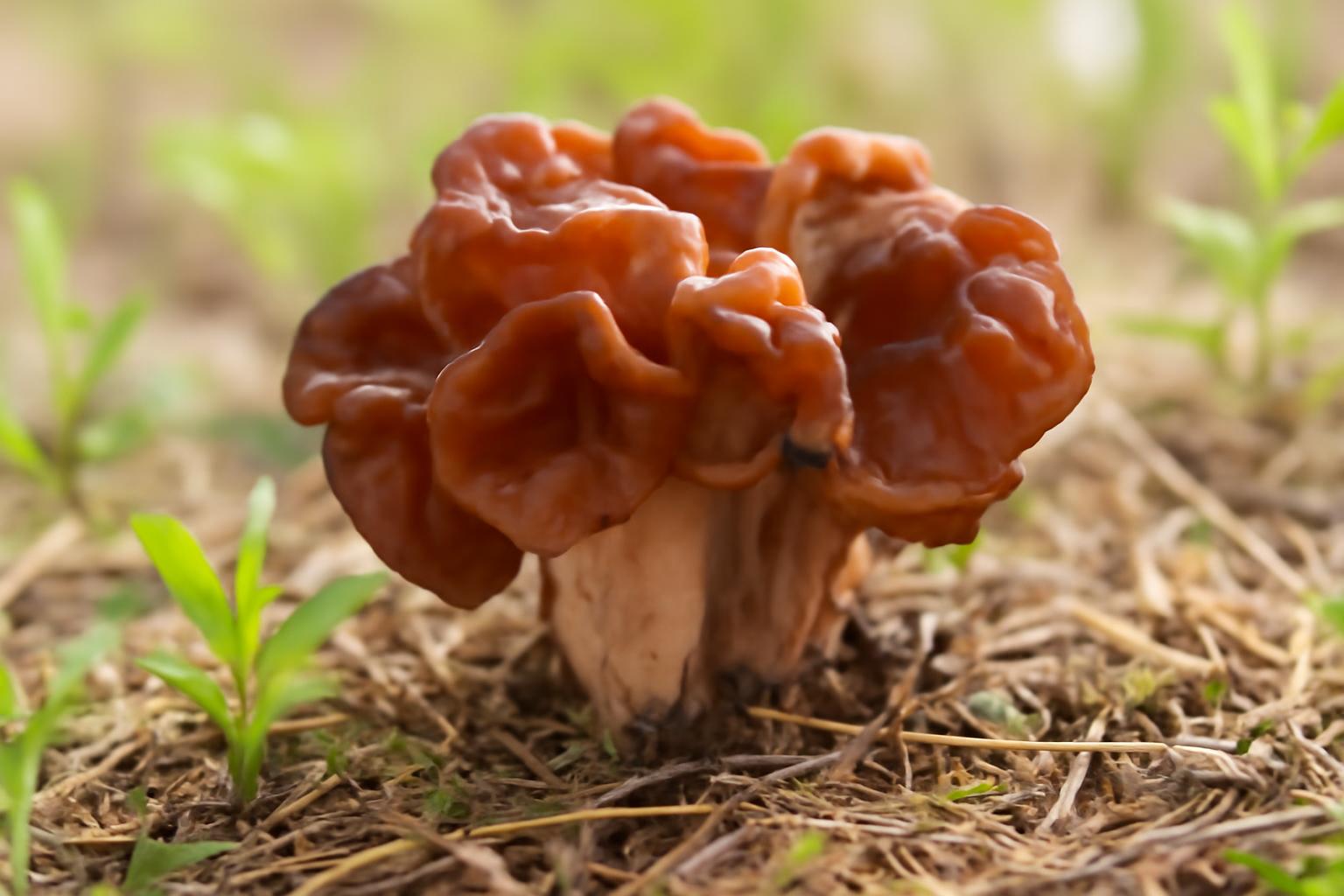
Cleaning guidance is practical, but available evidence does not establish any cooking protocol proven to make Gyromitra brunnea safe for consumption.
Overview
In a foraging context, the elephant ear mushroom usually means Gyromitra brunnea, also called the elephant ear false morel or gabled false morel. It is a spring mushroom with an irregular, lobed brown cap and a chambered interior. Its edibility is disputed, and the available evidence does not establish a proven safe preparation method.
The “false morel” label reflects its resemblance to true morels in season and general form, not membership in the same genus. True morels belong to Morchella, while G. brunnea belongs to Gyromitra. According to Forager Chef, the cap can resemble two or more wrinkled ears pressed together above a broad stem. Cutting the mushroom lengthwise reveals chambers rather than the continuously hollow interior expected of a true morel.
The common name needs context. “Elephant ear” can also be used for unrelated organisms, including aquarium corals and other mushrooms with ear-like forms. Foragers using the name usually mean G. brunnea, but a common name alone cannot establish identity.
Safety requires the same species-level precision. Editorial sources report a history of eating G. brunnea, while medical literature documents significant poisoning from gyromitrin-associated mushrooms, especially G. esculenta. Those bodies of evidence do not resolve the toxin content or safety of authenticated G. brunnea. A plausible identification is therefore only the first decision, not permission to eat the specimen.
How to identify an elephant ear mushroom
Identification of an elephant ear mushroom rests on a combination of cap shape, color, stem proportions, interior anatomy, season, and habitat. No single feature is sufficient to establish that a wild specimen is Gyromitra brunnea, particularly when the decision may lead to consumption.
The cap is irregularly lobed rather than uniformly shaped. Forager Chef describes it as resembling two or more wrinkled ears pushed together, although some specimens can be comparatively smooth. The reported color ranges from tan to reddish brown. This ear-like or gabled appearance is more useful than calling every convoluted cap “brain-like,” because another false morel, G. esculenta, is described as more evenly wrinkled and brain-like.
The stem is pale and relatively broad. Mushroom Appreciation describes the stem as approximately as wide as the head, in contrast with the thinner stem attributed to G. esculenta. The flesh may be whitish or flushed with rose, and it is extremely brittle. Handling damage can therefore obscure features before a specimen is examined.
The most decision-useful check is a complete lengthwise cut. Both Forager Chef and Mushroom Appreciation describe G. brunnea as chambered inside. The stem may also contain white, cottony pith. That internal structure differs from the hollow interior of a true morel.
A practical field assessment should consider the following clues together:
- An irregular cap with broad, ear-like lobes
- Tan to reddish-brown cap coloration
- A broad, pale stem rather than a conspicuously thin one
- Brittle, pale flesh
- Multiple internal chambers when cut from top to bottom
- Spring growth in hardwood habitat, often around dead wood
These characteristics can support an identification, but they do not prove edibility. Photographs that omit the base, stem proportions, or cut interior leave important uncertainty unresolved. A specimen being chambered establishes that it is not built like a true morel, but chambering alone does not determine which false morel species it is.
Field comparison with true morels and other false morels
The most useful comparison separates external appearance from internal anatomy. G. brunnea, true morels, and G. esculenta overlap enough in season and general form that a casual view from above can be misleading.
| Field criterion | Gyromitra brunnea | True morels (Morchella species) | Gyromitra esculenta |
|---|---|---|---|
| Cap form | Irregularly lobed, often resembling two or more wrinkled ears; some specimens are smoother | The supplied evidence establishes resemblance to false morels but does not provide a complete cap diagnosis | More evenly wrinkled and brain-like than G. brunnea |
| Reported cap color | Tan to reddish brown | Not specified in the supplied comparison evidence | Much darker reddish brown |
| Stem | Broad and pale, described as about as wide as the head | The supplied evidence does not provide a complete external stem comparison | Thinner than the stem of G. brunnea |
| Cut interior | Chambered, sometimes with white cottony pith | Hollow rather than chambered | Not specified in the supplied evidence |
| Decision value | The combined ear-like cap, broad stem, and chambered interior support identification | A continuously hollow interior separates a true morel from the chambered G. brunnea described here | The thinner stem and darker, more evenly brain-like cap support separation from G. brunnea |
This matrix is intentionally limited. The supplied evidence names G. korfii and G. caroliniana as relevant comparisons but does not provide enough authenticated diagnostic detail to assign them reliable field rows. A specimen suspected to be either species requires additional evidence rather than an improvised comparison.
Species-level identification matters because toxicity evidence is not distributed evenly across Gyromitra. The 19-year poison-center assessment primarily concerned G. esculenta, not G. brunnea. A warning derived from G. esculenta cannot automatically quantify the risk of G. brunnea, but a favorable claim about one alleged “safer” false morel cannot be extended across the genus either.
Where and when Gyromitra brunnea grows
Gyromitra brunnea is a spring-fruiting mushroom of hardwood habitat in eastern and midwestern North America. Its season overlaps with morel season, which helps explain both its discovery by morel hunters and its potential to be confused with true morels.
Forager Chef reports it from eastern North American hardwood forests around dead or dying elms, cottonwoods, stumps, and downed trees. Mushroom Appreciation similarly places it primarily under hardwoods near stumps and fallen wood, with a distribution across midwestern and eastern states. These observations support a regional hardwood pattern, not a claim that the species occurs beside every listed tree or throughout all of North America.
Its ecological relationship with trees and wood is not completely settled in the supplied corpus. Mushroom Appreciation describes the species as officially saprobic but potentially mycorrhizal. Alden Dirks also characterizes it as saprotrophic and possibly mycorrhizal with oaks. The cautious conclusion is that it is associated with hardwood settings and dead organic material, while the precise ecological mode remains uncertain.
Season and habitat strengthen an identification only when they agree with anatomy. A spring mushroom beside a hardwood stump is not necessarily G. brunnea, just as a lobed brown cap outside the reported region is not confirmed by appearance alone.
For a morel hunter who does not intend to eat false morels, the find can still be informative. G. brunnea shares spring hardwood environments with morels, so its presence indicates that the observer is searching in broadly plausible morel habitat. It does not prove that true morels are nearby.
Is the elephant ear mushroom edible or poisonous?
The supplied evidence does not justify a simple declaration that Gyromitra brunnea is either safely edible or uniformly poisonous. Editorial sources describe historical consumption and disagreement about its risk, while the medical evidence concerns gyromitrin-containing mushrooms generally and is dominated by G. esculenta. No supplied source establishes a safe toxin threshold for G. brunnea.
The clearest common warning is that raw or undercooked Gyromitra should be treated as hazardous. Forager Chef describes all Gyromitra as dangerously toxic when raw or undercooked. Mushroom Appreciation likewise states that most reported false-morel poisonings follow raw consumption or undercooking.
Those statements do not prove that cooking makes G. brunnea safe. They establish a hazard at one end of the preparation spectrum, not a validated endpoint at the other. Historical consumption is also evidence of practice, not a controlled demonstration that repeated or occasional consumption is harmless.
The chemical and clinical evidence requires careful attribution. A 2024 longitudinal poison-center assessment identifies gyromitrin as a clinically significant mycotoxin primarily associated with G. esculenta. Gyromitrin can yield monomethylhydrazine, a toxic metabolite associated with neurological injury. The study also reports that resemblance between false and true morels has led to toxic exposures after misidentification.
What remains absent is just as important. The supplied corpus contains no peer-reviewed measurements of gyromitrin or related hydrazines in authenticated G. brunnea specimens. It provides no preparation experiment demonstrating that a specified method reliably lowers those compounds below a defined safe threshold. It also provides no surveillance dataset capable of isolating the incidence or outcomes of G. brunnea ingestion.
The evidence-based conclusion is therefore limited: G. brunnea has a history of consumption, but that history does not establish safety. Genus-level warnings and G. esculenta poisoning data justify caution, yet they cannot quantify the species-specific risk of G. brunnea.
Four separate questions behind “edible or poisonous”
“Edible or poisonous” compresses four different judgments into one label. Each requires different evidence, and confidence in one cannot substitute for evidence about another.
-
How confident is the identification? A broad stem, lobed brown cap, chambered interior, spring season, and hardwood habitat can support G. brunnea. Uncertainty remains if the specimen has not been cut open or compared with other Gyromitra species.
-
What is the acute poisoning risk? Medical literature establishes that some gyromitrin-associated mushroom ingestions cause gastrointestinal, neurological, liver, or kidney effects. The available case data, however, are dominated by G. esculenta and do not quantify acute risk for G. brunnea.
-
Could repeated consumption create cumulative or delayed harm? A 1982 paper in Medical Hypotheses discussed inconsistent toxicity, individual variation, and a possible influence from repeated ingestion. That paper offers a proposed mechanism and historical discussion, not authoritative human evidence establishing cumulative neurological harm from G. brunnea.
-
Is the mushroom worth eating as food? Culinary reports evaluate texture and flavor, not toxicology. A crisp texture or a history of cooking the species cannot establish chemical safety.
Keeping these questions separate prevents a common reasoning error. Correct identification does not prove safety, absence of immediate symptoms does not resolve possible repeated-exposure concerns, and pleasant texture does not answer either toxicological question.
What Gyromitra poisoning evidence shows—and what it cannot show about G. brunnea
Medical evidence shows that ingestion of gyromitrin-associated mushrooms can produce delayed gastrointestinal illness and, in more serious cases, neurological or organ injury. It does not establish the frequency, toxin concentration, or expected outcome of G. brunnea ingestion specifically.
A clinical review titled Gyromitra Mushroom Toxicity describes the syndrome after G. esculenta ingestion as beginning with gastrointestinal illness more than five hours after eating. Acute liver injury can develop over the following two days, while acute kidney injury occurs to a lesser degree. Confusion can characterize central nervous system toxicity, and the most severe cases may involve refractory seizures.
The same review explains a proposed seizure mechanism. Monomethylhydrazine, derived from gyromitrin, inhibits the activation of pyridoxal 5-phosphate, a cofactor needed for gamma-aminobutyric acid synthesis. Reduced gamma-aminobutyric acid can increase central nervous system excitation. The review also identifies monomethylhydrazine as toxic to the liver and kidneys.
The 19-year Michigan Poison & Drug Information Center case series provides useful scale while exposing the species limitation. Of 118 identified cases, 108, or 91.5%, involved G. esculenta. Among 83 symptomatic ingestions, 62 patients, or 74.7%, had gastrointestinal findings. Neurological symptoms occurred in 22 symptomatic patients, or 26.5%, while hepatotoxicity occurred in 14, or 16.9%.
Most symptomatic patients in that series received supportive or symptom-directed care, specifically 58 of 83 patients, or 70%. Pyridoxine was used in seven patients with hepatotoxicity or neurotoxicity. Outcomes ranged from minor to major, and no deaths were reported in the series.
These figures should not be presented as G. brunnea rates. The heavy concentration of G. esculenta cases means the study is strong evidence about the clinical range of reported gyromitrin-associated poisoning, but weak evidence for estimating the probability of illness from G. brunnea. The supplied medical sources also do not establish symptoms caused specifically by inhaling fumes from cooking G. brunnea.
A person who develops gastrointestinal or neurological symptoms after eating a suspected false morel needs prompt medical or poison-center assessment. Species uncertainty should be reported with the timing of ingestion, preparation details, remaining mushroom material, and photographs when available.
Cleaning and cooking: what the evidence does not establish
The supplied evidence supports practical cleaning observations but not a cooking protocol proven to make Gyromitra brunnea safe. Published foraging accounts conflict about preparation, and none of the supplied sources defines a validated combination of method, temperature, duration, and acceptable residual toxin level.
Cleaning begins with the mushroom’s anatomy. Its internal chambers can retain dirt, debris, and insects that are not visible from the exterior. Mushroom Appreciation recommends slicing the mushroom and washing the pieces thoroughly to remove insects. Cutting it open also provides the identification evidence needed to distinguish its chambered structure from a hollow true morel.
The mushroom’s brittleness complicates handling. Thin chamber walls and fragile flesh can break apart during cutting and washing, making complete inspection difficult. Cleaning can remove visible contaminants, but it does not demonstrate removal of gyromitrin or related compounds. Visual cleanliness and toxicological safety are separate outcomes.
Cooking advice in the editorial corpus is inconsistent. Some accounts discuss extended cooking, while others describe parboiling or additional processing. The disagreement matters because a preparation tradition is not equivalent to an experimentally validated safety protocol. The evidence pack supplies no controlled analysis showing how much toxin authenticated G. brunnea contains before preparation, how much remains after a particular method, or what residual concentration would be safe.
It is therefore not possible to convert the available accounts into a defensible recipe. Adding times, temperatures, water changes, ventilation instructions, or serving sizes would create precision unsupported by the supplied evidence. Even the recurring warning against raw or undercooked Gyromitra establishes only that inadequate preparation is hazardous. It does not identify a point at which preparation becomes reliably safe.
Readers who encounter a recipe should ask three evidence questions: Was the mushroom identified as G. brunnea rather than another Gyromitra? Was toxin reduction measured under the stated conditions? Was the remaining amount compared with a defined safety threshold? None of those questions is resolved by the evidence supplied here.
Flavor, texture, and the preparation tradeoff
Culinary accounts are relatively consistent about texture but less enthusiastic about flavor. Forager Chef describes the cap as crisp but the flavor as bland at best. Alden Dirks also reports a good crispy texture while finding that little taste remained after preparation.
Mushroom Appreciation offers a somewhat more favorable description, calling the flavor meaty and savory but not distinctive. Taken together, these are observational tasting accounts, not controlled sensory measurements. They support a narrow synthesis: the texture may be pleasant or crisp, while the flavor is commonly described as mild, bland, or indistinct.
Extra handling creates a practical tradeoff without resolving safety. Cutting and washing help expose hidden debris but can damage the brittle flesh. Additional processing may further reduce an already subtle flavor, as Dirks’s account suggests. Neither intact texture nor flavor retention provides information about toxin levels.
The culinary evidence therefore does not strengthen the case for consumption. At most, it describes a fragile mushroom whose principal reported appeal is texture rather than a distinctive taste, while the species-specific toxicology and validated preparation questions remain unanswered.