
What Determines the Caffeine in Your Cup of Jasmine Tea
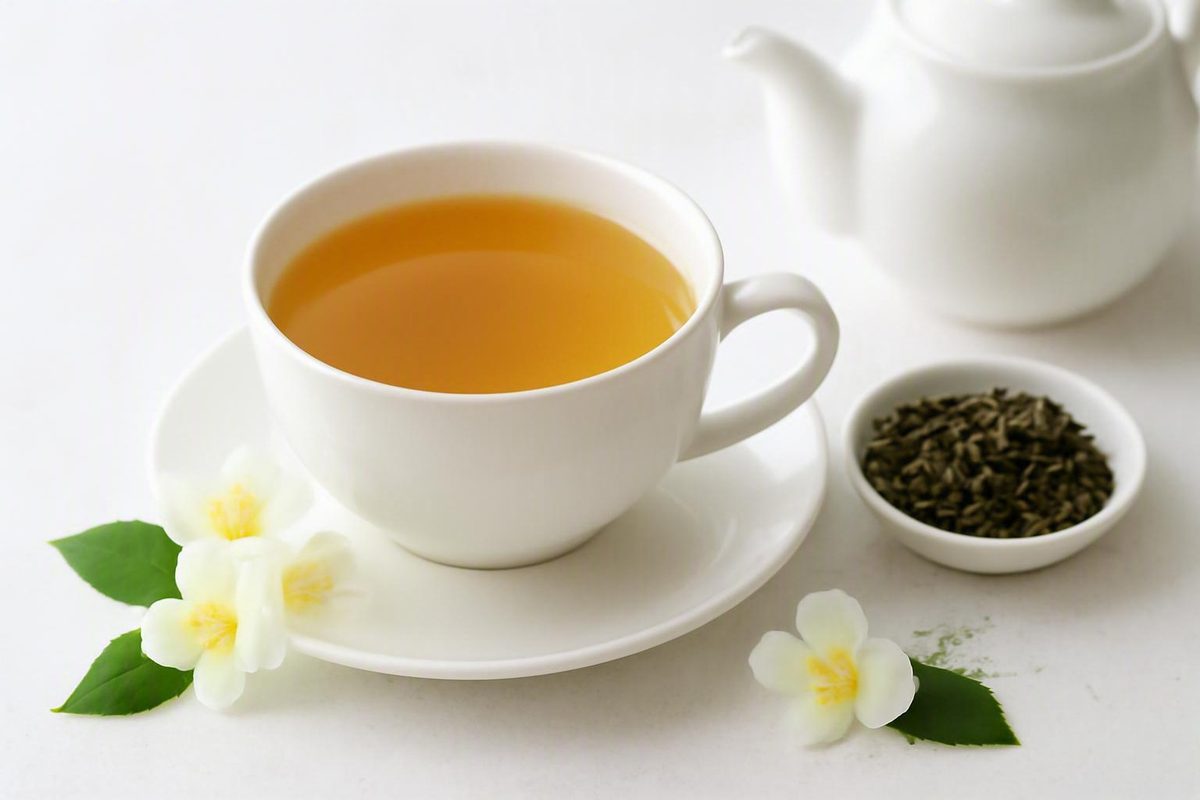
Plan on 20-60 mg per 8 oz. At the same brewed concentration, 16 oz scales to 40-120 mg. Using one tea bag for both sizes can break that conversion.
The short answer: approximately 20–60 mg per 8 ounces
A reasonable planning estimate for how much caffeine is in jasmine tea is approximately 20–60 milligrams per 8-fluid-ounce cup. This is an editorial range assembled from inconsistent commercial tea references—not a standardized laboratory range or a guarantee that every jasmine tea falls within those limits. For example, one retailer reports 15–60 mg per 8 ounces, while other commercial sources publish narrower or differently defined estimates. TeaVivre reports the 15–60 mg commercial range and identifies preparation variables that can change it.
For many jasmine teas made with a green-tea base, approximately 25–35 mg per 8 ounces is a useful midpoint for planning. That range is also an editorial synthesis rather than a directly published laboratory interval: Tea Forte reports about 25 mg per 8 ounces, while another retailer approximates jasmine tea by reference to green tea at about 35 mg per cup, without defining that cup’s volume. Tea Forte gives the more clearly standardized estimate of about 25 mg per 8 ounces.
Unless another serving size is identified, amounts in this article refer to 8 fluid ounces, approximately 237 milliliters.
For practical use:
- Jasmine tea with a true-tea base: use 20–60 mg per 8 ounces as a broad editorial planning range.
- Many green-tea-based jasmine teas: use 25–35 mg per 8 ounces as a narrower planning estimate.
- Decaffeinated jasmine true tea: expect a small residual amount rather than assuming zero.
- Jasmine-flower herbal infusion with no caffeinated ingredients: commercial guides generally describe this category as caffeine-free.
An individual cup may fall below or above the planning ranges. Its caffeine depends on the underlying tea, leaf quantity and form, water volume and temperature, steeping time, and whether the drink is prepared from a bag, loose leaves, pearls, or concentrate.
The most relevant peer-reviewed evidence in the available material does not solve the jasmine-specific evidence gap. Researchers measured caffeine in six other tea types and found that tea type, brewing temperature, brewing time, and serving form affected the results. The teas were brewed at 80°C or 100°C for 2, 5, or 10 minutes, but jasmine tea was not tested. The study therefore supports the conclusion that preparation matters; it cannot validate a universal caffeine range for jasmine tea. The peer-reviewed brewing study describes the tested teas, temperatures, times, and measured variation.
The central figures in this article should consequently be treated as a synthesis of retailer estimates. Anyone who needs an exact intake will require reliable testing for the specific product, serving size, and brewing procedure.
Jasmine is the aroma, not the caffeine category
“Jasmine” usually describes how a tea is scented, not a distinct caffeine level.
Ordinary jasmine tea is generally produced by exposing a base of true tea leaves to jasmine flowers so the leaves absorb their fragrance. Green tea is a common base, but producers may also use pouchong, white, oolong, black, or another true tea. Harney & Sons describes jasmine teas made with several possible tea bases.
Those underlying leaves come from Camellia sinensis, the tea plant, and naturally contain caffeine. Scenting them with jasmine flowers does not remove that caffeine.
That distinction explains why products bearing the same word on the package can have different caffeine profiles:
- Jasmine green tea contains caffeinated green tea leaves.
- Jasmine black tea contains caffeinated black tea leaves.
- Jasmine white tea contains caffeinated white tea leaves.
- Jasmine oolong or pouchong contains caffeinated oolong or pouchong leaves.
- Decaffeinated jasmine tea starts with true tea but undergoes processing to remove most of its caffeine.
- Jasmine herbal tea or tisane may contain jasmine flowers and other botanicals without true tea.
The ingredient list is therefore more informative than the product name. Look for green tea, black tea, white tea, oolong, pouchong, or Camellia sinensis. If any appears, assume the product contains caffeine unless it is specifically identified as decaffeinated.
Conversely, jasmine flowers alone do not establish that a drink contains caffeine. A flower-only infusion can be sold as caffeine-free. Mixed herbal blends need closer inspection because they may include true tea, yerba mate, guarana, or another caffeinated ingredient.
There is no adequate evidence here that jasmine scenting itself consistently raises or lowers caffeine. The useful clues are the base tea and preparation method, not the strength of the floral aroma.
Estimated caffeine by jasmine tea type
The table below separates three different kinds of evidence: jasmine-specific retailer estimates, general commercial tea-category estimates, and editorial planning ranges derived from those figures. None is a laboratory specification for every product.
| Product description | 8-ounce planning estimate | What the estimate is based on | Principal limitation |
|---|---|---|---|
| Jasmine green tea | Approximately 25–35 mg | Editorial midpoint based on commercial estimates, including about 25 mg per 8 ounces and broader jasmine-green figures | No source directly publishes 25–35 mg as a standardized laboratory range |
| Ordinary jasmine tea with an unidentified true-tea base | Approximately 20–60 mg | Editorial planning envelope assembled from commercial estimates; one guide reports 20–40 mg generally and 20–60 mg for a green-tea base Teami publishes these differently defined retailer estimates | The base tea may be unknown, and the source estimates are not methodologically consistent |
| Jasmine tea with a black-tea base | No definitive jasmine-specific figure; one general guide lists black tea at 40–70 mg | General commercial category guidance, not jasmine-black testing Art of Tea publishes the 40–70 mg category range | Another manufacturer lists black tea at 30–60 mg, illustrating disagreement between guides |
| Jasmine tea with a white-tea base | No definitive jasmine-specific figure; general category estimate of 15–45 mg | Commercial white-tea category guidance from the same Art of Tea guide | White tea is not automatically lower in caffeine than every green, oolong, or black product |
| Jasmine tea with an oolong base | No definitive jasmine-specific figure; general category estimate of 30–50 mg | Commercial oolong category guidance from the same Art of Tea guide | Leaf grade, mass, and preparation may matter as much as the category name |
| Decaffeinated jasmine true tea | Approximately 2–4 mg in one jasmine retailer’s guide; 1–8 mg for decaffeinated tea generally | Jasmine-specific commercial estimate and a broader manufacturer category estimate TeaVivre reports approximately 2–4 mg per 8 ounces for decaffeinated jasmine tea | “Decaffeinated” does not necessarily mean caffeine-free |
| Jasmine-flower herbal infusion with no true tea or other caffeinated ingredients | Described commercially as caffeine-free or 0 mg | Herbal-tea category guidance rather than chemical analysis of every jasmine infusion Bigelow lists decaffeinated tea at 1–8 mg and herbal tea at 0 mg per 8 ounces | The ingredient list must confirm that no caffeinated ingredient is present |
The broad tea categories overlap. Art of Tea’s guide lists green tea at 20–45 mg, black tea at 40–70 mg, oolong at 30–50 mg, and white tea at 15–45 mg per 8 ounces. These are typical commercial ranges, not fixed boundaries or measurements of jasmine products.
That overlap matters. A jasmine tea with a white-tea base should not automatically be assumed to contain less caffeine than every jasmine green, oolong, or black tea. A heavily brewed white tea may exceed a lightly brewed tea from another category, while products within one category can differ in leaf mass, grade, particle size, and growing material.
The labels also describe three materially different products:
- Caffeinated jasmine true tea: made with green, black, white, oolong, pouchong, or another true tea.
- Decaffeinated jasmine true tea: processed to remove most, but not necessarily all, caffeine.
- Caffeine-free jasmine herbal infusion: made without true tea or another caffeinated ingredient.
“Decaffeinated” and “caffeine-free” should not be used interchangeably.
Why the number changes from one cup to another
A caffeine figure applies to a particular product, quantity of leaf, water volume, and brewing procedure. Changing those inputs can change both the caffeine concentration and the total amount consumed.
Base tea
The base determines the starting material. Jasmine green, black, white, oolong, and pouchong teas all use true tea leaves, but they may differ in cultivar, harvest material, grade, processing, and particle size.
Broad category ranges provide context, but they cannot rank every product. The caffeine in a specific batch may not fall near the midpoint for its category.
Leaf mass
Using more tea gives the water access to more caffeine-containing material. Under otherwise similar conditions, a cup prepared with more leaf will generally have more caffeine available for extraction.
“One spoonful” is not a reproducible unit. A spoonful of large loose leaves, dense rolled pearls, and fine broken leaves may represent very different masses. Tea bags can also contain different quantities from one brand or product to another.
For more consistent preparation, follow package instructions stated in grams when available. Weight is more reproducible than a spoon measurement because leaf shape affects how much tea fits into the spoon.
Water volume
More water does not necessarily mean more caffeine. The leaf-to-water ratio and total leaf mass also matter.
Doubling both the leaf and water could produce a similar concentration while approximately doubling the total caffeine in the finished pot. Adding water to a fixed amount of already brewed tea may reduce its concentration without changing its total caffeine.
This distinction is important for café drinks. A 16-ounce tea made with twice the leaf may contain close to twice the caffeine of an 8-ounce serving prepared the same way. A 16-ounce drink produced by diluting one fixed infusion may not.
Water temperature
Hotter water generally increases or accelerates caffeine extraction relative to cooler water under otherwise similar conditions. That does not produce a universal conversion such as a fixed number of additional milligrams for every temperature increase.
Follow the product’s directions for an ordinary cup. If moderating caffeine is the goal, somewhat cooler water may reduce extraction relative to hotter water, provided the temperature remains suitable for the tea and desired flavor.
Steeping time
Longer contact between leaves and water generally allows more caffeine to enter the infusion. A 2-minute brew and a 10-minute brew should not be treated as equivalent.
The available peer-reviewed study found variation associated with tea type, temperature, time, and serving form. Because it did not test jasmine tea, its findings cannot be converted into a jasmine-specific formula.
Some commercial pages claim that a 1-minute steep always produces exactly 50% less caffeine than a 3-minute steep. The evidence supplied here does not support applying that percentage universally. A shorter steep will generally extract less than a longer one under otherwise identical conditions, but the difference depends on the product and brewing protocol.
Leaf form and particle size
Tea bags often contain smaller or more broken particles than loose-leaf products. Smaller particles expose more surface area to water and may extract quickly, but bag size, leaf mass, grade, and brewing directions also affect the result.
In the peer-reviewed study, the tested cup-sized black-tea bags produced 39 ± 9.9 mg per 200 mL, compared with 24 ± 7.2 mg per 200 mL from the tested loose black tea. This was a product- and protocol-specific finding—not proof that every bag contains more caffeine than loose tea or jasmine pearls. The study reports the black-tea bag and loose-leaf results under its defined test conditions.
Jasmine pearls add another variable. Rolled leaves open during brewing, and extraction can differ with their weight, tightness, water temperature, and infusion time. Their appearance alone cannot reveal their caffeine content.
Repeated infusions
Later infusions may contain less caffeine because an earlier brew has already removed some. The amount remaining depends on the temperature, duration, water volume, and leaf-to-water ratio used for that first infusion.
A brief initial infusion may leave substantial caffeine in the leaves; a long, hot infusion may remove more. The available evidence does not establish a dependable reduction for second or later infusions of jasmine tea.
Discarding a quick rinse or drinking only a later steep should therefore not be treated as reliable decaffeination. Either practice may change intake, but neither reveals the resulting number of milligrams without product-specific testing.
Convert the 8-ounce estimate for larger servings
To scale an 8-ounce planning estimate to another serving size, use:
Estimated caffeine = 8-ounce estimate × serving ounces ÷ 8
This arithmetic assumes the larger drink has the same brewed concentration as the 8-ounce reference.
Using the editorial 20–60 mg per 8 ounces range:
- 12 ounces: 20–60 × 12 ÷ 8 = approximately 30–90 mg
- 16 ounces: 20–60 × 16 ÷ 8 = approximately 40–120 mg
Using the editorial 25–35 mg per 8 ounces jasmine-green range:
- 12 ounces: 25–35 × 12 ÷ 8 = approximately 38–53 mg
- 16 ounces: 25–35 × 16 ÷ 8 = approximately 50–70 mg
| Serving size | Broad editorial jasmine estimate | Jasmine-green editorial estimate |
|---|---|---|
| 8 ounces | 20–60 mg | 25–35 mg |
| 12 ounces | 30–90 mg | 38–53 mg |
| 16 ounces | 40–120 mg | 50–70 mg |
These are calculations from the cited retailer-based planning ranges, not measurements of larger drinks. Linear conversion may fail when:
- A café uses the same tea bag for both small and large sizes.
- A larger serving uses additional bags or more loose tea.
- The drink is made from concentrate.
- Ice, milk, or water dilutes a fixed amount of brewed tea.
- A bottled product uses a different extraction process.
- The beverage contains another caffeinated ingredient.
For example, if a café brews 8 ounces of strong tea and adds enough ice to produce a 16-ounce drink, multiplying the caffeine estimate by two would overstate the total. If it doubles the leaf and water while keeping the same procedure, linear scaling may be more reasonable.
For close tracking, use the manufacturer’s tested figure for the actual product and serving whenever available. Confirm whether the number applies to the entire bottle, one prepared cup, one bag, or a smaller serving within the package.
How jasmine tea compares with other drinks
Jasmine green tea generally occupies the same broad caffeine territory attributed to other green teas because green tea is a common base. The jasmine aroma does not create a separate caffeine category.
Bigelow’s manufacturer guide gives the following commercial estimates per 8-ounce cup:
- Green tea: 25–50 mg
- Black tea: 30–60 mg
- Decaffeinated tea: 1–8 mg
- Herbal tea: 0 mg
Art of Tea publishes a different set of commercial category ranges: 20–45 mg for green tea, 40–70 mg for black tea, 30–50 mg for oolong, and 15–45 mg for white tea per 8 ounces. The disagreement and overlap illustrate why category figures should be treated as planning ranges rather than universal limits.
The editorial jasmine-green range of 25–35 mg per 8 ounces sits within both published green-tea ranges. A particular jasmine product can still fall outside it because of the leaves and preparation.
Commercial jasmine references commonly compare brewed coffee at approximately 95–96 mg per cup. On that comparison, an 8-ounce jasmine green tea estimated at 25–35 mg would usually contain substantially less caffeine. The supplied evidence does not include an independent coffee-composition source, however, so the coffee number should also be treated as a commercial comparison rather than a universal value. Teami uses approximately 96 mg per cup for its coffee comparison.
Serving size and brewing strength can overturn simple rankings:
- An 8-ounce jasmine green tea in the planning range would usually be below the commercial coffee comparison.
- A 16-ounce jasmine tea scaled from the broad editorial range could reach 40–120 mg.
- A lightly brewed black tea may contain less caffeine than a large, strongly brewed jasmine green tea.
- Decaffeinated jasmine tea may contribute a few milligrams, while an herbal jasmine infusion with no caffeinated ingredients may be described as caffeine-free.
“Green is always lower than black” and “tea is always lower than coffee” are therefore too simplistic for tracking a real serving. Compare the product, volume, leaf quantity, and brewing method.
The evidence also does not establish that jasmine tea has a uniquely smoother, safer, or healthier stimulant effect. Those questions are separate from estimating caffeine content.
How to estimate or moderate the caffeine in your own tea
Start with the package rather than the color, fragrance, or perceived strength of the drink. Sensory clues cannot reveal an exact caffeine amount.
Use this checklist:
- Identify the base tea. Look for green, black, white, oolong, pouchong, or another named tea.
- Check for Camellia sinensis. Its presence indicates true tea and therefore caffeine unless the product is decaffeinated.
- Confirm the serving size. Determine whether the stated figure applies to 8 ounces, a mug, a bottle, a bag, or the entire package.
- Note the leaf or bag quantity. One bag in 8 ounces is not directly comparable with two bags in 12 ounces.
- Read the brewing directions. Water temperature and steeping time affect extraction.
- Distinguish decaffeinated from caffeine-free. Decaffeinated true tea can retain caffeine.
- Inspect every ingredient. An herbal blend may still contain true tea, yerba mate, guarana, or another caffeine source.
If a manufacturer provides a caffeine number, ask what that number represents:
- Was the prepared product laboratory-tested?
- Was the figure calculated from a broad tea-category average?
- Does it apply only when the tea is brewed according to specified directions?
- Is “low,” “medium,” or “high” being used instead of a measured amount?
- Does the stated serving match the quantity you actually drink?
To make a more moderate cup, you can generally use:
- Fewer leaves or fewer tea bags
- A shorter steep
- Somewhat cooler water when compatible with the product’s directions
- A smaller serving
These changes are likely to reduce extraction or total intake relative to a stronger preparation. They do not guarantee a known percentage reduction.
Do not rely on a quick rinse as a dependable way to remove most caffeine. Cold brewing and later infusions may also change extraction, but they should not be treated as reliable decaffeination methods without testing of the specific product and procedure.
If avoiding caffeine is the goal, choose a jasmine-flower herbal infusion with no true tea leaves or other caffeinated ingredients. Verify the complete ingredient list rather than relying on “jasmine,” “herbal,” or “tisane” on the front label.
For precise tracking, the strongest practical evidence is tested manufacturer data for the exact product, serving, and preparation. When that is unavailable, use the retailer-based planning ranges cautiously and adjust for serving size and brew strength.
This article is for general informational purposes and is not individualized medical or dietary advice. Consult an appropriate healthcare professional if caffeine intake raises concerns related to a health condition or personal dietary needs.
Frequently asked questions
Does jasmine tea always contain caffeine?
No. Ordinary jasmine tea usually contains caffeine because it is commonly made by scenting green, white, oolong, black, pouchong, or another true tea. Those leaves come from Camellia sinensis and naturally contain caffeine.
A jasmine-flower infusion made without true tea or another caffeinated ingredient may be sold as caffeine-free. Decaffeinated jasmine true tea is a separate category: most caffeine has been removed, but a residual amount may remain.
How much caffeine is in an 8-ounce cup of jasmine green tea?
Use approximately 25–35 mg per 8 ounces as an editorial planning estimate for many jasmine green teas. It is not a directly published laboratory range. Commercial references include about 25 mg per 8 ounces, 25–30 mg per 8 ounces, and broader estimates extending to 15–60 mg per 8 ounces.
A specific cup can fall outside the planning range because leaf mass, product form, temperature, steeping time, and other preparation details vary.
Is jasmine-flower tea the same as decaffeinated jasmine tea?
No. Jasmine-flower herbal tea contains no true tea leaves and may be described commercially as caffeine-free, provided the blend contains no other caffeine source.
Decaffeinated jasmine tea starts with caffeinated true tea and undergoes processing to remove most of its caffeine. Commercial guidance estimates approximately 2–4 mg per 8 ounces for decaffeinated jasmine tea, while a broader manufacturer category range is 1–8 mg per 8 ounces. These are commercial estimates, not guarantees for every product.
Do tea bags, jasmine pearls, or loose leaves contain more caffeine?
No format is always highest. Tea bags often contain smaller particles that may extract quickly, while loose leaves and jasmine pearls vary in mass, grade, particle size, and how fully they open. Different products may also use different amounts of tea.
A laboratory study found more caffeine in the tested cup-sized black-tea bags than in its tested loose black tea under the reported protocol. That finding does not establish a universal rule for jasmine tea. A controlled comparison would need to account for tea variety, leaf mass, water volume, temperature, and steeping time.
Can a shorter steep make jasmine tea caffeine-free?
No. A shorter steep will generally extract less caffeine than a longer steep under otherwise similar conditions, but it does not remove the caffeine from true tea leaves or guarantee a caffeine-free drink.
No dependable universal percentage shows how much a short steep reduces caffeine in every jasmine tea. For a product described as caffeine-free, choose a jasmine-flower herbal infusion whose ingredient list contains no true tea or other caffeinated ingredient.