
A Practical Guide to the Caffeine in Your Glass of Iced Tea
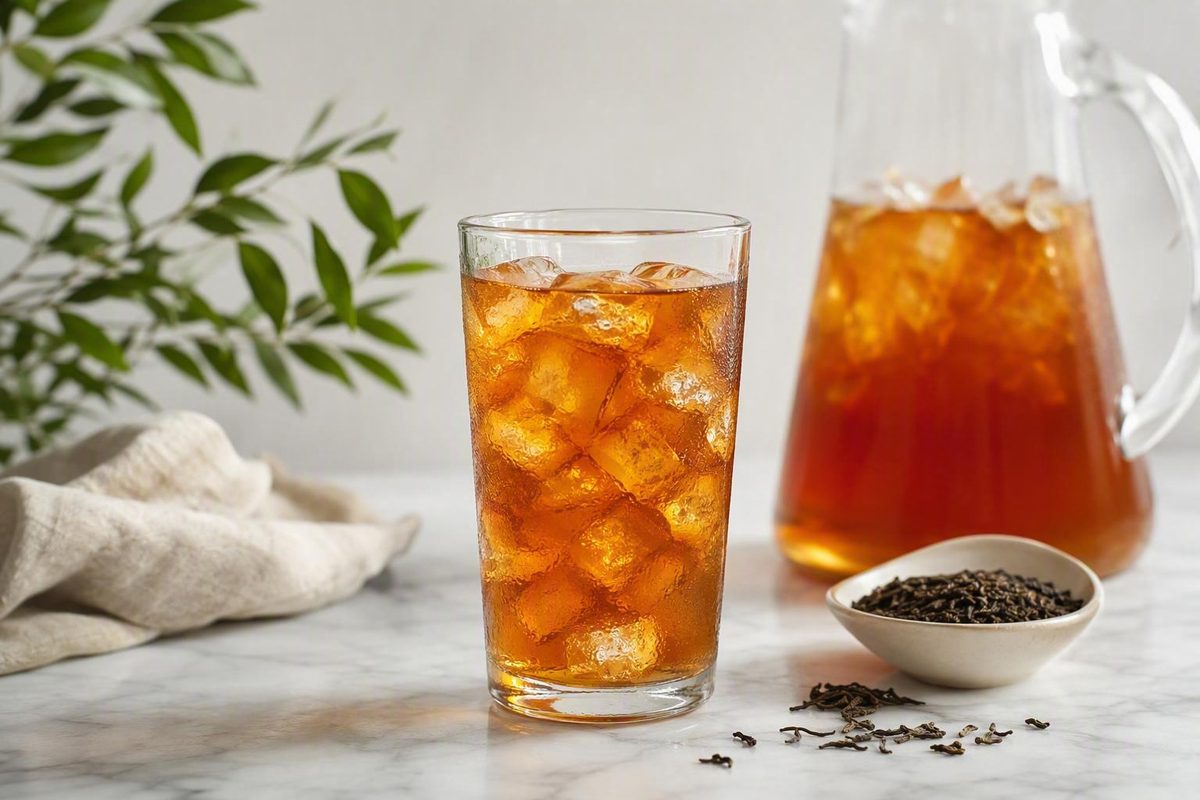
Use 20-60 mg per 8 fl oz as a rough fallback for caffeinated iced tea. Tea type, serving size, brew strength and dilution explain why glasses differ.
The short answer: about 20–60 mg per 8 ounces
A reasonable fallback estimate for unsweetened iced tea is about 20–60 milligrams of caffeine per 8 fluid ounces. This is a rough range published by commercial tea and beverage sites, not a laboratory-confirmed minimum and maximum for every iced tea. Southern Breeze, for example, gives this range while noting that tea type and brewing affect the result, but it does not provide supporting laboratory methods. See Southern Breeze’s commercial iced-tea estimate.
Quick answer
- Rough commercial-source estimate for unsweet iced tea: 20–60 mg per 8 fl oz
- Brewed black tea guide value: 48 mg per 8 fl oz
- Brewed green tea guide value: 29 mg per 8 fl oz
- Ready-to-drink bottled black tea guide value: 26 mg per 8 fl oz
The three specific guide values come from Mayo Clinic’s caffeine chart, which says caffeine amounts vary and its figures should be used as guides.
The practical answer is therefore not that every unsweet tea contains 20–60 mg. It is that 20–60 mg per 8 ounces can serve as a rough estimate when you know only that the drink is caffeinated iced tea. For a particular drink, a current package statement, manufacturer listing, restaurant nutrition page, or documented recipe is more useful.
An exact estimate requires several details:
- Is the drink black, green, white, oolong, matcha, decaffeinated, or herbal?
- How much tea was used?
- How long and how strongly was it brewed?
- Was it brewed at drinking strength or made as a concentrate?
- How much water or melting ice diluted it?
- How many fluid ounces were actually served?
- Is there current product-specific caffeine information?
“Unsweetened” answers a question about sweetness. It does not identify the tea base, brewing strength, serving size, or caffeine concentration. A lightly brewed green tea may fall near the lower end of the broad estimate, while a strong black tea or matcha drink could exceed it.
Unsweetened does not mean caffeine-free
Unsweetened normally means that sugar or another sweetener has not been added. It does not mean that caffeine has been removed.
If two batches of tea are otherwise identical, adding sugar to one does not create caffeine, and leaving sugar out of the other does not reduce caffeine. A commercial Chen Sheng Hao guide makes the same distinction: differences between sweet and unsweet tea come from the tea, recipe, brewing, and serving size—not the sugar itself. See the retailer’s explanation of sweetness and caffeine.
It helps to treat caffeine, sugar, and calories as separate characteristics:
- Caffeine depends on the ingredients, brewing, formulation, dilution, and serving size.
- Sugar depends on naturally present or added caloric sweeteners.
- Calories come from energy-containing ingredients, not from caffeine content alone.
A drink can therefore be:
- Unsweetened and caffeinated, such as plain black iced tea.
- Sweetened and caffeinated, such as sweet black iced tea.
- Unsweetened and caffeine-free, such as an herbal infusion containing no caffeinated ingredient.
- Sweetened and caffeine-free, such as a sweetened caffeine-free herbal infusion.
- Decaffeinated but not completely caffeine-free.
Black, green, white, and oolong teas are true teas made from Camellia sinensis. They naturally contain caffeine whether served sweetened or unsweetened. Their typical caffeine ranges overlap, so the tea category alone does not reveal the exact amount.
They are generally caffeine-free when they contain no true tea or other caffeine source. Because blends vary, check the complete ingredient list rather than assuming that every product labeled “herbal” contains no caffeine.
The useful rule is simple: do not infer caffeine content from sugar content. Identify the tea base and ingredients instead.
Caffeine estimates by type of unsweet tea
Tea type offers more information than the word “unsweetened,” but it still cannot provide an exact caffeine count. Leaf quantity and form, water temperature, steeping time, brewing method, dilution, and serving size all affect the finished drink.
The table below normalizes estimates to 8 fluid ounces. The ranges are typical figures from commercial tea publishers, not tested limits that apply to every recipe. Art of Tea supplies the black, green, white, oolong, and matcha ranges and cautions that preparation affects the result. Review Art of Tea’s type-by-type estimates.
| Type of unsweet tea | Typical estimated caffeine per 8 fl oz | How to interpret it |
|---|---|---|
| Black tea | About 40–70 mg | Mayo Clinic’s guide value is 48 mg. Strong and light preparations can differ. |
| Green tea | About 20–45 mg | Mayo Clinic’s guide value is 29 mg. |
| White tea | About 15–45 mg | The amount of leaf and brewing method can move it above or below another tea type. |
| Oolong tea | About 30–50 mg | Its estimated range overlaps those of green, white, and black tea. |
| Matcha | About 60–80 mg | The quantity of matcha and finished drink volume are especially important. |
| Decaffeinated black tea | Low, but not necessarily zero | Mayo Clinic’s guide value is 2 mg per 8 ounces. |
| Herbal infusion | Usually 0 mg when no caffeinated ingredient is present | Check the complete blend rather than relying on the word “herbal.” |
The Mayo Clinic figures in the table are guide values, not product guarantees, and are the same medical-reference values cited in the quick answer.
These categories do not create a strict caffeine ranking. A strongly brewed green or white tea can overlap with a lightly brewed black tea. A weak black tea may contain less caffeine than a stronger serving from a category commonly described as lower in caffeine.
Tea color and flavor do not resolve that uncertainty.
Black tea
Black tea is a common base for homemade and restaurant iced tea. The commercial estimate of approximately 40–70 mg per 8 ounces is useful for orientation, while Mayo Clinic’s 48 mg figure offers a single medical-reference guide value.
Neither figure measures a particular pitcher. A recipe made with more tea relative to water may contain more caffeine per ounce than a lighter recipe. If that strong brew is subsequently diluted, the final concentration may fall.
Green, white, and oolong tea
Green tea is often estimated below black tea, but their ranges overlap. White tea is also frequently described as lower in caffeine, yet a strong preparation could contain more than a mild black or green tea. Oolong falls across the middle of the commercial estimates, but its name alone does not determine the result.
For a packaged green, white, or oolong drink, use the amount listed for that exact product and package size whenever one is available.
Matcha
Matcha estimates can be comparatively high, but “matcha iced tea” is not one standardized recipe. Different cafés and manufacturers may use different quantities of matcha, finished volumes, and dilution ratios.
Before applying a general 60–80 mg estimate, confirm that the reference serving resembles the drink in question. A current manufacturer or café figure tied to the exact recipe should take priority.
Herbal and decaffeinated tea
A verified caffeine-free herbal infusion is the clearest choice when the objective is to avoid caffeine from tea. The qualification matters: its ingredients must contain no true tea and no other caffeine source.
Decaffeinated true tea begins with naturally caffeinated tea and retains a small amount after processing. “Decaf” should therefore be understood as low caffeine, not as a universal guarantee of zero. If trace amounts matter, check the package or contact the manufacturer.
How serving size changes the caffeine total
A caffeine amount is meaningful only when paired with a volume. “One glass” could mean 8 ounces at home, 16 ounces at a café, or more than 20 ounces at a restaurant. Bottle sizes also vary.
When the tea has the same strength throughout, use this formula:
Estimated caffeine in desired serving = listed caffeine × desired ounces ÷ listed ounces
For example, if a tea contains 40 mg per 8 ounces and you drink 16 ounces at the same concentration:
40 mg × 16 ÷ 8 = 80 mg
Applying the rough commercial-source estimate of 20–60 mg per 8 fluid ounces gives the following conversions:
| Serving size | Rough estimated caffeine at unchanged strength |
|---|---|
| 8 fl oz | 20–60 mg |
| 12 fl oz | 30–90 mg |
| 16 fl oz | 40–120 mg |
| 18.5 fl oz | Approximately 46–139 mg |
| 20 fl oz | 50–150 mg |
These are arithmetic conversions, not measurements of every tea sold in those sizes. They apply only when the larger serving has the same caffeine concentration as the 8-ounce reference.
That assumption may fail when:
- A restaurant uses a different concentrate-to-water ratio.
- Different cup sizes receive different proportions of tea and ice.
- A bottled product has a formulation unrelated to generic brewed tea.
- A café uses the same number of tea bags for several drink sizes.
- One pitcher is brewed more strongly than another.
Using Mayo Clinic’s 48 mg-per-8-ounce brewed-black-tea guide produces a more specific reference calculation:
- 12 ounces: approximately 72 mg
- 16 ounces: approximately 96 mg
- 20 ounces: approximately 120 mg
Again, those totals assume unchanged strength. They do not mean that every 20-ounce black iced tea contains 120 mg.
This is why fluid ounces are more useful than “cup,” “glass,” or “bottle.” Those words identify containers, not fixed volumes. Even “cup” may refer either to an 8-fluid-ounce measurement or to an ordinary drinking vessel of another size.
For a packaged tea:
- Find the caffeine amount, if stated.
- Confirm the serving size attached to that amount.
- Check how many servings the container holds.
- Multiply if you will drink more than one serving.
- Verify that the figure applies to the exact flavor and package size.
If caffeine is listed for the whole bottle, no scaling is needed unless you drink only part of it. If it is listed per serving and the bottle contains multiple servings, calculate the container total before comparing it with another drink.
Why two glasses of unsweet tea can contain different amounts
Two glasses can both be unsweetened black iced tea and still contain different amounts of caffeine. “Black tea” identifies the broad tea category; it does not standardize the recipe.
Relevant variables include:
- Tea type and variety
- Amount of tea used
- Whole, broken, or finely cut leaves
- Water temperature
- Steeping time
- Brewing strength and method
- Brand or blend
- Concentrate-to-water ratio
- Dilution and ice
- Final serving size
In general, using more tea, hotter water, or a longer steep increases caffeine extraction. Broken leaves and fine tea-bag material may release caffeine faster than large whole leaves. These are directional relationships, not formulas: the available evidence does not support claims that an extra minute of steeping always adds a particular number of milligrams. The Tea Spot similarly presents leaf type, quantity, size, temperature, time, and method as interacting variables. See The Tea Spot’s overview of brewing factors.
Drinking-strength tea versus concentrate
Some iced tea is brewed close to the concentration at which it will be consumed. Other tea begins as a strong concentrate and is later mixed with water or poured over ice.
The same tea type can therefore produce different caffeine concentrations. Hot tea and iced tea cannot be assumed to contain identical caffeine per ounce simply because both use black tea. The quantities of tea and water, extraction conditions, final volume, and dilution all matter.
Suppose one pitcher is brewed directly to its final volume, while another is brewed in less water and later diluted. Even if both begin with the same type of tea, differences in extraction and final proportions can produce different caffeine concentrations. Appearance alone cannot reveal the result.
Total caffeine versus caffeine concentration
Ice creates a separate source of confusion.
Adding ice does not destroy caffeine already extracted into tea. As the ice melts, it adds water and can reduce caffeine concentration—the amount per ounce—without making the caffeine disappear. Yishi Foods likewise distinguishes dilution from removal when discussing ice and iced tea. See the consumer guide’s explanation of ice and concentration.
There is one practical exception involving the amount poured: a glass packed with ice may hold less brewed tea than an ice-free glass of the same external size. It may then start with less total caffeine because less tea was served, not because the ice removed caffeine.
Sweetness, bitterness, flavor strength, and color are also unreliable measures. For a dependable number, use a documented recipe, current product information, or direct testing.
Homemade, bottled, and fountain tea require different estimates
Homemade brewed tea, ready-to-drink bottled tea, and restaurant fountain tea should not automatically be assigned the same caffeine concentration.
Homemade brewed tea
For homemade tea, record:
- Tea type and brand
- Number or weight of tea bags or loose leaves
- Brewing-water volume
- Water temperature
- Steeping time
- Added water and ice
- Final pitcher volume
- Number and size of servings
A consistent recipe makes an estimate more useful. If you have a reasonable caffeine figure for the tea, estimate the batch total and divide it among measured servings. The answer remains approximate unless the finished tea has been tested.
Measure the actual final volume rather than assuming that the pitcher’s capacity equals the amount of tea. Liquid retained by leaves, evaporation, added water, ice, and incomplete filling can change the volume served.
Ready-to-drink bottled tea
Bottled tea is a formulated product, not necessarily homemade tea transferred into a package. Its tea concentration and processing can differ by brand and variety.
Mayo Clinic’s guide values illustrate why format may matter: brewed black tea is listed at 48 mg per 8 ounces, compared with 26 mg per 8 ounces for ready-to-drink bottled black tea. These are guides, not a rule that every bottled tea contains less caffeine than every freshly brewed tea. A strong bottled product can exceed a weak homemade brew.
For bottled tea, check:
- The exact product name and flavor.
- The package size.
- Whether caffeine is stated per serving or per container.
- The number of servings in the package.
- The ingredient list.
- The current manufacturer product page.
- The package in hand if online records conflict.
Do not transfer a figure from one package size to another without checking whether the formulation and listed serving are the same.
Restaurant and fountain tea
Restaurant tea may be brewed on-site, made from concentrate, dispensed through fountain equipment, diluted automatically, or poured over varying quantities of ice. Multiple cup sizes and free refills add further uncertainty.
Look for current restaurant nutrition information identifying the drink, caffeine amount, and serving size. If none is published, ask which tea or concentrate is used and how much tea the cup contains.
When no product-specific information is available, report a qualified estimate rather than inventing a precise number. The rough 20–60 mg-per-8-ounce range may be scaled for informal tracking, but it should remain labeled as a commercial-source estimate.
For refillable drinks, track the total volume consumed. Two 16-ounce pours represent approximately 32 fluid ounces of beverage, even if they arrive in the same cup.
Formulas, package sizes, and product names can change. Current packaging and manufacturer information should generally take priority over an older third-party database entry.
Pure Leaf shows why current product data matters
Pure Leaf Unsweetened Black Tea illustrates why a generic range should not replace current product information.
The manufacturer currently lists 54 mg of caffeine in one 18.5-fluid-ounce bottle. The same listing reports 0 calories, 0 grams of total sugar, and 0 grams of added sugar, with brewed black tea and citric acid as the ingredients. View the manufacturer’s listing for the 18.5-ounce bottle.
To normalize the caffeine amount to 8 ounces:
54 mg × 8 ÷ 18.5 = approximately 23 mg per 8 fluid ounces
The bottle still contains 54 mg in total. The 23 mg figure is only an equivalent concentration for comparing it with figures reported per 8 ounces.
This product also demonstrates why caffeine and sugar must be considered separately. It contains no listed sugar, yet it contains caffeine because brewed black tea is its base.
A third-party database, Caffeine Informer, reports a conflicting 84 mg per 18.5 ounces for a similarly named Pure Leaf unsweetened product, equivalent to approximately 36 mg per 8 ounces. See Caffeine Informer’s third-party entry.
The available sources do not establish why the figures differ. The discrepancy should not be presented as proof of a formula change or assigned another undocumented cause.
For the specifically identified 18.5-ounce product, the current manufacturer listing deserves priority. Even then, check the bottle being purchased: the manufacturer warns that formulation and packaging may change and recommends referring to current packaging.
Use this verification sequence:
- Match the full product name.
- Match the tea type and flavor.
- Match the package size.
- Determine whether caffeine is listed per serving or per bottle.
- Compare the package with the current manufacturer page.
- Treat conflicting third-party records as secondary.
Do not generalize the 54 mg figure to another Pure Leaf package, another variety, another brand, or unsweetened tea as a category.
How unsweet tea compares with coffee—and how to choose less caffeine
Compare tea and coffee in equal volumes. Comparing an 8-ounce tea with a 16-ounce coffee confuses beverage type with serving size.
Mayo Clinic lists 48 mg of caffeine in 8 ounces of brewed black tea and 96 mg in 8 ounces of brewed coffee. It also says that up to 400 mg per day may be safe for most adults, while emphasizing that caffeine content and individual responses vary. People who are pregnant, trying to become pregnant, or breastfeeding are advised to discuss caffeine limits with a healthcare professional. Review Mayo Clinic’s comparison and guidance.
Based on those equal-size guide values, brewed black tea generally contains less caffeine than brewed coffee. That is not a universal ratio: both beverages vary with the product and preparation, so tea does not always contain exactly half as much caffeine as coffee.
For no caffeine from the tea itself
Choose an herbal infusion explicitly identified as caffeine-free, then inspect the ingredients. It should contain no black, green, white, oolong, or other true tea and no separate caffeine source.
Do not rely only on flavor names such as “mint,” “peach,” or “berry.” Those flavors can appear in either caffeine-free herbal infusions or caffeinated tea blends.
For a small amount of caffeine
Decaffeinated true tea is a lower-caffeine option, but it is not necessarily caffeine-free. Mayo Clinic’s 2 mg-per-8-ounce value for decaffeinated brewed black tea provides context, although specific products and preparations may differ.
If avoiding even small amounts is important, a verified caffeine-free herbal infusion provides a clearer choice than decaffeinated true tea.
For less caffeine from ordinary true tea
Practical options include:
- Choose a product with a published lower caffeine amount.
- Drink a smaller measured serving.
- Avoid untracked refills.
- Use less tea relative to the final water volume when brewing at home.
- Compare products on a caffeine-per-8-ounce basis.
- Include caffeine from other beverages, foods, supplements, and medicines when tracking total intake.
Personal tolerance varies. This article provides general information, not medical or dietary advice.
Frequently asked questions
Does unsweet tea have less caffeine than sweet tea?
Not when the two drinks are otherwise identical. Adding sugar does not add caffeine, and removing sugar does not remove it.
Sweet and unsweet teas may contain different amounts in practice if they use different tea bases, recipes, strengths, dilution ratios, or serving sizes. Any difference comes from those variables rather than sweetness itself.
How much caffeine is in 16 ounces of unsweet tea?
Using the rough commercial-source estimate of 20–60 mg per 8 fluid ounces, a 16-ounce serving would contain approximately 40–120 mg if the tea had the same strength throughout.
Using Mayo Clinic’s brewed-black-tea guide of 48 mg per 8 ounces, the same-size calculation gives approximately 96 mg. A current product-specific figure should take priority over either estimate.
Is herbal unsweet tea always caffeine-free?
No. An herbal infusion is generally caffeine-free only when it contains no true tea or other caffeinated ingredient.
Check the complete ingredient list and look for an explicit caffeine statement when avoiding caffeine is important.
Does decaffeinated unsweet tea still contain caffeine?
It can. Decaffeinated tea is typically low in caffeine rather than guaranteed to contain none. Mayo Clinic’s guide value for decaffeinated brewed black tea is 2 mg per 8 ounces, but a particular brand or preparation may differ.
For a clearer caffeine-free option, choose an herbal infusion verified to contain no caffeinated ingredients.
Does adding ice remove caffeine from iced tea?
No. Ice does not destroy or remove caffeine already brewed into tea.
Melting ice adds water, so it can lower the caffeine concentration without reducing the caffeine already present in the complete drink. A glass packed with ice may nevertheless start with less total caffeine if the ice leaves room for less brewed tea.
The bottom line
About 20–60 mg per 8 ounces is a useful fallback estimate for unsweetened iced tea, but it is a rough commercial-source range—not a universal caffeine count. For a better answer, identify the tea type and fluid-ounce serving, account for brewing strength and dilution, and check current manufacturer or restaurant information for a specific drink.
Unsweetened describes sugar—not stimulation.