
A Practical Guide to Estimating the Caffeine in Your Glass of Sweet Tea
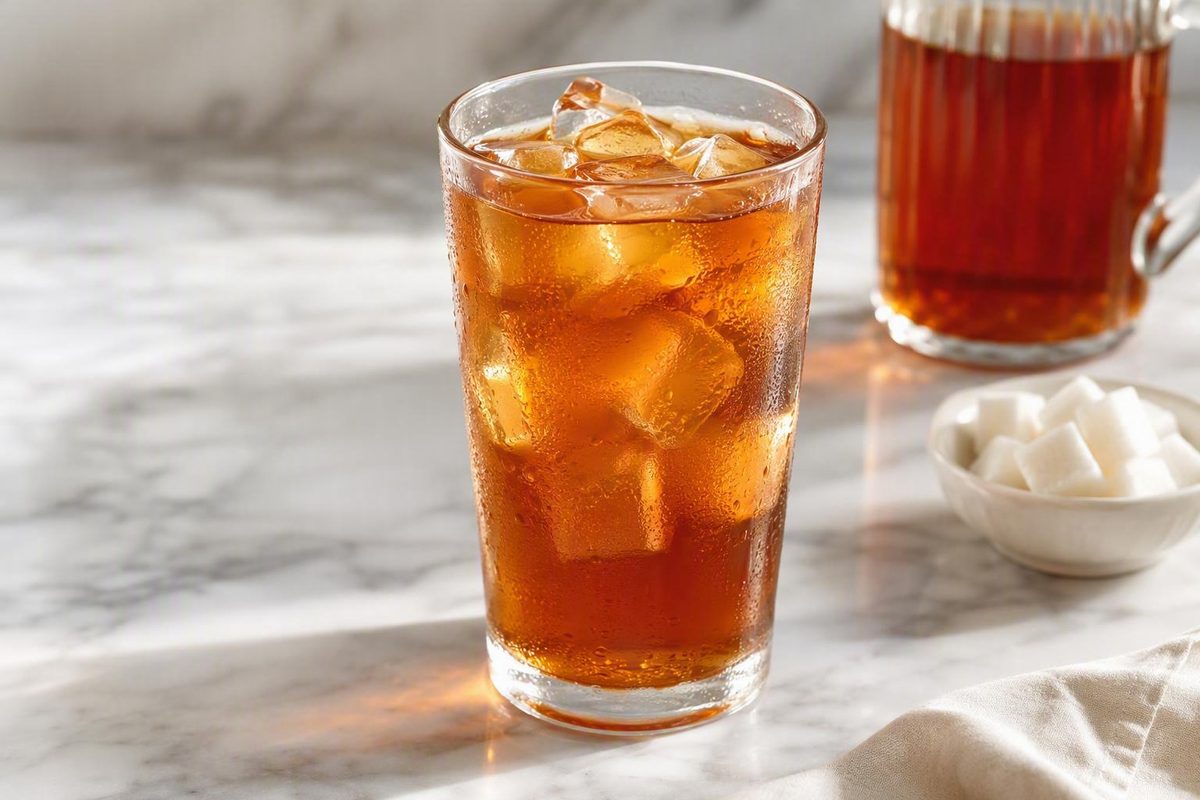
Traditional black-tea versions have about 20-50 mg per 8 oz. Decaf and herbal options may contain little or no caffeine, depending on the ingredients.
The short answer: about 20–50 mg per 8 ounces
A useful rule of thumb is that traditional black-tea sweet tea contains about 20–50 milligrams (mg) of caffeine per 8 fluid ounces. This is a practical estimate from commercial and secondary references, not a representative laboratory-tested range covering every homemade recipe, bottle, or restaurant drink (Southern Breeze’s sweet-tea caffeine guide).
If you know only the volume of your drink, you can scale that range proportionally:
| Sweet-tea serving | Estimated caffeine |
|---|---|
| 8 oz | 20–50 mg |
| 12 oz | 30–75 mg |
| 16 oz | 40–100 mg |
| 24 oz | 60–150 mg |
| 32 oz | 80–200 mg |
Only the 8-ounce row is the underlying rule-of-thumb range. Every larger value is a mathematical scaling, not a measured result. For example, 16 ounces is twice 8 ounces, so both ends of the range are doubled. That calculation does not prove that a particular 16-ounce drink contains 40–100 mg.
The actual amount may be lower or higher. A lightly brewed, heavily diluted homemade tea may fall below the estimate. A strong recipe made with more tea, less final water, or a concentrated commercial base may exceed it. Decaffeinated and herbal versions may contain little or no caffeine, while blends can receive caffeine from several ingredients.
Serving size can matter as much as strength. A tea with a modest amount of caffeine per ounce can still deliver a substantial total in a 24- or 32-ounce cup. Conversely, a small glass of stronger tea may contain less total caffeine than a large cup of weaker tea.
For a quick estimate, scale the 8-ounce range to the amount you drink. For a better answer, identify whether the tea is homemade, packaged, or prepared by a restaurant, and then look for recipe- or product-specific information.
Why sweet tea usually contains caffeine
Traditional sweet tea is generally iced tea brewed from black tea and sweetened while the tea is hot. Black tea naturally contains caffeine, so regular black-tea sweet tea is normally caffeinated. The sugar is not the caffeine source; caffeine depends on the tea or other caffeinated ingredients used in the recipe (Canal Coffee Company’s sweet-tea and iced-tea overview).
Sweet tea therefore has two largely independent variables:
- The tea variable determines the drink’s caffeine.
- The sweetness variable determines its sweetness and, when caloric sugar or syrup is used, contributes calories.
If one batch of black iced tea is divided into equal portions and sugar is added to only one, the two portions begin with approximately the same caffeine. One is sweetened and the other is not, but adding sugar does not change how much caffeine the tea leaves supplied.
Comparably brewed sweetened and unsweetened black iced teas should therefore contain similar caffeine amounts. If a restaurant’s sweet and unsweetened versions differ, the likely reason is a difference in the tea base, concentrate, tea-to-water ratio, dilution, or preparation—not the sweetness itself.
The name “sweet tea” does not guarantee a particular tea base. It may be made with:
- Regular black tea
- Green tea
- Decaffeinated black tea
- A mixture of regular and decaffeinated tea
- Herbal ingredients
- A blend of true tea and herbal flavorings
- A commercial concentrate with its own formulation
Green-tea sweet tea can have a different caffeine concentration from traditional black-tea sweet tea. Decaffeinated black tea retains a small amount of caffeine, while an herbal drink made entirely from caffeine-free ingredients may have none. Blends must be evaluated ingredient by ingredient.
Labels such as “Southern,” “classic,” “fresh brewed,” or “house sweet tea” do not establish caffeine content. They may describe flavor, preparation style, or marketing rather than a standardized formula. The useful questions are what tea was used, how much was used, how the batch was diluted, and how large the serving is.
Why there is no single caffeine number for sweet tea
The caffeine in a serving depends on both concentration and volume:
Caffeine per serving = caffeine concentration × serving volume
Concentration describes how much caffeine is present in each ounce. Serving volume describes how many ounces you drink. If two teas have the same concentration, a 32-ounce serving contains four times the caffeine of an 8-ounce serving.
Several variables can change the concentration or the total per serving:
- Tea type: Black, green, decaffeinated, herbal, and blended teas do not have identical caffeine profiles.
- Amount of tea: More tea leaves or bags relative to the final water volume can produce a more concentrated beverage.
- Brand and product: Tea bags and commercial concentrates are not interchangeable.
- Preparation: Loose-leaf tea, bags, instant powder, fountain concentrate, and ready-to-drink products may be formulated differently.
- Brewing time: Extraction changes during brewing, although the available evidence does not support a universal percentage adjustment.
- Final dilution: Added water spreads the extracted caffeine across a larger volume.
- Serving size: A larger pour increases the total consumed when concentration remains constant.
- Product recipe: Bottled and restaurant teas may be designed for a particular flavor or strength rather than to match homemade tea.
General black-tea figures illustrate the problem. Mayo Clinic lists brewed black tea at 48 mg per 8 ounces and ready-to-drink bottled black tea at 26 mg per 8 ounces. These are general reference values rather than direct measurements of sweet tea. The contrast shows why a single generic black-tea number cannot be assigned to every sweetened tea.
A freshly brewed recipe might resemble the brewed reference, while a diluted commercial product could be closer to the ready-to-drink reference. Either could also fall elsewhere. Mayo Clinic cautions that caffeine varies with factors such as growing conditions and brewing time and presents its figures as guides rather than guarantees.
Published sweet-tea estimates are not fully consistent. One commercial seller gives a broader range of 15–70 mg per 8 ounces, attributing the variation to factors such as tea strength and brewing time (Y’all Sweet Tea’s caffeine overview). That broader estimate does not necessarily invalidate the narrower practical range; it may simply include more weakly and strongly prepared recipes. The source does not provide a testing method or representative sample.
Available figures generally fall into one of four evidence categories:
- A category-level rule of thumb: Useful for a quick estimate but not product-specific
- A recipe calculation: Applicable only to the stated ingredients and final volume
- A seller statement: Specific to that seller’s product but not necessarily independently tested
- A secondary database entry: Convenient but potentially outdated or methodologically unclear
These categories are not equally precise. A disclosed recipe reveals its assumptions but may not show how much caffeine was actually extracted. A seller may know its formulation while omitting testing details. A secondary database may provide a precise-looking number without identifying its collection date or measurement method.
Brewing details matter, but they should not be converted into unsupported rules. It is reasonable to expect tea quantity, steeping conditions, and dilution to affect the finished drink. It is not reasonable to claim that changing brew time, water temperature, or brewing method always changes caffeine by a fixed percentage without controlled measurements for the tea and process involved.
Homemade, bottled, and restaurant examples are not interchangeable
Homemade tea is not automatically lower in caffeine than bottled or restaurant tea. Restaurant tea is not automatically stronger. Preparation category alone cannot settle the question because recipes, concentrates, dilution, and serving volumes differ.
A useful comparison keeps two measures visible:
- Caffeine per serving, which tells you how much the complete drink provides
- Caffeine per ounce, which helps compare concentration across different serving sizes
A disclosed homemade recipe
Caffeine Informer describes a Southern sweet-tea recipe made with six cup-size Lipton black tea bags, brewed and diluted to one gallon. It estimates the finished drink at 41 mg per 16-ounce serving, or about 2.6 mg per ounce (Caffeine Informer’s Southern sweet-tea recipe estimate).
This is more informative than an unexplained generic number because the number of bags and final batch volume are disclosed. It is still a recipe-based estimate, not reported laboratory analysis of the finished pitcher. It should not be generalized to recipes using another brand, more or fewer bags, a different brewing procedure, or another final volume.
A seller-reported bottled product
Savannah Sweet Tea Company reports 40–60 mg of caffeine in a 16-ounce bottle of its sweet tea. That is equivalent to approximately 2.5–3.8 mg per ounce. The statement is product-specific, but the seller’s page does not provide independent testing results or explain its measurement method (Savannah Sweet Tea Company’s product statement).
The reported range overlaps the homemade estimate. That does not establish that bottled and homemade teas are generally equivalent; it shows only that these two examples have similar serving totals.
An unverified secondary restaurant listing
A secondary caffeine table lists McDonald’s Sweet Tea at 100 mg per 32 ounces, or approximately 3.1 mg per ounce. The entry is not a current first-party restaurant specification, and the table does not establish when the figure was collected, how it was measured, or whether the formulation has changed (the secondary tea-caffeine table).
The limitations should remain visible when the examples are compared:
| Example | Reported or estimated serving total | Approximate concentration | Evidence type |
|---|---|---|---|
| Disclosed homemade recipe | 41 mg per 16 oz | 2.6 mg/oz | Recipe-based estimate |
| Savannah bottled tea | 40–60 mg per 16 oz | 2.5–3.8 mg/oz | Seller-reported range |
| McDonald’s listing—not verified as current | 100 mg per 32 oz | 3.1 mg/oz | Potentially outdated secondary entry |
The restaurant entry has more than twice the total caffeine of the homemade example, but its listed concentration is only moderately higher. Much of the difference comes from the serving being twice as large.
These evidence labels matter. “Estimated from a disclosed recipe,” “reported by the seller,” and “listed in a secondary database” do not mean “confirmed by current laboratory testing.” A number can look precise while still carrying substantial uncertainty.
For an exact current product value:
- Check the bottle or package for a caffeine declaration.
- Review the manufacturer’s current product page.
- Look for the restaurant’s official nutrition or ingredient information.
- Confirm that the listed serving size matches the cup you ordered.
- Contact the company if caffeine is important but not disclosed.
Do not assume that an old third-party listing remains accurate. Formulas, cup sizes, ice fills, concentrates, and preparation procedures can change.
How to estimate caffeine in a homemade pitcher
A homemade estimate requires two pieces of information:
- The estimated caffeine in the entire batch
- The final liquid volume after brewing and dilution
Use this formula:
Estimated caffeine per serving = estimated total batch caffeine × serving ounces ÷ final batch ounces
You can also calculate it in two steps:
- Divide estimated batch caffeine by final batch volume to find caffeine per ounce.
- Multiply caffeine per ounce by the number of ounces in your glass.
Using the disclosed one-gallon recipe as a consistency check, one gallon equals 128 ounces, so it contains eight 16-ounce servings. Eight servings at the recipe’s estimated 41 mg each imply an estimated batch total of approximately 328 mg (Caffeine Informer’s recipe and serving estimate).
The arithmetic is:
328 mg ÷ 128 oz = 2.5625 mg per oz
For a 16-ounce glass:
2.5625 mg per oz × 16 oz = 41 mg
This confirms that the batch estimate, serving estimate, and final volume are mathematically consistent. It does not turn the recipe estimate into a laboratory measurement.
Why the batch total is uncertain
A tea bag’s stated or estimated caffeine content is not necessarily the amount extracted into the finished drink. Extraction depends on the tea, leaf quantity, brewing procedure, and other conditions.
For that reason, avoid shortcuts such as “each bag always adds exactly X milligrams.” A per-bag figure can be an input for an estimate, but it is not a universal extraction rule.
If the package or manufacturer provides a caffeine range for prepared tea, use the preparation instructions associated with that range. If your method differs substantially—perhaps by doubling the number of bags or changing the final volume—the package value can support only an approximation.
Measure the final volume, not just the brewing water
Many sweet-tea recipes steep tea in a relatively small amount of hot water and then add cold water. The initial brewing-water volume is not the correct denominator for the finished drink.
Suppose tea is brewed in 32 ounces of water and then diluted to a final gallon. Dividing the batch caffeine by the initial 32 ounces would overstate the finished concentration fourfold. The appropriate denominator is the final 128-ounce volume.
Measure or calculate the finished pitcher after adding dilution water. If ice is added to the batch and allowed to melt before serving, account for that additional water when practical.
Record the variables that can be repeated
For a useful homemade estimate, record:
- Tea type and brand
- Regular, decaffeinated, herbal, or blended status
- Number and size of tea bags, or weight of loose tea
- Brewing procedure
- Final pitcher volume after dilution
- Actual glass size
- Amount of ice
- Number of servings poured
The objective is not laboratory precision. It is a consistent estimate that can be repeated when you make the same recipe again.
Understand dilution and serving-size changes
If a batch contains an estimated 300 mg of caffeine, adding water does not change the batch total. It changes how that caffeine is distributed.
- At 100 ounces, the concentration is 3 mg per ounce.
- At 150 ounces, the concentration is 2 mg per ounce.
A 10-ounce serving of the first batch would contain about 30 mg. The same-sized serving of the diluted batch would contain about 20 mg. Drinking the entire diluted batch, however, would still deliver the original estimated 300 mg.
A larger serving can offset dilution. If you weaken the tea but pour much more of it, your total caffeine may remain similar or increase. “Weaker tasting” therefore does not always mean “less caffeine consumed.”
Sugar, dilution, and ice: total caffeine versus concentration
Adding sugar does not add caffeine. Whether a recipe uses a small amount of sugar or a heavy syrup, the caffeine supplied by the tea remains unchanged unless the sweetening ingredient itself contains caffeine.
Water and ice require a different distinction: total caffeine versus caffeine concentration.
Imagine that a small amount of brewed tea contains an estimated 40 mg of caffeine:
- At a final volume of 8 ounces, it contains 5 mg per ounce.
- After adding 8 ounces of plain water, it contains 2.5 mg per ounce.
- The complete 16-ounce drink still contains 40 mg.
The concentration has been cut in half, but the caffeine has not been removed.
Melting ice works the same way. As ice becomes water, it spreads the existing caffeine across more liquid. If you drink the entire glass, you consume the caffeine that was present before the ice melted. If you drink only part of the beverage and discard the rest, you consume only the caffeine contained in the portion you drank.
This distinction explains why:
- A heavily iced tea may become less concentrated as it sits.
- The full glass does not lose caffeine merely because the ice melts.
- Leaving part of the drink behind reduces the amount consumed.
- A refill adds caffeine even if the tea tastes diluted.
- A large weak tea can provide more total caffeine than a small strong tea.
When comparing products, check both mg per serving and mg per ounce. Concentration helps compare strength, while caffeine per serving reflects the amount you are likely to consume.
Sugar should be tracked separately. A less sweet tea is not necessarily less caffeinated, and a very sweet tea is not necessarily more caffeinated.
How sweet tea compares with coffee, soda, and other tea
Comparisons are most useful when every drink is evaluated at the same volume. Comparing an 8-ounce coffee with a 32-ounce sweet tea confuses concentration with serving size.
Mayo Clinic provides the following reference values per 8 ounces:
| Beverage | Caffeine per 8 oz |
|---|---|
| Brewed coffee | 96 mg |
| Brewed black tea | 48 mg |
| Ready-to-drink bottled black tea | 26 mg |
| Brewed green tea | 29 mg |
| Brewed decaffeinated black tea | 2 mg |
| Cola | 33 mg |
These are general guides, not exact predictions for every product or preparation (Mayo Clinic’s caffeine comparison).
Sweet tea versus brewed coffee
At equal volume, traditional sweet tea generally contains less caffeine than brewed coffee. The practical sweet-tea range discussed above sits below the 8-ounce brewed-coffee reference.
Serving size can reverse the total. A large sweet tea may provide more caffeine than one small coffee even if the tea contains less caffeine per ounce. That does not make the tea more concentrated; it means more liquid was consumed.
Sweet tea versus cola
The 8-ounce cola reference falls within the practical range commonly used for sweet tea. Depending on the tea recipe, equal volumes of sweet tea could contain less, similar, or more caffeine than cola.
This is strictly a caffeine comparison. It does not establish that one beverage is healthier or otherwise preferable.
Sweet tea versus green tea
The brewed-green-tea reference also falls within the practical sweet-tea range. A lightly prepared black sweet tea could contain less caffeine, while a stronger one could contain more.
Sweet tea made from green tea should be evaluated according to that tea and its preparation rather than by applying a black-tea estimate automatically.
Sweet tea versus plain black tea
When made from the same tea, brewed to the same strength, and diluted to the same final volume, plain black iced tea and black-tea sweet tea should have comparable caffeine. Sugar does not create caffeine.
Some sweet-tea recipes are substantially diluted after brewing, which may lower their caffeine concentration relative to hot brewed black tea. Others may remain comparatively strong.
Bottled versus brewed tea
The ready-to-drink black-tea reference is lower than the brewed-black-tea reference, but that does not mean every bottled product contains less caffeine than every homemade tea. Commercial formulations vary, as do container sizes.
For a fair comparison:
- Match the volume.
- Use current product information when available.
- Convert each drink to caffeine per ounce if serving sizes differ.
- Multiply by the amount you expect to drink.
- Treat category-level figures as estimates.
Decaf and caffeine-free ways to make sweet tea
Decaffeinated black tea contains less caffeine than regular black tea, but “decaf” does not necessarily mean caffeine-free.
Mayo Clinic lists brewed decaffeinated black tea at 2 mg per 8 ounces. The same source reports that experts say up to 400 mg of caffeine daily may be safe for most adults, not everyone, and advises people who are pregnant, planning pregnancy, or breastfeeding to discuss caffeine limits with a healthcare professional (Mayo Clinic’s caffeine guidance).
A secondary tea table lists decaffeinated tea at 5 mg per 8 ounces. Taken together, approximately 2–5 mg per 8 ounces is a useful reference range for decaf tea, not a guarantee for every product (the secondary tea-caffeine table).
Practical ways to reduce the caffeine in sweet tea include:
- Brew with decaffeinated black tea.
- Replace part of the regular black tea with decaf.
- Choose a smaller serving.
- Increase dilution while remembering that a larger pour can offset the lower concentration.
- Use a caffeine-free herbal base.
Herbal tea can be caffeine-free when none of its ingredients contains caffeine and no caffeinated tea has been added. Check the package rather than relying only on words such as “herbal,” “wellness,” or “botanical,” especially when the product is a blend.
A mixture of regular and decaf tea can provide a middle ground. Reducing the regular-tea portion should lower the estimated batch caffeine, but the exact reduction cannot be guaranteed without knowing how much caffeine is extracted from each product. Record the ratio and final volume if you want a repeatable estimate.
If complete avoidance is important, decaf may not be sufficient. Look for a product explicitly identified as caffeine-free and verify that the ingredients do not include black tea, green tea, yerba mate, or another caffeinated component.
People who are caffeine-sensitive should use product-specific information and seek individualized healthcare guidance when appropriate. General reference values cannot determine the right intake for a particular person.
Frequently asked questions
How much caffeine is in a 16-ounce glass of sweet tea?
Using the practical 8-ounce estimate, a 16-ounce glass scales to about 40–100 mg. This is a mathematical rule of thumb, not a measured value for every glass (Southern Breeze’s serving-size estimate).
For a more precise answer, check the current label or product information. For homemade tea, estimate the batch total, divide by the final pitcher volume, and multiply by 16 ounces.
Does adding sugar make sweet tea more caffeinated?
No. Sugar changes sweetness but does not add caffeine. The caffeine comes from the tea or another caffeinated ingredient.
Sweetened and unsweetened black iced teas prepared from the same batch should contain approximately the same caffeine in equal serving volumes.
Does melted ice reduce the total caffeine in sweet tea?
Melting ice lowers the caffeine concentration by adding water, but it does not remove caffeine already present.
If you drink the whole diluted beverage, you consume the caffeine that was originally in the tea. If you drink only part and discard the remainder, you consume less.
Is decaf sweet tea completely caffeine-free?
Not necessarily. Decaffeinated tea can retain a small amount of caffeine, and the amount varies by product and preparation.
If complete avoidance matters, choose a product explicitly labeled caffeine-free and verify that its ingredients do not include regular tea or another caffeine source.
Does sweet tea have less caffeine than coffee?
Usually, when equal volumes are compared. Traditional black-tea sweet tea generally contains less caffeine per ounce than brewed coffee.
A large sweet tea can nevertheless provide more total caffeine than a much smaller coffee. Compare the caffeine per ounce, then multiply by the amount you will actually drink.
The practical takeaway
For traditional black-tea sweet tea, begin with the 20–50 mg per 8-ounce rule of thumb, then adjust for the amount you drink. Glass size, tea type, brew strength, dilution, and the actual recipe matter more than the name “sweet tea” alone.
Use current manufacturer or restaurant information whenever it is available. For a documented homemade recipe, divide estimated batch caffeine by the final pitcher volume and multiply by your serving size. Unless the finished beverage has been directly measured, treat the result as an informed estimate rather than an exact value.