
A Real Monosaccharide With Unusual Label Rules
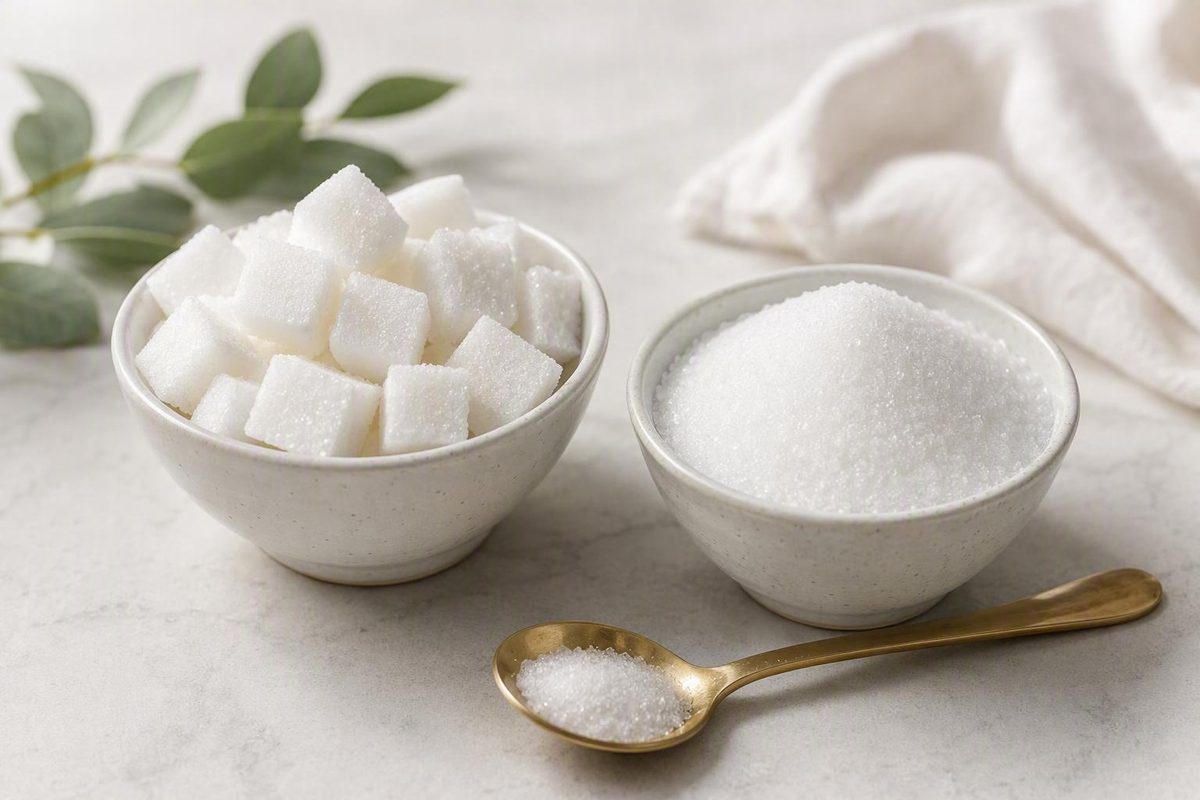
Under current FDA guidance, it stays in Total Carbohydrate but may be excluded from Total and Added Sugars pending rulemaking.
Yes, allulose is chemically a sugar because it is a monosaccharide. It is not table sugar, however, and the body handles it differently. That distinction explains why an allulose-sweetened product can include the ingredient in Total Carbohydrate while showing little or none of it under Total Sugars or Added Sugars on a U.S. Nutrition Facts panel. A front-label claim such as “zero sugar” is a separate—and currently disputed—legal question.
The short answer: allulose is a type of sugar
Allulose is a sugar by chemistry. More specifically, it is a rare monosaccharide: a single-molecule carbohydrate structurally related to fructose. It can simultaneously be used as a sugar substitute because “sugar” describes the molecule, while “sugar substitute” describes how an ingredient is used.
Allulose is not the same compound as table sugar.
Allulose at a glance
- Chemically a sugar: Yes
- The same as table sugar: No
- A sugar alcohol: No
- Counted in Total Carbohydrate: Yes
- Necessarily shown under Total Sugars: No—not under the FDA’s current enforcement-discretion policy
The confusion comes from the word “sugar” doing several jobs. It can describe a chemical class, a familiar ingredient such as sucrose, a line on the Nutrition Facts panel, or a front-of-package marketing claim. Those meanings overlap, but they are not interchangeable.
How allulose differs from table sugar
Calling both allulose and sucrose sugars does not make them nutritionally or metabolically identical. They differ in structure, sweetness, energy contribution and typical commercial use.
| Feature | Allulose | Table sugar |
|---|---|---|
| Chemical type | Monosaccharide related to fructose | Sucrose, a disaccharide |
| Sweetness | About 70% as sweet as sucrose | Reference sweetness |
| Energy value | No more than about 0.4 kcal/g under FDA guidance | About 4 kcal/g |
| Natural occurrence | Small amounts in foods including figs and raisins | Sucrose used as table sugar |
| Commercial use | Lower-calorie sugar substitute | General-purpose sweetener |
The sweetness and calorie comparison is approximate rather than product-specific. One commercial health review reports allulose at about 70% of sucrose’s sweetness and compares roughly 1.6 calories in 4 grams of allulose with 16 calories in the same amount of table sugar. It also describes commercial production through enzymatic modification of fructose. These figures describe the ingredients, not the final calorie count of every food containing them. See the cited allulose comparison and manufacturing explanation.
Allulose occurs naturally only in small amounts, including in figs and raisins. Commercial quantities are therefore not generally obtained by extracting it from fruit. They can be made from fructose through enzymatic epimerization, which changes the arrangement around part of the molecule.
The FDA concluded from the evidence it reviewed that allulose contributes no more than about 0.4 kilocalorie per gram. That general factor does not mean every allulose-containing serving is literally calorie-free.
None of this changes allulose’s chemical category. A substance can be a monosaccharide without being handled like sucrose, glucose or fructose.
How to read allulose on a U.S. Nutrition Facts label
The central U.S. policy is the FDA’s October 2020 nonbinding guidance. Pending rulemaking, the agency says it intends to exercise enforcement discretion when manufacturers exclude allulose from declared Total Sugars and Added Sugars and use a caloric value of 0.4 kcal/g. Allulose must remain within Total Carbohydrate because it is chemically a carbohydrate. These are nonbinding recommendations rather than a completed rule permanently exempting allulose from the sugar lines. Read the FDA’s allulose labeling guidance.
Here is what each part of a package can tell you:
| Label location | What to look for | How allulose may appear |
|---|---|---|
| Ingredient list | The named sweetener | Listed as allulose |
| Total Carbohydrate | Carbohydrate captured by the required calculation | Allulose remains included |
| Total Sugars and Added Sugars | Sugar declarations within Nutrition Facts | Allulose may be excluded under FDA enforcement discretion |
| Front-label claim | “Sugar-free” or “zero sugar” wording | Separate legal question from the Nutrition Facts declarations |
Conceptual example: Suppose the underlying formulation contains 8 grams of allulose and 2 grams of other carbohydrate per serving. Before applying the complete Nutrition Facts calculation and rounding rules, that is 10 grams of carbohydrate attributable to those components. The allulose would remain part of the Total Carbohydrate calculation even if the manufacturer excluded it from Total Sugars and Added Sugars under the current policy.
That example illustrates the relationship between the lines; it does not predict the exact numbers that must appear on a real package. A final declaration depends on the complete formulation, the required calculation method and applicable rounding rules.
Some manufacturers and tracking apps also calculate “net carbs,” sometimes by subtracting allulose.
Why zero-sugar claims containing allulose are disputed
A Nutrition Facts declaration and a prominent front-of-package “zero sugar” or “sugar-free” claim are not the same labeling question. The FDA guidance addresses enforcement discretion for the Total Sugars and Added Sugars declarations. Recent litigation asks whether products containing appreciable allulose can separately make zero-sugar claims.
FoodNavigator reports that a product must contain less than 0.5 gram of sugar per serving to qualify for a sugar-free claim and that, in an amicus brief involving Chobani, the FDA said the regulatory definition of total sugars includes all monosaccharides, including allulose. The same report says the Seventh Circuit allowed the Chobani case, originally filed in 2023, to proceed in late July 2026. These details come from secondary reporting rather than the underlying court docket or FDA filing. Read FoodNavigator’s account of the FDA position and appellate development.
The appellate development allowed consumers’ challenge to “Zero Sugar” marketing on allulose-sweetened yogurt to continue. It was not a final judgment that Chobani deceived consumers or violated the law. Food Dive likewise describes the ruling as a revival of the lawsuit rather than a finding of liability. See Food Dive’s report on the Chobani case.
Additional lawsuits were reported in August 2026 against brands including Liquid Death and David Protein. They are examples of the broader dispute, not proof of an industry-wide violation. Newly filed complaints contain allegations that have not been established as facts, and the cases do not by themselves show that any defendant broke the law. Food Dive reported the filing dates and allegations in those cases.
For shoppers, the practical result is unusual but straightforward: a package may show zero grams on its Nutrition Facts sugar lines under the FDA’s enforcement-discretion policy while its prominent “zero sugar” marketing remains legally contested.
What calorie and glucose trackers should take from the label
For calorie tracking, start with the product’s labeled serving size and stated calorie total. Do not automatically assign allulose either zero or four calories per gram.
If you need an ingredient-level estimate, the FDA’s general value is no more than 0.4 kcal/g. It is a labeling factor based on the evidence reviewed, not a product-specific laboratory measurement. The final food may contain other carbohydrates, fat, protein or ingredients that contribute energy, and the displayed calorie total may also reflect applicable rounding rules. The FDA guidance explains the caloric factor and the evidence behind it.
For consistent carbohydrate comparisons, check four details together:
- The labeled serving size
- Total Carbohydrate
- The ingredient list
- Any manufacturer-specific disclosure of allulose grams
This avoids treating the Total Sugars line as a complete inventory of every molecule that can chemically be called a sugar. It also keeps comparisons on the same serving basis.
It does not justify a universal promise that every allulose-containing product will have no glucose or insulin effect. The finished product matters too: a food can contain allulose alongside starches or other ingredients that contribute carbohydrate and calories.
They do not remove it from the chemical category of sugar.
Digestive tolerance and evidence limits
Reported symptoms include abdominal distention or bloating, abdominal pain, nausea and diarrhea, with more symptoms observed at higher doses in a small tolerance trial.
The study recruited 30 healthy Korean adults aged 21 to 30 with a narrow BMI range. It used a single-group, open-label, non-randomized design and relied on self-reported symptoms. At an allulose dose of 0.5 g/kg of body weight in the single-dose phase, 13 of 29 assessed participants reported diarrhea, including four reports of severe diarrhea.
The authors suggested a maximum single dose of 0.4 g/kg and a maximum total daily intake of 0.9 g/kg. Those numbers are study-derived suggestions, not universal safety limits or personalized intake recommendations.
The study’s design and population limit what can be concluded. Results from a small group of young, healthy adults cannot automatically be applied to children, pregnant people, older adults or people with gastrointestinal disorders.
For practical tracking, the amount in one serving and cumulative intake across several products may both matter. Someone who tolerates one portion could consume considerably more allulose by combining a drink, snack bar and dessert during the same day.
Is allulose natural or artificial?
Allulose occurs naturally in small amounts in foods including figs, raisins, wheat, molasses and maple syrup. Commercial allulose is generally manufactured by enzymatically converting fructose rather than extracting large quantities from those foods.
It is therefore accurate to call allulose a naturally occurring molecule while recognizing that the ingredient used in packaged foods is commercially produced. Calling it a sugar substitute describes its use, not a different chemical identity.
Is allulose FDA-approved?
“FDA-approved” is too broad. More precisely, the FDA has not objected to cited GRAS notices covering specified uses of allulose, and it has issued nonbinding guidance about declaring allulose on Nutrition Facts labels.
A company’s GRAS notice presents its conclusion that a particular ingredient is generally recognized as safe under specified conditions.
Allulose is a real sugar by chemistry, but it is not table sugar. Its unusually low energy contribution and different handling by the body explain its unusual U.S. Nutrition Facts treatment. When comparing products, separate the ingredient’s chemical identity from the Total Sugars line and from legally contested zero-sugar marketing claims, then use the labeled serving size and Total Carbohydrate as consistent starting points.