
Pili Nuts Have the Fewest Total Carbs in This Comparison
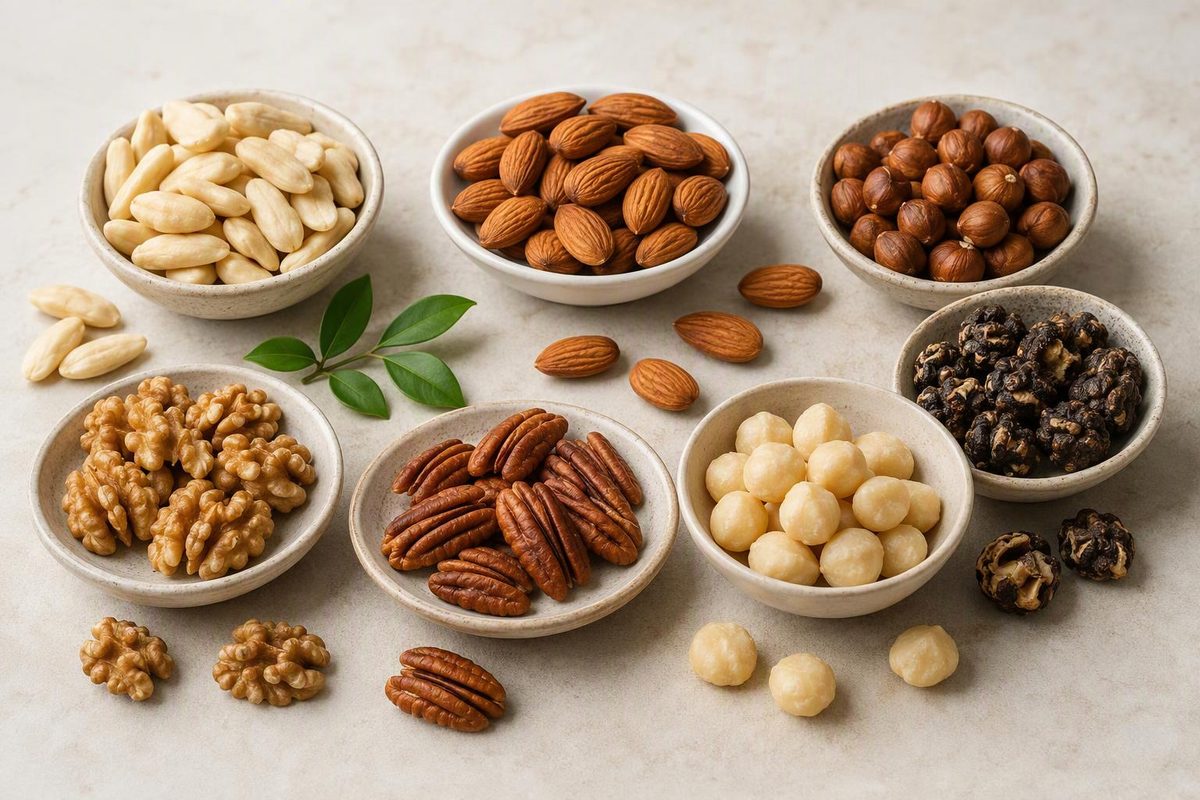
Compare seven nuts per 28 g: pili nuts lead on total carbs, while black walnuts lead on calculated net carbs where fiber data are available.
For 28 g of edible kernels, without shells or sweet coatings, dried pili nuts have the lowest total carbohydrate in this comparison: about 1.1 g. That estimate comes from the USDA dried-pili-nut record.
If you mean net carbs, dried black walnuts have the lowest calculated value among the entries below with fiber data: about 0.8 g per 28 g. Pecans and Brazil nuts each come to roughly 1.2 g, while raw macadamias have about 1.5 g.
Compare nuts at the same weight
Every row uses 28 g, approximately one ounce—not one handful or an equal number of nuts. Values are estimates scaled from USDA SR Legacy records, checked October 29, 2026. These are older reference data, not measurements of every current product.
| Nut and database preparation | Total carbs | Fiber | Calculated net carbs | Calories |
|---|---|---|---|---|
| Pili nuts, dried | 1.1 g | Not reported | Not calculated | 201 |
| Black walnuts, dried | 2.7 g | 1.9 g | 0.8 g | 173 |
| Brazil nuts, dried, unblanched | 3.3 g | 2.1 g | 1.2 g | 185 |
| Pecans, plain | 3.9 g | 2.7 g | 1.2 g | 193 |
| Macadamias, raw | 3.9 g | 2.4 g | 1.5 g | 201 |
| Almonds, plain | 6.0 g | 3.5 g | 2.5 g | 162 |
| Cashews, raw | 8.5 g | 0.9 g | 7.5 g | 155 |
Net carbs were calculated before rounding, so displayed columns may not subtract exactly. This is a comparison of selected nuts, not an exhaustive ranking of every variety or preparation.
Black walnuts are a specific type. Do not use their figure for a package that simply says “walnuts” without checking which database entry matches it.
Total carbs and net carbs answer different questions
On a U.S. Nutrition Facts label, Total Carbohydrate already includes dietary fiber. The FDA’s carbohydrate-label guide, dated October 2021, explains that sugars and sugar alcohols are also included in that total.
For these plain nuts, the calculation used here is:
Net carbs = total carbohydrate − dietary fiber
If your food log tracks total carbs, use the total-carbohydrate column rather than substituting net carbs. And missing fiber data do not mean zero fiber: the pili record supports a total-carb estimate, but not a precise net-carb calculation.
Choose and log the portion you actually eat
Pecans and macadamias are low-carb options in this comparison, but low carb does not mean low calorie. A 56 g portion of plain pecans—twice the table amount—has approximately 387 calories, 7.8 g total carbs and 2.4 g calculated net carbs.
Brazil nuts need a separate caution. The NIH Office of Dietary Supplements reports about 68–91 micrograms of selenium per nut and a U.S. adult upper limit of 400 micrograms per day from all sources. Their low carb count is not a reason to make large daily servings a habit.
For packaged nuts, use the package’s serving weight, Total Carbohydrate and Dietary Fiber values. Match the preparation—plain, roasted, glazed or chocolate-coated—and scale to your weighed portion:
Carbs eaten = label carbs × grams eaten ÷ label serving grams