
Maltodextrin vs Dextrose: The Practical Difference
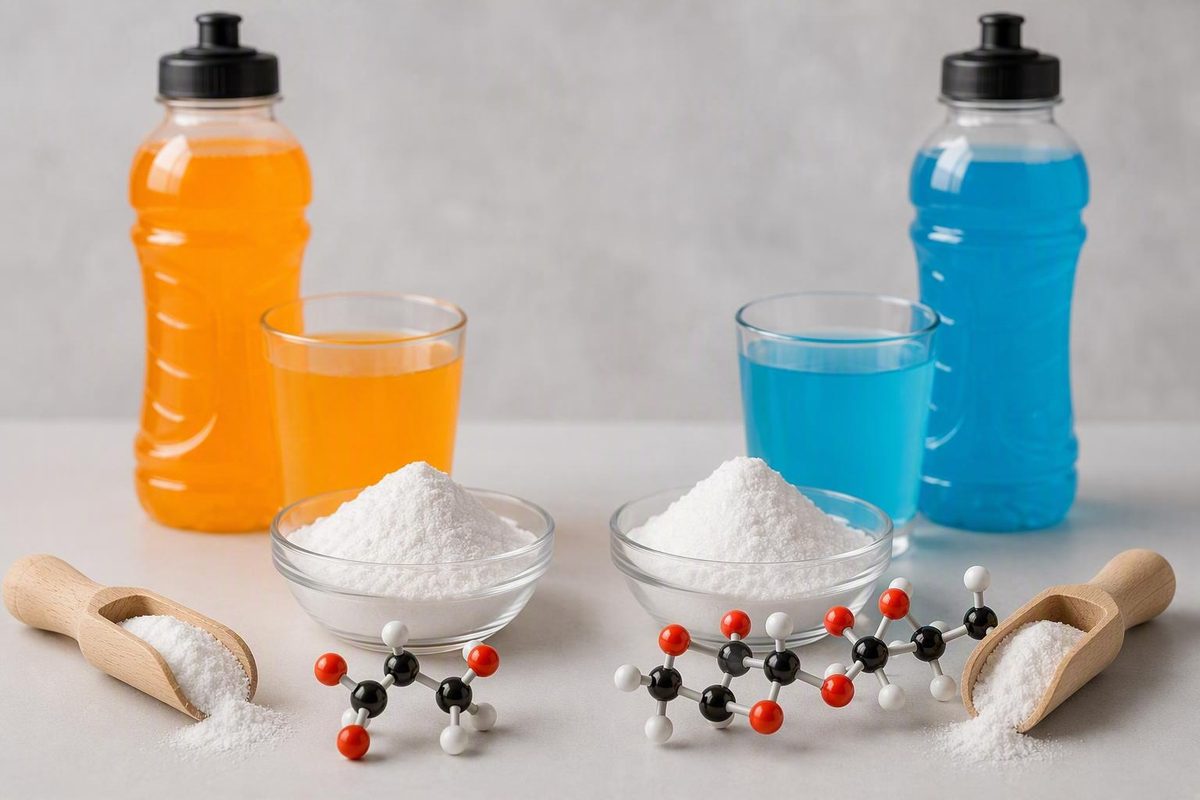
Dextrose is one glucose molecule; maltodextrin is a short glucose chain. Compare calories, sweetness, digestion, labels and sports-drink use.
Dextrose is D-glucose, a single sugar molecule. Maltodextrin is a group of short chains made mostly from glucose. For calorie tracking, however, the difference is small: digestible forms of both provide about 4 calories per gram of carbohydrate.
| Comparison | Dextrose | Maltodextrin |
|---|---|---|
| Basic structure | One glucose molecule | Short glucose chains |
| Taste | Sweet | Usually much less sweet |
| Calories | About 4 kcal per gram of carbohydrate | About 4 kcal per gram of digestible carbohydrate |
| U.S. label treatment | Listed within total and added sugars when added to a food | Usually contributes to total carbohydrate; do not assume its full weight appears as added sugars |
| Common reason for use | Sweetness and rapidly available carbohydrate | Carbohydrate, bulk or texture without as much sweetness |
| Blood-glucose response | Rapid | Also rapid when it is conventional digestible maltodextrin |
The structural difference
U.S. regulations define maltodextrin as a nonsweet, nutritive saccharide polymer made of D-glucose units, primarily joined by alpha-1,4 bonds. Its dextrose equivalent, or DE, is below 20, and it is produced by partially hydrolyzing corn, potato or rice starch (eCFR, accessed September 21, 2026).
DE describes the amount of reducing sugar relative to total dry carbohydrate; it is not the percentage of dextrose in the ingredient. Free dextrose has a DE of 100, while maltodextrin occupies the much lower range. A higher-DE maltodextrin has shorter average chains, but it remains a mixture rather than one standardized molecule (Hofman et al., 2016).
Calories: compare equal weights, not scoop sizes
FDA educational material uses 4 calories per gram of carbohydrate (FDA, October 2021). That gives these useful unrounded estimates for either ingredient when the stated amount is digestible carbohydrate:
- 10 g carbohydrate: about 40 calories
- 25 g carbohydrate: about 100 calories
- 30 g carbohydrate: about 120 calories
Do not compare one scoop with another unless the scoops hold the same number of grams. Powder density, moisture and other ingredients can change the weight and labeled carbohydrate per scoop. For a packaged powder, calculate from its own Nutrition Facts panel:
Calories from carbohydrate ≈ carbohydrate grams in your portion × 4
The package’s stated calories remain the better logging value because label calculations and rounding can make the displayed total differ slightly from simple multiplication.
How each appears on a U.S. food label
FDA explicitly includes dextrose among sugars added during food processing. It therefore contributes to Total Sugars and Added Sugars when a manufacturer adds it to a product (FDA, accessed September 21, 2026).
Maltodextrin is a glucose polymer rather than a free mono- or disaccharide, so its presence in the ingredient list does not mean that the same number of grams will appear on the Added Sugars line. It still contributes digestible carbohydrate and calories. FDA’s added-sugars guidance says manufacturers determine the declaration from the free mono- and disaccharides supplied by ingredients and the effects of processing (FDA guidance, revised December 2019).
For tracking a finished food, use this order:
- Match your portion to the label serving size.
- Log the label’s calories and total carbohydrate for that portion.
- Use the Added Sugars line—not the ingredient list alone—to count added sugar. Our portion-based added-sugar guide shows how to scale that line across a meal.
Digestion and blood sugar
The word “complex” can make maltodextrin sound slow-digesting, but that is not a reliable assumption. Digestible maltodextrin is rapidly broken down to glucose, and a scientific review found its absorption rate was not different from pure glucose in the research it evaluated (Hofman et al., 2016).
That makes both ingredients rapid carbohydrate sources. The response to a finished food still depends on the dose, serving size and what else is eaten with it. Anyone managing diabetes should not treat maltodextrin as a low-impact substitute for dextrose merely because the label may show little or no sugar.
Why choose one over the other?
Choose based on formulation rather than calories:
- Dextrose fits when sweetness and a simple glucose source are wanted.
- Maltodextrin fits when carbohydrate or bulk is wanted with less sweetness.
- In concentrated drinks, maltodextrin can deliver the same carbohydrate mass with fewer dissolved molecules and therefore lower osmolality. In one cited comparison, an 18.8% maltodextrin drink had much lower osmolality and emptied from the stomach faster than an isoenergetic 18.8% glucose drink; that specific experiment should not be read as a guarantee that every maltodextrin product will feel better during exercise (Hofman et al., 2016).
For most calorie trackers, the shortest answer is: equal grams of digestible carbohydrate from maltodextrin and dextrose are approximately equal in calories. The practical differences are sweetness, molecular form, label classification and how a product is formulated.