
Count Every Added-Sugar Gram in a Meal
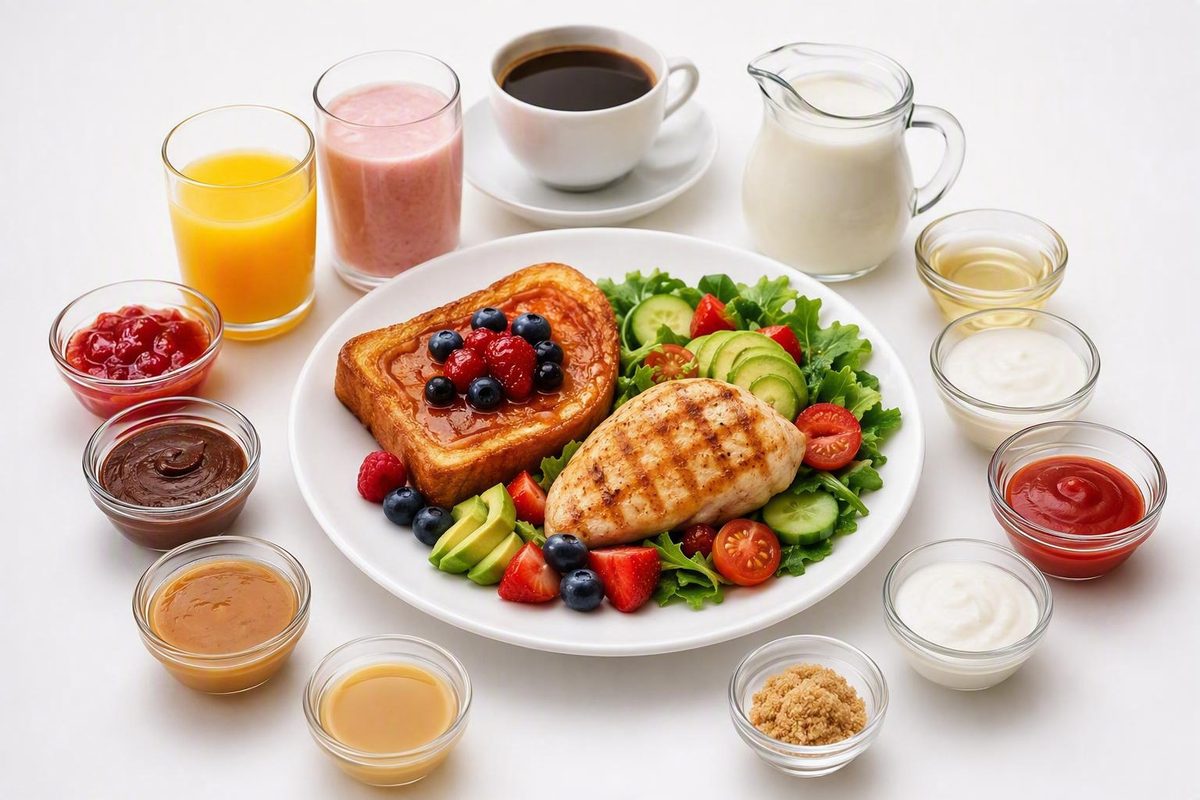
Scale each label’s Added Sugars grams to your portion, then total every food, drink, sauce, creamer, dressing, and condiment in the meal.
Count added sugar by finding “Includes X g Added Sugars” on each label, multiplying X by the number of servings you consumed, and adding the adjusted amounts from every food, drink, sauce, creamer, dressing, and condiment. For adolescents and adults, compare that total with the current federal ceiling of no more than 10 grams per meal; below 10 is under it, exactly 10 reaches it, and above 10 exceeds it.
Enter each item’s Added Sugars grams and the servings you consumed; the calculator totals the meal against 10 grams and the older 50-gram daily benchmark.
Use the grams from “Includes X g Added Sugars,” then enter how many labeled servings you ate. Mark Unknown when an item has no usable added-sugar figure.
| Meal Item | Added Sugars per Serving | Servings Eaten | Unknown | Adjusted Added Sugar | Remove |
|---|---|---|---|---|---|
| 4 g | |||||
| 3 g | |||||
| 2 g | |||||
| 0 g | |||||
| 0 g | |||||
| 0 g |
Meal total: 9 g added sugar
Result: 1 g below the 10 g per-meal ceiling.
- Formula: added sugar per serving × servings eaten.
- Meal comparison: below 10 g is under; 10 g reaches; above 10 g exceeds.
- Unknown item: the result becomes a known minimum plus the unknown component.
Default example without JavaScript: cereal 4 g + yogurt 3 g + coffee creamer 2 g = 9 g, which is 1 g below the meal ceiling and 18% of the older 50 g daily budget.
Sources: 2025–2030 Dietary Guidelines and CDC meal-based guidance; FDA Nutrition Facts guidance and the 50 g Daily Value for a 2,000-calorie diet. Example foods are arithmetic illustrations, not brand data.
Use the Added Sugars Line, Not Total Sugars
On a standard U.S. Nutrition Facts label, look beneath Total Sugars for the indented line that reads:
Includes X g Added Sugars
Record X. Do not use Total Sugars or Total Carbohydrate.
Added Sugars is part of Total Sugars, not an additional amount. If a label shows 15 grams of Total Sugars, including 7 grams of Added Sugars, the product contains 15 grams of sugar altogether. Seven of those grams are added. Count 7 grams, not 15 or 22.
The FDA uses that yogurt example in its explanation of Added Sugars labeling.
| Label Field | What It Includes | Use in This Calculation? |
|---|---|---|
| Total Carbohydrate | Sugar, starch, fiber, and other carbohydrate components in the total | No |
| Total Sugars | Naturally occurring and added sugars | No |
| Includes X g Added Sugars | Added sugars already included within Total Sugars | Yes—record X |
Read the label as a hierarchy:
Total Carbohydrate
└── Total Sugars
└── Includes X g Added Sugars
The three lines are not independent amounts. Each lower category sits inside the broader category above it.
For example, suppose cereal lists 30 grams of Total Carbohydrate, 10 grams of Total Sugars, and 6 grams of Added Sugars per serving. Record 6 grams for one serving. Some of the other 4 grams of sugar may be naturally occurring, while the remaining carbohydrate includes components other than sugar.
This is why a meal can exceed 10 grams of Total Sugars without exceeding 10 grams of Added Sugars. Whole fruit and plain dairy can contribute naturally occurring sugar without contributing added sugar.
Scale Each Label Value to the Portion Eaten
Every nutrient figure applies to the label’s stated Serving Size. It does not automatically describe your bowl, bottle, plate, or entire package. Serving size is a standardized reference amount, not a recommendation for how much you personally should eat. The FDA’s guide to serving information explains how serving size and servings per container relate to the listed values.
Use either version of the calculation:
Servings eaten = amount eaten ÷ labeled serving size
Adjusted added sugar = added sugar per serving × servings eaten
Or combine them:
Adjusted added sugar = labeled added sugar per serving × amount eaten ÷ labeled serving size
A sauce with 4 grams per two-tablespoon serving contributes 2 grams when you use one tablespoon:
1 tbsp ÷ 2 tbsp = 0.5 serving
4 g × 0.5 = 2 g
A drink with 6 grams per eight-fluid-ounce serving contributes 9 grams when you drink 12 fluid ounces:
12 fl oz ÷ 8 fl oz = 1.5 servings
6 g × 1.5 = 9 g
If a package contains two servings and lists 5 grams per serving, eating the entire package contributes 10 grams:
5 g × 2 servings = 10 g
That product alone reaches the meal ceiling before another sweetened item is counted. Check packages that look like one portion but contain multiple labeled servings before copying the Added Sugars figure.
Fractions use the same multiplication. One-quarter serving is 0.25, half is 0.5, three-quarters is 0.75, and one and a half is 1.5. A dressing with 8 grams per serving contributes 6 grams when you use three-quarters of a serving:
8 g × 0.75 = 6 g
Weight-based portions work the same way. If a product has 5 grams per 40-gram serving and you eat 60 grams:
5 g × 60 g ÷ 40 g
= 5 g × 1.5
= 7.5 g
Use package fractions, pieces, cups, spoons, milliliters, or grams—whichever unit lets you compare the portion with the serving size. If the portion was roughly poured and cannot be reconstructed, mark the result as an estimate rather than reporting false precision.
Add Every Component Once
Treat every separately labeled product as a line item. Count a product because it contains added sugar, not because it resembles dessert.
Suppose breakfast contains these arithmetic illustrations:
| Item | Added Sugar per Serving | Servings Eaten | Adjusted Amount |
|---|---|---|---|
| Cereal | 4 g | 1 | 4 g |
| Yogurt | 3 g | 1 | 3 g |
| Coffee creamer | 2 g | 1 | 2 g |
| Meal total | 9 g |
4 g + 3 g + 2 g = 9 g
The meal is 1 gram below the cited ceiling. The creamer gets its own row even though it was combined with coffee.
A second meal containing yogurt with 7 grams and a beverage with 5 grams totals 12 grams:
7 g + 5 g = 12 g
That result is 2 grams above the ceiling.
Small additions can change the comparison. Adding a condiment that contributes 2 grams to the 9-gram breakfast changes its total to 11 grams. Ketchup, dipping sauce, barbecue sauce, dressing, glaze, jam, syrup, sweetened nut butter, and coffee additions all require separate checks.
A confirmed zero may stay in the worksheet to show that the item was checked. Zero is not interchangeable with missing information. If a restaurant sauce has no usable added-sugar data, write:
Known labeled items: 7 g
Restaurant sauce: unknown
Meal total: at least 7 g, plus unknown sauce
Do not record the meal as 7 grams as though the unknown sauce contributed nothing.
The 10-Gram Ceiling Is Not a Daily Target
Current CDC guidance says adolescents and adults should consume no more than 10 grams of added sugar per meal. It is a ceiling, not an amount a person needs and not permission to reach 10 grams at every meal. The CDC gives different guidance by age, including no added sugar for children younger than 11. See the CDC’s age- and meal-based guidance.
The 2025–2030 Dietary Guidelines say that no amount of added sugar is recommended as part of a healthy diet while setting a maximum of 10 grams in one meal. Those statements are compatible: zero is not presented as a deficiency, and 10 grams is an upper boundary rather than a recommended serving. Harvard’s Nutrition Source notes that the meal-based guidance provides limited clarity for everyday implementation and differs from the previous percentage-based guideline in its analysis of the current Guidelines.
The FDA Daily Value remains 50 grams per day for a 2,000-calorie diet. That is a daily labeling reference, not the current per-meal ceiling. The FDA describes 5% Daily Value or less per serving as low and 20% or more as high.
| Benchmark | Time Frame | Function |
|---|---|---|
| 10 g | Per meal | Current age-scoped federal ceiling |
| 50 g | Per day | FDA Daily Value for a 2,000-calorie diet |
| 20% DV | Per labeled serving | A high contribution under the FDA label guide |
Ten grams equals 20% of the 50-gram Daily Value:
10 g ÷ 50 g × 100 = 20%
That conversion does not mean the meal rule was created by assigning 20% of a daily allowance to each meal.
The previous federal recommendation kept added sugars below 10% of daily calories. On a 2,000-calorie diet, that translated to approximately 50 grams per day. Do not divide 50 grams among three meals and call the resulting 16.7 grams an official meal limit. Likewise, do not add three 10-gram ceilings and call 30 grams a recommended daily intake.
The American Heart Association separately recommends daily maximums of 25 grams for women and 36 grams for men. Those are organization-specific daily recommendations rather than federal per-meal limits. See the AHA’s daily added-sugar recommendations.
Ten grams is approximately 2.5 teaspoons, using the approximation that 4 grams of sugar equals one teaspoon. Use grams for the actual count because Nutrition Facts labels report Added Sugars in grams.
Naturally Occurring Sugar Does Not Enter the Total
Sugar naturally present in whole fruit, vegetables, plain milk, and plain yogurt is not classified as added sugar. A plain yogurt can therefore show:
Total Sugars: 8 g
Includes 0 g Added Sugars
Count 0 grams toward the meal’s added-sugar total, not 8.
Sweeteners added during processing or preparation generally count. These include table, cane, and beet sugar; sucrose, dextrose, glucose, and fructose; honey, molasses, agave, maple and corn syrups; high-fructose corn syrup; rice syrup; and concentrated fruit or vegetable juices used as sweeteners.
A sweetener does not stop being added sugar because it is described as natural, raw, plant-based, unrefined, or alternative.
The ingredient list can identify sugar, syrup, words ending in “-ose,” honey, molasses, or fruit juice concentrate. Ingredients generally appear in descending order by weight, but the list usually cannot reveal the exact added-sugar grams in your portion. Use the two label sections differently:
- Nutrition Facts supplies the grams for the stated serving.
- Ingredients identifies sweeteners that may be present.
If both are available, use the Nutrition Facts value for the calculation. Sugar naturally inside an apple does not become added sugar when the apple is sliced; honey drizzled over it does count.
Homemade and Restaurant Totals May Remain Estimates
For a homemade recipe, total the added sugar supplied by measured sweetening ingredients, then divide by the number of portions produced:
Estimated added sugar per portion = recipe added sugar ÷ portions produced
If measured sweeteners contribute an estimated 48 grams and the recipe makes eight equal portions:
48 g ÷ 8 = 6 g per portion
Eating one and a half portions contributes an estimated 9 grams:
6 g × 1.5 = 9 g
This estimate is only as reliable as the ingredient data, quantities, finished yield, and portion division. For unequal portions, weighing the finished recipe and the portion eaten can support a proportional estimate:
Recipe added sugar × portion weight ÷ finished recipe weight
That method assumes the sweetener is reasonably distributed through the dish.
For restaurant food, check the restaurant’s published nutrition information and match the exact size and preparation. Determine whether its figures include beverages, sauces, dressings, marinades, glazes, toppings, and sides.
If only Total Sugars is published, do not assume all of it is added sugar. A comparable packaged product can provide rough context but cannot establish the restaurant item’s actual amount. Preserve the value as unknown when no reliable figure exists.
An ingredient list without an Added Sugars line has the same limitation. It can establish that a sweetener is present, but it cannot tell you whether your serving contains 3, 8, or 15 grams.
Check These Errors Before Accepting the Total
A valid meal total should pass four checks:
- The recorded number came from Added Sugars. Total Sugars and Total Carbohydrate were not substituted or added to it.
- Each number was scaled to the portion eaten. Servings per container and partial servings were included.
- Every component was checked. Drinks, creamers, sauces, glazes, dressings, and condiments received their own rows. Sugar-sweetened beverages may exceed the meal ceiling on their own.
- Unknown values stayed unknown. Missing data was not changed to zero.
Front-of-package wording is not a replacement for the Added Sugars line. “No sugar added” does not necessarily mean sugar-free because naturally occurring sugar may remain. “Sugar free” means less than 0.5 gram of sugar per serving, while “reduced sugar” means at least 25% less per serving than the identified comparison product. The American Diabetes Association explains these label terms.
App entries also need comparison with the package in hand. If they conflict, use the current package’s serving information and Added Sugars field.
The final arithmetic remains:
For each item:
added sugar per serving × servings eaten = adjusted added sugar
For the meal:
add all adjusted amounts once
Below 10 grams is under the cited ceiling, exactly 10 reaches it, and above 10 exceeds it. If any component is unknown, report the known total as a minimum rather than presenting it as a complete count.