
Counting Calories in Maple Syrup Coffee: Precise Estimates for Common Drinks
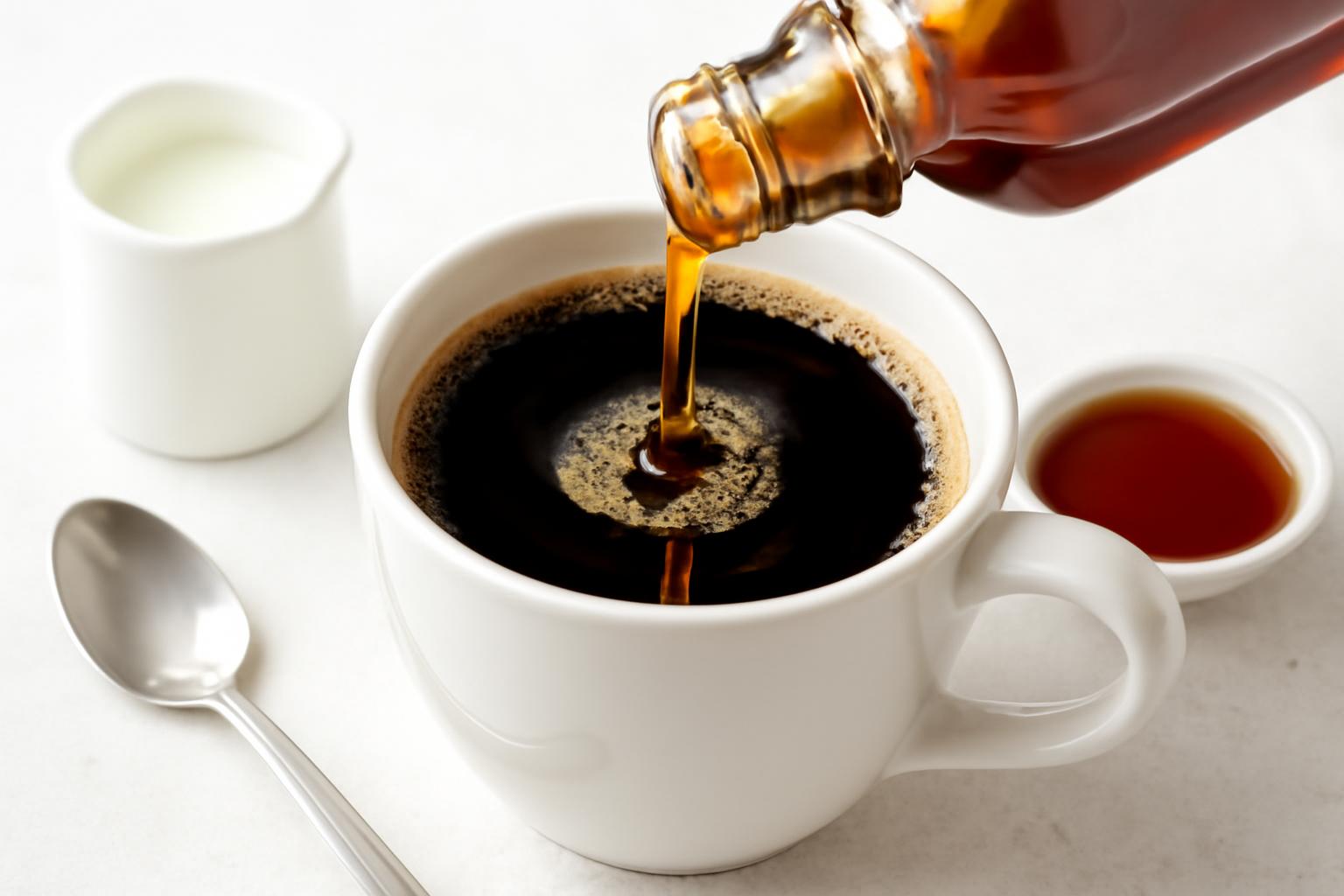
One teaspoon adds 17 calories and 4 g of sugar. Iced coffee often uses more syrup, while dairy can become the bigger variable in milk-based drinks.
Maple syrup in coffee is one of those additions that feels hard to track until you reduce it to the only numbers that matter: how much syrup went in, what else went in, and how much uncertainty you are willing to accept from ordinary food labels. For calorie and macro logging, the maple itself is the cleanest part of the drink. The harder part is everything around it: milk, cream, café naming, and the gap between what a recipe calls “a splash” and what actually lands in your mug.
The most useful anchor is simple: 1 teaspoon of maple syrup adds 17 calories and 4 grams of sugar to coffee, with trace minerals that are real but small in coffee-sized amounts (Eat This Much). From there, the drink can stay close to syrup-only territory if it is black, or climb quickly once dairy enters the cup.
What follows keeps the arithmetic honest. Where the evidence supports exact numbers, you will get exact numbers. Where the evidence only supports recipe-based estimates or usage ranges, that is how it is presented.
How Food Labels Calculate Calories (And Where the Number Can Be Wrong): Food labels use the Atwater system, not direct measurement. Here’s how the 4-4-9 factors work, why they allow a 20% margin of error, and what that means for tracking.
What Maple Syrup Adds to Coffee: Basic Nutrition Profile
For calorie tracking, 1 teaspoon is the most practical unit to start with. A 1 teaspoon, 7 gram serving of maple syrup provides 17 calories, 4 grams of net carbohydrate, and 4 grams of sugar, with effectively negligible fat and protein in normal logging terms (Eat This Much).
That same teaspoon also contains small amounts of micronutrients. The same nutrition entry lists about 8% of daily value for manganese and 7% for riboflavin, plus about 1% DV calcium and very small amounts of potassium and magnesium (Eat This Much). Those minerals are not fictional, but the serving is still overwhelmingly a sweetener serving, not a meaningful nutrient delivery system.
Two practical consequences follow from that:
- Maple syrup belongs in the “added sugar” bucket for logging.
- Its calories are predictable once the spoon size is known.
By weight, maple syrup is still energy-dense at 260 calories per 100 grams (Eat This Much; also summarized in expert-reviewed coverage at Real Simple). That is lower than granulated sugar by weight, but not low enough to reclassify it as anything other than a calorie-bearing sweetener in the context of coffee.
A compact way to think about common coffee amounts is this:
| Maple syrup amount | Calories | Carbs | Sugar |
|---|---|---|---|
| 1 tsp | 17 | 4 g | 4 g |
| 1.5 tsp | about 26 | about 6 g | about 6 g |
| 2 tsp | 34 | 8 g | 8 g |
| 1 tbsp | 52 | 13.4 g | 12.1 g |
Table note: the 1 teaspoon values come from the Eat This Much nutrition entry for maple syrup, and the 1.5- and 2-teaspoon rows are straightforward multiples of that entry. The 1 tablespoon value is summarized in Real Simple’s expert-reviewed sweetener comparison.
That scaling is what makes maple syrup easier to log than many flavored syrups. If you measure it, the calorie math stays clean. If you free-pour it, the uncertainty shifts from metabolism to simple kitchen sloppiness.
There is another layer of uncertainty, and it comes from labels themselves. CaloriePages notes that food-label calorie counts can be off by up to 20%, which is a good reminder that the number you log is an estimate, not a lab result (About CaloriePages). For everyday coffee tracking, that does not make logging pointless. It just means “1 teaspoon” is more trustworthy than “a generous drizzle.”
So the basic profile is straightforward: maple syrup adds mostly carbohydrate calories, a little flavor complexity, and some trace minerals. In coffee-sized amounts, it is still best treated as added sugar with known spoon-based math, not as a health food.
Calories in Black Coffee with Maple Syrup: Per-Cup Estimates
In black coffee, the syrup does almost all of the meaningful calorie work.
Because the evidence pack here gives strong support for the maple-syrup numbers but not for a standalone brewed-coffee calorie entry, the safest exact figures are the syrup contribution totals. In practice, a black coffee sweetened with maple syrup will end up very close to the syrup number itself, because the plain coffee contributes comparatively little energy relative to the sweetener.
Here is the clean part of the math:
| Black coffee with maple | Syrup calories added | Syrup carbs added | Syrup sugar added |
|---|---|---|---|
| 1 tsp maple | 17 | 4 g | 4 g |
| 1.5 tsp maple | about 26 | about 6 g | about 6 g |
| 2 tsp maple | 34 | 8 g | 8 g |
Table note: calculated from the same 1 teaspoon = 17 calories and 4 grams sugar maple entry cited above.
For actual use, recipe guidance is consistent enough to be helpful. Mindy’s coffee recipe notes that most people use 1 to 2 teaspoons per cup for hot or iced coffee, which is a sensible real-world range for home drinks (Mindy’s Cooking Obsession). In other words, the typical black maple coffee at home is usually adding 17 to 34 syrup calories per cup, not 100.
That also explains why black maple coffee is one of the easier coffee drinks to log. The main error sources are not exotic metabolic effects. They are ordinary kitchen ones:
- a heaped teaspoon instead of a level one,
- a splash from the bottle instead of a measured pour,
- or rounding differences between app entries.
The better-supported nutritional distinction is glycemic index, not calorie magic. A peer-reviewed review reports a glycemic index of 54 for maple syrup versus 65 for table sugar, suggesting a somewhat lower average glycemic response than sugar, while still leaving maple firmly in the added-sugar category (PMC review). That is useful context if you compare sweeteners, but not a reason to stop counting the spoonfuls.
So for black coffee, the logging rule is simple:
- 1 tsp maple: count 17 calories, 4 g sugar
- 2 tsp maple: count 34 calories, 8 g sugar
- if you want the total cup exact to the last calorie, log the coffee entry too
- if you just want the meaningful change, the syrup is the part to measure carefully
That is the closest thing to a “precise estimate” the evidence actually supports: for black coffee, the syrup amount is the number that matters.
Maple Syrup Lattes and Milk-Based Drinks: Full Breakdowns
Once milk or cream enters the drink, the syrup often stops being the main variable.
The best-supported concrete example in the evidence pack comes from Mindy’s homemade maple coffee recipe. It uses 1.5 cups strong brewed coffee, 1/4 cup milk, and 2 teaspoons pure maple syrup for the batch, and gives an approximate nutrition estimate of 39 calories per serving (Mindy’s Cooking Obsession). Because that figure is recipe-specific and marked approximate, it should be treated as a small-home-drink example, not as a universal latte number.
Still, it is useful. It shows what a restrained milk-and-maple coffee can look like in practice: not black, not dessert-like, and still fairly modest.
Kitchen Skip says rich coffee or espresso is swirled with maple flavor and fall-spiced cream that’s lightly sweetened with maple syrup Maple Syrup Coffee - Kitchen Skip. That recipe is valuable not because it gives one exact calorie total—it does not—but because it holds the maple amount steady while allowing widely different dairy choices. That is exactly how real-life coffee calories drift upward: not because maple syrup suddenly becomes caloric, but because the liquid around it changes.
A practical way to break milk-based maple coffee into tracking tiers is this:
1. Lightly milked coffee
This is the territory of a small amount of milk plus 1 teaspoon or so of maple syrup. Mindy’s approximate 39-calorie serving sits in this category. In a drink like that, the syrup remains a big part of the total, because the dairy amount is restrained.
2. Creamy homemade coffee
Kitchen Skip’s template keeps the syrup at 1 teaspoon but allows milk, cream, half-and-half, or plant milk. The syrup contribution there stays fixed at 17 calories, while the dairy contribution can vary materially based on what you choose.
3. Latte-style maple drinks
Kitchen Skip also notes that the same idea can be turned into a maple latte by using espresso and more milk. The evidence pack does not provide a standardized nutrition panel for that exact build, which is why it is more honest to say: once the milk volume goes up, the drink stops behaving like “coffee plus sweetener” and starts behaving like “a milk drink that also happens to contain coffee.”
That distinction matters for people who wonder why two maple coffees can log so differently. Consider three descriptions that sound similar but are not nutritionally equivalent:
- black coffee with 1 tsp maple
- coffee with a small splash of milk and 1 tsp maple
- latte-style coffee with maple and a much larger milk volume
The syrup amount may be identical across all three. The calorie outcome is not.
The most reliable logging method is therefore component-based, not name-based:
-
Log the maple syrup first. Use 17 calories per teaspoon and scale from there.
-
Log the dairy separately. Use the package or café nutrition info for the exact milk, cream, half-and-half, or plant milk you used.
-
Treat the coffee base as the minor part unless the drink is heavily built.
-
Do not count frothing as added energy. Frothing changes texture and apparent volume, not the ingredient list. The same milk still contains the same label calories before and after it is frothed.
If you are thinking in net-energy terms, carbohydrates have a thermic effect of roughly 5% to 10%, but food labels and tracking apps still work from gross label calories, not digestion-adjusted ones (TDEE explained). So while it is technically true that your body does not retain every listed carbohydrate calorie with perfect efficiency, it is usually a mistake to manually “discount” your maple coffee in a food log.
One more note on precision: the evidence here supports recipe examples better than it supports universal café drink totals. That is why the most defensible language is:
- recipe-based estimate when a source gives an actual nutrition panel,
- component math when you have a syrup amount plus a dairy label,
- and range language when the drink name is vague.
That may be less exciting than a single “maple latte calories” number, but it is much closer to how tracking actually works.
Hot vs Iced Maple Coffee: Dilution and Sweetener Adjustments
Hot and iced maple coffee are not different because of temperature itself. They differ because iced versions often end up with more maple syrup.
Mindy’s recipe is especially useful here because it makes the point plainly: most people use 1 to 2 teaspoons per cup, and the iced version may need more sweetness because of dilution from ice (Mindy’s Cooking Obsession). That gives you a very workable rule of thumb:
Using the same maple math as above, that means the syrup contribution commonly looks like this:
| Drink style | Common maple amount | Syrup calories | Syrup sugar |
|---|---|---|---|
| Hot maple coffee | 1 tsp | 17 | 4 g |
| Slightly sweeter hot or lightly iced | 1.5 tsp | about 26 | about 6 g |
| Iced maple coffee with stronger sweetness | 2 tsp | 34 | 8 g |
Ice itself adds no calories. What it changes is concentration. If the glass contains a large amount of ice, the same teaspoon of syrup tastes less sweet because the final drink is colder and, over time, more diluted.
That is why “hot versus iced” is really shorthand for three different questions:
- How much maple syrup did you add?
- How much ice watered the drink down?
- Did you compensate with stronger coffee, more syrup, or both?
Mindy’s recipe specifically calls for strong brewed coffee for both hot and iced versions, which helps preserve coffee flavor when the iced drink is diluted.
Another practical point is mixing. Maple syrup dissolves easily in hot coffee, and recipe guidance also treats it as workable in iced drinks, especially when mixed into coffee before the final milk and ice are added. That convenience matters in real life: a sweetener that mixes cleanly is easier to use consistently, and consistency is what makes your logs match your habits.
For tracking, the key difference between hot and iced drinks is not chemistry. It is the way people pour. A hot mug that tastes balanced at 1 teaspoon may turn into an iced glass that wants 2 teaspoons. That is a meaningful difference: it takes the maple portion from 17 calories and 4 grams of sugar to 34 calories and 8 grams of sugar.
Put differently, the most common “iced coffee surprise” is not the ice. It is the extra sweetener.
And while that difference matters, it still lives inside a much bigger calorie-control system. The thermic effect of carbohydrate is only about 5% to 10%, and NEAT can vary by up to 2,000 calories per day between people with similar body size and formal exercise habits (TDEE explained). So yes, the jump from 1 teaspoon to 2 teaspoons is worth counting. But no, it is usually not the dominant reason body weight does or does not move over time.
Maple Syrup vs Sugar or Honey: Calorie Density Comparison
The fairest comparison is this: maple syrup is not low-calorie, but it is also not dramatically different from other common sweeteners in a coffee cup.
At the maple end, the most solid spoon-based number here is unchanged: 1 teaspoon of maple syrup adds 17 calories and 4 grams of sugar. By weight, maple syrup contains 260 calories per 100 grams (Eat This Much; also summarized in Real Simple).
Real Simple’s expert-reviewed sweetener comparison says maple syrup and honey both provide more nutrients than refined sugar, but all three still count as added sugars and should be used in moderation (Real Simple). The same piece also reports 387 calories per 100 grams for granulated sugar, which shows maple is less calorie-dense by weight than sugar.
That sounds like a big win until you move from 100-gram comparisons to actual coffee habits.
Coffee sweetening happens by spoon, not by the hundred grams. And spoon comparisons compress the gap because maple syrup is denser than water and heavier per spoonful than dry sugar. So in a real mug:
- honey is commonly described as a bit higher per equal spoonful
- all three remain sweeteners whose totals add up quickly when poured casually
The glycemic-index comparison is clearer than the calorie one. The peer-reviewed review cited earlier reports a glycemic index of 54 for maple syrup and 65 for sugar (PMC review). Real Simple likewise summarizes maple syrup and honey as having a lower glycemic index than white sugar. That suggests maple may produce a somewhat gentler average blood-sugar response than table sugar, but the important caveat is the boring one: lower does not mean low, and “natural” does not remove it from the added-sugar category.
A useful way to compare the three for coffee purposes is:
Maple syrup
- Known spoon math: 17 calories and 4 g sugar per teaspoon
- Distinct flavor beyond sweetness
- Lower GI than table sugar in the cited comparison
- Still an added sugar
Sugar
- Higher calorie density by weight than maple syrup
- In everyday coffee use, often not very different from maple in practical calorie impact
- Neutral sweetness profile compared with maple’s flavor contribution
Honey
- Generally grouped with maple as a natural sweetener rather than refined sugar
- Usually a little higher than maple per equal spoonful in expert summaries
- Still an added sugar, and still easy to over-pour
So if the real question is, “Should I switch from sugar to maple syrup to save a meaningful number of coffee calories?” the evidence-based answer is: usually not by much. If the real question is, “Do I prefer how maple tastes?” then yes, flavor is the more legitimate reason to choose it.
The strongest nutrition-based conclusion is not that maple “wins.” It is that sweetener choice matters less than how much sweetener you use and what else is in the drink.
Pure Maple vs Imitation: Label Reading for Accurate Tracking
For logging accuracy, “maple” on the front of the bottle is not enough.
Kitchen Skip’s guide lays out three different ways maple flavor gets into coffee:
- maple flavoring syrup with sweetener
- unsweetened or lightly sweetened maple flavoring
- pure maple syrup (Kitchen Skip)
Those are not interchangeable from a tracking perspective. If you are using pure maple syrup, the ingredient list should be simple, and the nutrition should look broadly consistent with ordinary maple-syrup entries. Kitchen Skip also notes that pure maple syrup is a one-ingredient product and summarizes the current Grade A flavor/color categories as Golden/Delicate, Amber/Rich, Dark/Robust, and Very Dark/Strong (Kitchen Skip). Those grade names matter more for flavor than for calories.
A practical label check looks like this:
- Ingredients: ideally just maple syrup
- Serving size: note whether the label uses teaspoons, tablespoons, or metric grams
- Nutrition pattern: look for numbers in the same neighborhood as ordinary maple syrup, such as about 260 calories per 100 grams and about 17 calories per 7-gram teaspoon
- Product type: distinguish pure syrup from maple-flavored syrups that may use added sweeteners or flavorings
That 260 calories per 100 grams figure is best used as a rough consistency check, not as proof of purity. A label that looks wildly different from that benchmark may not be a standard pure-maple product, but matching the benchmark does not by itself authenticate anything. The ingredient list still matters more.
This is where imitation and café-style maple syrups create logging problems. A maple-flavored product can taste similar enough in the cup while having a different ingredient base, different sweetness, and different serving math. If the bottle includes other sweeteners, stabilizers, or flavorings, the right move is simple: log the product you actually bought, not a generic maple syrup entry.
Weighing helps here too. The generic teaspoon entry above uses 7 grams per teaspoon. If you care about precision, weighing the syrup is better than guessing from the pour. That does not defeat label uncertainty—labels can still be off by up to 20%, as noted earlier—but it does eliminate one very common household error: thinking that every “teaspoon-ish” squeeze from a bottle is the same.
The practical takeaway is uncomplicated:
- Pure maple syrup is easier to track because the ingredient list is simple.
- Imitation or maple-flavored syrups may be perfectly usable in coffee, but they are separate products with separate nutrition panels.
- Grade names affect flavor profile, not the basic logic of logging.
If the goal is calorie accuracy, the back label matters more than the front label.
Tracking Maple Coffee in TDEE: Calibration and Error Rates
If you are using maple coffee inside a maintenance, fat-loss, or gain plan, the cleanest method is to log the drink as components.
That means:
- maple syrup: 17 calories per teaspoon
- coffee: whatever entry you normally use for the brewed base
- milk, cream, or plant milk: the exact nutrition for the amount you actually used
That parts-based method sounds obvious, but it solves most coffee-logging problems at once. It avoids vague café names, prevents you from importing the wrong dairy assumptions, and keeps the syrup math stable from drink to drink.
It also fits how TDEE should be calibrated. CaloriePages’ TDEE explainer notes that common calculator estimates built from equations such as Mifflin-St Jeor have a mean error of about ±10%, and recommends improving them with 2 to 4 weeks of accurate intake logging plus daily weigh-ins interpreted through weekly averages (TDEE explained). That is the right context for maple coffee: a teaspoon matters, especially if it is daily, but the body-weight trend over weeks matters more.
This is also where it helps to resist pseudo-precision. Yes, carbohydrates have a thermic effect of about 5% to 10%. No, that does not usually mean you should shave a few calories off every sweetened drink you log. Labels and apps use gross calories, and consistency beats hand-adjusted “net” math for most non-laboratory tracking.
Added-sugar guidance belongs in this section too. Real Simple’s expert-reviewed summary cites the American Heart Association guidance of no more than 6 teaspoons of added sugar per day for women and 9 teaspoons for men (Real Simple). Maple syrup counts toward that total just as fully as table sugar does. The fact that it contains trace manganese or riboflavin does not change the accounting.
A useful way to think about maple coffee inside TDEE is:
When it matters a lot
- you drink it every day
- you have it more than once per day
- your “1 teaspoon” is often really 2 or 3
- the drink includes significant dairy or cream
When it matters less
- the syrup is measured and stable
- the drink is otherwise simple
- the rest of your intake is logged consistently
- you judge progress from weekly trends, not from one drink in isolation
A person who moves from 1 teaspoon to 2 teaspoons daily adds 17 syrup calories per cup. Over time, that is real. It just exists inside a system where calculator error, ordinary label variance, and daily activity variation can be much larger.
So the practical TDEE advice is not glamorous:
- measure the syrup,
- read the dairy label,
- log the drink the same way each time,
- then evaluate the result against multi-week body-weight trends
That is more useful than arguing about whether maple syrup is “better” than sugar in the abstract.
Variations and Serving Size Ranges: From Minimal to Indulgent
“Maple coffee” hides a wider range of drinks than the name suggests. The difference between a lightly sweetened black mug and a creamy fall-style iced drink can be substantial even when both are described with the same two words.
The simplest version is still the anchor:
Minimal black maple coffee
If you add 1 teaspoon of pure maple syrup to black coffee, the syrup contributes 17 calories and 4 grams of sugar. Because the coffee itself is a minor contributor relative to the syrup, the finished drink stays very close to that syrup number in practical logging terms.
Slightly sweeter or iced black maple coffee
A drink using 1.5 teaspoons adds about 26 calories from maple alone; 2 teaspoons adds 34 calories. This is where many iced coffees land once the drink is cold, diluted, and adjusted for taste.
Restrained homemade milk-and-maple coffee
Mindy’s approximate nutrition estimate of 39 calories per serving is a good example of a non-black maple coffee that still stays modest. It is not a universal number, but it does show that a measured homemade version can remain far from dessert-drink territory.
Creamier one-cup homemade coffee
Kitchen Skip’s template uses 1 teaspoon maple syrup plus 1/4 cup milk, cream, half-and-half, or plant milk in a single cup. The syrup remains fixed at 17 calories; the dairy choice becomes the main source of variation. This is the point where a nutrition app’s generic “maple coffee” entry starts to lose value, because the same drink frame can be light or rich depending on what fills that quarter cup.
Indulgent iced maple coffee
Producer guidance aimed at home coffee users notes that an indulgent iced maple coffee may use up to 1 tablespoon of maple syrup. A tablespoon of maple syrup provides 52 calories, 13.4 grams of carbs, and 12.1 grams of sugar (usage guidance from Maple from Canada; nutrition summary from Real Simple). Before milk, cream, whipped toppings, or flavored syrups, that already triples the maple load of a 1-teaspoon drink.
That last example is important because it shows where the drink range really opens up. The “sweetener problem” is not just what kind of sweetener you chose. It is whether your pour stayed at teaspoon level or drifted into tablespoon territory.
A few other variations are worth separating out.
Spiced maple coffee
Recipes in the evidence pack commonly add cinnamon or pumpkin spice in small amounts. In tracking terms, those spices matter more for flavor than for the core maple math. The big levers remain the syrup and the dairy.
Plant-milk versions
Kitchen Skip explicitly allows plant milk in the same one-cup maple-coffee build. That is useful, but it does not mean plant milks are nutritionally interchangeable. The evidence pack here does not supply standardized calorie entries for almond, oat, or soy products, and branded formulas vary widely. So if you use plant milk, the carton is a better source than a generic app assumption.
Maple simple syrup for cold drinks
The Whole Cook’s maple-cinnamon simple syrup recipe uses 1 cup pure maple syrup and 1 cup water, optionally with cinnamon (The Whole Cook). From a tracking standpoint, that means the finished syrup mixture is roughly half maple syrup and half water by volume.
That can be genuinely helpful for iced drinks. It gives you:
- easier mixing in cold beverages,
- finer control over sweetness,
- and a lighter-calorie pour per spoonful of finished syrup mixture
The tradeoff, obviously, is that you need more total liquid volume to reach the same sweetness as straight maple syrup.
Putting all of that together, the most useful serving-range summary looks like this:
| Style | Typical maple amount | What the evidence supports |
|---|---|---|
| Minimal black | 1 tsp | 17 calories, 4 g sugar from maple |
| Sweetened black / common iced | 1.5-2 tsp | about 26-34 calories from maple |
| Restrained milk-and-maple homemade | recipe-based | about 39 calories per serving in one approximate recipe |
| Creamy homemade | 1 tsp maple + 1/4 cup dairy | syrup fixed at 17 calories; dairy becomes main variable |
| Indulgent iced | up to 1 tbsp | 52 calories from maple before dairy and extras |
That range is wide, but not mysterious. The calories rise for predictable reasons:
- more syrup,
- richer or larger dairy additions,
- bigger cup size,
- or extra flavored add-ins layered on top.
In other words, maple coffee is not hard to understand. The label “maple coffee” is just too broad to be a useful nutrition category by itself.
How many calories in 1 tsp maple syrup coffee (black)?
Maple syrup in coffee: carbs and sugar per serving?
For 1 teaspoon, maple syrup adds 4 grams of carbohydrate and 4 grams of sugar. For 2 teaspoons, that becomes 8 grams of carbohydrate and 8 grams of sugar; 1.5 teaspoons works out to about 6 grams of each, calculated from the same teaspoon entry (Eat This Much).
Pure maple syrup calories vs table sugar in coffee?
Maple syrup is lower than granulated sugar by weight, at 260 calories per 100 grams versus 387 calories per 100 grams, but in coffee the spoon-level difference is much smaller than the 100-gram numbers suggest. In normal mug use, maple and sugar are usually close enough that flavor preference matters more than major calorie savings (Real Simple).
Does milk type change maple coffee calories much?
One recipe-based example comes out to about 39 calories per serving with a restrained amount of milk and syrup, while another one-cup maple-coffee framework keeps the syrup at 1 teaspoon but allows milk, cream, half-and-half, or plant milk, making the dairy choice the bigger variable (Mindy’s Cooking Obsession; Kitchen Skip).
Glycemic index of maple syrup vs sugar for coffee?
The cited comparison reports a glycemic index of 54 for maple syrup and 65 for table sugar, which suggests maple may have a somewhat lower average glycemic impact than sugar while still remaining an added sugar that counts fully in a food log (PMC review).
Maple syrup in coffee is easiest to track when you stop treating it like a mysterious café flavor and start treating it like a measured ingredient. The firmest number is still the most useful one: 1 teaspoon adds 17 calories and 4 grams of sugar. From there, black coffee stays simple, iced coffee often uses more syrup, and milk-based versions become dairy questions as much as sweetener questions. This article is for general informational purposes only and does not constitute medical or dietary advice (CaloriePages Terms of Use).