
How to Choose the Right Espresso-and-Milk Drink
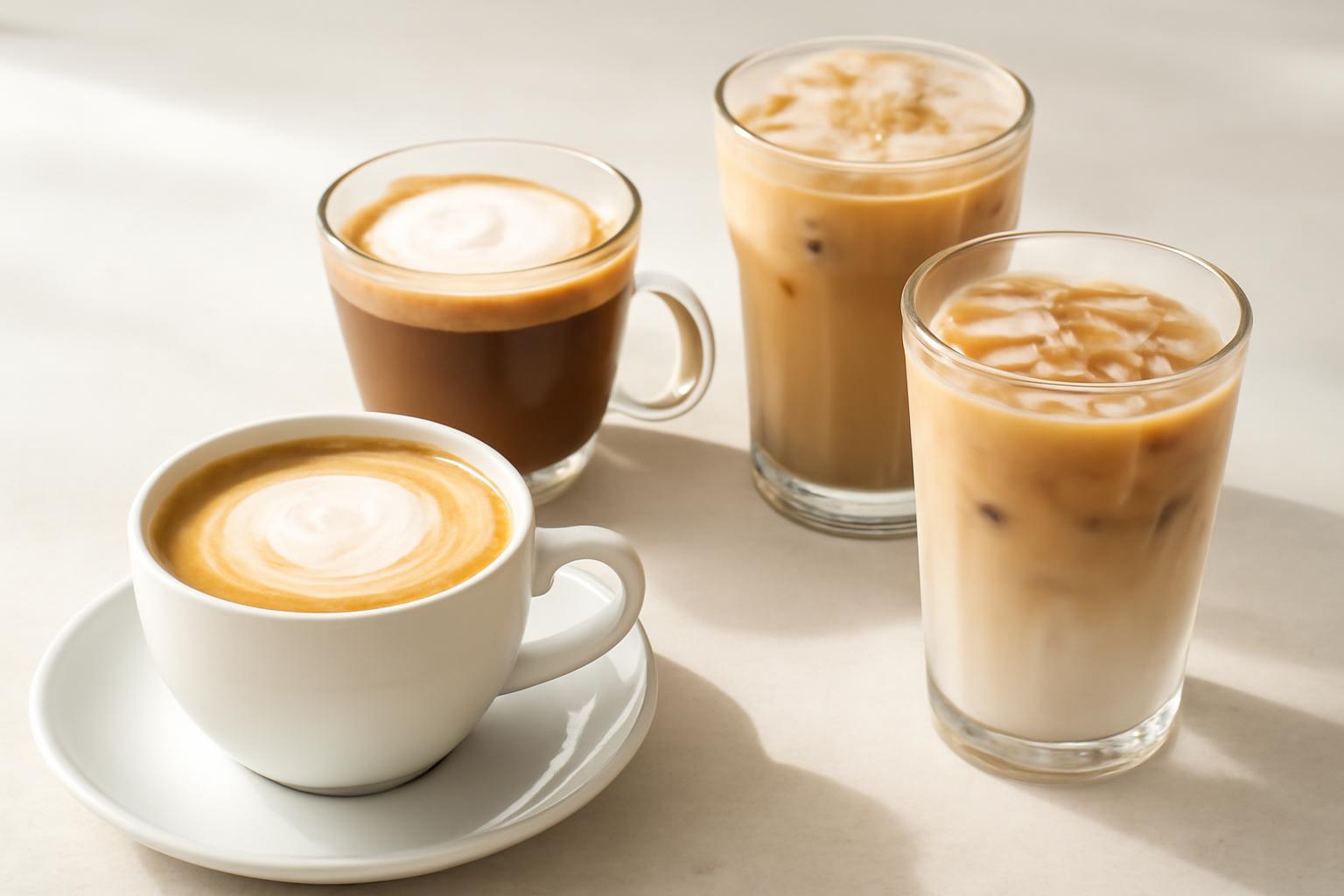
A cappuccino with substantial foam may contain less liquid milk than a latte in a similar cup. Compare 5 drinks by milk, texture and espresso presence.
What “milky espresso coffee” means
Milky espresso coffee is a broad category of drinks that combine espresso with steamed, textured, foamed, or cold milk. It is not one standardized café recipe. Lattes, cappuccinos, flat whites, cortados, and espresso macchiatos all belong to the category, even though they use different amounts and textures of milk.
Espresso is a concentrated brewing method rather than a particular bean or roast. Coffees of different origins and roast levels can be prepared as espresso; in these drinks, espresso simply forms the coffee base to which milk is added, as this guide to espresso drinks explains.
Five variables account for most of the differences between milky espresso drinks:
- Espresso dose: how much espresso forms the base.
- Liquid-milk quantity: how much pourable milk is added.
- Foam quantity: how much cup space is occupied by aerated milk.
- Foam texture: whether the bubbles are fine and integrated or thick and airy.
These variables are related but not interchangeable. A cappuccino may have a substantial foam cap without containing as much liquid milk as a latte. A small flat white may taste more espresso-forward than a larger latte even when their espresso doses are similar.
Café terminology varies by region, business, and barista. Ratios, shot counts, and serving sizes should therefore be treated as approximate patterns rather than universal formulas. Flat white definitions are especially variable, but even names such as cappuccino and macchiato do not guarantee one preparation. A glossary of espresso-and-milk drinks likewise cautions that coffee shops do not apply these names consistently.
The general category should also be distinguished from proprietary menu names. A branded “Milky Way,” for example, may be a flavored drink containing chocolate, vanilla, caramel, toppings, or other ingredients rather than a foundational espresso-and-milk style. One café’s Milky Way menu listing includes espresso, milk, multiple flavors, and hot, iced, or blended preparation.
For an immediate ordering answer:
- Choose a latte for the most milk-forward mainstream option.
- Choose a flat white or cortado when you want milk without losing as much espresso presence.
- Choose an espresso macchiato when you want espresso with only a small addition of milk or foam.
- Choose a cappuccino when you want a prominent, airy foam texture rather than abundant liquid milk.
The milkiness spectrum: macchiato to latte
The main drinks can be placed on an approximate spectrum from least to most liquid milk:
Espresso macchiato → cortado → flat white or cappuccino → latte
The middle of the spectrum can shift. A flat white may contain more liquid milk than a compact cappuccino at one café and less at another. A cappuccino’s foam can also make the serving look larger without making it the most milk-heavy drink.
| Drink | Relative liquid-milk level | Foam style | Commonly reported serving pattern | Perceived espresso prominence | Selection cue |
|---|---|---|---|---|---|
| Espresso macchiato | Very low | Small addition of milk or foam | Espresso-sized and compact | Highest in this core comparison | Espresso with minimal softening |
| Cortado | Low | Usually little foam | Small, with roughly balanced espresso and warm milk | High | Compact milk-and-espresso balance |
| Flat white | Moderate | Fine, integrated microfoam | Commonly smaller and less milky than a latte | Moderate to high | Smooth milk texture with clear espresso presence |
| Cappuccino | Moderate, often less than a latte | Substantial foam component | Compact to medium, depending on the café | Moderate | Lighter, frothier mouthfeel |
| Latte | High | Thin or light foam layer | Commonly the largest and most milk-forward core style | Lowest | Abundant milk and a mild perceived coffee flavor |
An espresso macchiato is the most espresso-led drink in this comparison. In this context, “macchiato” refers to espresso marked with a small amount of milk or foam. The addition softens the drink without turning it into a large milk beverage.
A cortado commonly follows an approximately balanced espresso-to-warm-milk pattern. Its compact serving size and limited foam preserve more espresso concentration than a typical latte. “Balanced” describes a common convention, not a mandatory mathematical ratio.
A flat white generally uses less milk than a latte and emphasizes finely textured microfoam rather than a large, airy foam cap. It is commonly compact and espresso-forward, but cafés disagree about its shot count, espresso preparation, cup size, and exact milk quantity.
A cappuccino combines espresso, liquid milk, and a substantial foam component. The familiar equal-parts description is a useful model rather than a rule followed everywhere. Because foam occupies cup space, total cup volume does not reveal how much liquid milk the drink contains.
A latte usually contains comparatively generous steamed milk with only a light foam layer. The greater dilution commonly makes it the mildest-tasting and most milk-forward of these five styles. These broad differences among latte, cappuccino, and flat white are also reflected in this comparison of their milk and foam patterns.
The practical distinction is not simply “larger cup equals more milk.” Compare the espresso, liquid milk, foam, and total serving size separately.
Latte, cappuccino, flat white, cortado and macchiato compared
A drink name provides a useful starting point, but the café’s recipe determines the actual balance.
Latte
A latte usually combines espresso with a generous quantity of steamed milk and a light foam layer. Spreading the espresso through more liquid milk generally makes it taste milder than a cortado or flat white prepared with a comparable espresso dose.
Choose a latte when you want a creamy, milk-led drink rather than the clearest possible espresso flavor. Its large milk base also accommodates flavored syrups, although an unflavored latte is not inherently sweetened.
For more espresso presence, ask for a smaller size, less milk, or an extra shot. Do not assume that a larger latte automatically contains more espresso than a smaller one.
Cappuccino
A cappuccino commonly contains espresso, steamed liquid milk, and more foam than a latte. Because aerated foam occupies part of the cup, the drink can feel voluminous and frothy while containing less pourable milk than a similarly sized latte.
The traditional equal-parts model—espresso, steamed milk, and foam—remains a helpful description, but preparation varies. Some cafés integrate the liquid milk and foam closely; others produce a more distinct foam cap.
A dry cappuccino generally means more foam and less liquid milk. The term is not used identically everywhere, so confirm what “dry” means if the precise texture matters. It is a suitable starting point when you prefer an airy mouthfeel to the fluid creaminess of a latte.
Flat white
A flat white is usually a relatively compact espresso-and-milk drink made with fine microfoam. Compared with a typical latte, it commonly contains less milk and has a thinner, more integrated texture, allowing the espresso to remain more apparent.
This is also one of the hardest major styles to define precisely. Cafés differ in their espresso dose, cup size, espresso preparation, and milk quantity. For example, one café describes its flat white as a double espresso with finely textured steamed milk, but that is a café-specific recipe rather than a universal definition.
Choose a flat white when you want finely textured milk with more espresso presence than a typical latte. If caffeine or total milk quantity matters, ask about the café’s actual espresso dose and cup size.
Cortado
A cortado is commonly a small drink with approximately balanced quantities of espresso and warm milk. It generally contains less milk than a latte or flat white and little foam, although the recipe varies.
Its defining practical feature is compactness: enough milk to soften the espresso, but usually not enough to make milk the dominant ingredient. It suits someone who finds straight espresso too concentrated but does not want a large cup of steamed milk.
“Balanced” should be understood as a recurring preparation pattern. Espresso yield, milk quantity, foam, and glass size can all differ.
Espresso macchiato
An espresso macchiato is espresso with a very small addition of milk or milk foam. It remains fundamentally an espresso drink rather than a milk-led beverage.
This makes it the logical choice when you want only a slight softening of espresso’s perceived intensity. It is much less milky than a latte macchiato despite the shared word.
When the menu is ambiguous, ask whether the item is an espresso macchiato or a latte-style macchiato.
Finally, espresso prominence and caffeine are different questions. A cortado or flat white may taste stronger than a latte because less milk dilutes the espresso flavor. That does not establish that it contains more caffeine. Comparing caffeine requires information about the actual espresso dose, not an impression based on bitterness, cup size, or concentration.
Why steamed milk, foam and microfoam feel different
Milk quantity determines much of a drink’s balance, but texture determines how that milk feels.
Steamed milk is heated and textured to produce a creamy liquid body with a relatively thin layer of small bubbles. It remains readily pourable and forms the main body of a latte.
Foamed or frothed milk is more heavily aerated. It has a thicker, lighter structure and occupies more volume relative to the underlying liquid. This is the texture most closely associated with a prominently frothy cappuccino.
Microfoam distributes very fine bubbles throughout the milk. Instead of forming a coarse, separate cap, it creates a smoother and more integrated texture. Flat whites are commonly associated with this treatment, although carefully prepared lattes and other drinks can also contain microfoam. A milk-based espresso guide similarly distinguishes steamed milk, conventional foam, and fine microfoam by their degree of aeration and texture.
Foam volume and liquid-milk volume should always be considered separately. Aeration expands milk and fills cup space with bubbles. A cappuccino with a substantial foam layer may therefore contain less liquid milk than a latte even when the drinks occupy similar cups.
The usual texture map is:
- Latte: abundant steamed milk with a light foam layer.
- Cappuccino: liquid milk plus a substantial, airier foam component.
- Flat white: finely textured microfoam integrated through the drink.
- Cortado: warm milk with little or no distinct foam in many recipes.
- Espresso macchiato: only a small addition of milk or foam.
Milk choice can change flavor, body, and foaming behavior. Dairy milks and plant-based alternatives do not all behave identically, and formulations vary by brand. The available evidence does not support a universal ranking in which one milk is always creamiest, easiest to foam, lowest in calories, or best for every espresso drink. The exact product and preparation technique both matter.
Related drinks and commonly confused names
The core styles are only part of the espresso-and-milk menu. Other names may indicate a different preparation order, flavoring, or milk product.
Espresso macchiato versus latte macchiato
An espresso macchiato starts with espresso and adds only a small amount of milk or foam. A latte macchiato reverses the emphasis: it is milk-forward, with espresso poured into or over the milk, sometimes producing visible layers.
The shared word can be misleading because these drinks sit near opposite ends of the milkiness spectrum. Saying the full name is the safest way to order.
Mocha
A mocha is an espresso-and-milk drink containing chocolate.
It is best understood as a flavored member of the milky espresso category rather than a separate coffee-brewing method. Its calorie total cannot be inferred from “mocha” alone because the chocolate preparation, milk quantity, toppings, and serving size vary.
Breve
A breve substitutes half-and-half or cream for the milk used in a conventional espresso-and-milk drink. That replacement changes the drink’s richness, texture, and calorie calculation, but it does not establish one universal recipe or serving size.
If calorie tracking matters, ask which dairy product is used and how much goes into the drink. “Breve” alone is not enough information for an accurate total.
Galão
A galão is another milk-forward espresso style, commonly described as containing a high proportion of milk relative to espresso. Its exact ratio and serving format should be treated as café conventions rather than an authoritative formula.
Café au lait or café misto
Café au lait and café misto resemble milky espresso drinks in flavor and use, but they are normally made with brewed coffee and steamed milk rather than espresso. The distinction is the coffee base, not simply the presence of milk. These definitions of latte macchiato, breve, and café au lait are summarized in the same café drink guide.
Proprietary and dessert-like drinks
Branded beverages may combine espresso with several syrups, chocolate or caramel sauces, whipped toppings, flavored foam, cream, or blended bases. Their names may reveal little about their ingredients.
Read the menu description instead of classifying an unfamiliar drink by name alone. If the description is incomplete, ask:
- Does it contain espresso or brewed coffee?
- Is it sweetened by default?
- Which syrups or sauces are included?
- Does it contain whipped cream, drizzle, or flavored foam?
- What milk or cream product is used?
- What is the espresso dose?
Those answers are more useful than the proprietary name itself.
How to choose and order the drink you actually want
Start with your preferred balance rather than memorizing disputed ratios.
| If your priority is… | Start with… | What to confirm |
|---|---|---|
| Abundant milk and a mild perceived coffee flavor | Latte | Size, espresso dose, and whether it is sweetened |
| Fine microfoam with more espresso presence than a typical latte | Flat white | The café’s cup size and espresso dose |
| A compact balance of espresso and milk | Cortado | Milk quantity and foam level |
| A frothier, airier texture | Cappuccino | Whether you want it dry or with more liquid milk |
| Espresso softened by only a touch of milk | Espresso macchiato | That it is the traditional espresso-led version |
| A sweet chocolate drink | Mocha | Chocolate preparation, toppings, milk, and sweetness |
| A cold milk drink | Iced latte or iced flat white | Cup size, ice quantity, milk volume, and espresso dose |
If you want milk without losing the espresso taste, a cortado or flat white is the most direct starting point. The cortado is usually smaller and less milky. The flat white commonly provides more milk texture while retaining greater espresso presence than a typical latte.
A cappuccino can also work when you prefer foam. Because it commonly contains less liquid milk than a latte, the espresso may remain more noticeable even though milk foam occupies a substantial part of the cup.
Useful ordering scripts include:
- “A small latte with less milk, please.”
- “A cortado with little foam.”
- “A dry cappuccino, with more foam and less liquid milk.”
- “A flat white—what espresso dose do you use?”
- “An espresso macchiato, not a latte-style macchiato.”
- “An unsweetened drink with no syrup or whipped cream.”
- “How much milk goes into that size?”
- “Does the iced version use the same espresso dose?”
Asking about the espresso dose is more dependable than estimating caffeine from taste or cup size. A larger drink may simply contain more milk, while a compact drink can taste concentrated without necessarily containing more caffeine.
Extra shots, decaf, half-caf, alternative milks, and hot or iced service may be available, but options and preparation differ among cafés. Treat them as questions rather than assumptions. Changing the milk product can alter texture and calorie totals; changing the espresso dose can affect caffeine without changing the amount of milk.
Sweetness should also be considered separately from milkiness. An unflavored latte can be very milky without added syrup. Conversely, an espresso-forward drink can be highly sweetened if it contains sauces or flavored additions.
How to estimate calories in a milky espresso coffee
There is no single dependable calorie number for “a latte,” “a cappuccino,” or another milky espresso drink. The name does not establish the serving size, measured milk volume, milk formulation, espresso dose, or additions.
Commercial coffee-calorie tools and comparisons produce different totals because they assume different recipes and products. They are useful for identifying the variables involved, not for establishing an authoritative calorie value for every drink. For example, one coffee calculator changes its estimate according to drink size, milk, sweetener, and extras.
In an unsweetened milk-based espresso drink, milk commonly accounts for most of the calories because it occupies much more of the recipe than espresso. Sugar, chocolate, syrup, cream, whipped cream, sauces, drizzle, and sweetened foam can raise the total further.
Use this calculation framework:
Total drink calories = espresso calories + calories from the milk quantity used + sweeteners and flavored ingredients + cream and toppings
Calculate each component separately.
Step 1: Identify the exact milk product
Use the nutrition label from the actual carton or the café’s published nutrition information. Do not assign one generic value to every oat, almond, soy, or dairy milk. Products can differ by brand, formulation, and whether they are sweetened or unsweetened; commercial milk comparisons themselves caution that calorie estimates depend on the specific product and serving size, as this coffee-and-milk calorie guide notes.
Step 2: Measure or estimate the milk volume
At home, measure the milk poured before steaming. In a café, ask how much milk is normally used or consult the café’s ingredient and nutrition information where available.
Do not treat cup capacity as milk volume. Espresso, foam, ice, toppings, other ingredients, and unfilled room also occupy the cup. An iced drink in a large cup may contain much less milk than the cup’s stated capacity.
Step 3: Scale the product label
If the milk label lists calories for a stated serving volume:
- Divide the listed calories by the label’s serving volume.
- Multiply the result by the volume used in the drink.
The formula is:
Milk calories used = (label calories ÷ label serving volume) × milk volume poured
Keep the units consistent. If the label uses milliliters, measure the milk in milliliters. If it uses cups or fluid ounces, use those units throughout or convert before calculating.
For a label that states L calories per V units of milk, with M units poured:
Milk calories = (L ÷ V) × M
A label-based workflow might therefore look like this:
- Copy the label’s calorie value as L.
- Copy its serving volume as V.
- Measure the amount poured as M.
- Calculate L ÷ V × M.
- Add the listed values for the espresso and every extra ingredient.
This is a worked calculation method rather than a universal numerical example. The result applies only to the selected product and measured recipe.
Step 4: Add espresso
Use the café’s published nutrition information or the information associated with your home preparation. Include the complete espresso dose rather than assuming that all lattes or flat whites use the same amount.
Espresso occupies much less volume than the milk in a latte, but it should still be included when a complete estimate is required.
Step 5: Add every extra
Count each ingredient using its own label or the café’s nutrition listing:
- Sugar
- Flavored syrup
- Chocolate or caramel sauce
- Cocoa mixture
- Honey or another sweetener
- Half-and-half or cream
- Whipped cream
- Drizzle
- Sweetened foam
- Blended or powdered base
Do not use a universal “calories per pump” value. Pump volume, syrup concentration, and commercial recipes differ. Use the value for the actual product and portion.
Step 6: Record the uncertainty
A café estimate may differ from the served drink if the pour or topping quantity changes or if the amount of ice is unknown. Record your assumptions rather than presenting the result as exact.
If you want to reduce the calculated total without making a health claim, the available recipe changes include:
- Choose a smaller serving.
- Request less milk.
- Check the label for the exact milk used.
- Order the drink unsweetened.
- Reduce or omit syrup, sauce, whipped cream, drizzle, or flavored foam.
- Measure ingredients when preparing the drink at home.
The governing principle is to calculate from the ingredients, not the drink name. A small sweetened latte and a large unsweetened latte are different recipes, so one generic latte estimate cannot accurately describe both.
Iced versions, home preparation and limits of café labels
Iced milk-based espresso drinks commonly combine espresso, cold milk, and ice, but their proportions are no more standardized than those of hot drinks.
Some iced recipes reduce the milk to leave room for ice. The result depends on cup capacity, ice quantity, espresso preparation, and café practice. An iced version should not be assumed to match the hot drink.
At home, use adaptable starting patterns rather than rigid formulas:
- Latte: espresso with generous milk and light foam.
- Cappuccino: espresso with some liquid milk and a substantial foam component.
- Flat white: espresso with less milk than a typical latte and finely integrated microfoam.
- Cortado: espresso with an approximately balanced quantity of warm milk and little foam.
- Espresso macchiato: espresso with only a small addition of milk or foam.
- Iced latte: espresso, cold milk, and ice, adjusted to the cup rather than copied directly from a hot recipe.
One collection of home espresso-and-milk recipes shows how these styles can be translated into starting quantities, but its recipes represent one roaster’s interpretation rather than fixed definitions.
For repeatable flavor, record:
- Coffee dose
- Espresso yield or dose
- Milk product
- Milk volume before steaming
- Approximate foam level
- Cup size
- Ice quantity
- Syrups, sauces, and toppings
For repeatable calorie estimates, the most important records are the exact milk product, measured milk volume, espresso information, and every added ingredient.
Café labels are shorthand for commonly recognized patterns, but recipes still vary. “Flat white” suggests fine milk texture and a relatively compact balance, yet it does not reveal the exact espresso dose. “Cappuccino” suggests more foam than a latte, but not a guaranteed milk volume. “Macchiato” may require clarification. Asking about size, espresso, milk, sweetness, and toppings remains the most reliable way to understand what a particular café serves.
As a compact rule of thumb, choose a latte for the most milk, a cappuccino for more foam, a flat white for fine microfoam and greater espresso presence, a cortado for a compact balance, or an espresso macchiato for only a touch of milk. These are café conventions rather than fixed formulas.
If you track calories, disregard totals based only on a drink name. Use the actual milk product, approximate volume, espresso dose, and every sweetened addition in your calculation.
This information is for general purposes and does not constitute individualized medical or dietary advice, consistent with the CaloriePages terms of use.
Frequently asked questions
What is the milkiest common espresso drink?
A latte is usually the most milk-forward of the common foundational espresso drinks. It generally contains more liquid steamed milk and a lighter foam layer than a cappuccino, flat white, cortado, or espresso macchiato.
A latte macchiato can also be highly milk-forward, but it is assembled differently and may appear layered. Proprietary flavored drinks can contain additional milk or cream, so compare their actual ingredient lists rather than relying on their names.
Which milky espresso drink still tastes strongly of coffee?
Choose a cortado or flat white. A cortado commonly uses a compact, approximately balanced combination of espresso and warm milk. A flat white generally uses less milk than a latte and fine microfoam, allowing greater espresso presence while retaining a smooth milk texture.
For the greatest espresso emphasis with any milk at all, choose an espresso macchiato. If you want more total milk, ask for a small latte with less milk or confirm the espresso dose in a flat white.
Is a cappuccino milkier than a latte?
Usually not in terms of liquid milk. A cappuccino commonly has a larger foam component, while a latte contains more steamed liquid milk and only a light foam layer.
A cappuccino may look very milky because foam occupies substantial cup space. That does not mean it contains more liquid milk. Recipes vary, so compare the café’s actual preparation when the distinction matters.
Does a stronger-tasting flat white have more caffeine than a latte?
Not necessarily. A flat white can taste stronger because it commonly uses less milk, leaving the espresso flavor less diluted. That sensory intensity does not establish its caffeine content.
A caffeine comparison requires information about the actual espresso dose used in each drink. Ask the café about the specific flat white and latte sizes you are considering.
How can I calculate the calories in a milky espresso coffee?
Use the actual recipe:
Total calories = espresso + milk for the measured amount + sweeteners and flavorings + cream and toppings
For the milk, divide the calories on the product label by its stated serving volume, then multiply by the volume used in the drink. Add the listed values for the espresso, syrup, chocolate, sugar, cream, whipped cream, drizzle, or other ingredients.
Do not use total cup capacity as the milk amount because espresso, foam, ice, toppings, and unfilled space also occupy the cup. For a café drink, its own nutrition information or ingredient quantities are more useful than a generic estimate attached to the drink name.