
How Much Caffeine Does Masala Chai Really Contain? A Breakdown by Prep and Serving
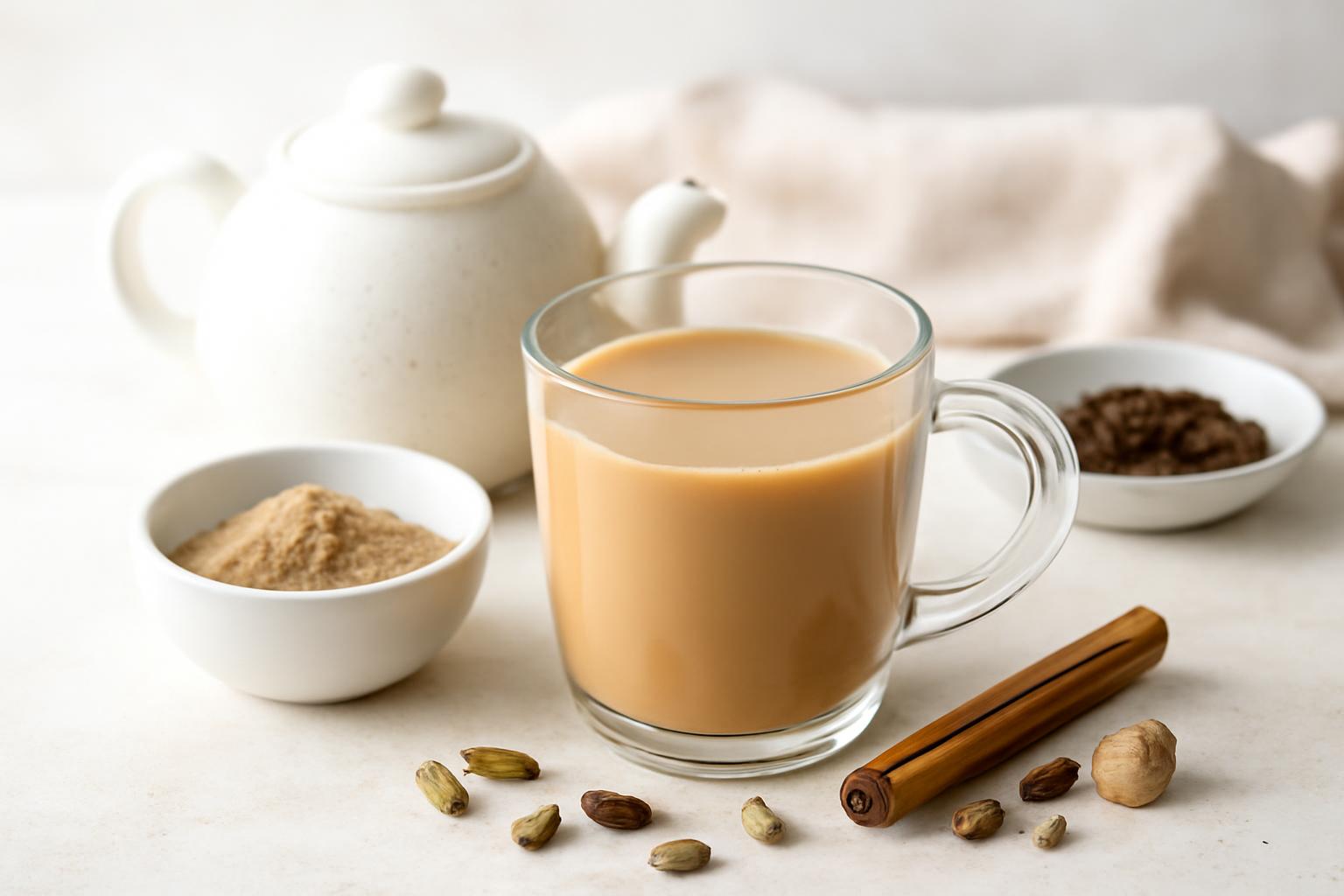
Use 40 mg per 8 oz as a practical default for a black tea brew, then adjust it by preparation and format instead of trusting a generic database entry.
If you track caffeine the way you track calories, masala chai is one of those drinks that looks simple until you try to log it. The short answer is still useful: traditional black tea-based masala chai usually contains about 20 to 70 mg of caffeine per 8-ounce serving, and many everyday brewed versions appear to fall somewhere around 30 to 50 mg.
That makes masala chai usually lower in caffeine than drip coffee, but definitely not caffeine-free. The caffeine comes from the tea base, not the spices. The amount can shift a lot depending on how much black tea is used, how long it steeps or simmers, how much milk ends up in the final cup, and whether you are drinking a homemade brew, a concentrate-based latte, or a dirty chai with espresso.
For tracking, the goal is not to pretend there is one exact universal number. It is to get the right preparation-specific estimate and scale it to your serving.
Method note: Published chai caffeine data are messy. This guide synthesizes ranges and product guidance from tea retailers and beverage companies including Tea Trolley, Bones Coffee Company, Clearview Tea Co., David Rio, Saratoga Tea & Honey, Aditi Chai, Perkatory Coffee Roasters, Rishi Tea, and Adagio. Those sources are useful, but most are seller-affiliated rather than standardized lab references, so the numbers below are presented as practical estimates, not a single definitive lab value.
What Is Masala Chai Tea?
Masala chai is a spiced tea drink traditionally made with black tea, spices, milk, and often sweetener. Common spices include:
- cardamom
- ginger
- cinnamon
- cloves
- black pepper
- sometimes fennel, nutmeg, or star anise
In Western menus, “chai tea” usually means this Indian-style spiced tea rather than plain tea. Strictly speaking, “chai” already means tea, but for caffeine purposes the only question that matters is: what is the tea base?
Traditional masala chai commonly uses black tea, especially Assam or Ceylon. Multiple source guides describe classic chai this way, including David Rio, Tea Trolley, Clearview Tea Co., and Perkatory Coffee Roasters. That matters because the caffeine comes from the tea leaves alone. The spices themselves do not contribute caffeine, a point stated explicitly by Clearview Tea Co. and Bones Coffee Company.
That is why products sold as “chai” are not nutritionally interchangeable:
- Traditional masala chai: black tea + spices + milk/water
- Chai concentrate: pre-brewed tea and spice base designed for dilution
- Chai powder mix: often tea extract plus sweetener and milk solids
- Chai syrup: may be flavoring-forward rather than tea-forward
- Herbal or rooibos chai: chai spices without a caffeinated tea base
So when someone asks whether masala chai has caffeine, the real answer is not just “yes” or “no.” It is “usually yes if it is made with black tea.”
That also explains why published caffeine numbers do not line up perfectly. One masala chai recipe may use a modest amount of tea and lots of milk. Another may use strong Assam, broken leaf, and a longer stovetop simmer. Same drink name, different caffeine outcome.
Does Masala Chai Tea Have Caffeine?
Yes. Masala chai made with black tea contains caffeine.
Across several published chai guides, the most defensible working range for a standard 8-ounce serving is about 20 to 70 mg, with many brewed versions clustering around 30 to 50 mg (Tea Trolley, Bones Coffee Company, Clearview Tea Co., David Rio, and Perkatory all land somewhere inside that band).
That range is more honest than a single fixed number because chai is not standardized the way a canned energy drink is. Even among the reviewed sources:
- David Rio places black tea chai around 20 to 50 mg per cup
- Tea Trolley gives about 25 to 50 mg per 8 oz, with a broader possible range of 20 to 70 mg
- Clearview Tea Co. gives 30 to 70 mg per 8 oz
- Bones Coffee Company also gives roughly 30 to 70 mg per 8 oz
- Perkatory gives a simpler average of about 50 mg per 8 oz
Those numbers sound inconsistent until you notice the variables behind them. Some are talking about a classic brewed 8-ounce cup. Some refer to a “typical cup” prepared a certain way. Aditi Chai, for example, cites about 40 mg for a typical serving prepared with 4 oz of black tea, which is useful as a reminder that not every source means the same thing by “cup.”
For intake tracking, that leads to a simple rule set:
- If the drink is traditional black tea masala chai, assume it has caffeine.
- If the recipe looks ordinary and you do not know the exact tea strength, 40 mg per 8 oz is a reasonable midpoint estimate.
- If you know it is a weaker or more milk-heavy preparation, log toward the lower end.
- If it is strong Assam chai or a longer-simmered stovetop brew, log toward the upper end.
- If the café drink is a concentrate latte, do not assume it scales like brewed tea.
The big takeaway is straightforward: masala chai is usually a moderate-caffeine drink. It is not caffeine-free, but it is also usually not a coffee-equivalent on a cup-for-cup basis.
Caffeine Content by Preparation Type
Brewing method changes masala chai caffeine more than the spice list does. The evidence supports broad bands better than narrow, universal numbers, so the table below should be read as a practical logging guide, not a lab chart.
| Preparation type | Practical estimate | How confident you should be |
|---|---|---|
| Lighter brewed chai, tea-light and spice-forward | Often toward the low end of chai’s overall range; commonly around 20–30 mg per 8 oz | Moderate confidence; some seller calculations on light infusions run even lower |
| Typical black tea masala chai | Often around 30–50 mg per 8 oz | Highest-confidence everyday range across reviewed sources |
| Strong brewed or long-simmered chai | Can reach the high end of the common range, about 50–70 mg per 8 oz | Moderate confidence; depends heavily on tea amount and brew time |
| Chai latte made from concentrate or powder | Often about 30–60 mg in a 12–16 oz drink | Fair confidence; supported by Tea Trolley and seller guidance, but brand formulas vary |
| Dirty chai | Often about 100–150 mg total | Good confidence; driven by chai plus espresso |
Those estimates reflect the strongest overlap among Tea Trolley, Bones Coffee Company, Clearview Tea Co., Saratoga Tea & Honey, and other seller guides. The broad pattern is more reliable than any one exact figure.
Regular infusion tends to be lower
If a chai recipe uses a relatively modest amount of tea and leans heavily on spices and milk, it often lands near the lower end of the overall chai range. Tea Trolley’s published guidance places lighter chai near the bottom of the chai spectrum, and Saratoga Tea & Honey’s seller-specific infusion calculations can come out lower still.
That does not mean every “mild-tasting” chai is low in caffeine. It only means that if the drink uses less black tea relative to total volume, it will usually end up lower than a stronger brew.
Stronger brews push upward
Longer-simmered stovetop chai, or chai made with more black tea leaves, can move toward the upper end of the common range, roughly 50 to 70 mg per 8 ounces according to Tea Trolley, Clearview Tea Co., and Bones Coffee Company.
This is one reason homemade chai can vary so much. “Masala chai” does not tell you whether the recipe used one teaspoon of tea or two, or whether it steeped briefly or simmered hard.
Concentrates can be deceptive
Commercial chai lattes often taste rich, sweet, and intense, but that does not automatically mean they are extremely high in caffeine. Published guidance for regular chai lattes made from concentrate often lands around 30 to 60 mg in 12- to 16-ounce servings (Tea Trolley; Saratoga Tea & Honey’s latte estimate is about 30 to 40 mg; Bones Coffee Company gives 30 to 50 mg for coffee-shop chai from concentrate).
That matters because milk increases volume fast. A large latte can taste “strong” while still having only moderate caffeine if the concentrate portion is limited.
Steep time matters, especially early
One of the more consistent tea-brewing points in the source set is that caffeine extraction is front-loaded. Saratoga Tea & Honey notes that a large share is released in roughly the first 3 minutes, with extraction continuing up to about 10 minutes.
In practical terms:
- a shorter steep usually lowers total extraction
- a longer steep usually raises it
- boiling or simmering often pulls more than a quick mug infusion
So if you want a lower-caffeine chai, the two biggest levers are still less tea leaf and less extraction time.
Factors Influencing Masala Chai Caffeine
Two people can both say they had “a cup of chai” and mean drinks with very different caffeine totals. These are the main reasons.
1. Tea-to-spice ratio
This is the most important driver. More black tea usually means more caffeine. More spices do not add caffeine; they only change flavor intensity.
That sounds obvious, but it explains a lot of the range spread. A spice-heavy chai with a modest tea base will not log the same as a tea-dense Assam chai, even if both taste bold.
2. Steep time and temperature
Longer and hotter extraction generally raises caffeine yield. Tea Trolley, Clearview Tea Co., Bones Coffee Company, and Saratoga Tea & Honey all point in this direction.
A useful way to think about it:
- short steep = usually lower extraction
- longer steep = usually higher extraction
- stovetop simmer or boil = often higher than a standard quick infusion
That is why “traditional stovetop chai” can sometimes end up stronger than a café latte made from a measured concentrate.
3. Leaf type and grade
Not all black tea performs the same way.
Tea Trolley’s guidance places Assam-based chai toward the stronger end and Darjeeling-based chai toward the lighter end. That is best read as a general tendency, not a hard rule.
Some seller guides also point to leaf grade. Bones Coffee Company and Clearview Tea Co. both note that broken or crushed tea leaves extract faster than whole leaves. That is one reason tea bags or crushed chai blends may give up caffeine quickly.
Bones Coffee Company also mentions younger leaves as a possible higher-caffeine factor. That may be true directionally, but for most consumers it is not something you can verify easily from a café drink or supermarket box. It is better treated as background context than a tracking tool.
For logging purposes, the practical shortcut is:
- robust black tea base
- broken or crushed leaf
- longer extraction
usually means log higher, not lower.
4. Milk lowers concentration, not necessarily total caffeine
This distinction matters, especially for lattes.
Once caffeine has been extracted from the tea, adding milk does not remove it. What milk does is increase the final volume and therefore lower the caffeine concentration per ounce.
So a milk-heavy chai can be:
- less caffeinated per ounce
- but still contain a moderate total amount in the whole drink
That is why a 16-ounce chai latte may taste gentler than an 8-ounce homemade stovetop chai without necessarily being caffeine-free or even especially low in total caffeine.
5. Serving size changes total intake
Serving size still matters. If two drinks are made at the same strength, the larger one will contain more total caffeine.
But this is where tracking gets tricky: bigger café drinks are not always scaled linearly. Some shops add proportionally more milk than concentrate as cup size increases. So size is helpful, but format matters more than ounces alone.
A useful rule:
- scaling by size works best for homemade brews of similar strength
- scaling works less well for café chai lattes, where dilution practices vary
6. Product format matters
This is one of the biggest reasons database entries go wrong.
A café chai might be:
- brewed loose-leaf or tea-bag chai
- liquid chai concentrate
- powdered chai mix
- flavored chai syrup
Those are not interchangeable. Clearview Tea Co. notes that powders and concentrates may contain slightly less caffeine than freshly steeped chai, while chai-flavored syrups may contain no caffeine if they are flavor systems rather than tea-based brews.
If you want a more accurate estimate, ask what the drink is made from, not just what size it is.
Masala Chai vs Coffee and Other Teas
The cleanest comparisons come from normalizing drinks to 8 ounces when possible.
| Drink | Practical caffeine comparison |
|---|---|
| Masala chai, black tea-based | 20–70 mg per 8 oz |
| Plain black tea | 40–70 mg per cup |
| Green tea | about 25–45 mg per cup |
| Green tea chai | about 15–45 mg per cup/8 oz |
| Drip coffee | about 95 mg or more per 8 oz |
That summary reflects the overlap across Tea Trolley, Clearview Tea Co., Perkatory Coffee Roasters, Bones Coffee Company, and David Rio.
Masala chai is usually lower in caffeine than coffee
This is the easiest comparison to make cleanly.
- Tea Trolley: chai 30–50 mg vs coffee 95–200 mg
- Bones Coffee Company: chai 30–70 mg vs drip coffee 95 mg
- Perkatory: chai about 50 mg vs coffee about 95 mg
- Aditi Chai: chai about 40 mg vs coffee about 120 mg in its stated serving comparison
So while the exact numbers move, the relationship is stable: plain masala chai usually contains less caffeine than drip coffee.
Chai can overlap with espresso territory by total serving
Bones Coffee Company cites a single espresso shot at about 63 mg. That means a stronger 8-ounce masala chai can approach espresso territory by total caffeine in the serving, even if the drinks are very different in concentration and volume.
That is why “chai is low caffeine” is too simplistic. Compared with coffee, yes, it is often lower. Compared with a very small espresso shot, a strong full cup of chai can be closer than many people expect.
Masala chai is similar to black tea, often a bit lower
Because the caffeine comes from black tea, chai naturally overlaps with plain black tea. Tea Trolley and Clearview Tea Co. place ordinary black tea around 40 to 70 mg per cup, which overlaps strongly with black-tea chai.
Still, many chai preparations end up slightly lower than plain black tea because some of the final cup’s flavor comes from spices and milk rather than a larger dose of tea leaves. That is common, but not guaranteed. A strong Assam chai can sit right alongside plain black tea.
Green tea chai is usually lower
If the base is green tea instead of black tea, caffeine usually drops.
Here the published ranges are wider and less consistent:
- David Rio: 15–30 mg per cup
- Clearview Tea Co.: 35–45 mg per 8 oz
The safest synthesis is that green tea chai is usually lower than black tea chai, often landing somewhere in a broad 15–45 mg zone depending on product and brewing style.
Normalize before comparing
A lot of confusion comes from mismatched serving definitions:
- one source uses a 4-ounce tea base
- another means an 8-ounce finished mug
- a café label refers to a 12- or 16-ounce latte
- an espresso comparison refers to 1 ounce
So before comparing drinks, make sure you are comparing like with like. Per 8 ounces is the cleanest general standard for brewed drinks.
Cafe Chai Lattes and Commercial Products
This is where chai logging gets messier.
Homemade chai is variable, but at least you can see the tea. Café and packaged products may use concentrate, powder, or syrup, and many labels still do not give a clear milligram number.
Concentrates and powders are often moderate, not extreme
The strongest defensible guidance for plain commercial chai lattes is still the moderate range:
- Tea Trolley: 30–60 mg for a regular coffee-shop chai latte
- Saratoga Tea & Honey: 30–40 mg for a masala chai latte estimate
- Bones Coffee Company: coffee-shop chai from concentrate 30–50 mg per serving
That means most plain chai lattes should be logged as moderate caffeine drinks, not as stealth coffee-level drinks by default.
Larger café sizes do not guarantee proportionally high caffeine
A 16-ounce chai latte is bigger than an 8-ounce homemade cup, but the extra volume is often heavily milk-driven. So a larger latte does not automatically contain double the caffeine of a smaller brewed chai.
This is where the earlier concentration-versus-total distinction matters. Bigger size may increase total caffeine, but if the recipe also gets more diluted, the increase may be smaller than expected.
For plain chai lattes, the safest read from the source set is still:
- often around 30–60 mg in a 12- to 16-ounce drink
- sometimes lower or higher depending on brand and concentrate strength
- not reliable enough to assign one universal number without a label
Labels are often qualitative, not quantitative
Two product pages in the evidence set show the problem clearly:
- Rishi Tea labels Masala Chai as “High” caffeine on a scale but does not give an exact mg number.
- Adagio also labels Masala Chai as “High” without a precise milligram count.
That kind of label is useful for choosing between teas, but not for logging intake. “High” could still mean very different things depending on tea amount, steep time, and serving definition.
If a product page is vague, check four things:
- Is black tea listed as the base?
- Does the brew method call for a long steep or lots of leaf?
- Is the product a brewed tea, powder, concentrate, or syrup?
- What serving size is the caffeine guidance actually referring to?
Syrups are a special case
Clearview Tea Co. states that chai-flavored syrup can contain no caffeine, which makes sense if the product is mainly flavor and sweetness rather than tea extract.
That means two café drinks both labeled “chai” can differ dramatically:
- one may be tea-based and caffeinated
- another may be syrup-based and effectively not contribute tea caffeine at all
If you need an accurate estimate, the simplest useful question is: “Is your chai a tea concentrate, a powder, a syrup, or brewed tea?”
Dirty chai is a separate category
This is the one place where the numbers jump more clearly.
Both Bones Coffee Company and other compiled guidance support about 100 to 150 mg total caffeine for a typical dirty chai, because you are combining chai caffeine with espresso. Bones Coffee Company also gives about 63 mg for a single espresso shot, which explains the jump.
For logging purposes, dirty chai should not be grouped with plain masala chai. Once espresso is involved, the drink belongs in a different caffeine category.
Caffeine-Free Masala Chai Alternatives
If you want the spice profile of chai without much or any stimulant load, there are several workable options.
Rooibos chai: 0 mg caffeine
This is the cleanest caffeine-free substitute. Multiple sources, including Aditi Chai, Saratoga Tea & Honey, Tea Trolley, Bones Coffee Company, and David Rio, describe rooibos chai as naturally caffeine-free.
If your target is “chai flavor, zero caffeine,” rooibos is usually the best fit.
Decaf black tea chai: trace caffeine
Decaf chai is not always literally zero, but Tea Trolley places decaf chai around 2 to 5 mg per serving, which is close enough to “trace” for most trackers.
This option makes sense if you want a flavor profile closer to classic black-tea chai while still keeping caffeine very low.
Herbal or spice-only chai blends: caffeine-free
Some chai blends use the flavor profile without any tea base at all. Across David Rio, Tea Trolley, and other product guides, the basic rule is simple:
- if there is no black tea
- no green tea
- and no other naturally caffeinated tea base
then the blend is generally caffeine-free.
That includes:
- spice-only chai blends
- herbal chai blends
- rooibos chai
- honeybush-style chai alternatives mentioned by David Rio
Best use cases
Caffeine-free chai alternatives are especially useful for:
- evening drinking
- people sensitive to caffeine
- anyone already near a daily caffeine target or limit
- anyone who wants the ritual and flavor of chai without the stimulant effect
The practical lesson is the same one repeated throughout this article: “chai” describes a style, not a caffeine level. The base determines the caffeine.
Tracking Chai Caffeine in Your Nutrition Log
If your goal is logging rather than tea trivia, keep the system simple.
1. Start with a midpoint
For a standard 8-ounce black tea-based masala chai, use 40 mg caffeine as a starting estimate.
Why 40 mg? Because it sits near the middle of the most repeated published ranges:
- David Rio: 20–50 mg
- Tea Trolley: 25–50 mg average range
- Clearview Tea Co.: 30–70 mg
- Bones Coffee Company: 30–70 mg
- Perkatory: about 50 mg
- Aditi Chai: about 40 mg in its typical prepared serving
It is not a universal truth. It is a workable midpoint.
2. Adjust for preparation, not just for name
Then move that estimate up or down based on what you actually drank.
A simple framework:
- light, milk-forward, tea-light chai: log toward the lower end
- ordinary brewed black tea chai: log near the middle
- strong Assam or long-simmered chai: log toward the upper end
- green tea chai: log lower than black tea chai
- rooibos or herbal chai: log as 0 mg
- decaf chai: log as trace, often just a few milligrams
That is more reliable than entering whatever random database entry says “chai tea.”
3. Use format-specific examples
These are examples, not universal measurements, but they are better than guessing blindly.
Example 1: Homemade black tea masala chai, 8 oz If it is a normal brewed cup and you do not know exact tea weight, log about 40 mg. If you know it was weak, use the lower end. If you know it simmered hard with a strong black tea base, push upward.
Example 2: Coffee-shop chai latte, 12–16 oz, made from concentrate If the shop uses standard chai concentrate and lots of milk, the evidence-supported estimate is usually around 30–60 mg total, not automatically coffee-level.
Example 3: Dirty chai with one espresso shot Log it in the 100–150 mg total neighborhood unless the café publishes something more specific. The espresso is doing a lot of the work here.
These three scenarios cover most real-world logging needs better than trying to derive a universal per-ounce formula.
4. Be careful with linear scaling
Scaling by ounces is tempting, but it can mislead.
For homemade chai of similar strength, scaling is often reasonable. If two batches are brewed the same way and one is simply a larger portion, the larger one should contain more total caffeine.
For café lattes, scaling is weaker because a larger drink may contain proportionally more milk, not proportionally more tea concentrate. So instead of assuming a perfect 12-ounce-to-16-ounce ratio, anchor your estimate to the format first:
- brewed tea
- concentrate latte
- powder mix
- syrup-based drink
- dirty chai
5. Treat caffeine logging the way good trackers treat labels
CaloriePages’ own tracking philosophy is useful here: labels and calculators are helpful, but they are not perfectly exact. The site’s nutrition coverage emphasizes that food labels can be off by about 20%, and its TDEE guide emphasizes calibration over false precision.
That same attitude fits chai well. Not because chai caffeine has a formal 20% rule—it does not, based on the evidence here—but because recipe variation is real.
A better logging mindset is:
- pick a defensible estimate
- apply it consistently
- update it if you learn more about the product or recipe
- care more about patterns than fake exactness
If your daily target is sensitive—for example, you are trying to stay under a personal caffeine limit—use the high end when uncertain.
6. Log calories separately from caffeine
Masala chai often includes milk and sweetener. Perkatory explicitly notes that chai commonly comes with milk and sweeteners, while black coffee is nearly calorie-free by comparison.
So if you are tracking intake seriously, do not stop at caffeine. Log:
- caffeine estimate
- calorie estimate
Those are different numbers, and chai can be modest on one while being meaningful on the other.
In short: use 40 mg per 8 oz as a default for black tea masala chai, then adjust by preparation and format. That is usually better than copying a generic “chai tea” entry that does not match your cup.
Masala chai is best understood as a moderate-caffeine range, not a fixed number. For most black tea versions, 20 to 70 mg per 8 ounces is the most practical working band supported by the available source set. If you want less, use less tea or shorten extraction. If you want none, choose rooibos or another herbal chai. And if you want a precise log, ask what the drink is actually made from.
How much caffeine is in an 8 oz cup of masala chai tea?
A standard 8-ounce cup of black tea-based masala chai usually contains about 20 to 70 mg of caffeine, with many brewed versions clustering around 30 to 50 mg according to Tea Trolley, Bones Coffee Company, Clearview Tea Co., David Rio, and Perkatory.
If you need one practical logging number, 40 mg per 8 oz is a reasonable midpoint estimate.
Is masala chai lower in caffeine than coffee?
Usually, yes. Published comparisons consistently place masala chai below drip coffee on an equal-volume basis.
A typical 8-ounce masala chai often lands around 20 to 70 mg, while an 8-ounce drip coffee is commonly listed at about 95 mg or more, and sometimes higher depending on the source. So plain masala chai is generally the lower-caffeine choice.
Does milk or steep time affect chai caffeine?
Yes, but in different ways.
Steep time affects total extraction: longer steeping or simmering usually pulls more caffeine from the tea.
Milk mainly affects concentration: it does not remove caffeine that has already been extracted, but it can lower the caffeine per ounce by increasing the final volume. So milk can make a drink less concentrated without necessarily reducing total caffeine in the cup.
What are caffeine-free masala chai options?
The main low- or no-caffeine options are:
- rooibos chai, which is naturally caffeine-free
- herbal or spice-only chai blends, if they contain no caffeinated tea base
- decaf black tea chai, which usually contains only trace caffeine
If you want the closest everyday substitute for classic chai flavor without caffeine, rooibos chai is usually the simplest answer.
How to brew masala chai with less caffeine?
To reduce total caffeine, use one or more of these:
- use less black tea
- choose a lighter tea base
- shorten steep time
- avoid long simmering or boiling
- switch to green tea chai, decaf chai, or rooibos chai
If you simply want a lower concentration per ounce, adding more milk can dilute the final drink, but it does not remove caffeine already extracted from the tea. The biggest levers for reducing total caffeine are still less tea leaf and less extraction time.