
Breaking Down Peach Oolong Tea's Calories, Caffeine, and Nutrition by Type and Prep
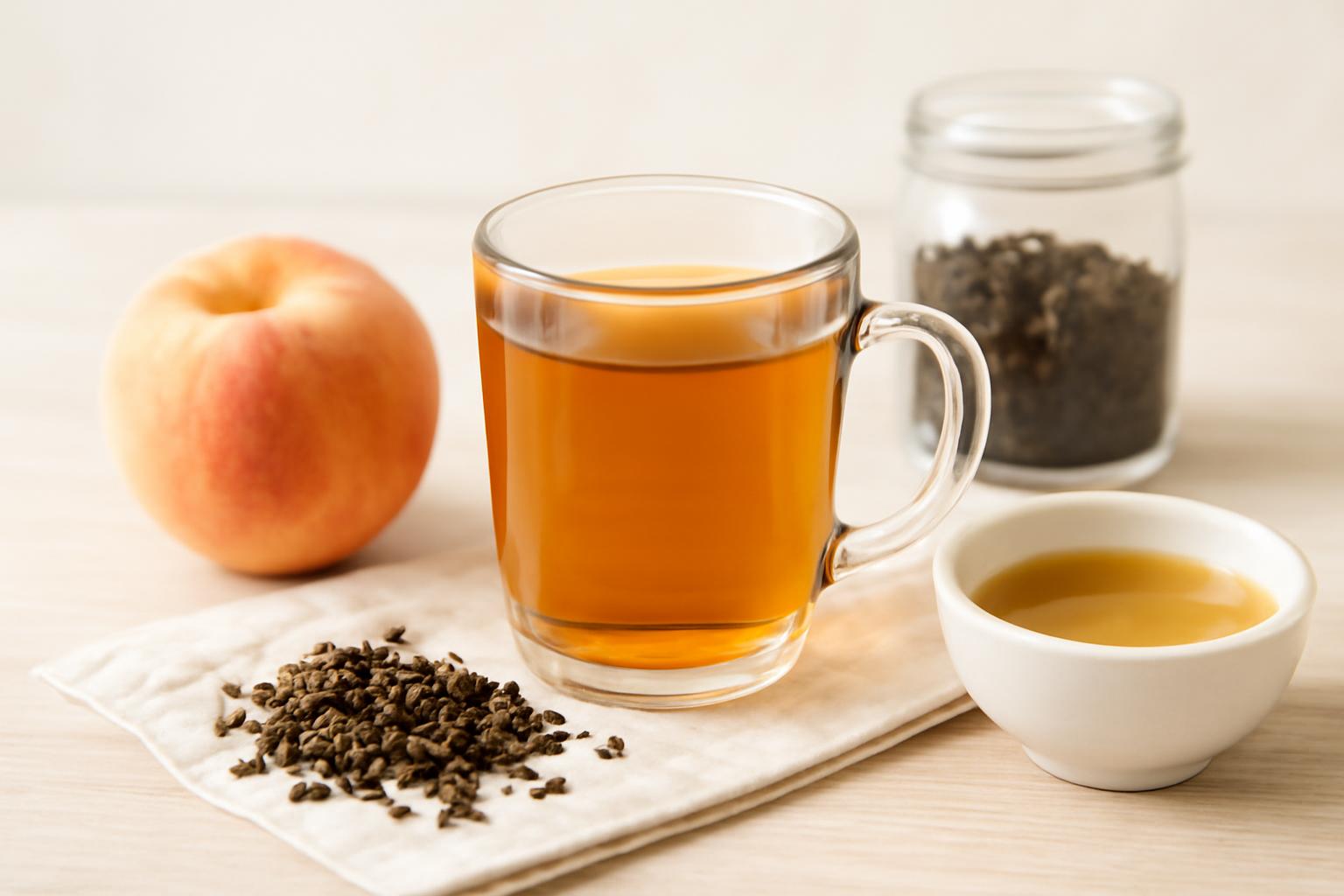
The same headline calorie number can cover very different amounts of liquid, so serving size matters when comparing bottled peach oolong.
Peach oolong tea sounds like one drink, but for calorie tracking it is really a category. It can mean a plain loose-leaf oolong with peach flavoring or peach pieces. It can also mean a homemade café-style drink built from brewed tea plus peach puree, syrup, honey, or sugar. And in the ready-to-drink aisle, it can mean a bottled beverage with its own ingredients list, serving size, and nutrition panel.
That difference matters more than the name on the front of the package. If you brew peach oolong plain at home, the useful tracking question is usually whether you added anything caloric to the tea. If you buy it bottled, the useful answer is whatever the label says for that exact bottle and serving. If you make a recipe-style peach tea at home, most of the calories usually come from the peach and sweetener additions rather than from the oolong base.
So the simplest way to think about peach oolong is in three buckets:
- plain brewed tea
- brewed tea with caloric add-ins
- bottled tea with a nutrition panel
Once you separate those cases, the numbers get much easier to interpret.
Related: Masala Chai Tea Caffeine Content: mg Per Serving, Variations and Comparisons.
What Is Peach Oolong Tea?
At its core, peach oolong tea is oolong tea with peach notes added to it. Oolong itself is a partially oxidized tea style, and one seller overview describes oolong as sitting between green and black tea in character, which helps explain why peach oolong can range from light and floral to deeper and more rounded depending on the base tea used. Seven Teahouse
In loose-leaf form, the ingredient list can be very simple. Happy Lucky’s Peach Oolong lists oolong, dried peach, and peach flavoring, and the captured product page shows a default listing price of $5.45. Happy Lucky
Other brands widen the category. Boulder Tea Company describes its peach oolong as a Jin Xuan oolong oxidized to 15% to 20%, which is enough to change the feel of the finished cup even before any peach flavoring is considered. The same captured listing shows $28 for 4 oz. Boulder Tea Company
The format changes the nutrition picture too. Loose leaf and tea bags are typically just meant to be infused in water. On the manufacturer page for Just Ice Tea Peach Oolong, the visible ingredients are brewed organic oolong tea, organic cane sugar, natural peach flavor, and citric acid, while the product description also refers to brewed organic oolong and black tea, making it a sweetened packaged tea beverage rather than a plain loose-leaf style infusion.
So if you ask what peach oolong tea “is,” the most accurate answer is: a family of peach-flavored oolong drinks. The shared core is oolong plus peach. Beyond that, oxidation level, added fruit components, sweeteners, and packaging format can all change what ends up in your cup and what you should log.
Calories in Home-Brewed Loose Leaf Peach Oolong Tea
For plain home brewing, the strongest evidence-based wording is not “this tea has exactly X calories per cup.” In this evidence set, the loose-leaf seller pages describe ingredients, steeping instructions, and product format, but they do not provide a measured nutrition panel for an unsweetened 8-ounce cup of brewed peach oolong.
That is a logging convention, not a label-backed universal number for every possible cup.
That distinction is visible in a beginner recipe from Dong Po Tea. The tea itself is brewed first, and then the recipe layers in peach slices, peach puree, or peach syrup, plus optional honey, sugar, simple syrup, or lemon. Structurally, the brewed oolong is the base; the meaningful calories are introduced when you turn it into a fruit-and-sweetener drink. Dong Po Tea recipe
That practical distinction matters more than people sometimes expect. When someone says “my peach oolong had calories,” that can mean very different things:
- they brewed plain flavored loose leaf in water
- they steeped the tea and added peach syrup
- they blended in puree or fruit
- they bought a bottled product with sugar already included
Those are not nutritionally interchangeable drinks, even if they share the same name.
For logging, a clean working rule looks like this:
- Plain brewed peach oolong: usually log as negligible.
- Peach oolong with syrup, puree, honey, sugar, or simple syrup: log the additions separately.
- Peach oolong with fresh peach slices: still usually modest, but less exact because the amount of fruit and whether you consume it both matter.
This is also where serving setup helps. Happy Lucky’s brewing guidance uses 1 teaspoon per 8 oz and a 1- to 3-minute steep, which is a typical example of how little dry tea is being used to flavor a cup of water in the first place. Happy Lucky
It is the stuff that quietly turns the tea into a sweetened beverage: syrup poured freehand, puree added without measuring, honey that gets counted as “just a drizzle,” or a large tumbler that feels like one serving but actually holds much more than a teacup.
A second source of confusion is cup size. An 8-ounce teacup, a 12-ounce mug, and a 16-ounce tumbler can all feel like “one tea.” But it can change your caffeine exposure, and it definitely changes the total if you sweeten each vessel by habit rather than by measurement.
If you want a durable home system, standardize four things:
- your usual cup or bottle
- your usual leaf amount or tea bag count
- your usual steep time
- every caloric add-in
Once those are consistent, peach oolong becomes much easier to track. The tea base stops being the mystery. The uncertainty is almost always in the syrup, puree, sugar, honey, juice, or other additions.
So the article’s bottom line on loose-leaf calories is intentionally modest: the evidence here supports treating plain brewed peach oolong as negligible for tracking, but it does not support pretending there is a universal, measured, label-backed calorie number for every unsweetened homemade cup. That distinction is important, and it is more honest than false precision.
Nutrition Facts for Bottled Ready-to-Drink Peach Oolong Tea
Ready-to-drink peach oolong is where the category becomes label-specific. Once the drink is bottled, the important numbers are the listed serving size, calories, carbohydrate, sugars, and any stated caffeine amount.
Here are the brand examples available in this evidence set:
| Brand | Listed serving | Calories | Carbs | Sugars | Other visible details |
|---|---|---|---|---|---|
| Everyday Group (MyNetDiary) | 225 ml | 70 | 18 g | 11 g | 0 g fat, 0 g protein, 40 mg sodium |
| Honest Organic (CalorieKing) | 16.9 fl oz bottle | 70 | 17 g | 17 g | 0 g fat, 0 g protein, 0 mg sodium, 66 mg caffeine |
| Just Ice Tea, app listing only (Fitia) | 16 fl oz bottle | 2 | not visible | not visible | macro details hidden behind app prompts |
The first useful comparison is not the calorie number alone, but the serving it belongs to. Everyday Group’s 70 calories are attached to 225 ml, while Honest’s 70 calories are attached to an entire 16.9 fl oz bottle. That means the same headline number is covering very different amounts of liquid, so the two products should not be treated as nutritionally equivalent at a glance.
The second useful comparison is where the energy comes from. In the two clearer bottled examples here, calories come from carbohydrate, especially sugar. Honest makes that especially easy to read because its bottle is listed at 70 calories, 17 g carbohydrate, 17 g sugars, and 0 g fat and protein. In practical terms, that is a lightly sweetened bottled tea, not a plain brewed tea with negligible energy.
The Just Ice number needs more caution than the other entries. Fitia lists 2 calories per 16 fl oz bottle, but the manufacturer page for the product visibly includes organic cane sugar in the ingredients and describes the drink as a real-brewed peach tea beverage rather than a plain unsweetened infusion. That does not prove the app entry is wrong, but it does make the 2-calorie listing too weak to treat as a firm category anchor without a directly viewable manufacturer nutrition panel. Just Ice Tea
That leaves a careful, usable bottom line for bottled peach oolong:
- In this evidence set, clearly viewable bottled examples include 70-calorie servings.
- Sugar and carbohydrate account for most or all of those calories in the visible label-style listings.
- Serving-size differences make quick brand comparisons easy to misread.
- A tracker or app entry is less reliable than a directly viewable label or a clear nutrition database page when the two do not line up cleanly.
For fast logging, bottled tea is both easier and trickier than home brewing. It is easier because you usually get a printed or database-stated number. It is trickier because the word “tea” on the front does not tell you whether the bottle behaves more like plain brewed tea or like a sweetened packaged beverage. The panel does.
Caffeine Content in Peach Oolong Tea
Caffeine is usually less standardized than calories. Loose-leaf peach oolong pages often describe caffeine in relative terms instead of publishing exact milligrams, so the category name alone tells you less than many shoppers assume. In this evidence set, loose-leaf versions are described with terms such as medium, moderate, or lightly caffeinated rather than with a universal milligram range.
The clearest hard number here comes from Honest Organic Peach Oolong Tea, which is listed at 66 mg caffeine per 16.9 fl oz bottle. That number is useful because it gives a concrete reference point, but it applies to that bottle, not to all peach oolong products. CalorieKing
That distinction matters. The peach flavor tells you very little about caffeine by itself. The oolong base and the product format tell you much more.
So a practical hierarchy works best:
- Most precise: a bottled or packaged product that publishes milligrams
- Next best: a specific brand description such as medium or moderate
- Weakest: assuming the category name “peach oolong” gives you enough information on its own
For people who just want a general sense of whether the tea is stronger or lighter, a brand’s relative label may be enough. But the safest habit is still the same one that works for calories: check the specific product, not just the category name.
Standard Brewing Methods and Serving Sizes
For consistent home tracking, the goal is not to find one “perfect” way to brew peach oolong. The goal is to make it in a repeatable way so your taste, caffeine exposure, and add-ins stay fairly stable from cup to cup.
Adagio’s peach oolong represents the hotter end of the range in this evidence set. Its product page recommends 212°F water and a 3- to 5-minute steep, and it notes that the tea can be re-steeped. Adagio
Dong Po Tea gives a gentler recipe-style range: 185°F to 205°F, about 2 to 3 minutes, and a warning not to go much beyond 4 minutes if you want to avoid bitterness. The same guide suggests two practical iced methods: brew stronger and chill, or cold brew in the refrigerator for 12 to 24 hours. Dong Po Tea recipe
Taken together, the evidence shows a broad but normal brewing range for peach oolong:
- about 1 teaspoon per 6 to 8 ounces in the loose-leaf examples here
- roughly 185°F to 212°F depending on the tea base and brand guidance
- roughly 2 to 5 minutes for hot brewing
- much longer refrigerator infusions for cold brew
- sometimes one infusion, sometimes more than one
That spread is not a contradiction. It is just how tea behaves.
If your main goal is consistent calorie tracking, a four-step system works well:
- Pick one vessel. Measure it once so “one cup” always means the same thing for you.
- Use the same leaf amount. A spoon is better than guessing.
- Stay inside a repeatable steep window. If your brand gives no better guidance, a short brew is a safer starting point than an aggressive one.
- Log every caloric addition separately. Syrup, puree, sugar, honey, juice, and milk-like additions matter more than the brewing itself.
That last point matters most. Add-ins do. If two cups use the same peach oolong base but one includes peach syrup and the other does not, they are no longer the same drink nutritionally.
Iced tea adds one more variable: dilution. A glass packed with ice can taste weaker than the same tea served hot even before you sweeten it. If you want a more repeatable result, either brew a stronger base before icing or chill the tea first and pour it over a more moderate amount of ice.
From a tracking standpoint, the principle stays simple: plain tea stays plain tea whether it is hot or iced. The nutrition changes when you add something with calories.
Price, Availability, and Brand Variations
Price matters less than the label for nutrition tracking, but it still tells you something about format and buying style. Loose-leaf products give you the most control. Bottled teas give you the easiest fixed serving. Availability is also a moving target, so all pricing and stock notes here should be read as captured snapshots rather than permanent market facts.
Here is a cleaner way to compare the examples in this evidence set:
| Brand | Captured offer | Standardization note |
|---|---|---|
| Happy Lucky (product page) | $5.45 default listing | captured page does not clearly show the default ounce selection |
| Adagio (product page) | $8 for 2 oz | about $4.00 per oz |
| HANFANGLING (Amazon listing) | $9.99 | listing explicitly shows $5.68 per oz |
| Boulder Tea Company (product page) | $28 for 4 oz | about $7.00 per oz |
| Cha Redefine (product page) | $30 for 4 oz | about $7.50 per oz; captured page marked sold out |
The reason this matters for calorie tracking is not that expensive tea is healthier. It is that format changes the nutrition problem. Homemade recipe-style tea gives you the most flavor control, but also the most room to undercount syrup and sweetener. Ready-to-drink bottles are the easiest to log precisely, but they are also the format most likely to include sugar as part of the product itself.
So the more useful comparison is format rather than price:
- Loose leaf or tea bags: easiest if you want a plain, low-calorie default
- Homemade recipe-style tea: best for taste control, but easy to under-log
That is the real brand variation that matters to a calorie tracker. Cost affects what you buy. Format affects what you drink.
Tracking Tips: Label Accuracy and Personal Calibration
Food labels are useful, but they are not exact. CaloriePages’ own overview notes that calorie counts on labels can be off by as much as 20%, which is a good reason to treat bottled peach oolong numbers as standardized estimates rather than laboratory truth down to the last calorie. CaloriePages About
For peach oolong, that matters in two places. First, tiny differences between products are less meaningful than they look when serving sizes differ. Second, not every data source deserves equal trust. A visible manufacturer ingredient list or a clear nutrition page is usually stronger than an app entry with key macro details hidden.
For homemade tea, the practical solution is simple: log the tea base conservatively and measure the additions that actually move the total. If you add peach syrup, puree, sugar, honey, or juice, those are the numbers worth caring about. If you brew the tea plain, the useful question is rarely whether the cup is exactly 0, 2, or 4 calories. It is whether you quietly turned it into a sweetened drink.
For ready-to-drink tea, read more than the product name. “Peach oolong tea” does not tell you whether the bottle is unsweetened, lightly sweetened, or clearly sweetened. The ingredient list and nutrition panel do. In this evidence set, one example shows 70 calories per 225 ml, while another shows 70 calories per 16.9 fl oz bottle. That alone is enough to show why the front label is not the useful unit.
The last layer is personal calibration. If you are tracking intake for body-weight management, the most reliable method is not blind trust in any single label or app. It is comparing your logged intake against your body-weight trend over time. CaloriePages’ TDEE explainer recommends using a 2- to 4-week food log plus weight trend to see whether your intake estimate matches what your body is actually doing.
That kind of calibration matters far more than trying to force false precision onto plain tea.
A durable working system looks like this:
- log plain brewed peach oolong as negligible
- measure and log every syrup or sweetener you add
- trust visible labels more than weak database entries
- compare your intake log with your weight trend over several weeks
- adjust only when the pattern is consistent
That approach is usually more useful than obsessing over whether a plain cup of brewed tea should be entered as exactly zero.
How many calories in 8 oz of unsweetened peach oolong tea?
The important caveat is that this is a practical logging convention for plain brewed tea, not a universal measured nutrition label for every homemade cup. If you add syrup, puree, sugar, or honey, log those separately.
What is the caffeine level in peach oolong tea?
Usually, it is described in relative terms rather than exact milligrams. Many peach oolong products use labels like medium or moderate, while some bottled products publish a specific number. If caffeine matters to you, the safest move is to check the exact brand rather than assume the category tells you enough.
Do bottled peach oolong teas have added sugar?
Often, yes. Bottled peach oolong can include sweeteners, so it is worth checking the ingredient list and nutrition panel before assuming it behaves like plain brewed tea. The category name alone does not tell you the sugar load.
Best water temperature to brew peach oolong without bitterness?
If your tea tastes harsh, shorten the steep or lower the temperature before changing anything else. When a brand gives clear instructions, those should take priority.
How to estimate calories if brewing with peach syrup?
Do not try to assign those calories to the tea itself. Log the brewed tea as negligible, then measure the peach syrup and record that amount separately. The same rule applies to puree, honey, sugar, and similar sweeteners.
If you buy it bottled, the label matters more than the category name. And if you want your log to be useful rather than just tidy, standardize your serving size, measure your add-ins, and compare your intake record against your own results over time. This article is for general informational purposes only and does not constitute medical or dietary advice.