
Organic Soy Lecithin: Forms, Uses, Safety, and Product Verification
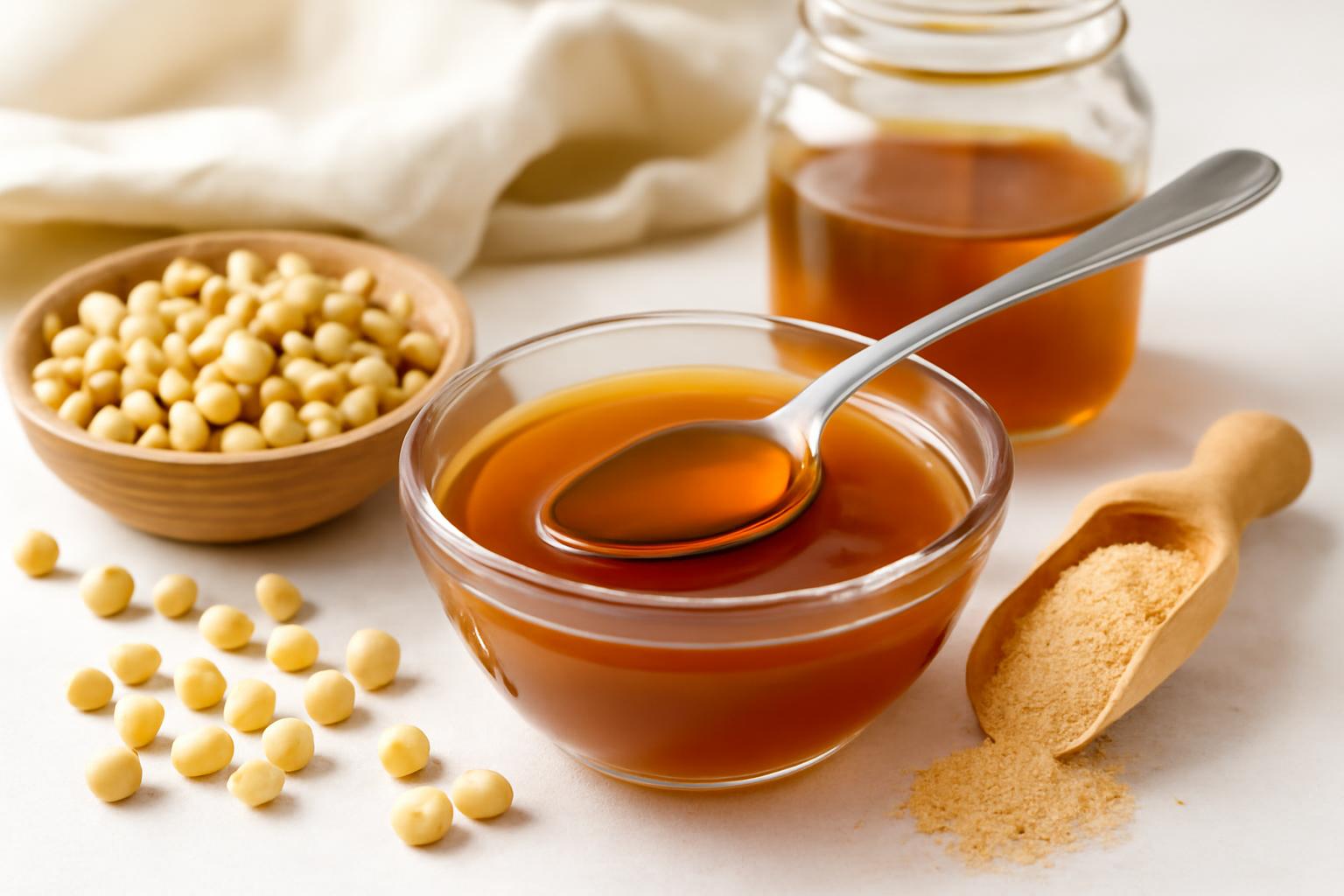
Liquid, powder, granules and softgels suit different uses. For soy allergy, reported residual protein spans 2.8 to 202 mg per 100 g.
Overview
Organic soy lecithin is a soy-derived functional ingredient used primarily to emulsify, disperse, stabilize, thicken, or otherwise modify foods and formulations. Choosing a product requires matching its liquid, powder, granule, capsule, or softgel form to the intended use, then checking the exact product’s organic claim, other certifications, ingredient list, allergen declaration, directions, and storage requirements.
The word “organic” does not identify one standardized physical form or one universal formulation. Supplier descriptions cover viscous liquids, concentrated deoiled powders, granules intended for food or dietary use, and premeasured softgels. Products also differ in whether they make separate non-GMO, kosher, halal, or other certification claims.
These differences matter because evidence from one listing cannot be transferred automatically to another. A suggested food-use percentage from one liquid supplier is not a universal recipe ratio, and directions for a granule or softgel supplement are not instructions for an emulsifier used in manufacturing.
What organic soy lecithin is and why it works
Soy lecithin is a mixture of soy-derived lipids used for its functional behavior in mixtures containing ingredients that do not combine easily. According to organic ingredient supplier Ciranda, lecithin contains both lipophilic, or oil-friendly, and hydrophilic, or water-friendly, lipids. This combination explains why lecithin can help disperse an oil phase and a water phase within the same formulation.
“Organic soy lecithin” describes lecithin associated with an organic production and labeling claim, but the supplied evidence does not establish one manufacturing process followed by every producer. Jedwards International describes its liquid product as a viscous brown fluid produced by cracking, dehulling, and pressing organic soybeans, followed by degumming and drying the crude soybean oil. Simmons Grain Company describes its lecithin as originating from mechanically expelled organic soy oil and states that its process uses no additives. These are product-specific production descriptions, not proof that all organic soy lecithin is processed identically.
Form can also reflect further processing. Ciranda states that its organic deoiled soy lecithin powder is made by drying liquid soy lecithin. The supplier describes the resulting powder as more concentrated and easier to dose and dispense than the liquid starting material.
The practical mechanism is therefore consistent across the supplier evidence, even though manufacturing details vary: lecithin has affinity for both oil and water components, which makes it useful at the boundary between them. How well a particular product fits a recipe or commercial formulation still depends on its form, composition, directions, and the other ingredients present.
Uses and functions in foods and formulations
Emulsification is the best-known role of soy lecithin, but supplier materials identify several additional functions. Depending on the product and formulation, lecithin may aid dispersion, stabilization, release, thickening, viscosity modification, or dough improvement. Those terms describe different formulation goals and should not be treated as interchangeable.
Jedwards International says its liquid organic soy lecithin may thicken formulations, increase viscosity, stabilize emulsions in foods such as confections and fat spreads, and increase dough volume. Simmons Grain lists emulsifying, dispersing, and release-agent uses for its product. Together, these descriptions support several practical distinctions:
- An emulsifying use focuses on helping oil-friendly and water-friendly components remain distributed.
- A dispersing use focuses on distributing material through a formulation.
- Stabilization concerns maintaining the desired mixture or physical condition.
- Release use concerns helping a product separate from a surface during processing.
- Thickening, viscosity modification, and dough improvement address texture, flow, or handling rather than emulsification alone.
Application lists are broad. Farbest Brands identifies beverages and powders, bars, snacks, cereals, dairy, supplements, desserts, confectionery, bakery products, sauces, seasonings, and pet food as application categories for its organic lecithin offerings. Granule seller Bluebonnet Nutrition gives consumer-level examples, stating that its granules may be sprinkled on cereals or salads or incorporated into soups, stews, sauces, gravies, juices, and baked goods.
These lists show the range of marketed uses, not validated performance in every recipe. A buyer should begin with the formulation problem, such as dispersion, viscosity, or emulsion stability, and then confirm that the selected product’s directions and technical documentation address that application.
Choosing liquid, powder, granules, capsules, or softgels
The most defensible form choice follows the intended role. Liquid and deoiled powder are described as formulation ingredients, while the supplied granule and softgel examples include dietary-use directions. The evidence does not support a universal ranking or direct substitution ratio among the forms.
| Form | Supported characteristics | Evidence-bounded fit | Important limitation |
|---|---|---|---|
| Liquid | Jedwards International describes its organic liquid as a viscous brown fluid. Its product page associates the form with thickening, viscosity, emulsion stabilization, confections, fat spreads, and dough. | A candidate when a liquid lecithin ingredient and its handling properties fit the formulation. | Viscosity may affect measuring and incorporation. The evidence does not show that every liquid product has the same composition or performance. |
| Deoiled powder | Ciranda says its powder is produced by drying liquid soy lecithin and describes it as more concentrated and easier to dose and dispense. | A candidate when dry handling, controlled dispensing, or incorporation into a powdered system is important. | “More concentrated” is the supplier’s comparison with its liquid starting material. It does not establish a universal liquid-to-powder conversion. |
| Granules | Bluebonnet Nutrition states that its granules can be sprinkled on foods or incorporated into several prepared foods. Its supplement direction is one tablespoon, or 7.5 g, daily. | A candidate for the uses explicitly named on the selected granule product, including its labeled dietary use. | The 7.5 g direction belongs to that product. It is not a recipe quantity or a direction for all granules. |
| Capsules | Capsule formats place lecithin in pre-portioned supplement units. | Consider only according to the ingredient list and directions of the exact capsule product. | The supplied evidence contains no capsule-specific composition or directions, so it cannot support a broader comparison. |
| Softgels | Standard Process lists 385 mg of organic soybean lecithin per softgel and directs one softgel per meal, or as directed. It also lists gelatin, water, and glycerine as other ingredients. | A premeasured supplement format for someone evaluating that product’s labeled use. | A softgel is not a practical substitute for bulk formulation lecithin, and its directions do not establish a universal intake. |
The liquid-to-powder contrast is the clearest handling distinction in the evidence. Liquid is described as viscous, whereas deoiled powder is described as more concentrated and easier to dispense. That does not prove that powder always performs better, only that physical handling differs.
Granules and softgels should remain a separate purchasing case from bulk formulation ingredients. Their labels include dietary directions, serving amounts, and other ingredients that are irrelevant to many manufacturing uses but central to evaluating a supplement. Capsules cannot be characterized as precisely from the supplied material.
How much to use or take
No single amount applies across recipes, commercial formulations, granules, and softgels. The supplied numbers come from individual sellers and cover very different contexts, so each must remain attached to its original product and purpose.
One liquid seller, Bulk Naturals Wholesale, publishes suggested use levels of 0.5% to 25%. That is a wide product-specific range, and the page evidence supplied here does not map particular percentages to baking, chocolate, gummies, sauces, beverages, or cosmetic emulsions. It therefore cannot validate a starting percentage for any one application.
The supplement examples are narrower but still product-specific. Bluebonnet Nutrition directs adults to take one tablespoon, identified as 7.5 g, daily or as directed by a healthcare practitioner. Standard Process lists 385 mg per softgel and directs one softgel per meal, or as directed. The difference between those numbers cannot be interpreted as a potency comparison because the products use different forms, serving definitions, ingredient presentations, and label instructions.
The evidence also does not provide validated conversion ratios among liquid, powder, and granules. Replacing one gram of one form with one gram of another could change handling or composition, particularly when a supplier describes deoiled powder as more concentrated than liquid lecithin. For a recipe, the relevant source is the direction for that exact product and application. For commercial formulation, the relevant materials are the supplier’s specification and application guidance. For a supplement, the labeled serving is the supported reference point, not a quantity borrowed from a food-ingredient listing.
Health claims and the limits of the supplied evidence
The supplied corpus records health-support claims made by a supplement seller, but it does not provide independent clinical evidence proving those benefits. The distinction between a marketed claim and an independently supported outcome is essential when evaluating an organic soy lecithin supplement.
Standard Process markets its soybean lecithin softgel with statements concerning liver fat processing, neurotransmitter precursors, cognitive function, cell membranes, and nerve function. The same listing identifies 385 mg of organic soybean lecithin in each softgel. These facts establish what the company says about its product and how much lecithin the label declares. They do not establish the magnitude of any benefit, which populations may benefit, how long an effect might take, or whether the claims apply to other lecithin products.
The evidence pack contains no controlled clinical trials, systematic reviews, or independent comparisons addressing brain, liver, cognitive, heart, nerve, cell-membrane, or lactation outcomes. It consequently supports neither a conclusion that these advertised benefits are proven nor a conclusion that they have been disproven. It also does not support treating organic status as evidence of greater therapeutic effect.
A supplement decision should therefore separate three questions: what the label contains, how the seller directs its use, and whether independent clinical evidence supports the desired outcome. The supplied sources answer the first two for particular products but do not adequately answer the third.
Soy allergy, labeling, storage, and other cautions
Soy-derived lecithin requires attention to allergen information even though its protein content may differ from less processed soy foods. The available FDA material indicates that residual protein is the relevant concern, but it does not provide a single risk threshold that can be applied to every lecithin or every person with soy allergy.
An FDA report on allergen thresholds explains that ingredients such as lecithin can be derived from major food allergens and that their role in food allergy has not been fully characterized. The report says soy lecithin may contain residual protein capable of eliciting a reaction in sensitive individuals. It cites reported soy-lecithin protein contents ranging from 2.8 to 202 mg per 100 g, a spread that argues against assuming identical residual-protein exposure across products.
The same FDA report notes detection of IgE-binding proteins in soy lecithin and reports that allergic reactions have occurred. This does not quantify the risk for a particular product or individual, but it means the word “lecithin” alone is not enough information for someone managing soy allergy.
In the United States, FDA’s allergen-exemption petition inventory explains that federal allergen-labeling requirements apply to packaged conventional foods and dietary supplements. It identifies soybeans, and ingredients containing soy-derived protein, within the statutory definition discussed on the page. The agency also describes a petition process through which evidence may be submitted for an ingredient-specific exemption. These are U.S.-specific rules, not a substitute for checking requirements in another jurisdiction.
Product labels in the supplier corpus illustrate explicit declarations. Standard Process lists “Contains: Soy” for its softgel, while Nuts.com gives the same declaration for its granules. A person with soy allergy should check the exact label rather than infer safety from organic status, physical form, or another seller’s product.
Other cautions are also product-specific. Bluebonnet Nutrition labels its granules for adults and advises consultation with a physician for people who are pregnant or nursing, take medication, or have a medical condition. That wording cannot be generalized into a contraindication for every soy-lecithin product, but it should be followed for the product on which it appears.
Storage directions vary as well. Bulk Naturals Wholesale directs customers to protect its liquid product from direct light and humidity and store it at 50°F to 77°F, or 10°C to 25°C. This is one product’s instruction, not a universal storage range for powders, granules, capsules, softgels, or other liquids.
How to verify organic soy lecithin before buying
Verification should occur product by product. “Organic,” “made with organic,” non-GMO, kosher, halal, vegan, gluten-free, and allergen statements are separate claims or declarations. The presence of one does not demonstrate the others, and the supplied listings show that attributes vary among products.
For U.S. labeling context, the USDA Agricultural Marketing Service explains that products labeled “organic” must contain at least 95% organic ingredients. Products labeled “made with organic” specified ingredients or food groups must contain at least 70% organic ingredients. Products below 70% may identify organic ingredients in the ingredient panel, but cannot make an “organic” claim on the principal display panel. These categories concern the organic percentage of a product and should not be applied as global labeling rules.
Wording can expose an important ambiguity. Bulk Naturals Wholesale says its liquid soy lecithin is “sourced from a supplier as organic but not labeled organic.” That statement is materially different from a finished product carrying an organic label. It indicates a sourcing representation while expressly withholding an organic label claim for the listed product.
Non-GMO positioning should be checked separately. Farbest lists both USDA or EU organic certification and Non-GMO Project verification among attributes for its organic lecithin offerings. This demonstrates that a supplier may present organic and non-GMO credentials as distinct items. It does not establish that every organic soy-lecithin product has both credentials.
A concise pre-purchase check can reduce unsupported assumptions:
- Read the front-panel wording exactly. Distinguish “organic” from “made with organic” or wording that merely refers to organically sourced material.
- Confirm which product the certification covers. Jedwards International states that its organic certificate, status, and certified products can be checked in the USDA searchable database. Match any record to the supplier and exact product rather than relying only on a badge.
- Check non-GMO and other claims independently. Look for the specific declaration or certification attached to the item. Do the same for kosher, halal, vegan, or gluten-free positioning instead of inferring one from another.
- Read the complete ingredient and allergen statements. Supplement forms may contain additional ingredients. The Standard Process softgel, for example, lists gelatin, water, and glycerine and declares soy.
- Match the form to the use. Confirm whether the listing is for food or beverage formulation, cosmetic formulation, general cooking, or dietary use. Do not use supplement directions as formulation instructions.
- Review directions and storage on the exact item. Product-specific amounts, temperature ranges, light or humidity protections, and cautions should not be transferred between liquid, powder, granule, capsule, and softgel products.
- Ask for missing product facts. When origin, certification scope, specifications, or intended-use documentation is not stated, treat it as unconfirmed rather than filling the gap from another supplier’s listing.
The available evidence supports this verification workflow but does not provide complete authoritative instructions for independently validating every non-GMO claim or every certification program. The defensible decision is narrower: verify the exact wording, record, ingredient list, allergen statement, intended use, directions, and storage conditions attached to the product under consideration.