
Pikes Peak Roast Nutrition and Cooking: Heel of Round Calories, Macros, and Low-Slow Recipes
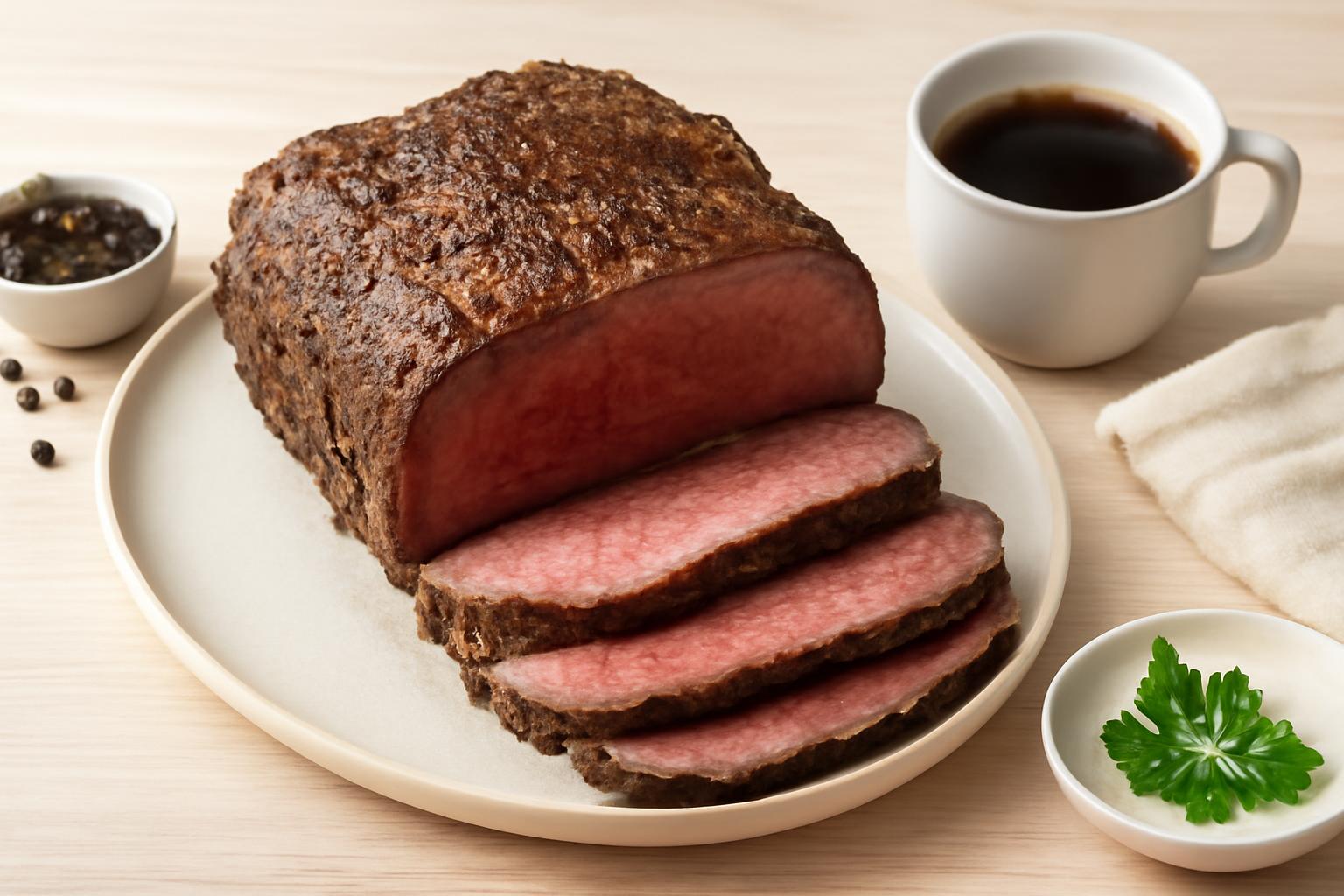
Choose thin-sliced, medium-rare roast beef or take a covered braise all the way to pot-roast tenderness; the cut supports both.
If you searched for pikes peak roast, you probably ran into two different things: a beef roast cut and Starbucks Pike Place® Roast coffee. This article is about the beef cut — the heel of round — and specifically about how to estimate its calories and protein, how to cook it so it stays reasonably tender, and how to avoid reading too much certainty into recipe nutrition panels.
For macro tracking, Pikes Peak roast is useful because the published recipe examples are consistently high in protein without reading as heavily fatty. The catch is texture. This roast comes from a hard-working part of the animal, so “how many calories are in a serving?” is never just a serving-size question. It is also a cooking-method question. Thin-sliced roast beef cooked to medium-rare is a different finished product from a covered braise taken all the way to pot-roast tenderness.
The practical takeaway is simple: treat published recipe nutrition as a range, not a universal fact; weigh the meat when you can; and choose your endpoint based on whether you want sandwich slices or a softer braised roast. As our Terms of Use note, this kind of content is for general informational reading, not individualized dietary advice.
What Is Pikes Peak Roast?
Pikes Peak roast is another name for the heel of round roast, a cut from the round primal in the rear leg. In the seller and recipe evidence, it is described as coming from the lower or bottom half of the round and sitting above the hock, which helps explain both its flavor and its chew: this is a worked muscle, not a naturally tender steak cut. Redger Farms’ Heel of Round Roast listing
That worked-muscle structure is the main thing to understand before you cook it. Pikes Peak roast is not difficult because it lacks flavor; it is difficult because flavor and tenderness are not the same thing. Treated like a prime rib, it is likely to disappoint. Treated like a roast that needs gentle heat, moisture or careful slicing, and a real rest before carving, it becomes much more useful.
For size and price, the evidence is best read as seller examples, not a market-wide benchmark. One butcher page lists a typical weight of 3 pounds and a price of $8.00 per pound. Another describes the roast as about 3 to 4 pounds and shows a price discrepancy on the same page: $8.00/lb in the header and $6.50 per pound in the description. That is less a clean pricing reference than a reminder that this is a somewhat niche butcher cut and labeling can vary by shop. Five Mile Meats’ Pikes Peak Roast page
If your store does not use the Pikes Peak name, asking for heel of round is the best first move. Savory Spice’s Pikes Peak pot roast recipe
Calories and Nutrition in Pikes Peak Roast
The cleanest way to say this is: the article-length nutrition numbers available for Pikes Peak roast are recipe outcomes, not universal cut facts. They reflect different portion sizes, different amounts of retained liquid, and different serving counts from roughly similar roasts. That makes them useful for tracking — but only as approximations.
In one grilled 3-pound Pikes Peak roast recipe, the roast is divided into 12 servings, with an estimated 188 calories, 30 grams of protein, and 5 grams of fat per serving. That is a thinner-sliced, leaner roast-beef-style result. Out Grilling’s Pikes Peak Roast recipe
In a different Dutch oven recipe using a 3-pound heel of round with onion, mushrooms, 2 cups brewed coffee, 1/2 cup soy sauce, garlic, and gravy thickened with cornstarch, the estimate is 266 calories, 40 grams of protein, and 8 grams of fat per serving when divided into 8 servings. Cast Iron Skillet Cooking’s Pikes Peak Roast
Put together, those examples suggest a practical home-tracking band of roughly 188 to 266 calories per serving, with 30 to 40 grams of protein and roughly 5 to 8 grams of fat when the roast is portioned somewhere between one-twelfth and one-eighth of a 3-pound roast. The lower end usually reflects thinner slicing and more portions. The higher end usually reflects a larger serving, more liquid or gravy on the plate, or both.
If you want a better estimate than a recipe plugin gives you, track the roast in stages:
- Start with the raw packaged weight.
- Log added ingredients separately if they matter to you.
- Weigh the cooked meat after cooking and resting.
- Divide your plated portion by the total cooked yield.
A worked example makes that easier to use. Suppose you buy a roast labeled 4 pounds raw, log all the ingredients in your tracker, and your whole batch totals 1,900 calories after you add the seasonings and any cooking liquid you expect to eat. After cooking and resting, suppose the edible cooked yield weighs 38 ounces. If your plate gets 6 ounces of cooked roast, that portion is 6 ÷ 38 = about 15.8% of the cooked yield. Multiply 1,900 × 0.158, and the meat portion comes out to about 300 calories before gravy. If you then add a separately logged 1/4 cup of gravy, you add that on top. The point is not that every roast will land at 300 calories per portion; the point is that your own yield math is usually more believable than a generic recipe widget.
That same serving-based logic matters in sauced beef dishes too, where oil, nuts, or gravy can swing the estimate more than the meat alone; see Chinese beef with cashews calories.
There is a second layer of uncertainty here that is worth separating clearly. CaloriePages says on its About page that label calorie counts can be off by 20%. That statement is about how much trust to place in neat printed calorie numbers; it is not a formal ±20% rule for your homemade roast. Home-cooked tracking has its own uncertainty from trimming, moisture loss, and uneven distribution of gravy and vegetables.
For high-protein foods like roast beef, there is one more useful nuance. Our guide to why protein fills you up on fewer calories summarizes protein’s thermic effect of food at about 20% to 30% of protein calories, versus roughly 5% to 10% for carbohydrates and 0% to 3% for fat. That does not mean you should manually discount the calories in your app. It just helps explain why high-protein meals can feel slightly more efficient and filling than the same gross calories from lower-protein foods.
Best Cooking Methods for Pikes Peak Roast
The common rule across the recipe evidence is simple: cook it gently.
One detailed recipe uses a beer marinade, sets the roast over vegetables, and cooks it covered at 320°F until the roast reaches the chosen doneness, with 130°F to 140°F used for medium-rare and a 10-minute rest before carving. Foods of Our Lives’ Pike’s Peak Roast recipe
For a softer braised result, the same cut can be taken much higher in a moist environment. The coffee-and-soy Dutch oven version bakes covered at 325°F for about 2 hours, with the recipe treating 145°F as the minimum target and preferring about 190°F for a more fork-tender texture. Cast Iron Skillet Cooking’s Pikes Peak Roast
If convenience matters more than crust, the slow cooker is the easiest route. In the slow-cooker evidence, a 4-pound Pikes Peak or bottom round roast sits over tomatoes, cornstarch, onions, and carrots and cooks for 5 to 6 hours on high or 10 hours on low, until fork-tender, then rests about 10 minutes before slicing. Savory Spice’s slow cooker Pikes Peak pot roast
Grilling works too, but only if you treat the roast like a roast, not like a steak. The grilling method in the evidence uses indirect heat around 300°F, optional hickory smoke, and a target of about 140°F to 145°F for sliceable roast beef after roughly 1 1/2 hours, or continued cooking to around 190°F for a softer but less juicy finish. Out Grilling’s grilled Pikes Peak Roast method
Across those methods, the texture decision is the real decision. Lower finishing temperatures suit thin slices. Higher finishing temperatures in liquid suit pot-roast tenderness. The roast is not being contradictory; you are just choosing between two legitimate end states.
The liquid pattern is also consistent. The recipe set uses beer, coffee and soy sauce, tomatoes, and red wine.
Oven and Dutch Oven Recipes
For a sliceable oven roast, the beer-marinade approach is the clearest template. Marinate the roast overnight if you can, or at least an hour if you cannot, then set it over vegetables and roast it covered at 320°F. Pull it in the 130°F to 140°F range if your goal is medium-rare slices rather than pot roast, and let it rest about 10 minutes before carving. The same recipe uses onions, carrots, and potatoes under the roast, which is helpful both for flavor and for buffering the meat from harsher direct pan heat.
That method is best when you want roast beef for sandwiches or plated slices.
For a more classic braise, the coffee-and-soy Dutch oven recipe is the most detailed example in the evidence set. It uses a 3-pound heel of round, sliced onion and mushrooms, 2 cups brewed coffee, 1/2 cup soy sauce, and garlic, then bakes the covered pot at 325°F for about 2 hours. The recipe notes 145°F as the minimum target but prefers about 190°F for tenderness, then thickens the cooking liquid into gravy with 2 to 3 tablespoons of cornstarch.
The choice between those two routes is mostly a choice between texture goals:
-
130°F to 140°F: sliceable, roast-beef style (Foods of Our Lives recipe.)
-
Around 190°F in liquid: pot-roast-style softness (Cast Iron Skillet Cooking recipe.)
The braise route is richer and more forgiving, but the final nutrition depends more on how much gravy and cooked-down liquid actually gets served.
In either version, a thermometer matters more than the clock. Time tells you when to start checking. It does not tell you that your roast is done.
Slow Cooker and Crock Pot Versions
If your goal is an easy pot roast with a wide margin for error, the slow cooker is the most forgiving option in the evidence set. The clearest version starts with 14.5 ounces of diced tomatoes mixed with 2 tablespoons of cornstarch, then adds 1 pound of carrots, 2 sweet onions, and a 4-pound Pikes Peak or bottom round roast seasoned with rub and salt. The recipe cooks for 5 to 6 hours on high or 10 hours on low, until the roast is fork-tender, then rests it about 10 minutes before slicing.
That recipe is especially useful for shoppers because it confirms a substitution many people actually need: bottom round can stand in for Pikes Peak roast.
A second crock pot version leans more savory than classic pot roast. It browns the roast first, then layers on 1 large onion, 2 green bell peppers, 2 large tomatoes, a bunch of cilantro, 1 tablespoon cumin, 1/2 cup soy sauce, and 1/2 cup red wine, then cooks on medium-low for 5 to 6 hours before serving the sliced roast with vegetables and some of the cooking liquid to keep it juicy. Lasater Grasslands Beef’s crock pot Pikes Peak roast recipe
Two cautions matter with slow cookers. First, fork-tender does not always mean shred-friendly with heel of round. Second, if you plan to slice rather than pull, give the roast a short rest and use a sharp knife. Clean, thin slices do more for this cut than aggressive shredding ever will.
Grilling and Storage Tips
Yes, you can grill Pikes Peak roast — just do not grill it like a steak. The supported method uses a dry rub, indirect heat around 300°F, and optional hickory smoke. It reaches a sliceable medium roast-beef texture around 140°F to 145°F after about 1 1/2 hours, while cooking onward to 190°F makes it softer but less juicy. A 10- to 15-minute rest follows before slicing.
That tradeoff is the whole grilling game with this cut:
- Earlier pull, thinner slices: juicier and better for sandwiches (Out Grilling recipe.)
- Later pull, higher temp: softer bite, but usually drier unless wrapped or otherwise protected (Out Grilling recipe.)
That is not a garnish-level tip for heel of round; it is part of the tenderness strategy. A correctly cooked roast can still seem tough if the slices are thick or if you cut with the grain.
For leftovers, the most specific refrigeration note in the evidence says cooked Pikes Peak roast keeps in an airtight container in the refrigerator for up to 4 days. For longer storage, the grilling source recommends wrapping the roast unsliced in plastic wrap and foil and freezing it for up to 3 months.
If you know the leftovers are headed for sandwiches, chill the roast whole, then slice only what you need. That one habit usually does more for leftover texture than any reheating trick.
Internal Temps, Resting, and Common Mistakes
The apparent disagreement over internal temperature is mostly a disagreement about style, not about whether the recipes are talking about the same cut.
For a roast-beef result, the doneness bands in the evidence look like this:
- 120°F to 125°F: rare (Foods of Our Lives recipe.)
- 130°F to 140°F: medium-rare, good for thin slicing (Foods of Our Lives recipe.)
- 135°F to 140°F: the seller recommendation most explicitly aimed at sliced roast beef (Redger Farms listing.)
- 145°F to 150°F: medium (Foods of Our Lives recipe.)
- 155°F to 165°F: well done (Foods of Our Lives recipe.)
- Around 190°F: braised or continued slow-cook tenderness rather than classic roast-beef slicing (Cast Iron Skillet Cooking recipe; Out Grilling recipe.)
One recipe lists 120˚-125˚ for rare Pike’s Peak Roast | Foods of Our Lives. If you want sandwich slices, you do not automatically chase 190°F. If you want pot roast, you should not panic when the roast is technically “done” earlier but still feels tough. That is often a sign that the cut needs more time in moist heat, not proof that the thermometer failed.
Resting matters too. Across the evidence, the advised rest lands between about 10 and 20 minutes depending on size and method. Foods of Our Lives uses 10 minutes. Out Grilling uses 10 to 15 minutes. Redger Farms suggests at least 20 minutes before slicing.
The most common mistakes are predictable:
Cooking too hot. The supported methods cluster around 300°F to 325°F or long slow-cooker times. (Out Grilling recipe; Foods of Our Lives recipe; Cast Iron Skillet Cooking recipe.)
Using time instead of temperature. Roasts vary in thickness, shape, starting temperature, and how your oven actually runs. A thermometer is the tool that makes the method repeatable. (Foods of Our Lives recipe.)
Slicing too thick or with the grain. Thin slices are part of the method, not a presentation detail. (Redger Farms listing; Out Grilling recipe.)
Expecting chuck-roast behavior. That is not failure; it is just the nature of the cut. (Redger Farms listing.)
Pikes Peak Roast vs. Pike Place Roast Coffee
No — Pikes Peak roast is not the Starbucks coffee.
The beef cut is a heel of round roast from the rear leg. Starbucks Pike Place® Roast is brewed coffee. On Starbucks’ official nutrition page, a grande 16 fl oz Pike Place® Roast has 5 calories, 1 gram of protein, 0 grams of fat, 0 grams of carbs, and approximately 315 to 390 mg of caffeine.
The names are similar enough to pollute search results, but the products are obviously unrelated. A 16-ounce black coffee at 5 calories is not remotely the same object as a 3- to 4-pound heel of round roast.
If you are tracking the beef, the safer workflow is to verify the cut on the package or with the butcher, log the raw roast weight, account for major add-ins separately, and then weigh the cooked yield before portioning. That is a much more believable system than tapping the first “pike place” or “pikes peak” entry your app throws at you.
How many calories in a serving of Pikes Peak Roast?
A realistic published recipe range is roughly 188 to 266 calories per serving, with 30 to 40 grams of protein and roughly 5 to 8 grams of fat depending on portion size and how much sauce or gravy ends up served. Those numbers come from two different recipe examples, not from a single universal cut label.
Best internal temperature for Pikes Peak Roast?
The best temperature depends on your goal. For thin-sliced roast beef, the evidence points to about 130°F to 140°F, with one seller specifically recommending 135°F to 140°F for sliced roast beef. For a more standard roast, 145°F is the minimum target cited in the recipe set. For braised, pot-roast-style tenderness, some cooks take the roast to around 190°F, especially in a covered moist cook. (Foods of Our Lives recipe; Redger Farms listing; Cast Iron Skillet Cooking recipe; Out Grilling recipe.)
What is the difference between Pikes Peak Roast and Pike Place Roast?
Pikes Peak Roast is a beef cut, usually the heel of round. Pike Place® Roast is Starbucks brewed coffee, listed at 5 calories per grande 16 fl oz with approximately 315 to 390 mg of caffeine. They are unrelated products that happen to have similar names. (Cast Iron Skillet Cooking recipe; Starbucks nutrition page.)
Can you substitute bottom round for Pikes Peak Roast?
Yes. Bottom round is the clearest substitute in the recipe evidence, especially for slow-cooker or pot-roast applications. Just treat it the same way: low heat, enough moisture, and realistic expectations about slicing versus shredding.
How to store cooked Pikes Peak Roast?
For short-term leftovers, keep the roast in an airtight container in the refrigerator for up to 4 days. For longer storage, freeze it unsliced, well wrapped, for up to 3 months. Leaving it whole helps limit moisture loss when you reheat and slice later.