
Rice Nutrition Facts, Calories, Health Benefits, and Safety
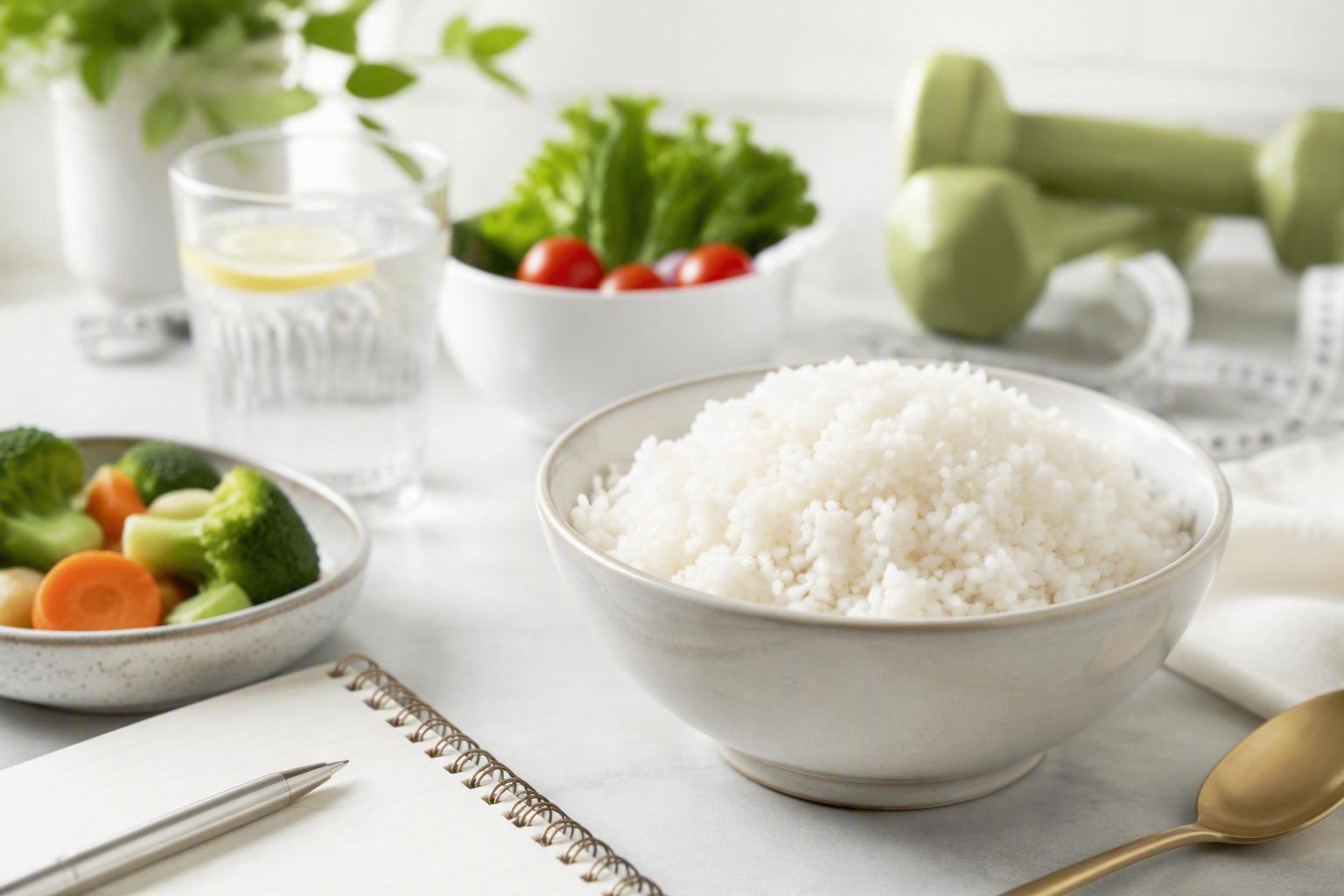
Plain cooked white rice has about 130 calories per 100 g. Dry and cooked figures differ, and brown rice has more fiber but also more arsenic.
Overview
Plain cooked white rice contains about 130 calories per 100 grams, with roughly 28 grams of carbohydrate, 2.7 grams of protein, and almost no fat, according to the reference values published by NutriScan. That figure only applies when the rice is plain, cooked, and measured in that specific amount; dry rice, cup measurements, and other varieties produce very different numbers.
Rice is primarily a carbohydrate food. Medical News Today notes that both white and brown rice consist mainly of carbohydrates with some protein and virtually no fat or sugar, and that the nutrient value depends on the variety and cooking method. That variability is why a single calorie figure without a labeled serving is nearly useless for logging or comparison.
The practical decisions this article covers follow from that starting point: how to read a rice nutrition figure correctly, whether brown or white rice better fits a given goal, what the evidence actually shows about blood sugar and type 2 diabetes, how much cooked rice counts as an official grain serving, and how to handle arsenic exposure and leftover rice safely.
Rice calories and nutrition facts by serving
A rice nutrition figure is only interpretable when four things are named: the rice type, whether it is cooked or dry, the serving unit, and the gram weight. The table below shows two clearly labeled references from the evidence for this article, and they are deliberately not interchangeable.
| Nutrient | White rice, cooked, per 100 g (NutriScan) | White long-grain, parboiled, enriched, cooked, 1 cup (URMC Rochester) |
|---|---|---|
| Calories | 130 kcal | 194.34 kcal |
| Carbohydrate | 28 g | 41.16 g |
| Protein | 2.7 g | 4.6 g |
| Fat | 0.3 g | 0.58 g |
| Fiber | 0.4 g | Not listed in the source record |
| Sugars | 0.1 g | Not listed in the source record |
The first column, from NutriScan, describes 100 grams of plain cooked white rice. The second, from the University of Rochester Medical Center, describes one full cup of cooked parboiled enriched long-grain white rice. The cup serving shows higher totals mainly because a cup of cooked rice weighs more than 100 grams, not because parboiled rice is a dramatically different food.
This is the most common source of confusion when comparing rice figures across websites and food-tracking apps. Some entries use 100 grams, others use one cup, half a cup, or one-third of a cup, and some describe dry rice rather than cooked. Supernatural Eats, for example, lists uncooked white short-grain rice at 356 calories per 100 grams and uncooked glutinous rice at 370 calories per 100 grams. Placed next to the 130-calorie cooked figure without labels, those numbers look contradictory. They are not; the figures are not directly comparable, because their documented serving and preparation bases differ or are incomplete.
Before logging or comparing any rice entry, check that the type, cooked state, unit, and gram weight match. If any of the four differs, the numbers cannot be compared directly.
Why dry and cooked rice values differ
Dry and cooked rice show sharply different calories per 100 grams because cooking adds water, not because cooking removes energy. Medical News Today reports that water makes up almost 70% of cooked rice’s total weight. Water contributes weight but no calories, so each 100 grams of cooked rice contains far less actual rice, and therefore fewer calories, than 100 grams of dry rice.
The two published figures illustrate the scale of the difference: Supernatural Eats lists uncooked white short-grain rice at 356 calories per 100 grams, while NutriScan lists white rice at 130 calories without a documented cooked state or serving weight. The total calories in a given amount of dry rice do not disappear during cooking; they are simply distributed across a much heavier, water-rich cooked volume.
This matters most for calorie tracking. Weighing rice in one state and logging it against a database entry for the other state can produce a substantial tracking error, so the measured state should always match the database entry. The lowest-error approach is to log the same state that was measured: weigh dry rice against a dry entry, or weigh the cooked portion against a cooked entry. Mixing states is one of the more consequential tracking shortcuts, because the error compounds with every rice-based meal logged.
Brown rice vs. white rice
Brown and white rice are the same grain processed differently, and neither is universally superior; the better choice depends on what the reader is optimizing for. WebMD notes that kernels of brown rice keep the bran layer intact, while in white rice it has been polished away. Healthline describes the fuller picture: all white rice starts out as brown rice, and a milling process removes the husk, bran, and germ, which extends shelf life but removes much of the grain’s fiber, vitamins, and minerals.
The decision matrix below compares the two on the axes the evidence supports.
| Decision factor | Brown rice | White rice |
|---|---|---|
| Fiber | Higher; the bran retains most of the grain’s fiber (Medical News Today) | Lower; the fiber-rich bran is removed during milling (Medical News Today) |
| Natural micronutrients | Higher in magnesium and other nutrients present in the intact grain (Healthline) | Most naturally occurring B vitamins, minerals, phytochemicals, and fiber are removed in milling (Harvard T.H. Chan School of Public Health) |
| Enrichment | Not artificially enriched (Healthline) | Enriched versions have B vitamins and iron added back; enriched white rice is a good folate source (Healthline; Harvard) |
| Shelf life | Shorter; the intact bran and germ are retained | Longer; milling increases shelf life (Healthline) |
| Glycemic tendency | Average GI of 55 in Harvard’s summary, though both types can score high (Harvard; Healthline) | Average GI of 64 in Harvard’s summary (Harvard) |
| Arsenic distribution | Higher arsenic levels, because the metal accumulates in the grain’s outer layers (Harvard) | Lower arsenic, since the outer layers are removed |
Read as a whole, the matrix points to goal-dependent choices rather than a single winner. A reader prioritizing fiber, magnesium, and a somewhat lower average glycemic index has reasons to prefer brown rice, which Healthline describes as generally more nutritious. A reader prioritizing folate intake from enrichment, longer storage, or lower arsenic exposure has legitimate reasons to choose enriched white rice. Many households reasonably use both, matching the type to the meal and the person eating it.
The one framing to avoid is treating white rice as nutritionally empty or brown rice as risk-free. Enrichment gives white rice a real micronutrient contribution, and brown rice’s outer layers carry both its nutritional advantages and its higher arsenic content.
What enrichment restores—and what it does not
Enrichment adds back specific nutrients lost in milling, but it does not recreate the original grain. The Harvard T.H. Chan School of Public Health explains that milling and polishing remove the majority of naturally occurring B vitamins, minerals, phytochemicals, and fiber, and that B vitamins and iron are then added back, with the label term “enriched” indicating this. Harvard also notes that only a fraction of the original amount of these nutrients is restored.
Within that limitation, folate is a genuine strength of enriched white rice. Healthline reports that an average 1-cup serving of enriched white rice can contain 195 to 222 micrograms of folate, about half the daily recommended amount. Fiber, magnesium, and phytochemicals removed with the bran and germ are not added back, which is why the brown-versus-white fiber and micronutrient gap persists even for enriched products. When comparing packages, the word “enriched” on a label signals restored B vitamins and iron, not a whole-grain equivalent.
Evidence-based health benefits of rice
The benefits that can be attributed to rice with reasonable confidence are nutritional functions, not disease-prevention outcomes. Rice supplies carbohydrate energy; Medical News Today notes that its carbohydrates provide energy to the body but can also raise blood sugar, which is the tradeoff at the center of the blood-sugar section below. Rice also contributes some protein, with 2.7 grams per 100 grams of cooked white rice in NutriScan’s reference and 4.6 grams in a cup of cooked parboiled rice in the URMC record.
Rice contributes micronutrients beyond its macronutrients. USA Rice states that rice provides fiber and more than 15 essential vitamins and minerals, including folic acid, B vitamins, potassium, magnesium, selenium, iron, and zinc. For brown rice specifically, WebMD reports that its insoluble fiber promotes regular bowel movements, and that fiber more generally can lower cholesterol and, because it increases fullness, may make weight maintenance easier. On satiety, USA Rice cites a 2013 human clinical trial reporting that having white or brown rice at a meal increased satiety and the feeling of fullness.
Two evidence boundaries keep these claims honest. First, fiber-related findings about cholesterol, heart disease, and stroke risk describe fiber and whole grains as a category, not rice as a specific food; a reader can obtain the same fiber benefits from other whole grains, and eating rice is not itself demonstrated to prevent cardiovascular disease. Second, most rice-specific outcome evidence is observational. The 2022 systematic review in BMJ Open found that brown rice intake was associated with lower type 2 diabetes risk in cohort studies, but its randomized substitution trials showed inconsistent cardiometabolic findings, with only a small high-density lipoprotein increase of 0.06 mmol/L favoring brown rice. Association-level evidence of this kind identifies patterns; it does not prove that switching rice types causes better health outcomes. The defensible summary is that rice is a useful energy and micronutrient source whose health effects depend heavily on type, portion, and the rest of the diet.
Rice, blood sugar, and diabetes
Rice raises blood glucose because it is a concentrated carbohydrate source, and no rice type is exempt. Medical News Today states the operative principle plainly: consuming too many carbohydrates from any source can raise blood glucose, so portion size matters regardless of whether the rice is whole grain or refined.
Glycemic index (GI), a measure of how quickly a food raises blood glucose relative to a reference, differs between rice types but is not a fixed property of “rice.” The Harvard T.H. Chan School of Public Health reports an average GI of 55 for brown rice and 64 for white rice, while Healthline notes that both white and brown rice can have a high GI score. The BMJ Open meta-analysis similarly observes that variability in GI exists across rice strains. Any single GI number for rice should be read as an average across varieties and preparations, not a universal value, which is why published GI figures for rice frequently disagree.
The long-term diabetes evidence is observational and should be labeled as such. The 2022 systematic review and meta-analysis of eight cohort studies, published in BMJ Open, found that white rice intake was associated with a 16% higher risk of type 2 diabetes comparing the highest with the lowest intake categories (pooled relative risk 1.16), with a dose-response appearing at intakes above roughly 300 grams of rice per day, where each additional 158-gram daily serving was associated with 13% higher risk. Brown rice showed the opposite pattern: an 11% lower risk comparing extreme categories (pooled relative risk 0.89), with each 50-gram daily serving associated with 13% lower risk. The review attributes part of this difference to dietary fiber and micronutrients such as magnesium in the intact grain.
Two caveats bound these findings. Cohort associations of this kind cannot prove that rice type causes or prevents diabetes, since high rice intake correlates with other dietary and lifestyle factors. And the same review found that randomized trials substituting brown rice for white rice produced inconsistent effects on cardiometabolic risk factors, with the review authors noting concerns about bias in most trials. For a diabetes-conscious eating pattern, the evidence supports moderate portions, a preference toward higher-fiber varieties where practical, and attention to the whole meal, rather than eliminating rice or relying on a single GI number.
Why rice variety and starch structure matter
Two rice varieties can produce different textures and different digestion rates because of the ratio of two starches, amylose and amylopectin. Medical News Today explains that the body takes longer to digest high-amylose rice because amylose slows starch digestion, while sticky, amylopectin-rich rice is digested very quickly.
The same starch chemistry that determines how a rice cooks also shapes its glycemic behavior. High-amylose varieties tend to cook up firmer and more separate, while sticky rice’s rapid digestion is one mechanism behind faster glucose responses. This is a key reason a single glycemic value cannot be assigned to all white rice: two visually similar white rices can differ in amylose content and therefore in digestion speed.
The practical implication is modest but useful. A reader managing carbohydrate intake should treat variety as one variable among several, alongside portion size and the rest of the meal, rather than assuming every white rice behaves identically. The evidence supports the mechanism and the direction of the difference, not fixed per-variety numbers.
Rice portions for weight management and balanced meals
The only officially defined rice portion in the evidence for this article is a grain ounce-equivalent, not a weight-loss dose. MyPlate, the USDA’s food-group guidance, counts one-half cup of cooked rice, or 1 ounce of dry rice, as one ounce-equivalent of grains. For context, MyPlate’s daily grain recommendations range from about 5 to 8 ounce-equivalents for most adult women and 6 to 10 for most adult men depending on age, with roughly half from whole grains. Those figures describe how rice fits a food-group framework; they are not an individualized prescription for weight loss or diabetes management, which depends on total energy intake and health status.
Within that boundary, the evidence supports rice fitting a weight-management diet through portion control rather than exclusion. NutriScan states that rice does not cause weight gain, excess calories do, and that rice can fit a weight-loss diet with careful portion control, suggesting one-half to three-quarters of a cup cooked per meal balanced with protein and vegetables. Medical News Today adds that substituting higher-fiber rice for white rice may aid weight loss and decrease cholesterol, phrased as a possibility rather than a guarantee.
A workable pattern for building a rice-based meal looks like this:
- Measure the rice portion deliberately, using half-cup cooked increments so the amount maps onto MyPlate ounce-equivalents.
- Add a protein source and non-starchy vegetables, which slow the meal down and displace some carbohydrate volume, in line with NutriScan’s portion-and-balance framing.
- Log or account for everything added to the rice, not just the rice itself.
That last point deserves emphasis. A plain-rice database entry only applies when its rice type, cooked state, serving unit, and weight are explicitly specified and match what was measured. Butter or oil stirred in during or after cooking, coconut milk used as the cooking liquid, sauces, and frying all add calories that the plain-rice figure does not capture, and fried or sauced preparations can differ substantially from the plain reference. The evidence here does not quantify those additions, so the reliable practice is to log each added ingredient separately rather than assuming a plain-rice database entry covers the finished dish.
Arsenic, antinutrients, and rice safety
Three materially different concerns attach to rice, and each has a different response. The first is arsenic: WebMD reports that rice accumulates arsenic more than other grains because it is grown in water, which makes preparation choices relevant and is covered in detail below. The second is phytic acid, an antinutrient sometimes raised as a concern with rice, though the evidence gathered for this article does not quantify its effects. The third is bacterial growth in cooked rice that is not cooled properly, a storage issue rather than a nutrition issue, addressed in the leftover-rice section below.
Keeping these three separate prevents overreaction. Phytic acid is handled by normal thorough cooking, arsenic by cooking method and variety choice, and bacterial risk by prompt refrigeration.
Arsenic and cooking tradeoffs
Rice takes up more arsenic than other grains because of how it is grown. WebMD attributes this to rice being cultivated in water, where arsenic in soil and water can accumulate in the plant. The distribution within the grain matters for variety choice: the Harvard T.H. Chan School of Public Health notes that brown rice contains higher arsenic levels than white rice because the metal accumulates in the outer layers of the grain, the same bran layers that give brown rice its fiber and micronutrient advantage.
Preparation can reduce exposure. WebMD advises rinsing rice and cooking it with extra water to reduce arsenic content. Harvard quantifies the extra-water method: it removes about 50% of the arsenic. The tradeoff is nutritional, and Harvard states it directly: some water-soluble B vitamins are also lost when rice is cooked in excess water and drained. For enriched white rice, whose added B vitamins are part of its nutritional case, this means the arsenic-reduction method partially works against the enrichment benefit.
There is no single correct resolution to this tradeoff; it depends on how often rice is eaten and which nutrients the rest of the diet already supplies. A household eating rice occasionally may reasonably prioritize nutrient retention, while a household eating rice daily may prioritize arsenic reduction. This article’s evidence does not include current official arsenic guidance for infants, young children, pregnant people, or other higher-exposure groups, so readers in those situations should consult current regulatory guidance rather than general cooking advice.
Leftover rice safety
Cooked rice left at room temperature supports the growth of Bacillus cereus, a bacterium that WebMD identifies as growing in rice and other starchy foods when they are not kept cool. According to WebMD, it causes nausea and vomiting, and it is the reason some people describe leftover rice as unsafe.
Leftover rice is not inherently dangerous; improperly stored rice is. WebMD’s guidance is to refrigerate leftover rice promptly and to use proper kitchen hygiene, which addresses the conditions the bacterium needs. The practical failure mode is leaving a pot or takeout container of cooked rice sitting out for an extended period before refrigerating it, since the risk comes from time spent warm rather than from reheating itself.
For meal planners who batch-cook rice, the same principle applies at larger scale: move cooked rice into the refrigerator promptly after cooking rather than letting a large warm batch cool slowly on the counter. The evidence supplied here does not specify exact time or temperature thresholds, so prompt refrigeration is the defensible standing rule.
Is rice naturally gluten-free?
Yes. Medical News Today states that all rice is naturally gluten-free, and USA Rice describes rice as gluten-free, highly digestible, and the least allergenic of all grains, making it a relevant grain option for people with celiac disease or gluten intolerance.
The qualifier applies to products, not the grain. Healthline notes that people concerned about gluten intake should avoid rice products with added gluten, which can appear in seasoned rice mixes, sauced rice dishes, and other processed preparations through added ingredients. Plain white, brown, basmati, or jasmine rice cooked at home contains no gluten; a flavored packet or restaurant preparation requires checking the ingredient list. For anyone managing celiac disease, the label check on processed rice products is the step that matters, not the rice itself.