
The Calorie Math Behind White Cognac Shots and Servings
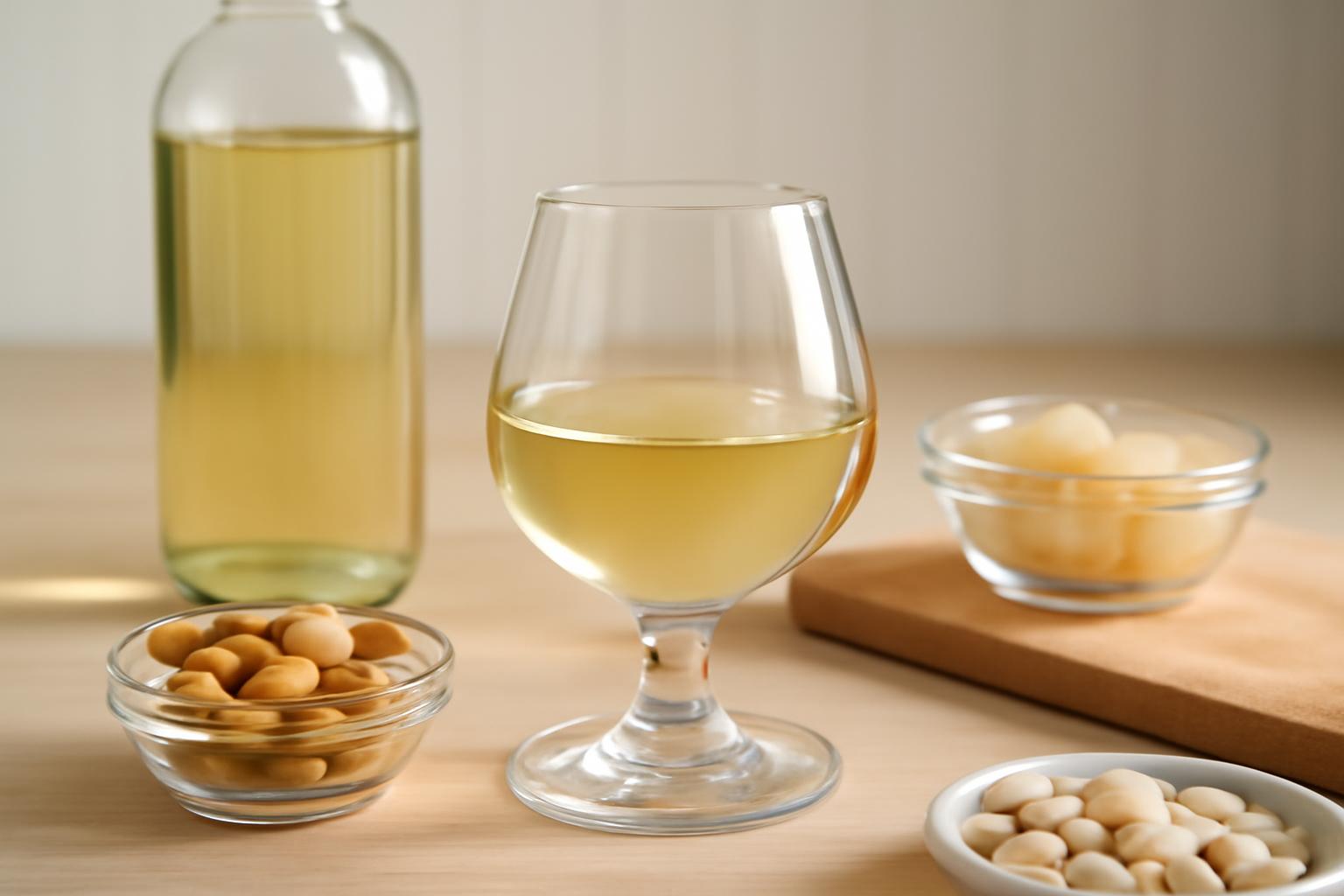
A standard 40% ABV shot lands at 96-97 calories. The actual pour sets the spirit calories. Juice, syrup and liqueur can raise the mixed-drink total.
What makes this topic slightly confusing is not the nutrition itself, but the naming. “White cognac” sounds like it should be a separate nutrition category. For tracking, it usually is not. The deciding variables are still alcohol strength and serving size.
Related: Low-Calorie Mixed Drinks: 7 Measured Options and Smarter Swaps.
What Counts as White Cognac for Nutrition Tracking
What matters first is the bottle’s alcohol strength and size. A retail listing for White X Cognac, one of the most visible current examples, shows a 750 mL bottle at 40% ABV, which is the key tracking detail to pull from the label or product page (Total Wine White X listing).
That gives you a straightforward tracking hierarchy:
- Check the ABV or proof.
- Measure the actual pour.
- Ignore the marketing descriptor unless it signals different alcohol strength or added ingredients.
If the bottle is still a plain 40% spirit, the standard cognac entry is usually the right one.
Calories in a Standard White Cognac Shot
A standard 1.5-fluid-ounce shot of 80-proof cognac contains 96 calories and 13.9 grams of alcohol, with the calories coming entirely from alcohol (CalorieKing cognac entry).
If you sometimes see 97 calories instead of 96, that does not mean the spirit changed. It usually means the database is using a slightly different shot convention. A U.S. 1.5-fluid-ounce shot is about 44.4 mL, while many alcohol references round a spirit shot to 45 mL. That tiny serving-size difference is enough to make one source show 96 and another show 97. For logging, the practical answer is that a standard white cognac shot at 40% ABV lands in the 96-to-97-calorie range.
That also explains why spirits can look deceptively “light” on paper. A shot is small, so the total number is modest compared with a full beer or a glass of wine. But those calories are highly concentrated. Per ounce, a plain 80-proof spirit is much more energy-dense than beer because almost all of the energy is coming from alcohol.
From a tracking standpoint, that concentration is both good and bad. It is good because the entry is clean and easy to log. It is bad because a free-poured “shot” can drift upward fast. If your home pour is 2 ounces instead of 1.5 ounces, the spirit itself is no longer a 96-calorie entry.
Full Nutrition Breakdown per Serving
For a plain 1.5-ounce serving of 80-proof cognac, the nutrition line is close to as simple as spirits get: 0 grams fat, 0 grams carbohydrate, 0 grams fiber, 0 grams sugar, 0 grams protein, and 0 mg cholesterol. CalorieKing also lists sodium at less than 1 mg, potassium at less than 1 mg, calcium at 0 mg, iron at less than 1 mg, vitamins A and C at 0 mg, and caffeine at 0 mg (CalorieKing nutrition facts panel).
That is why plain white cognac fits neatly into macro tracking apps. It adds calories, but it does not meaningfully move your carb, fat, or protein totals. If you log net carbs, it is effectively a zero-carb spirit. If you drink it neat, on the rocks, or diluted with plain water, the calorie total comes from the alcohol itself, not from meaningful macros.
You may see broader cognac explainers discuss trace compounds from aging or production. For everyday nutrition tracking, that is not very useful unless a producer provides a measurable, product-specific nutrition panel. In the evidence here, there is no white-cognac-specific nutrition dataset that changes the main entry. The practical log remains: alcohol calories only.
“Zero carb” is not the same thing as “free,” but it does make the macro side of the log unusually straightforward.
Calories by Pour Size and Bottle
Once you know the standard shot, the rest is just scaling. Using the 96-calorie, 1.5-ounce cognac entry as the base, the practical estimates are:
- 1 ounce: about 64 calories
- 1.5 ounces: about 96 calories
- 2 ounces: about 128 calories
Those are not separate lab tests. They are just linear scaling from the standard 1.5-ounce cognac entry used by common food databases (CalorieKing cognac entry).
If your app uses metric servings, the same idea applies. A rounded 45 mL shot is commonly listed at 97 calories in alcohol calculators, so a quick mental shortcut is to scale from either 96 per 1.5 U.S. fluid ounces or 97 per 45 mL. The important thing is to stay consistent with the convention your app uses instead of mixing ounce-based and rounded-metric entries mid-log.
A good consumer shortcut is:
- Calories for a 40% cognac pour ≈ 96 × (your ounces ÷ 1.5)
- or, if your app uses rounded metric shots,
- Calories ≈ 97 × (your mL ÷ 45)
That is easier to apply in real life than chemistry-style formulas, and it stays tied to the cited serving data above.
For bottle totals, start with the bottle size rather than guessing from the word “cognac.” A White X listing from Fine Wine & Good Spirits shows 750 mL and 80 proof, which is enough to estimate the full-bottle calorie total (Fine Wine & Good Spirits White X listing).
Using the shot math, a 750 mL bottle of 40% white cognac works out to the low 1,600s in total calories, not the mid-2,000s. Here is why:
- 750 mL ÷ 44.4 mL per 1.5 U.S. fluid-ounce shot = about 16.9 shots
- 16.9 shots × 96 calories = about 1,622 calories
If you instead use rounded 45 mL shots at 97 calories, you land very close to the same place:
- 750 mL ÷ 45 mL = about 16.7 shots
- 16.7 shots × 97 calories = about 1,620 calories
That low-1,600s estimate is the one that matches the serving data. If you ever see a much higher bottle number for a plain 40% spirit, the math is usually treating too much of the bottle as pure alcohol or using the wrong serving base.
The user-side error here is usually not the formula. It is the pour. A bottle estimate can be tidy on paper, while your real nightly intake depends on whether your “one drink” is a measured 1.5 ounces or an unmeasured 2-ounce-plus home pour.
White Cognac vs Other Alcohol Calories
Calorie-wise, white cognac sits exactly where a plain 80-proof spirit should sit. MedlinePlus lists gin, 80 proof, 1.5 fl oz at 97 calories. The same table lists light beer at 103 calories per 12 oz, regular beer at 153, higher-alcohol craft beer at 170 to 350, and white table wine at 128 calories per 5 oz (MedlinePlus alcohol calorie table).
What changes is the serving volume. A shot packs roughly the same calories as a light beer, but into a much smaller amount of liquid.
This is where people often misread the tradeoff. A shot can look “lighter” because it is a smaller glass. But if you compare ounce for ounce, distilled spirits are far more concentrated than beer or wine. The spirit is not cheating the calorie math; it is just compressing the calories into less volume.
Where white cognac can be easier for trackers is macro simplicity. Plain spirits are easier to log precisely than drinks that naturally bring carbs along with them. If your choice is between a measured spirit pour and an alcoholic drink with meaningful sugar or carb content, the spirit often gives you a cleaner entry even when the calorie totals are similar.
That does not automatically make it better for fat loss. It just makes the numbers easier to enter accurately.
Fitting White Cognac into Your TDEE
If you are trying to fit white cognac into a daily calorie budget, the useful question is not “Does alcohol count differently?” It is “How does this entry fit into my actual maintenance intake?” CaloriePages’ own TDEE explainer breaks total daily energy expenditure into BMR, TEF, exercise activity, and NEAT. It notes that BMR is about 60 to 70% of TDEE for most sedentary adults, TEF averages around 8 to 10% on a mixed diet, NEAT is the most variable component, calculator estimates have about ±10% mean error, and 2 to 4 weeks of intake plus body-weight trend is the most practical way to calibrate maintenance. The same explainer also uses the rough approximation that 7,700 kcal is about 1 kg of body-mass change (CaloriePages TDEE explainer).
Applied to white cognac, that means the drink itself is the easy part. A measured shot is about 96 to 97 calories. The harder part is whether your logged intake still matches your real-world maintenance over time.
That is why TDEE calibration matters more than one-off drink anxiety. Two people can both log the same two shots and still get different scale outcomes because the shot math is only one piece of the week. The rest of the picture includes how accurately they pour, what they eat around the drink, how often restaurant meals enter the mix, and how consistent the rest of the log is from weekday to weekend.
A useful calibration method looks like this:
- Log food and drinks as accurately as you can for 2 to 4 weeks.
- Weigh daily under the same conditions.
- Use the weekly average, not the noisiest single day.
- If the average weight is flat, your average intake is close to maintenance.
- If the average weight trends up or down, adjust from the trend rather than trusting a calculator’s default setting.
That framing also keeps alcohol in the right place. White cognac is not some special metabolic exception. It is part of total intake, and total intake still has to be tested against real body-weight trend if you want an honest maintenance number.
Reading White Cognac Labels and Error Rates
In practice, alcohol bottles and retailer pages often give you the information you need for calorie estimating without giving you a full food-style nutrition panel. The White X listing from Fine Wine & Good Spirits, for example, gives 80 proof and 750 mL, which are the two details a tracker needs most for a baseline estimate (Fine Wine & Good Spirits White X listing).
That is the normal mindset to bring to alcohol labels: expect proof or ABV and bottle size first, then estimate calories from there. Do not expect every bottle to hand you the kind of complete Nutrition Facts panel you would see on a packaged food. For consumer tracking, the practical habit is to verify the ABV, then measure the pour yourself.
There is a second layer of uncertainty beyond the label layout itself. On its About page, CaloriePages notes that calorie counts on labels can be off by 20%, which is a useful reminder that tracked calorie numbers are estimates, not perfect lab-certified truths (CaloriePages About page).
For alcohol, though, the biggest errors are usually even simpler than label tolerance:
- free-pouring instead of measuring
- logging “one drink” when the glass actually holds more
- using a generic cocktail database entry instead of the actual recipe
- switching between ounce and milliliter entries without noticing
So the best label-reading habit is not hunting for a calorie number that may not be there. It is checking the ABV, checking the bottle size, and then measuring what actually goes into the glass.
Tracking Tips for Mixed White Cognac Drinks
A neat or on-the-rocks white cognac pour is the easy case. You are mostly logging the spirit itself. As soon as you turn it into a mixed drink, the mixer becomes the moving part.
That is why cocktail tracking gets messy faster than spirit tracking. The cognac portion may still be straightforward, but juice, regular tonic, syrups, liqueurs, sweetened sodas, cream, and pre-made mixes can change the total far more than the word “white” ever will. If the goal is a lower-calorie drink, the usual win comes from measuring the spirit and simplifying the mixer, not from assuming one cognac style is nutritionally special.
A reliable method is:
- Log the cognac first by ounces or mL.
- Add each mixer separately.
- Avoid generic cocktail entries when you know the actual build.
- Measure your home pour at least once so your “usual drink” is not guesswork.
In practice, that means a white cognac highball with soda water and citrus will stay much closer to spirit-only calories than a drink built with juice and syrup. The calorie difference is mostly recipe-driven.
This is also where a measured-pour mindset pays off. If you accidentally make the base pour 2 ounces instead of 1.5, you have already raised the spirit portion from about 96 to about 128 calories before the mixer adds anything. For more measured drink examples in the same style, the site’s broader articles archive includes other alcohol-calorie explainers built around pour size and mixer math.
The broader lesson is that apps are only as accurate as the ingredients you enter. Mixed drinks are not hard because the math is advanced. They are hard because people often do not know what is in the glass.
BAC and Metabolism After White Cognac
A cognac calculator page cited here states that a 45 mL / 1.5 oz shot contains about 14.2 grams of alcohol, equals about 1.01 standard drinks, and may take roughly 2 to 3 hours to metabolize at the page’s cited 5 to 7.5 grams per hour rate. The same page gives rough Widmark-style examples suggesting that about 4 shots could put an 80 kg man near 0.08% BAC, while about 3 shots could put a 70 kg woman near that level, with large individual variation (Drinkmeter cognac BAC explainer).
The important word there is rough. Those are calculator-based educational estimates, not medical clearance and not legal advice. Food intake, body size, medications, drinking pace, health status, and individual alcohol response can shift the outcome substantially.
From a calorie-tracking perspective, the practical takeaway is only that shots stack fast. Each additional pour adds more than just calories; it adds more alcohol exposure in a small volume. That matters even if your original reason for checking the drink was just to log it.
The safety takeaway is even simpler: do not use generalized BAC math to decide whether you are okay to drive.
Are there carbs in white cognac?
Not in any meaningful tracking sense. A plain 1.5-ounce serving of cognac is commonly logged as 0 grams of carbohydrate, along with 0 grams of fat and 0 grams of protein. That is why plain cognac is usually treated as a zero-carb spirit in macro tracking (Advanced Mixology cognac nutrition overview).
Calories in a 750ml bottle of white cognac?
Using a 750 mL bottle at 40% ABV as the model, a full bottle works out to roughly 1,620 calories, or the low 1,600s overall when you scale from standard shot values. White X is listed in a 750 mL bottle at 40% ABV, which is why that estimate is the right ballpark for that product type (Total Wine White X listing).
Is white cognac keto-friendly?
From a carb-counting perspective, yes. Plain cognac is generally treated as zero carb, which is why it is commonly described as compatible with ketogenic or very low-carb tracking. The limitation is that zero carb does not mean zero calorie, and it does not make mixers disappear (Advanced Mixology cognac and keto overview).
How many standard drinks in one white cognac shot?
For a 1.5-ounce / 45 mL cognac shot, the calculator summary cited above puts it at about 1.01 standard drinks. In everyday tracking, that is easiest to think of as basically one standard drink (Drinkmeter cognac BAC explainer).
Does white cognac label show calories?
Often, not in the way food packages do. The White X listing cited here shows 80 proof and 750 mL, which is enough to make a reasonable calorie estimate even without a visible calorie panel (Fine Wine & Good Spirits White X listing).
For practical tracking, that is really the whole story: verify the ABV, measure the pour, log the spirit as standard 80-proof cognac if the bottle is 40% ABV, and remember that most of the real error comes from the glass in your hand rather than the database entry on your screen.