
Calorie and Macro Realities Behind Common Vegan Asian Dishes
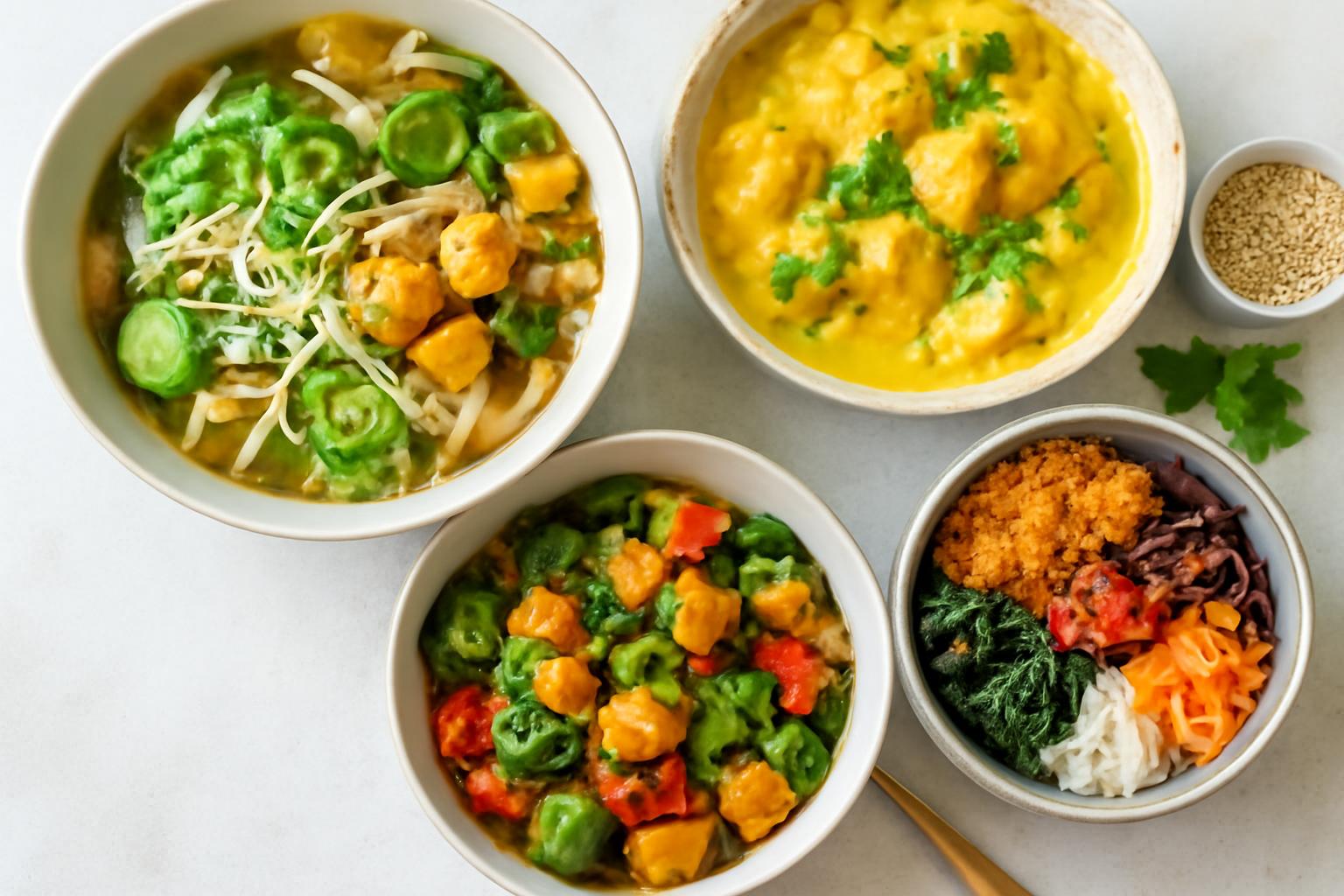
Break each dish into protein, starch, sauce and extras, then log the components instead of treating its recipe name as a nutrition fact.
Plenty of vegan Asian dishes look similar on a recipe page but behave very differently in a food log. A tofu pho, a coconut curry, a bibimbap bowl, and a peanut ramen can all be plant-based, yet the parts that matter for tracking are not the cuisine labels. They are the tofu or tempeh, the rice or noodles, the sauce base, and the fact that packaged nutrition numbers are estimates rather than laboratory measurements.
That is the main problem with this topic. Recipe roundups from sites like Veggie Anh, Veganuary, No Sweat Vegan, The Foodie Takes Flight, Hungry Huy, Vegan Heaven, and Two City Vegans reliably show that vegan versions of many Asian dishes exist. But those pages usually give titles, photos, and promotional summaries—not standardized nutrition panels, weighed ingredients, or reproducible macro calculations.
So this article takes a narrower and more honest approach. It is not a recipe collection and not a verified nutrition database for every named dish below. It is a tracking guide for common vegan Asian dish formats, built from:
- CaloriePages evidence on tofu protein density, food-label error, Atwater factors, thermic effect of food, protein satiety, and TDEE calibration
- VegNews for supported tofu-versus-tempeh comparisons
- Third-party recipe sites and roundups only to show which vegan dish formats are commonly published and, in a few cases, to report source-stated calorie numbers
Where a named dish includes a calorie number below, it is called out as source-reported. Where no traceable nutrition panel exists in the supplied evidence, the discussion stays at the component level.
The estimates and methods here are for general information only, not medical or dietary advice.
Method and confidence level: Calorie and macro tracking works best when you break a dish into four pieces: protein, starch, sauce, and extras. That matters especially here because CaloriePages notes that most food labels are calculated from general Atwater factors—about 4 kcal per gram of protein, 4 per gram of carbohydrate, and 9 per gram of fat—and can still be off by as much as 20%. So the goal is not false precision. It is better judgment.
Core Ingredients in Vegan Asian Recipes
If you are tracking vegan Asian dishes seriously, tofu and tempeh are the two protein anchors that matter most in the supplied evidence.
| Ingredient | Supported nutrition figure | Supported traits | Tracking takeaway |
|---|---|---|---|
| Firm tofu | 8 g protein and 76 kcal per 100 g | Soy-based, pressed from coagulated soy milk; smooth, neutral; high in isoflavones | About 9.5 kcal per gram of protein, which makes it a relatively efficient plant protein for calorie-conscious meals |
| Tempeh | 19 g protein per 100 g | Fermented soybeans; firm, dense, nutty; also described by VegNews as higher in fiber and a better source of probiotics than tofu; high in isoflavones | Higher protein density than tofu, but the supplied evidence here does not provide a paired calorie figure to calculate its exact kcal-per-gram-of-protein ratio |
The cleanest benchmark is tofu. CaloriePages lists firm tofu at 8 grams of protein and 76 calories per 100 grams, which works out to about 9.5 kcal per gram of protein. For trackers, that is useful because it gives you a stable reference point: tofu can raise protein intake without behaving like a sauce, oil, or coconut base.
Tempeh changes the equation differently. VegNews places tempeh at 19 grams of protein per 100 grams, versus tofu at 8 grams. That supports a simple practical conclusion: if two bowls look similar but one is built around tempeh and the other around tofu, the tempeh version is more likely to contribute meaningfully to your protein target.
There are also texture and format differences that matter in actual meals. VegNews describes tofu as smooth and neutral, and tempeh as firm, dense, and nutty because it is made from fermented soybeans rather than coagulated soy milk. In practice, tofu fits easily into broths, tomato sauces, curries, and soft stews; tempeh tends to hold its identity better in bowls, stir-fries, and plated mains.
Both foods also bring isoflavones. Tofu is the leaner-supported option because the evidence here includes its calories. Tempeh is described by VegNews as higher in fiber and as a better source of probiotics because of fermentation. That is relevant nutritionally, but for calorie and macro tracking the bigger day-to-day distinction is still this:
- Tofu is the clearest low-calorie protein benchmark in the evidence.
- Tempeh is the clearer high-protein-density benchmark.
That does not mean protein is the whole story. CaloriePages also emphasizes that food labels themselves are estimates. Packaged tofu, bottled sauces, noodles, and plant-based meats are typically labeled using the Atwater 4-4-9 system, and U.S. labeling rules can still leave room for totals to be off by up to 20%. When you assemble a multi-part dish, that uncertainty stacks.
A practical hierarchy for vegan Asian meal logging looks like this:
- Protein source first: tofu if you want the clearest low-calorie protein anchor, tempeh if you want higher protein density.
- Starch second: rice, rice noodles, udon, soba, vermicelli, and sticky rice are the parts you can usually measure most consistently.
- Sauce third: curry bases, peanut sauces, teriyaki, hoisin, and coconut components are concentrated enough that small changes matter.
- Label humility always: log carefully, but do not confuse a package number with a lab result.
Protein also matters for reasons beyond the nutrition panel. CaloriePages reports that protein has a higher thermic effect of food than carbohydrate or fat: roughly 20% to 30% of protein calories are spent in digestion and processing, versus 5% to 10% for carbohydrate and 0% to 3% for fat. That helps explain why protein-forward meals often feel more filling and may differ slightly in net energy over time.
But this is where many articles become sloppy, so it is worth being explicit: TEF is context, not a subtraction rule for mixed meals. You should not take a curry, decide that its tofu portion is “discounted,” and then log the bowl lower than its ingredients justify. TEF helps explain satiety and small metabolic differences. It does not turn dish logging into net-calorie arithmetic.
Vietnamese Vegan Soups and Rolls
The supplied recipe sources clearly show that vegan Vietnamese-style dishes are common online. Veggie Anh lists Vegan “Beef” Pho, Vietnamese Sweet and Sour Soup, Vietnamese Fried Spring Rolls, and Vietnamese Tofu with Tomato Sauce. Veganuary lists Vegan Tofu Pho and Vietnamese Rice Paper Rolls. The Foodie Takes Flight features a Banh Hoi Platter with Hoisin Tofu.
What those sources do not provide in the supplied evidence are standardized nutrition facts or reproducible serving calculations. So the honest way to use these dishes for tracking is to read them as formats, not as verified calorie totals.
| Dish style | What the supplied sources confirm | What to log first |
|---|---|---|
| Pho / tofu pho | Vegan versions are commonly published | Noodle portion, tofu or other protein, broth add-ins, sauces and toppings |
| Sweet and sour soup | Vegan versions are commonly published | Whether it is eaten alone or with rice |
| Rice paper rolls / spring rolls | Both fresh rice paper rolls and fried spring rolls appear in vegan recipe roundups | Wrapper count, filling, dipping sauce, and whether the roll is fresh or fried |
| Tofu with tomato sauce / bánh hỏi with hoisin tofu | Tofu-centered Vietnamese mains are common | Tofu portion, vermicelli or rice side, hoisin or other sauce |
Pho is a good example of why title-only tracking fails. “Vegan pho” tells you very little by itself. What matters is the split between the rice noodles, the protein portion, the broth, and any sauces or toppings you add or dip. Since CaloriePages gives the TEF range for carbs at 5% to 10%, and tofu’s supported protein density is much clearer than noodles’, a tofu-heavy bowl and a noodle-heavy bowl should not be treated as interchangeable even if both are called pho.
The same caution applies to Vietnamese sweet and sour soup. In tracking terms, the important distinction is not whether the soup sounds light. It is whether it is logged as:
- the soup alone, or
- the soup plus a rice side
That second version is a different meal.
Rolls are similar. Veganuary lists Vietnamese Rice Paper Rolls, while Veggie Anh lists Vietnamese Fried Spring Rolls. Those are not the same tracking problem. Fresh rice paper rolls bring a wrapper count, a filling, and a dipping sauce question. Fried spring rolls add a separate cooking-fat variable and should be logged as a different format rather than assumed equivalent because the names sound related.
Vietnamese Tofu with Tomato Sauce and Banh Hoi Platter with Hoisin Tofu are useful for a different reason: they make the protein source visible. In both formats, tofu is not buried inside the dish title. That matters because tofu’s supported benchmark—8 g protein and 76 kcal per 100 g, or 9.5 kcal per gram of protein—gives you something concrete to anchor the log around. The noodles, vermicelli sheets, or rice then become add-ons you can estimate separately.
A good Vietnamese dish workflow for trackers is:
- Identify the starch: rice noodles, vermicelli sheets, rice, or wrappers.
- Make the tofu count visible: use grams if you have them.
- Treat dipping sauce as its own entry: hoisin, peanut, or other sauces are too concentrated to hide inside “mixed dish.”
- Log fresh and fried versions separately.
Two broader limits still matter here. First, CaloriePages notes that labels can be off by up to 20%, so even careful homemade logging is approximate. Second, your own energy expenditure is not fixed. CaloriePages reports that NEAT can differ by up to 2,000 kcal per day between otherwise similar people. So even well-logged bowls do not interact with every body in the same way.
That is not a reason to stop tracking. It is a reason to stop pretending that a recipe title like “vegan pho” is already a nutrition fact.
Thai and Southeast Asian Curries
The recipe sources in the evidence set make one point very clearly: vegan Thai and Southeast Asian dishes often combine tofu with coconut. Veggie Anh lists Vegan Panang Curry. Veganuary lists Tofu Thai Green Curry, Thai Vegetable Red Curry, Curry Coconut Cauliflower Soup, Spicy Tofu & Noodle Coconut Soup, and Laksa Malaysian Noodle Soup. No Sweat Vegan also features a Vegan Thai Curry.
That does not let you assign a verified calorie total to “Thai curry” as a category. But it does tell you what the tracking structure usually looks like.
| Dish format | What the title already signals | Main tracking variables |
|---|---|---|
| Panang, green, or red curry | Curry base plus tofu/vegetables; often coconut in the broader recipe category | Coconut base, tofu portion, rice side, concentrated sauce ingredients |
| Laksa or coconut noodle soup | A rich soup format plus noodles | Noodle weight, coconut-rich broth, protein add-ins |
| Tofu or tempeh curry | Visible soy protein | Whether protein is a main component or just a garnish |
The big calorie question in these dishes is usually not the tofu. It is the fat-rich base. CaloriePages’ Atwater guidance is simple: fat contributes about 9 kcal per gram, compared with 4 kcal per gram for protein or carbohydrate. CaloriePages also lists fat as the macronutrient with the lowest TEF, at roughly 0% to 3%. So once a curry leans heavily on coconut milk or another fat-forward base, the bowl is operating very differently from a broth-based soup or a tofu-tomato dish.
That does not mean coconut-based vegan curries are “bad” for tracking. It means the tracking job is less about the word vegan and more about the composition of the bowl:
- How much of the meal is coconut-rich sauce?
- How much tofu is actually present?
- Is there a rice side?
- Are noodles involved too?
Laksa is the clearest warning format in the evidence set because the title itself tells you it is a noodle soup, and Veganuary lists a Laksa Malaysian Noodle Soup. When a dish combines a rich soup base with a noodle base, you have two major components to log carefully instead of one.
Protein still helps. Tofu has the clearest calorie efficiency number in the evidence. Tempeh, per VegNews, provides 19 g protein per 100 g, which can improve protein density if you use it in a curry or noodle bowl. But that should be understood correctly: a tempeh swap can change the macro balance of the dish; it does not create a free calorie offset.
The same caution applies to oil-free marketing language. No Sweat Vegan labels some Asian-inspired recipes “oil-free,” including Thai curry and teriyaki tofu entries. That can be a useful recipe descriptor, but it is not proof that the finished dish is low-calorie. If a bowl still contains coconut milk, nut-based sauces, or a substantial starch side, the calories still have to come from somewhere. CaloriePages’ Atwater framework is the right corrective: log the identifiable components rather than treating a blog label as a nutrition verdict.
TEF belongs here too, but only in the right role. CaloriePages reports that protein costs more energy to process than carbs or fat and helps explain why higher-protein meals often feel more satisfying. In a curry context, that means a tofu- or tempeh-forward bowl may behave differently for hunger and adherence than a sauce-and-noodle bowl. It does not mean you subtract 20% to 30% from the full curry total.
The safest rule for Thai and Southeast Asian curries is therefore simple:
- Use exact numbers only when a recipe or package provides them.
- Otherwise, estimate by components and keep the sauce base visible.
That is less glamorous than saying “Thai curry has X calories,” but it is more defensible.
Korean Vegan Stews and Bowls
The supplied sources also show a wide range of vegan Korean dish formats. Veggie Anh lists Kimchi Jjigae. No Sweat Vegan lists Vegan Bibimbap with Tofu. Veganuary includes Plant-Based Steak Kimbap. Veggie Anh also lists Soy Milk Noodles (Kongguksu), while The Foodie Takes Flight highlights Crispy Pan-Fried Enoki Mushrooms with Gochujang Sauce in its latest recipes and has a large Korean recipe category overall.
Again, the titles confirm the market. They do not create verified nutrition facts. But they do split neatly into two tracking patterns: stews and rice- or noodle-based builds.
| Dish | Format signal | Tracking implication |
|---|---|---|
| Kimchi jjigae | Brothy or stew-like dish with tofu | Log the tofu and any rice side separately |
| Bibimbap | Rice bowl with toppings | Rice is the anchor entry; tofu and sauce determine how protein-heavy it becomes |
| Kimbap | Rice-forward rolled format | Piece counts can hide how much rice is actually included |
| Kongguksu / soy milk noodles | Noodle format with soy milk base | Noodles remain central; protein depends on the actual soy content and any added tofu |
| Gochujang-coated enoki | Sauce-coated mushroom dish | Sauce amount matters more than the vegetable name alone suggests |
Kimchi jjigae and bibimbap are useful contrasts. Kimchi jjigae is a stew format, and Veggie Anh’s title makes tofu visible within the broader Korean stew tradition. Bibimbap, by contrast, is explicitly called a Korean rice bowl by No Sweat Vegan. That wording alone is valuable for tracking because it tells you which part of the plate is structural. Bibimbap is not mainly a vegetable dish with some rice. It is a rice bowl whose toppings may or may not make it protein-forward.
Kimbap works the same way in rolled form. Veganuary’s listing for Plant-Based Steak Kimbap tells you the filling is plant-based, but the roll is still built around rice. Small pieces can look lighter than they are if you log them casually.
Kongguksu is a different case. Veggie Anh identifies it as Soy Milk Noodles, which signals a dish whose tracking hinges on both noodle quantity and the soy-based liquid component. That may create a different fat profile than a coconut curry, but without a nutrition panel or weighed ingredients you still cannot call it low-calorie or high-protein by title alone.
Protein’s value in these dishes is not just the grams. CaloriePages explains that protein supports satiety through stronger increases in PYY and GLP-1, along with longer suppression of ghrelin, than carbohydrate or fat alone. That is one reason a bibimbap with a meaningful tofu portion may keep hunger down better than a similarly sized rice bowl with minimal protein.
The same source also gives a general evidence-based protein target of about 1.6 to 2.2 grams per kilogram of body weight per day when preserving lean mass in a calorie deficit is a priority. That number is not Korean-food-specific, but it changes how you evaluate Korean vegan meals:
- A tofu-rich jjigae may help you hit a daily protein target more effectively than its appearance suggests.
- A bibimbap or kimbap may need more intentional protein than the default format provides.
- A noodle dish like kongguksu may still be carb-led even when soy appears in the title.
For calorie trackers, the practical Korean hierarchy is:
- Stews first: ask what comes with them, especially rice.
- Rice bowls second: count the rice as the structural base.
- Rolls third: do not let small piece size hide the rice total.
- Sauce last but visible: gochujang-style dishes can accumulate calories through concentrated sauce, not just base ingredients.
That is a more useful lens than trying to force unsupported per-dish calorie numbers out of title-only recipe pages.
Noodle and Rice Dishes Across Cuisines
Across the supplied recipe roundups, the highest logging risk shows up in dishes where starch and sauce are both central. Veggie Anh lists Spicy Peanut Ramen. Two City Vegans lists Tofu Fried Rice and Sesame Soba Noodles. Vegan Heaven lists Yaki Udon. Hungry Huy includes sticky rice and garlic fried rice.
These are all different dishes, but from a tracker’s perspective they share a common problem: the calories are easy to bury inside a single mixed entry.
| Dish type | What usually drives error | Better tracking move |
|---|---|---|
| Peanut ramen | Noodles plus separate sauce or broth concentration | Log noodles and sauce as visible components |
| Fried rice | Rice volume plus oil or sauce additions | Use a weighed rice amount or a repeatable bowl size |
| Soba / udon dishes | Noodle weight plus dressing | Treat dressing separately instead of assuming it is trivial |
| Sticky rice plates | Dense starch base | Pair with a visible protein source if you want a more balanced macro profile |
| Garlic fried rice | Rice-first format | Count the rice first, then add fats and toppings |
Spicy peanut ramen is a strong example because the title already tells you there are two major entries: a noodle base and a peanut-based sauce or broth element. CaloriePages’ TEF data helps frame this properly. Carbohydrate sits around 5% to 10% TEF, and fat around 0% to 3%. So a starch-and-fat-centered bowl usually will not behave like a protein-forward meal for satiety, even when total calories are similar.
Tofu fried rice can be more balanced, but only when tofu is more than decoration. The name alone does not tell you that. If the bowl is mostly rice with scattered tofu cubes, it is still a rice dish. If the tofu portion is substantial, the meal is easier to fit into protein targets because tofu gives you a supported 9.5 kcal per gram of protein benchmark.
Sesame soba noodles and yaki udon raise the same issue from a different angle. The main tracking mistake is often not the noodles themselves, but the habit of treating the dressing as background. That is where a separate sauce entry helps. Even when the total is approximate, splitting the meal into noodles, protein, and dressing gives you better repeatability than using a single generic database entry.
Sticky rice and garlic fried rice are even simpler. They are starch-first foods by design. If you enjoy them, the honest macro move is not to call them secretly light. It is to pair them with a more protein-dense side—often tofu, or tempeh if you want more protein per 100 grams.
A useful question across all these dishes is:
What percentage of the meal is actually protein?
If the answer is “a few cubes of tofu on top,” the meal is probably starch-led. If the protein portion is substantial and visible, the dish becomes easier to place inside a macro plan.
These meals also interact badly with short-term scale reading. CaloriePages notes that TDEE calibration works best over 2 to 4 weeks, and that water weight can fluctuate by 1 to 3 kg from carbohydrates, sodium, and other factors. So a week with ramen, fried rice, or noodle bowls may look worse on the scale than it really is if you judge by single weigh-ins instead of weekly averages.
The point is not to avoid noodles or rice. It is to stop treating every vegan Asian dish as nutritionally interchangeable just because the protein source is plant-based.
Low-Calorie Vegan Asian Options Under 500 kcal
This is the one section where the supplied evidence includes actual calorie numbers for named vegan dishes. Those numbers are still source-reported, not independently verified here, but they are more concrete than the title-only examples elsewhere.
| Dish | Reported calories | What the source clarifies |
|---|---|---|
| Sesame Ginger Seitan | 335 kcal | Rabbit and Wolves reports this per serving in a roundup of vegan low-calorie entrees |
| Beijing Tempeh | 460 kcal | Rabbit and Wolves reports this including steamed rice |
| Spicy Chile-Garlic Tofu | 136 kcal | PETA reports this per serving; best read as the tofu dish itself, not automatically a full meal with sides |
| Maple-Miso Tempeh Cutlets | 298 kcal | PETA reports this per serving in a low-fat vegan roundup |
These are useful examples precisely because they are labeled carefully enough to show what a number does and does not mean.
- Sesame Ginger Seitan (335 kcal) is a source-reported single-dish example from Rabbit and Wolves.
- Beijing Tempeh (460 kcal including rice) is stronger as a meal example because the source explicitly says the rice is already included.
- Spicy Chile-Garlic Tofu (136 kcal) is probably most useful as a low-calorie protein anchor, not as proof that the whole meal will stay that low once you add rice, noodles, or extra sauce.
- Maple-Miso Tempeh Cutlets (298 kcal) show that tempeh can still fit lower-calorie tracking when the serving is controlled.
There are also under-500 Asian-inspired or vegetarian examples in the supplied roundups, but they need more caution. Taste.com.au lists Vegetable and Tofu Nasi Goreng in an “under 500 calories” gallery and also includes eggplant and tempeh dishes in that roundup. However, the supplied text does not clearly verify vegan status for every example, and the calorie claims are not independently confirmed in the evidence provided here.
So the best way to use under-500 roundups is not as a guarantee, but as a filter:
Better bets
- Tofu- or tempeh-forward mains with a stated per-serving calorie total
- Dishes where the source says whether rice is included
- Simple stir-fries or cutlets where the protein is the obvious main component
Less reliable bets
- Roundups where the dish may be vegetarian rather than clearly vegan
- Listings that do not say whether sides are included
- Entries where the calories may reflect a recipe portion, not a restaurant or takeout serving
And the same label caveat still applies. CaloriePages notes that packaged foods can be off by up to 20% because of label rules and Atwater-based estimation. So even the best low-calorie examples here should be treated as useful reported benchmarks, not as guarantees you can copy into a log without checking the actual build.
Sauces and Gluten Checks for Vegan Asian Cooking
Sauces create two separate problems in vegan Asian tracking: hidden calories and gluten uncertainty.
Start with gluten. CaloriePages states that eel sauce is not always gluten-free, largely because the soy sauce used in it may contain wheat. The practical fix is also straightforward: check whether the product uses tamari or another clearly gluten-free soy alternative, and be more cautious with restaurant versions where labels and cross-contact are harder to verify.
CaloriePages also notes that plain sake is generally gluten-free, but flavored bottles or versions with additives may change that answer. So if gluten matters, plain sake and flavored sake should not be treated as interchangeable.
The same label-first logic belongs with teriyaki and hoisin. The supplied evidence does not give standardized nutrition numbers for those sauces across brands, and No Sweat Vegan’s teriyaki listings are recipe titles rather than verified nutrition panels. In practice, that means both calories and gluten status remain product-dependent.
For calorie tracking, sauces are easy to undercount because they are concentrated and visually small. CaloriePages’ Atwater framework is enough to explain why: the sauce may contain meaningful amounts of sugar, fat, or both, and the label is still an estimate rather than an exact measure. That is not a reason to ignore sauce. It is a reason to measure it separately when the dish depends on it.
There is also a satiety angle here. CaloriePages reports that protein’s hunger effect comes partly through PYY and GLP-1, along with longer suppression of ghrelin. Sauce does not do that work. So if a noodle bowl looks satisfying mainly because it is glossy and heavily coated, that visual cue should not be confused with protein density.
A practical checklist:
- Need gluten-free? Check the soy sauce source first.
- Need tighter calorie tracking? Measure the sauce separately.
- Need better fullness? Add tofu or tempeh before adding more sauce.
- Need realism? Accept that labels and restaurant descriptions are approximate.
A sauce can fit your macros. It just should not be treated as nutritionally invisible.
Tracking Vegan Asian Recipes for TDEE
Calorie tracking gets harder when food uncertainty and expenditure uncertainty collide. Vegan Asian dishes bring both.
CaloriePages breaks TDEE into four parts:
- BMR — basal metabolic rate
- TEF — thermic effect of food
- EAT — deliberate exercise
- NEAT — non-exercise activity
For most sedentary adults, CaloriePages says BMR accounts for about 60% to 70% of TDEE. NEAT is the wild card and can differ by up to 2,000 kcal per day between people with similar body size and formal exercise habits. That alone explains why two people can eat the same tofu curry or noodle bowl and see different scale behavior over time.
CaloriePages also notes that common calculators have a mean error of about ±10%. So a calculator can give you a reasonable starting point, but it cannot tell you with confidence whether a specific vegan Asian meal fits maintenance, a deficit, or a surplus.
The better method is still the boring one:
- Track intake for 2 to 4 weeks.
- Weigh yourself daily under consistent conditions.
- Use weekly average body weight, not single-day readings.
- Compare weekly calorie intake to the weight trend.
- Adjust from real data.
That matters even more with vegan Asian meals because carb-heavy and sodium-heavy dishes can push water weight around. CaloriePages notes that water fluctuations of 1 to 3 kg are normal enough to obscure the short-term picture. One ramen or fried-rice meal does not tell you your TDEE. A month of consistent logging tells you much more.
Protein helps on the diet-quality side too. CaloriePages reports three relevant points:
- Protein has the highest TEF at 20% to 30%
- Protein drives stronger satiety signaling through PYY and GLP-1
- Adequate protein helps preserve lean mass in a deficit, and muscle burns about 13 kcal per kilogram per day at rest, versus about 4.5 kcal per kilogram per day for fat tissue
That does not mean extra tofu dramatically boosts metabolism. It means protein-rich eating patterns make it easier to hold lean mass and manage hunger while you figure out your true maintenance.
CaloriePages also cites the often-repeated Weigle et al. 2005 finding: increasing protein from 15% to 30% of calories led to a spontaneous drop in intake of about 441 kcal per day. That is not a promise that every tofu bowl will reduce intake by 441 calories. It is evidence that protein can make adherence easier.
A practical TDEE strategy for vegan Asian eating is:
- Keep a few repeat meals in rotation so portion sizes stay comparable
- Log tofu and tempeh as separate protein entries instead of burying them under “mixed dish”
- Treat rice, noodles, and sauces as distinct parts of the meal
- Judge success by weekly averages, not whether one curry felt “clean”
CaloriePages even gives a useful example: if you average 2,200 calories per day and your weekly body-weight trend rises by around 0.1 to 0.2 kg per week, your real TDEE is likely closer to about 2,000 to 2,100 calories than to a flattering calculator estimate.
That kind of personal calibration matters more than any generic statement about vegan Asian dishes as a category.
In the end, these meals are highly trackable—but only if you respect the uncertainty. Use supported protein benchmarks like tofu’s 9.5 kcal per gram of protein, recognize the higher protein density of tempeh, keep sauces and starches visible, check labels, and let your own 2- to 4-week trend settle the question.
How accurate are calorie labels on vegan Asian ingredients like tofu?
Not perfectly accurate. CaloriePages explains that food labels are generally calculated using Atwater factors—about 4 kcal per gram of protein, 4 per gram of carbohydrate, and 9 per gram of fat—and can be off by as much as 20%. So the package number on tofu, noodles, sauce, or mock meat is useful, but it is still an estimate.
Is tempeh better than tofu for vegan Asian protein density?
For protein density, yes. VegNews lists tempeh at 19 g protein per 100 g versus tofu at 8 g per 100 g. But tofu is the clearer low-calorie benchmark in the supplied evidence because CaloriePages also gives its calories: 76 kcal per 100 g, or about 9.5 kcal per gram of protein. So tempeh is stronger for protein density; tofu is easier to anchor in calorie-conscious logging.
Calories in a typical serving of vegan Thai curry?
The supplied sources list vegan Thai curry formats, including Thai green curry, red curry, Panang curry, and coconut-based soups, but they do not provide a standardized calorie figure for a “typical serving” in the evidence provided here. The honest estimate depends on the coconut base, the tofu amount, the rice or noodle side, and the sauce quantity. If you need a real number, calculate from the actual recipe ingredients or from weighed components.
Gluten-free status of sake or eel sauce in vegan recipes?
CaloriePages says plain sake is generally gluten-free, but flavored or additive-containing versions may not be. It also says eel sauce is not always gluten-free, usually because of the soy sauce used in it. If gluten matters, check the label for the soy source, look for tamari or explicit gluten-free wording, and be especially careful with restaurant sauces.
How to calibrate TDEE with high-protein vegan Asian meals?
Use them inside a 2- to 4-week tracking block, not as one-off “good” meals. CaloriePages recommends logging intake carefully, weighing yourself daily under consistent conditions, and comparing weekly average calories with weekly average body weight. High-protein meals built around tofu or tempeh can help because protein improves satiety, has a higher TEF, and supports lean-mass retention—but your real TDEE still has to be calibrated from your own trend data, not from a calculator alone.