
Calories in Edible Hibiscus Flowers: Low-Cal Facts for Labels and Trackers
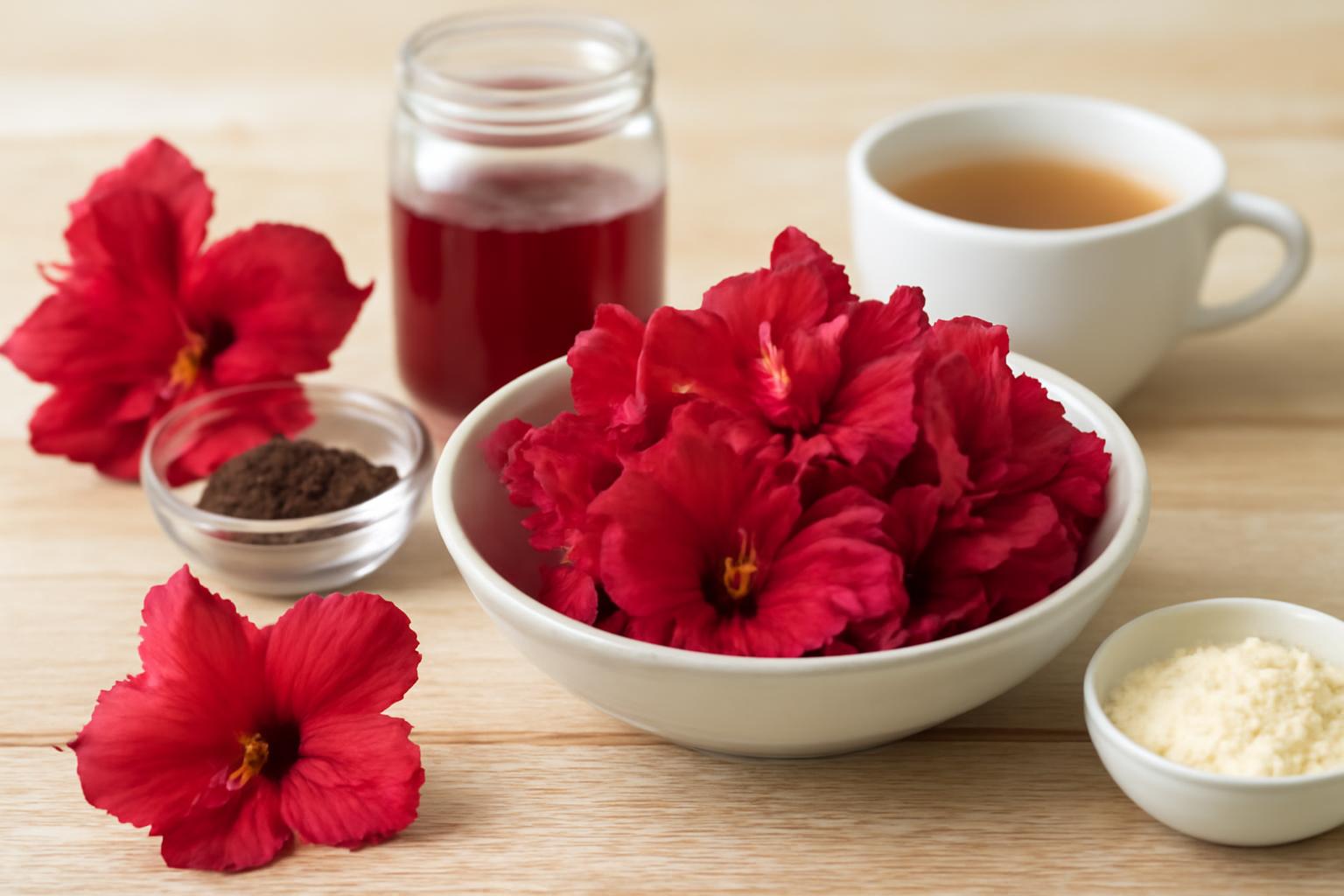
A confirmed edible plant grown for food is different from a decorative landscape hibiscus with an unknown spray history.
If you want to log edible hibiscus flowers accurately, the first problem is not calories. It is identification.
The ingredient most people mean by “hibiscus” in tart red tea is usually roselle, Hibiscus sabdariffa, and the part most often used is the calyx rather than the showy petal (WebMD; Tyrant Farms). That distinction matters because nutrition entries, tea pages, recipe posts, and marketplace listings often blur together fresh calyces, dried hibiscus, brewed tea, and candied products as if they were one food. They are not.
The evidence available for tracking is workable, but it is not lab-grade. Consumer nutrition databases and consumer health summaries in this evidence pack report:
- 0 to 1 calorie for very small dried hibiscus servings such as teaspoons or tablespoons used for brewing (MyNetDiary; PerkChops)
- 28 to 29 calories per cup for fresh hibiscus or fresh roselle-style calyces (WebMD; Fitia; Savor the Southwest)
- About 5 calories per cup for unsweetened hibiscus tea (NutriScan)
Those numbers are best treated as form-specific estimates, not universal constants. The evidence base here is mixed: consumer databases, growing guides, marketplace listings, and consumer health pages are useful for practical logging, but much weaker for precise composition claims or universal safety rules.
Are Hibiscus Flowers Edible?
Some hibiscus are edible, but “hibiscus” is not one interchangeable food.
The clearest edible case in the evidence pack is Hibiscus sabdariffa, usually called roselle. Tyrant Farms describes the calyces, leaves, and flower petals of H. sabdariffa as edible, with calyces used for tea, sauces, and jams, leaves used in salads or stews, and petals added to salads. WebMD likewise says the flowers, leaves, and seeds of hibiscus are edible, and notes that the calyces are the part most commonly used in tea, syrups, jellies, and sauces.
There is also evidence of traditional culinary use for Hibiscus rosa-sinensis. Hidden Valley Hibiscus describes H. rosa-sinensis flowers as traditionally used for tea and food in parts of Asia and Africa, with flowers eaten raw, cooked, or pickled and young leaves used cooked or raw. That supports documented traditional use, but it is not the same thing as a blanket rule that every ornamental hibiscus in every yard is automatically food-safe.
Commercial listings show another useful distinction. Amazon and Etsy both contain products marketed as edible hibiscus flowers, including dried hibiscus for tea, candied hibiscus, edible cake decorations, seeds, and live plants. That demonstrates a real culinary market for hibiscus products. It does not prove that any random garden hibiscus is appropriate to eat.
For practical tracking and kitchen use, it helps to separate the plant into parts:
- Petals / corolla: the soft colored flower parts
- Calyx / calyces: the cup-like structure enclosing the bud; in roselle, this is the fleshy red part harvested for tea and preserves
- Central reproductive structure: the prominent center column and related parts
That distinction matters because the sources do not treat all parts equally. WebMD and Tyrant Farms describe roselle calyces as a common food ingredient. By contrast, the foraging blog Savor the Southwest recommends a more conservative rule for ordinary garden hibiscus: use just the petals, not the green calyx or the central reproductive structures, and treat Hibiscus sabdariffa as the main exception. Because that guidance comes from a blog rather than a formal authority, it is best framed as a cautious rule of thumb, not a universal food-safety law.
So the careful answer is:
- Yes, certain hibiscus varieties are edible
- Roselle (Hibiscus sabdariffa) is the best-documented food type in this evidence pack
- Traditional culinary use is also described for Hibiscus rosa-sinensis
- Unknown ornamental hibiscus should not be treated as automatically edible just because it is called hibiscus
Edible Varieties and Plant Parts
For calorie logging, the most useful move is to stop treating “hibiscus flower” as one nutrition item. Species, plant part, and preparation all change the answer.
| Plant or market name | Edible parts described in this evidence pack | Common uses described | Confidence note |
|---|---|---|---|
| Hibiscus sabdariffa (roselle) | Calyces, petals, leaves | Tea, jams, sauces, syrups, salads, stews | Strongest edible case here (Tyrant Farms; WebMD) |
| Hibiscus rosa-sinensis | Flowers; young leaves also described as edible | Tea, raw or cooked flower use, leaves cooked like spinach or eaten raw | Traditional-use evidence exists, but not a universal backyard rule (Hidden Valley Hibiscus) |
| “Turks Cap” hibiscus | Flowers described as sweet | Fresh eating, edible landscaping | Listed by an edible-plant nursery; species-level confirmation still matters |
| “Cranberry” hibiscus | Leaves described as edible | Teas, garnish, salads | Nursery example; common-name ambiguity means confirm the actual plant before eating |
Roselle: the main edible hibiscus for tea and tracking
If your goal is the classic tart hibiscus ingredient used in tea, preserves, and calorie logs, start with Hibiscus sabdariffa.
Tyrant Farms describes these edible uses for roselle:
- Calyces for tea, sauces, jams, and similar preparations
- Leaves for salads, sauces, stews, and tea
- Petals for salads
WebMD is broadly consistent on the key point that calyces are the main culinary structure used in dried hibiscus tea and similar preparations.
This is also the form most closely connected to the calorie numbers people search for. When a database gives a meaningful nonzero hibiscus entry, it often appears to reflect fresh roselle calyces or a similar fresh hibiscus ingredient, not just decorative petals.
A useful harvest detail from Tyrant Farms: roselle calyces are typically harvested 3 to 7 days after the flower drops. That timing matters for cooking and also helps explain why “fresh hibiscus” and “fresh calyx” entries are often referring to something more specific than a generic blossom.
Other edible hibiscus types
The edible-plant nursery Eat Your Yard Jax markets several plants under edible hibiscus categories:
- Roselle for its tart crimson calyces
- Turks Cap for flowers described as sweet
- Cranberry hibiscus for edible leaves used in teas, garnish, and salads
These listings are useful as evidence that multiple hibiscus-related plants are sold for culinary use. They are not strong nutritional authorities, and taxonomy can get messy with common names. For a calorie tracker, the takeaway is practical: if your plant is not clearly roselle, calorie data will usually be less standardized and plant-part confusion becomes more likely.
Hibiscus rosa-sinensis
Hidden Valley Hibiscus describes traditional food use for Hibiscus rosa-sinensis, including:
- flowers eaten raw
- flowers cooked or pickled
- flowers brewed into tea
- young tender leaves cooked like spinach or used in salads
That supports culinary use in some contexts. It does not erase two problems:
- species certainty
- treatment history
A confirmed edible plant grown for food is different from a decorative landscape hibiscus with an unknown spray history.
Harvest tips that reduce confusion
A few practical harvest rules can reduce the worst logging mistakes:
- For roselle, harvest the calyces a few days after the flower drops, typically 3 to 7 days later (Tyrant Farms)
- For garden hibiscus of uncertain type, a conservative rule of thumb from Savor the Southwest is to use petals only
- Avoid the central reproductive structure unless you have species-specific culinary guidance
- Avoid assuming that the green calyx or sepals of a non-roselle hibiscus are edible
That distinction matters because a cup of fresh roselle calyces is not nutritionally equivalent to a handful of petals, and neither is equivalent to a brewed tea infusion or a candied garnish.
Calories and Nutrition in Edible Hibiscus Flowers
The calorie story for edible hibiscus changes almost entirely with form:
- dried hibiscus used in tiny brewing amounts
- fresh roselle calyces
- brewed unsweetened tea
- candied or sweetened products
These are different foods with different water content, serving sizes, and source quality. The strongest way to present the numbers is to keep each one tied to its own form and source.
Reported calorie ranges by form
| Form | Serving | Reported calories | Source in this evidence pack | What to make of it |
|---|---|---|---|---|
| Dried hibiscus flowers | 1 tablespoon (5 g) | 0 kcal | MyNetDiary | Likely rounded down and incomplete |
| Dried hibiscus | 2 teaspoons (1.68 g) | 1 kcal | PerkChops | Tiny serving, herb-like use |
| Generic hibiscus flower entry | 1 cup (17 g) | 0 kcal, 1 g carbs | ReciPal | Generic spice/herb-style entry; many fields blank |
| Hibiscus flower, generic | 1 cup (60 g) | 29 kcal | Fitia | Generic fresh-style entry; not clearly species-specific |
| Fresh hibiscus calyces | 1 cup | 28 kcal, 0.5 g protein, 6.5 g carbs, 0 g fat | WebMD; also cited in Savor the Southwest | Best-supported ballpark for fresh roselle-style calyces |
| Hibiscus tea, unsweetened | 1 cup (240 ml) | 5 kcal, 1 g carbs, 0 g fat, 0 g protein | NutriScan | Brewed infusion, not raw flower |
That range looks inconsistent only if you pretend all hibiscus entries represent the same food. They do not.
Dried flowers: often logged as 0 to 1 calorie
Small dried servings are commonly listed as 0 to 1 calorie.
Two examples in this evidence pack:
- 0 calories per tablespoon (5 g) for organic hibiscus flowers on MyNetDiary
- 1 calorie per 2 teaspoons (1.68 g) on PerkChops
Those entries do not prove dried hibiscus literally contains no energy. They show what often happens with herb, spice, and tea ingredients: serving sizes are so small that databases round them to zero or near zero, and some entries are incomplete.
For tracking, the practical conclusion is modest and well supported: plain dried hibiscus used to brew tea is usually a very low-calorie input. The bigger calorie variable is almost always what gets added to the drink afterward.
Fresh calyces: roughly 28 to 29 calories per cup
Fresh roselle-style entries are more substantial.
WebMD says 1 cup fresh hibiscus calyces contains:
- 28 calories
- 0.5 g protein
- 6.5 g carbohydrates
- 0 g fat
The Savor the Southwest blog repeats that same fresh-calices panel as USDA nutrition data for Hibiscus sabdariffa calyces, though it does not reproduce the original USDA table directly. Fitia lists a generic 1 cup (60 g) hibiscus flower entry at 29 calories.
That is not enough for a perfect standardized database profile, but it is enough for a reasonable tracking conclusion: if your recipe uses fresh roselle calyces, the best-supported estimate in this evidence pack is about 28 to 29 calories per cup.
Hibiscus tea: low calorie, but separate from raw hibiscus
NutriScan lists unsweetened hibiscus tea at:
- 5 calories per 1 cup (240 ml)
- 1 g carbohydrate
- 0 g protein
- 0 g fat
- caffeine-free
That same page also reports micronutrients such as vitamin C and potassium for brewed tea. Meanwhile, raw or generic hibiscus entries in other databases often show many micronutrient fields as zero or unknown. That inconsistency is a warning against false precision.
So the safe editorial version is:
- plain hibiscus tea is low calorie
- it is commonly listed as about 5 calories per cup
- tea micronutrient data is not standardized across the sources here
Why hibiscus nutrition data looks inconsistent
The disagreement is real, but it has obvious causes.
1. Different plant parts Petals, calyces, leaves, and brewed tea are not nutritionally interchangeable.
2. Fresh vs. dried vs. brewed Water content changes everything. A cup of fresh calyces and a teaspoon of dried hibiscus cannot share one meaningful calorie value.
3. Tiny servings get rounded Herb-and-tea style entries often round to zero.
4. Database quality varies Some entries in this evidence pack provide only calories and a few macros. Others leave many fields blank or unknown.
5. Packaged labels are estimates, but raw-database variation has other causes too CaloriePages’ own background material notes that calorie labels are estimates and can be off by about 20%. That is relevant when you are looking at packaged hibiscus products or branded items. But it does not fully explain why raw hibiscus entries disagree. For raw plant foods and brewed infusions, species, plant part, water content, and database quality are at least as important.
What about dry-weight nutrition?
There is a review reference to dry-weight nutritional composition of hibiscus flowers, specifically in a Hibiscus rosa-sinensis review on ResearchGate. But the actual table values are not transcribed in the evidence provided here.
That means the careful conclusion is:
- dry-weight hibiscus nutrition has been discussed in review literature
- the visible evidence in this pack does not provide a complete usable table
- it is better to log using practical entries for fresh calyces, dried hibiscus, or brewed tea than to reverse-engineer dry-weight values from an incomplete review snapshot
Best logging shortcuts without inventing precision
If you want the cleanest, most defensible shortcuts, keep them narrow:
- Tiny dried brewing servings: entries in this pack usually land at 0 to 1 calorie
- 1 cup unsweetened hibiscus tea: about 5 calories
- 1 cup fresh roselle calyces: about 28 to 29 calories
- Candied hibiscus, sugar flowers, fondant toppers, or sweetened syrups: use the product label, not raw hibiscus entries
For plain petals used as garnish, the evidence pack does not provide a strong standalone petal-specific calorie number. In practice the energy contribution is likely small, but if you want audit-friendly logging, the honest answer is that petal-only data here is weak.
Culinary Uses for Edible Hibiscus Flowers
Hibiscus is used in food because it contributes tart, bright flavor and intense color. PerkChops describes the taste as tart and bright, used primarily in tea and some desserts. Tyrant Farms and other culinary sources in the pack describe similar uses for roselle calyces, leaves, and petals.
Tea: the easiest low-calorie use
Tea is the simplest and best-documented low-calorie use.
NutriScan gives this brewing method for hibiscus tea:
- 1 to 2 teaspoons dried hibiscus flowers
- 8 ounces hot water
- steep 5 to 10 minutes
That same page lists the finished unsweetened tea at 5 calories per cup.
For trackers, this is the cleanest hibiscus use case:
- the ingredient amount is tiny
- the finished drink is still low calorie
- the biggest calorie changes come from sweeteners or mixers, not the hibiscus itself
If you add sugar, honey, agave, juice, or cocktail syrup, the math changes quickly.
Garnishes: not all “edible hibiscus flowers” are the same thing
Marketplace listings make this especially clear.
Amazon listings in this evidence pack show dried candied hibiscus flowers sold for garnish, baking, cooking, and snacking. Etsy listings show a mix of:
- dried hibiscus for tea
- candied hibiscus
- sugar flowers
- royal icing hibiscus decorations
- fondant-style tropical cake toppers
- seeds and live plants
All of those may appear under the search term edible hibiscus flower. They are not nutritionally comparable.
For logging:
- plain dried hibiscus and brewed tea are low calorie
- candied hibiscus is a sweetened confection
- royal icing or sugar hibiscus decorations should be logged as dessert decorations, not as raw flowers
The search term is not the nutrition answer. The ingredient list is.
Salads, jams, sauces, and savory cooking
The evidence pack describes hibiscus used in:
- salads
- jams
- sauces
- syrups
- jellies
- preserves
- stews
- tea infusions
Tyrant Farms says roselle calyces are used in tea, sauces, and jams; leaves in salads, sauces, stews, and tea; and petals in salads. Savor the Southwest also describes uses such as agua fresca, herbal tea, syrup, cordial, preserves, and drying the flowers for later use.
For trackers, the useful split is simple:
- fresh salads and unsweetened tea keep calories low
- jam, cordial, syrup, preserves, and candy usually become sugar-heavy fast
So “hibiscus” by itself may be a low-calorie ingredient, but many hibiscus products are not low-calorie foods.
Global hibiscus drinks and foods
WebMD and NutriScan list several regional names for hibiscus drinks, including:
- agua de Jamaica
- bissap
- zobo
- karkade / karkadé
- sorrel tea
- Sudanese tea
These may be served hot or iced and may include citrus, spices, or sweeteners. The calorie count depends less on the hibiscus than on the rest of the recipe.
The evidence pack also describes broader culinary use:
- flowers eaten raw or cooked
- flowers pickled
- petals baked into cakes
- leaves used like greens
- calyces turned into tea, sauces, syrups, and preserves
Again, for logging, the right question is never just “Is this hibiscus?” It is:
Which part, in what form, prepared how?
Good low-calorie ways to use hibiscus
For a tracker-friendly approach, hibiscus works best in uses where the plant does the flavoring and color work without much added sugar:
- unsweetened hot hibiscus tea
- unsweetened iced hibiscus tea
- fresh petals in salads, where appropriate for the species used
- tart hibiscus concentrates diluted without sugar-heavy mixers
- small garnish applications where the garnish itself is not candied
If you turn hibiscus into jam, syrup, candy, or cake decorations, the calories will usually come from the added ingredients, not the flower.
Safety and Risks of Eating Hibiscus Flowers
The main safety issues in this evidence pack are not “hibiscus is dangerous” versus “hibiscus is harmless.” They are more practical:
- species confusion
- plant-part confusion
- ornamental chemical treatment
- possible interaction cautions mentioned in consumer-health sources
Because the evidence quality here is mixed, the right tone is caution, not certainty.
Species and plant-part confusion
Tyrant Farms explicitly says not all hibiscus plants are edible and recommends varieties bred or known for edibility, especially Hibiscus sabdariffa. Savor the Southwest goes further and recommends, for common garden hibiscus, using only the petals, not the calyx or the central structures, while treating H. sabdariffa as the notable exception whose calyx is used as food.
That is best understood as a conservative rule of thumb for uncertain plants.
A practical summary:
- if it is verified roselle, the calyx is the main food part described in the sources
- if it is another identified edible hibiscus, use the part documented for that plant
- if it is an unknown ornamental hibiscus or hybrid, do not assume it belongs in food
Pesticides and ornamental chemicals
Several sources imply the same sourcing problem even when they differ on plant parts: an edible species is still a bad food choice if it was grown as an ornamental and treated accordingly.
Avoid eating hibiscus from plants with unknown exposure to:
- pesticides
- fungicides
- ornamental sprays
- nursery treatments you cannot verify
Food-safe sourcing matters more than appearance.
Medication interactions and pregnancy caution
This is the area where wording needs the most restraint.
The foraging blog cites WebMD for possible interactions involving hibiscus tea and:
- chloroquine
- blood pressure medication
- diabetes medication
- birth control
Hidden Valley Hibiscus also mentions possible interactions with aspirin. NutriScan lists contraindication notes involving pregnancy and low blood pressure.
Those are consumer-health summaries and caution notes, not definitive proof of the same outcome for every person drinking occasional hibiscus tea. The evidence pack itself also describes much of the health literature as preliminary, mixed, or limited.
So the best-supported conclusion is not “hibiscus definitely causes these problems.” It is:
- possible interaction cautions are commonly mentioned
- the strength of evidence varies
- if you are pregnant, trying to conceive, or take regular medication for blood pressure, blood sugar, or other chronic conditions, ask a clinician or pharmacist before making hibiscus a daily habit
That is a lower-claim, higher-confidence way to present the evidence.
Daily use is not the same as universal safety
NutriScan describes 2 to 3 cups per day as a common usage range in the context of hibiscus tea. That is a description of use, not a universal recommendation.
Even when a tea is commonly consumed, it is still reasonable to check with a clinician if you have a medical condition, use regular medication, or want to drink it frequently.
Possible overconsumption effects
NutriScan and Hidden Valley Hibiscus mention possible mild effects such as:
- diuretic action
- laxative effect
- digestive sensitivity in some people
Again, that is not a claim that normal culinary use is inherently risky. It is a reminder that hibiscus is a biologically active plant ingredient, not just flavored water.
Pets and children
The evidence pack includes anecdotal material here, not strong veterinary or pediatric guidance.
Hidden Valley Hibiscus says hibiscus is edible for pets and children, mentions a zoo using hibiscus for reptiles, and includes anecdotal reports of dogs eating flowers without harm. Those anecdotes may be reassuring in a limited sense, but they are not enough to make a blanket safety claim.
So the careful version is:
- there are anecdotes of hibiscus being eaten by pets, children, and reptiles
- those anecdotes do not replace species-specific medical or veterinary guidance
- if the species is unknown, the plant may have been chemically treated, or symptoms appear after ingestion, contact a poison resource, pediatric clinician, or veterinarian
Allergies and uncertainty
As with any plant food, allergy or intolerance is possible. If it is your first time trying hibiscus, especially raw, start small.
And because the available sources here vary in authority and completeness, this article is for general informational purposes only, not medical or dietary advice.
Sourcing Edible Hibiscus Flowers
If you plan to eat hibiscus, the safest approach is to source it as a food product or a known edible plant, not as a random ornamental bloom.
What you can buy
Marketplace and nursery sources in this evidence pack show several distinct categories sold under hibiscus-related edible terms:
- dried hibiscus for tea
- candied hibiscus flowers
- sugar or royal icing hibiscus decorations
- fondant-style cake toppers
- seeds
- live plants, including roselle and other edible hibiscus-type offerings
Amazon shows dried candied hibiscus marketed for cocktail garnish, baking, cooking, and snacking. Etsy shows dried tea hibiscus, edible cake decorations, seeds, and live plants. Eat Your Yard Jax sells live plants labeled as Roselle, Turks Cap, and Cranberry hibiscus.
That proves availability, not quality.
Read past the phrase “edible hibiscus flower”
This search term can refer to very different products:
- plain dried roselle calyces for tea
- real candied hibiscus
- sugar decorations shaped like hibiscus
- royal icing toppers
- seeds for growing hibiscus
- live edible plants
For calorie tracking, this distinction is crucial. A tea ingredient, a candy, and a cake topper can all show up under “edible hibiscus flower,” but they do not belong under one nutrition entry.
Check seller claims, but treat them as claims
Some marketplace listings in the evidence pack use claims such as:
- vegan
- kosher
- non-GMO
- gluten-free
Those may be useful filters, but they remain seller or package claims unless you verify them on the product itself.
For readers who need certification for medical, religious, or allergy reasons, the right move is to check the actual packaging or seller documentation rather than trusting a search result summary.
“Food” handling flags are not quality proof
Amazon marks the candied hibiscus listing in this pack as non-returnable due to food safety reasons. That tells you the marketplace is handling it as an ingestible product. It does not independently prove the item is especially safe, accurately labeled, or nutritionally suitable for your needs.
Best sourcing checklist
For the least confusing hibiscus purchase, look for:
- a clearly identified variety, especially roselle / Hibiscus sabdariffa
- a stated culinary or tea use
- an ingredient list that matches the form you want
- evidence of food-safe handling where available
- no reliance on the assumption that an ornamental flower is edible just because it is attractive
What to avoid
Avoid eating hibiscus from:
- unknown landscaping plants
- florist flowers
- garden-center ornamentals with unknown treatment history
- unlabeled dried floral blends where hibiscus is not clearly identified
If your goal is safe, low-calorie logging, mystery flowers are not worth much.
Growing Your Own Edible Hibiscus
Growing your own plant can remove two major unknowns:
- which species you have
- whether it was treated like an ornamental
Growing roselle (Hibiscus sabdariffa)
If your goal is classic tea hibiscus, roselle is the clearest choice in this evidence pack.
Tyrant Farms describes roselle as:
- an annual in zone 7b
- a perennial in tropical climates
- able to reach about 6 feet tall
- sun-loving
For starting from seed, that source recommends:
- soaking seeds for about 24 hours
- starting indoors 6 to 8 weeks before the last frost
- using warm conditions to help germination
Those growing notes are useful because they align with the practical reason trackers might grow hibiscus at all: not just freshness, but certainty.
Harvest timing matters
For roselle, the main edible harvest is the calyx, not just the petal.
Tyrant Farms recommends harvesting calyces about 3 to 7 days after the flower drops. That window matters both for cooking quality and for identifying the ingredient correctly. If you are harvesting late-stage roselle calyces, you are not dealing with the same food as a fresh ornamental petal garnish.
Support the branches
Tyrant Farms also notes that heavily loaded roselle branches can snap in wind and may need support. Wet conditions can also reduce quality, with moisture and mold becoming issues if the calyces sit too long after rain.
That is gardening detail, but it matters for sourcing: “homegrown hibiscus” still varies depending on harvest stage and handling.
Other edible hibiscus options
Eat Your Yard Jax also markets:
- Cranberry hibiscus for edible leaves
- Turks Cap for flowers described as sweet
Those can make sense for edible landscaping, but they are less standardized than roselle for tea-style calorie logging. If you want the least ambiguity, roselle remains the easiest place to start.
Why growing helps trackers
Homegrown edible hibiscus does not give you a lab nutrition panel, but it does give you better control over the variables that matter most:
- species
- plant part
- treatment history
- harvest stage
For a calorie tracker, that removes a lot of ambiguity before you ever open the app.
Tracking Hibiscus in Your Calorie Log
For most people, hibiscus is a small-calorie food with a large-identification problem.
The main task is not finding one perfect universal number. It is choosing the right entry for the form you actually used.
Use form-specific entries, not one generic “hibiscus” entry
Here is the most defensible logging framework from this evidence pack:
| What you used | Best kind of entry to log | Evidence-backed starting point | Confidence note |
|---|---|---|---|
| Dried hibiscus used for brewing | Dried hibiscus flowers | 0 to 1 kcal for small servings | Supported by MyNetDiary and PerkChops for tiny dried amounts |
| Plain brewed hibiscus tea | Unsweetened hibiscus tea | About 5 kcal per cup | Supported by NutriScan |
| Fresh roselle calyces | Fresh hibiscus calyces / roselle | About 28 to 29 kcal per cup | Supported by WebMD, Savor the Southwest, and Fitia |
| Candied hibiscus | Product-specific entry | Varies widely | Sugar usually dominates |
| Royal icing, sugar, or fondant hibiscus toppers | Dessert decoration / product label | Varies widely | These are not raw hibiscus nutritionally |
| Plain petals as garnish | Closest generic entry only if needed | No strong standalone petal value in this pack | Treat as uncertain rather than pretending precision |
That table is more honest than trying to force every hibiscus use into one database result.
Treat hibiscus numbers as estimates
A sensible tracking range from this evidence pack is:
- 0 to 1 calorie for tiny dried brewing servings
- about 5 calories per cup for unsweetened brewed tea
- about 28 to 29 calories per cup for fresh calyces
Then add one more layer of humility: CaloriePages notes that food-label calorie numbers are estimates and can be off by about 20%. That matters most for packaged hibiscus products and sweetened commercial preparations. For raw hibiscus entries, disagreements also come from plant-part differences and inconsistent databases.
In practice, the error around plain hibiscus is usually small because the base calorie numbers are small. The much bigger logging mistake is usually confusing tea with fresh calyces, or raw hibiscus with a candied garnish.
TEF is basically irrelevant here
If you are calibrating TDEE, hibiscus itself has so few calories that its thermic effect of food is not worth much attention.
The more useful takeaway is practical:
- hibiscus can add acidity, flavor, and color
- it contributes little protein
- if you want more satiety, pair hibiscus-containing meals or drinks with a real protein source
For a refresher on that side of the math, see Why Protein Fills You Up on Fewer Calories.
Calibrate against your own weight trend
Hibiscus is usually too small a calorie variable to make or break your TDEE estimate by itself. The better question is whether your overall logging system matches your real-world weight trend.
CaloriePages’ TDEE explainer recommends the usual calibration method:
- log intake consistently
- track body weight over time
- adjust your maintenance estimate based on what actually happens
If you want the full framework, see What TDEE Measures and Why Calculators Underestimate It.
Caffeine and gluten questions
NutriScan describes plain hibiscus tea as caffeine-free, which is one reason it is often used as an herbal alternative to black or green tea.
Gluten is more product-specific. Some retail hibiscus products in marketplace listings are sold as gluten-free, but the evidence here supports only a label-by-label conclusion. For pure hibiscus, flavored blends, cake decorations, and cross-contact-sensitive situations, check the specific packaging.
Best bottom-line logging rule
For calorie and macro trackers, the cleanest rule is:
- log dried brewing hibiscus as near zero to 1 calorie per tiny serving
- log unsweetened hibiscus tea separately at about 5 calories per cup
- log fresh roselle calyces at about 28 to 29 calories per cup
- log candied, sweetened, or decorative hibiscus products by their own label
That will get you closer than chasing a universal “hibiscus flower” number that the evidence does not really support.
How many calories in a cup of edible hibiscus flowers?
It depends on what “cup” means.
For fresh hibiscus calyces, the best-supported values in this evidence pack are 28 to 29 calories per cup. WebMD lists 1 cup fresh hibiscus calyces = 28 calories with about 0.5 g protein, 6.5 g carbohydrates, and 0 g fat. Fitia lists a generic 1 cup (60 g) hibiscus flower = 29 calories.
By contrast, a generic spice/herb-style database entry on ReciPal lists 1 cup (17 g) hibiscus flower = 0 calories with 1 g carbohydrate, and dried hibiscus entries for tiny servings can land at 0 to 1 calorie. So the answer depends on whether you mean fresh calyces, generic dried hibiscus, or a brewed tea ingredient.
Can you eat hibiscus flowers from your garden?
Sometimes, yes, but not automatically.
The safest answer from this evidence pack is:
- yes, if you have confirmed an edible type such as roselle (Hibiscus sabdariffa)
- possibly, for other identified hibiscus with documented culinary use such as Hibiscus rosa-sinensis
- no assumption, if it is an unknown ornamental or hybrid
Also check treatment history. Several sources warn, directly or indirectly, against treating ornamental plants as food without knowing whether they were sprayed. For uncertain garden hibiscus, Savor the Southwest offers a conservative rule of thumb: use petals only, not the green calyx or central structures, unless you are dealing with roselle or another specifically identified edible plant.
Is hibiscus tea low calorie and caffeine-free?
Yes, plain unsweetened hibiscus tea is typically described in this evidence pack as both low calorie and caffeine-free.
NutriScan lists 1 cup (240 ml) at 5 calories, 1 g carbohydrate, 0 g fat, and 0 g protein, and explicitly labels it caffeine-free. That applies to plain brewed tea. Once you add sugar, juice, syrup, or alcohol mixers, the low-calorie advantage can disappear quickly.
What hibiscus varieties are best for eating?
The clearest choice in this evidence pack is Hibiscus sabdariffa, or roselle.
It is the best fit for:
- tea
- jams
- sauces
- syrups
- calyx-based recipes
- calorie logging with the least ambiguity
Other hibiscus-related plants are also sold or described for edible use, including Hibiscus rosa-sinensis, “Turks Cap,” and “Cranberry” hibiscus, but the evidence is thinner and the naming can be less standardized. If you want the simplest answer for both cooking and tracking, start with roselle.
Are there risks eating edible hibiscus flowers?
Yes, but the risks are better understood as uncertainties and cautions than as one fixed hazard.
The main issues described in this evidence pack are:
- eating the wrong species
- using the wrong plant part
- eating flowers from plants treated with ornamental chemicals
- possible medication interaction cautions mentioned in consumer-health sources
- pregnancy-related caution
- possible allergy or digestive sensitivity
WebMD-related summaries and other consumer sources in the pack mention cautions involving blood pressure medication, diabetes medication, birth control, chloroquine, and aspirin, along with pregnancy caution and possible mild diuretic or laxative effects. Because those claims come from mixed-authority sources and often reference early or limited evidence, the careful conclusion is not certainty but caution. If you have a health condition, are pregnant, or use regular medication, ask a clinician or pharmacist before frequent use.
Verified edible hibiscus—especially roselle—can be a useful low-calorie ingredient: tart, colorful, and low in calories in plain tea or fresh-calyx form. But the tracking win comes from identifying the exact form, not from pretending the databases are more precise than they are. If you want fewer surprises, choose food-grade products or grow confirmed roselle, log tea separately from fresh calyces, and use product labels for candied or decorative versions. As with any plant food with mixed-source evidence, this article is for general information only, not medical or dietary advice.