
How US Food Labeling Regulations Shape the Nutrition Numbers You Track
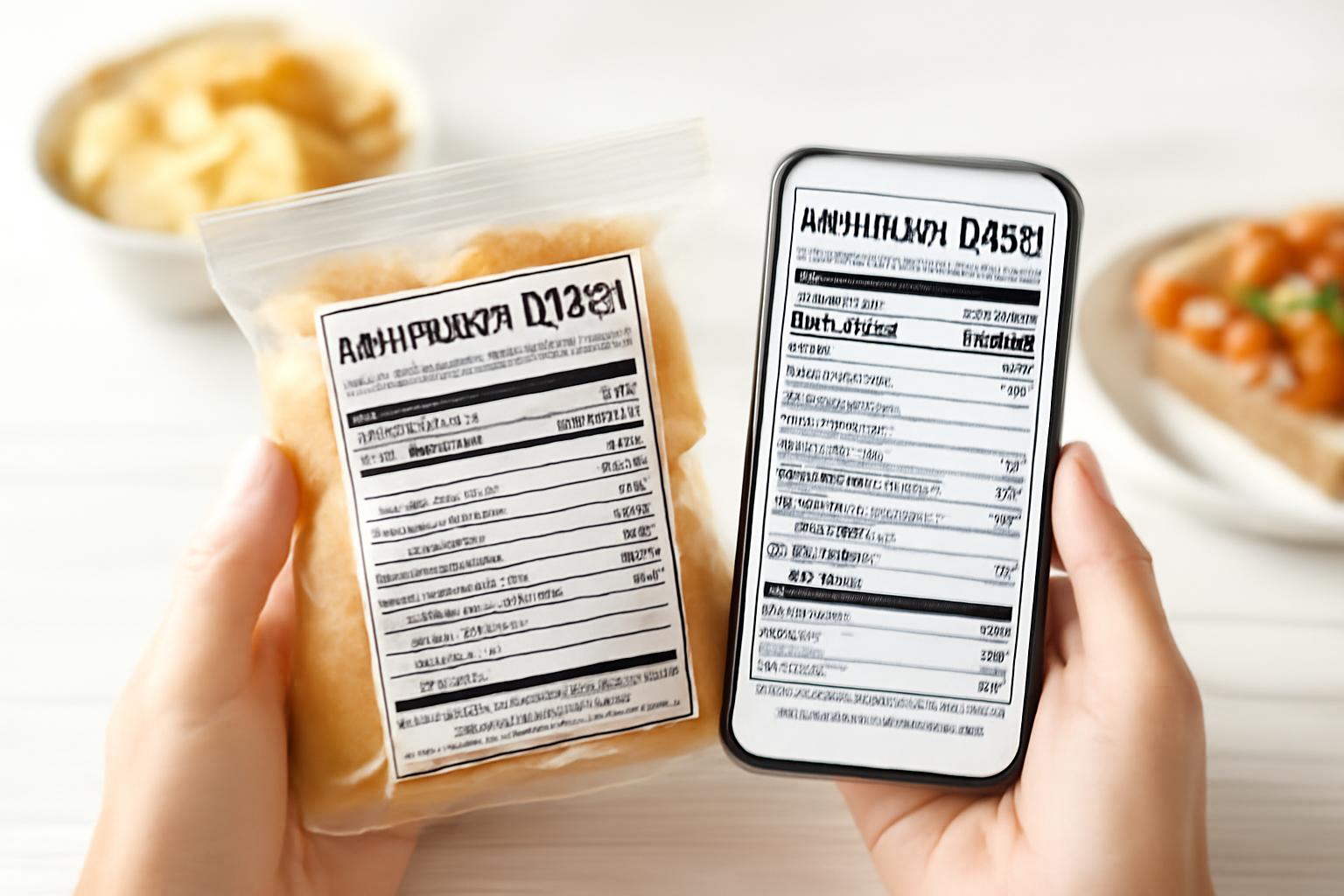
The FDA generally does not pre-approve food labels. Manufacturers are expected to ensure compliance before marketing the product.
If you count calories, compare macros, or adjust intake against body-weight trends, the label on a packaged food is doing more than most people realize. It is not just package copy. It is a regulated disclosure system meant to turn manufacturing, ingredient composition, and consumer-facing nutrition data into a standardized panel you can use.
It is also why labels can feel exact while still falling short of biological perfection. Federal rules tell companies what has to appear, where it belongs, and which claims have formal meanings. But a label is still a package-based estimate. It is not a direct reading of what your own body will digest, absorb, or burn.
For calorie and macro trackers, that distinction matters. Serving sizes are reference amounts, not instructions. Nutrition Facts panels are required for most prepared packaged foods, but not literally every food you buy. Allergen rules are strict for specific major allergens, yet they do not cover every intolerance or sensitivity. And some prominent phrases on the front of a box are regulated claims, while others are mostly marketing language.
A useful way to read label numbers is the way CaloriePages approaches the broader trust problem: not “is this label real or fake?” but “what kind of number is this, how standardized is it, and how much confidence should I place in it?” That broader context is reflected in CaloriePages’ food-label coverage and its editorial approach to label trust.
US Agencies and Laws Governing Food Labels
For most packaged foods sold in the United States, the legal backbone starts with the Federal Food, Drug, and Cosmetic Act and later amendments, including the Nutrition Labeling and Education Act. The main regulators are the Food and Drug Administration for most foods and the US Department of Agriculture for certain animal products, with other agencies handling narrower areas such as alcohol labeling and advertising. The National Agricultural Law Center’s overview is useful here because it lays out the split among FDA, USDA/FSIS, FTC, and other players in one place while tying that structure back to the governing statutes. National Agricultural Law Center overview
FDA’s own Food Labeling Guide is helpful for interpretation, but FDA also says that guide reflects current agency thinking rather than binding law. The binding requirements are the statutes and regulations themselves. The same guide also states that FDA generally does not pre-approve food labels before sale, so manufacturers carry the first-line responsibility for compliance. FDA Food Labeling Guide
FDA is not the whole system, though. USDA’s Food Safety and Inspection Service regulates meat, poultry, and shelled egg products, and the National Agricultural Law Center notes that FSIS uses a different approval culture from FDA, including generic approval for many labels and pre-approval for some special statements such as certain religious claims, export deviations, and other specified label situations. That is one reason similar-looking products can still be operating under different label rules.
From a tracker’s perspective, the practical lesson is simple. A cereal box, protein bar, frozen entrée, chicken sausage, and bottle of wine can all sit in the same grocery cart while being shaped by different regulators and different rule sets. If one label seems to use unfamiliar wording or a different claim style, the governing framework may not be identical.
That split also explains why labels can feel both standardized and imperfect. Federal law creates the framework, but companies build labels within it. Regulators can later challenge misleading or noncompliant labeling, yet for most FDA-regulated foods there is no universal front-end review of every package before it reaches the shelf.
Core Required Elements on Food Labels
Under 21 CFR Part 101, FDA separates requirements for the principal display panel, the information panel, and nutrition labeling, including §101.1 for the principal display panel, §101.2 for the information panel, and §101.9 for nutrition labeling. That structure is why packaged foods from different brands still feel broadly familiar even when their design styles differ.
For tracking, that separation is useful because it helps you distinguish the quick sales pitch from the details you actually need.
Nutrition labeling is required for most prepared packaged foods such as breads, cereals, canned foods, frozen foods, snacks, desserts, and drinks. FDA also says nutrition labeling for raw fruits and vegetables and for fish is voluntary instead, which is why a packaged snack bar and a bag of apples do not come with the same mandatory disclosure setup. FDA nutrition and food labeling overview
Ingredients matter just as much as calories. Ohio’s agriculture department, summarizing the federal framework in 21 CFR Part 101, describes the ingredient statement as a complete breakdown listed by common or usual name in descending order of predominance by weight, with sub-ingredients included where applicable. Ohio Department of Agriculture labeling guidance
That ingredient order is one of the best reality checks on the package. A bar can emphasize protein, fiber, or whole grains on the front and still be built primarily from sweeteners, refined starches, or oils on the back. The legal structure does not eliminate marketing. It gives you a standardized place to verify it.
Nutrition Facts Label Breakdown
The Nutrition Facts panel is the part of the label most directly tied to calorie tracking. Harvard’s Nutrition Source explains that the current panel includes serving size, calories, major fat and carbohydrate lines, protein, selected vitamins and minerals, and percent Daily Value, with %DV based on a 2,000-calorie diet. The same guide also summarizes the 2016 revision: calories and serving size were made more prominent, added sugars were separated from total sugars, vitamin D and potassium became required declarations, and serving sizes were updated to better reflect what people typically consume. Harvard Nutrition Source guide
For trackers, the most important line is often the one people read too fast: serving size. The panel is built around the labeled serving. That sounds obvious, but it is where a large share of logging error begins. The error is assuming the package equals one serving when the panel says otherwise.
The next important distinction is between gram amounts and %DV. Percent Daily Value is there to standardize comparison across products, not to individualize your diet. A sodium line showing 20% DV tells you the food contributes a substantial share of a standard reference intake. It does not tell you whether that amount makes sense for your own calorie target, training load, sweat losses, blood pressure status, or medical history.
The 2016 revision made several tracker-relevant details easier to use quickly. Added sugars became easier to separate from naturally occurring sugars. Calories and serving size became harder to overlook. Updated serving sizes made product-to-product comparison somewhat more realistic by tracking how people actually tend to eat, even if your own portion still differs from the reference amount.
Serving size remains one of the most misunderstood parts of the label. It is not a recommendation for how much you should eat, but it is not meaningless boilerplate either. It is the measurement unit the panel uses. If one granola lists 210 calories for 55 grams and another lists 140 calories for 30 grams, “per serving” is not enough by itself. You have to notice the gram weight or convert both to the amount you would actually pour into the bowl.
That mindset is more useful than either extreme. Do not treat serving size as a diet rule, and do not dismiss it as arbitrary. Treat it as the baseline unit for the numbers on the panel. If you eat half, log half. If you eat double, log double. The regulation gives you the standard reference point; you still have to apply it honestly.
How Labels Calculate Calories: Atwater System Limits
This is where regulation and metabolism diverge most clearly. CaloriePages’ own TDEE explainer describes food labels as using the Atwater 4-4-9 convention—about 4 calories per gram of carbohydrate, 4 per gram of protein, and 9 per gram of fat—and discusses a commonly cited real-world error range of up to 20%. For a regulation-focused article, the careful takeaway is narrower than “the law guarantees a 20% allowance”: within this evidence set, the strongest supported point is that label calories are standardized estimates rather than direct measurements of the exact usable energy any one body will extract.
That distinction matters because the calorie number on a package is built to be comparable across foods, not personalized to your metabolism. The panel is a standardized disclosure system. It is not a custom metabolic test of your breakfast. That is why package calories are useful for comparison and trend analysis while still falling short of biological precision.
Thermic effect of food is one reason identical label calories can play out somewhat differently in real life. CaloriePages’ protein and calorie density explainer summarizes protein’s thermic effect at about 20–30% of protein calories, carbohydrate at about 5–10%, and fat at about 0–3%. In plain terms, protein costs more energy to digest and process than fat does, so two foods with the same labeled calories can differ modestly in net usable energy.
For trackers, the practical takeaway is modest, not magical. This does not mean you should start inventing your own “corrected” calorie numbers for every meal. The more useful lesson is simply that a package calorie total belongs to a standardized estimate system.
That is also why label perfectionism usually backfires. The Atwater approach is useful because it makes packaged foods comparable. Without a shared framework, label-to-label tracking would be chaos. But consistency is not the same thing as exact personal physiology.
For most people, the right mental model is: reliable enough to anchor trends, not exact enough to eliminate all need for calibration. If your intake log and your multiweek weight trend do not line up perfectly, the package number may be part of the explanation—but usually not the only part.
Major Food Allergen Declarations
Allergen labeling is a safety system first and a convenience feature second. Under the Food Allergen Labeling and Consumer Protection Act, later updated by the FASTER Act, FDA-regulated packaged foods must declare the current major allergens identified in federal law: milk, eggs, fish, crustacean shellfish, tree nuts, wheat, peanuts, soybeans, and sesame.
That list matters because the rules are specific by design. Major-allergen disclosure is built around a defined legal list, not around every ingredient that might trigger digestive discomfort, migraine, food intolerance, or a personally avoided reaction. So the system is strict, but it is not universal.
For readers who still think in terms of the older “Big 8,” sesame is the update that often gets missed. Older summaries are not always malicious; many are simply outdated. But on a safety issue, outdated is still a real problem.
Harvard’s guide explains that ingredients are listed by descending weight and notes that allergens can be made clear either in the ingredient list itself or through a plain-language “Contains” statement. As a practical reader, use both: the ingredient list tells you what is in the product and roughly in what order, while the allergen disclosure tells you what the law requires the package to flag clearly.
For trackers, this part of the label can feel secondary if your main goal is calories or macros. That is a mistake. If you or someone in your household has a true food allergy, the allergen statement outranks the macro fit. A high-protein snack that looks perfect in an app is still unusable if the package says it is unsafe for you.
Regulated Claims: Nutrient Content and Health
One of the most useful things to understand about labels is that not every front-of-pack phrase belongs to the same category. Under 21 CFR Part 101, nutrient content claims and health claims sit in different regulatory sections, including §101.13 for general principles on nutrient content claims and §101.14 for general requirements for health claims. That is why terms like “low sodium” or “high fiber” are not supposed to mean whatever a brand wants them to mean.
For tracking purposes, nutrient content claims are best read as statements about one nutrient, not as verdicts on the entire food. A cereal can be high in fiber and still be sugar-heavy. A soup can be low in fat and still be sodium-dense. A yogurt can be high in protein and still become calorie-dense once you eat two or three servings.
Health claims are a different move. They connect a food or food component with reduced disease risk rather than merely describing the amount of a nutrient. The National Agricultural Law Center notes that qualified health claims also exist as a separate category when the evidence does not meet the standard for an authorized health claim, so the wording has to be narrower and more carefully framed.
That distinction matters because claims create health halos. Front-of-pack language can be useful as a clue, but it is a poor substitute for the back panel. A tracker who wants dependable numbers should treat claims as prompts to investigate, not as conclusions to trust.
By contrast, some familiar package terms sit in a much murkier space. Harvard’s consumer guidance notes that terms such as “natural” and “multigrain” are not FDA-regulated in the same way as formal nutrient content claims, and that common package dates such as sell-by, best-by, and use-by are generally manufacturer-determined rather than federally required for most foods.
Exemptions for Small Businesses and Special Foods
US food labeling rules are broad, but they are not identical across every seller and product category. FDA’s food-labeling overview says nutrition labeling is required for most prepared foods, while raw produce and fish are treated differently, and it points readers to separate resources on small-business exemptions rather than implying that one rule fits every seller.
That matters because “missing Nutrition Facts” does not automatically mean “illegal.” Some foods are handled differently from the start. Raw fruits, vegetables, and fish are the clearest consumer examples. Dietary supplements have separate labeling requirements. Infant formula and medical foods sit in more specialized frameworks. Meat and poultry products may fall under USDA/FSIS rather than FDA. So “food labeling regulations” is really an umbrella term for several related systems.
A useful cautionary example comes from Ohio’s agriculture department. In 2018, it summarized then-applicable federal nutrition-labeling exemptions and described retailers with under $50,000 in food sales or under $500,000 in total sales, and small manufacturers with fewer than 100 full-time equivalent employees and fewer than 100,000 units, as potentially exempt from nutrition labeling. Because that page is a 2018 state guidance summary rather than the controlling current federal text, it is best used as an illustration of how exemption rules can make local packaged foods look different from national brands—not as the final nationwide answer today. Ohio Department of Agriculture labeling guidance
For trackers, the practical point is straightforward. A local bakery loaf, small-batch sauce, or farmers-market packaged item may not present the same Nutrition Facts detail you expect from a large national brand, and that difference may reflect the applicable framework rather than carelessness.
That does not make the smaller product worse. It means your confidence interval around the numbers may need to widen.
Practical Tips for Reading Labels as a Tracker
Start with serving size before you look at calories. That single habit prevents a surprising amount of tracking error. Regulations give you a standard reference amount, but they cannot make your intake match it. If you eat 1.8 servings, the honest log is 1.8 servings.
Second, treat label calories as strong inputs, not as metabolic truth. They are standardized numbers designed to make products comparable and to help you spot intake trends over time. They are not identical to the exact net energy your body will extract. If you are trying to calibrate maintenance intake against body-weight trends, think in weeks rather than single meals.
Third, use the front of the package to ask questions and the back of the package to answer them. “High protein,” “whole grain,” “keto,” “gluten-free,” and similar phrases can help you decide which package deserves a closer look. But the actual decision should come from the Nutrition Facts panel, ingredient statement, and allergen disclosure.
Fourth, let ingredient order add context to the macro lines. A food with acceptable calories on paper may behave very differently for appetite and adherence depending on whether it is built primarily from oats, dairy, legumes, and nuts or from sweeteners and refined starches. Descending-by-weight ingredient order exists for a reason: it gives you a quick picture of what the product mostly is.
Fifth, if allergies or medical conditions are involved, treat the label as safety-relevant information, not just nutrition information. For someone with a true allergy, “close enough” is not close enough. And for people managing blood sugar, blood pressure, kidney disease, GI conditions, or medically necessary diet restrictions, a package label can inform decisions but cannot replace individualized care. CaloriePages says this plainly in its Terms of Use: the site’s content is for general informational purposes only and is not medical or dietary advice.
Finally, use patterns rather than single labels to calibrate trust. One snack that turns out to be somewhat off will rarely matter. A repeated pattern of underestimating portions, relying on health halos, ignoring serving sizes, or treating every package number as exact will matter a lot. If you want more examples of how label numbers interact with everyday calorie choices, the broader CaloriePages article archive is most useful when you read it with that auditing mindset.
Mastering the basics pays off: know which agency likely governs the product, check serving size first, read Nutrition Facts as a standardized estimate, remember that calorie arithmetic is practical rather than personalized, and verify claims and allergens against the back panel. That is how food labeling regulations become useful in daily tracking instead of remaining abstract policy.
Does the FDA pre-approve food labels before sale?
No, not for most FDA-regulated foods. FDA’s Food Labeling Guide says the agency generally does not pre-approve food labels, which means manufacturers are expected to ensure compliance before marketing the product.
That is why labels can later be corrected, challenged, or enforced against after products are already on the market. For most FDA-regulated foods, the system is largely manufacturer-built first and regulator-reviewed later.
What is the allowed error in food label calorie counts?
Within this evidence set, the strongest support is practical rather than a clean statement of federal tolerance law. CaloriePages explains labels through the Atwater 4-4-9 system and discusses a commonly cited real-world error range of up to 20%, but that should be read here as tracking context rather than as a fully sourced blanket legal rule. CaloriePages TDEE explainer
The safest takeaway for trackers is simpler: label calories are standardized estimates, not exact measures of personal energy delivery. What matters most in practice is whether your logging method is consistent enough to line up with multiweek intake and body-weight trends.
How many major allergens must be declared?
For FDA-regulated packaged foods, the current major-allergen list is 9: milk, eggs, fish, crustacean shellfish, tree nuts, wheat, peanuts, soybeans, and sesame. That reflects the older FALCPA framework as updated by the FASTER Act’s addition of sesame. What Does the FDA Require on Food Labels?
If you still see references to the “Big 8,” you are usually reading an older summary. For safety-relevant label reading, that older shorthand is no longer sufficient.
Are expiration dates federally required?
Generally, no. Harvard’s Nutrition Source explains that common package dates such as sell-by, best-by, and use-by are generally manufacturer-determined and are not federally required for most foods.
What exemptions apply to small food sellers?
There are real exemptions and category differences, but they should be described carefully. FDA says nutrition labeling is required for most prepared foods while some foods, such as raw produce and fish, are treated differently, and FDA directs readers to separate small-business exemption resources rather than a one-size-fits-all rule.
A state example shows how this can look in practice. Ohio’s agriculture department summarized then-applicable federal exemption thresholds in 2018 and paired them with Ohio-specific sale-date rules for some perishables. That illustrates how federal baseline rules and state implementation can overlap, but it should not be treated as the final current national answer everywhere.