
The Highest ABV Alcohols Explained: From Rectified Spirits to Everyday Drinks and Their Calories
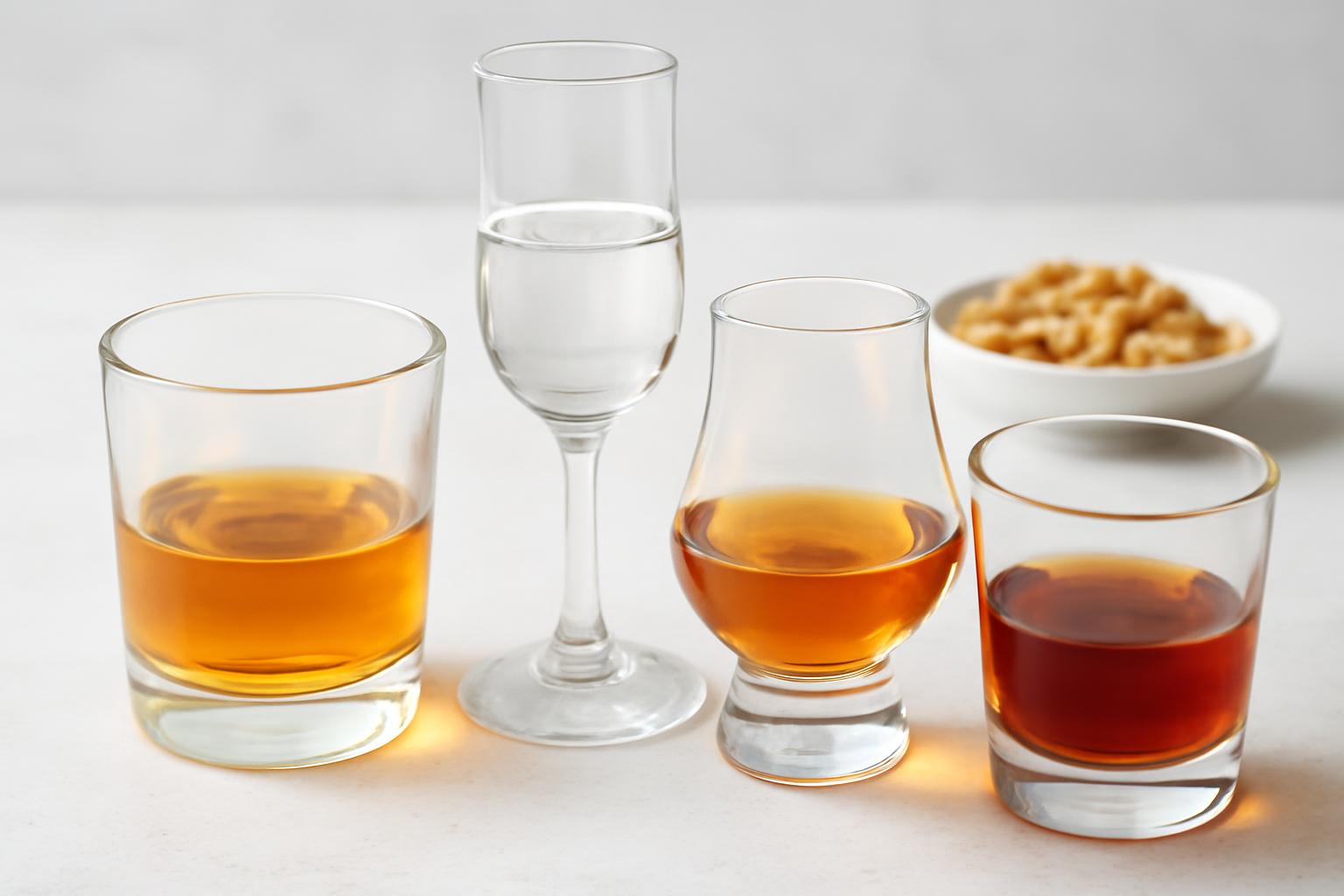
The strongest figures cluster around 95% to 96% ABV, far beyond ordinary shelf strengths. See why exact bottle rankings can shift.
When people search for highest volume alcohol, they usually mean the drink with the highest alcohol by volume, or ABV—not the biggest bottle or the largest pour.
For calorie tracking, that distinction matters. The strongest products commonly reported in consumer coverage are not everyday vodka, gin, rum, whiskey, wine, or beer. They are extreme-proof spirits, usually described as rectified or neutral spirits around 95% to 96% ABV rather than normal shelf-strength liquor (Food & Wine’s roundup of very high-proof spirits).
That difference changes the calorie math fast. A small measured pour of a very high-proof spirit can contain far more alcohol—and therefore far more alcohol calories—than people expect from the size of the glass alone.
So the useful bottom line is simple: the highest commonly reported consumer alcohols are extreme-proof spirits, not everyday drinks. But most real-world logging mistakes happen a step lower, where people underestimate standard pours, assume dilution erased calories, or forget that a lower-ABV drink can still become high-calorie once sugar-heavy mixers enter the picture.
What Alcohol by Volume (ABV) Measures
ABV is a technical labeling measure of ethanol concentration. More precisely, it is the volume the ethanol would occupy if separated from the rest of the drink, divided by the drink’s total volume, with both measured at 20°C. Pure ethanol has a density of about 0.789 g/mL, and ethanol-water mixtures are not perfectly additive by simple visual guesswork, which is why ABV is a standardized lab-style measure rather than a rough eyeball estimate (Alcohol by volume).
In U.S. labeling, proof is approximately double ABV. So 40% ABV is 80 proof, 95% ABV is 190 proof, and 96% ABV is 192 proof. That is why the strongest bottles are often described in both forms: a 190-proof product is essentially a 95% ABV product, and a 192-proof product is essentially a 96% ABV product.
For calorie tracking, ABV matters because alcohol itself supplies energy before you add any tonic, juice, cola, syrup, cream, or sugar. A practical working formula is:
alcohol calories ≈ volume in mL × ABV × 0.789 × 7
That formula uses alcohol density and alcohol’s energy value of 7 kcal per gram. It estimates alcohol-only calories, not the extra calories from carbs, sugars, or creamy mixers (Alcohol Calorie Calculator).
A few consequences follow from that formula:
- If serving size stays fixed, higher ABV means more alcohol calories.
- If ABV stays fixed, a larger pour means more alcohol calories.
- If you dilute a drink with water, soda water, or melting ice, the concentration drops, but the alcohol already poured does not disappear.
That last point is where casual logging often goes wrong. A drink can taste weaker after dilution and still contain the same alcohol calories it had when the spirit first entered the glass. Dilution changes percentage. It does not retroactively change how much ethanol you poured.
For tracking purposes, ABV is usually a better first input than drink name. “Martini,” “highball,” or “house cocktail” can hide large differences in proof, spirit volume, sugar, and final size. The label ABV plus the measured pour tells you more than the cocktail name ever will.
Highest ABV by Beverage Category
At the broad category level, spirits sit far above beer and wine. One range summary in this evidence set places spirits and liquors roughly from 20% to 95% ABV, with vodka from about 40% to 95%, gin, rum, and whiskey commonly in the 36% to 50% range, and tequila listed around 50% to 51%. The same source places unfortified wine around 14% ABV, fortified wine at 16% to 24%, ordinary beer around 4% to 8%, many craft beers up to about 12%, and malt beverages up to roughly 15% (AdCare’s beverage ABV range summary).
Even fortified wine, which is materially stronger than standard wine, still does not approach the extreme top end of rectified spirits. The upper ceiling belongs to distilled products built to concentrate ethanol far beyond what ordinary fermentation reaches on its own.
Liqueurs complicate the picture in a different way. The same broad summary describes many liqueurs as averaging around 15% ABV or less, but that should be treated as a rough category shorthand rather than a hard ceiling. For practical tracking, the more important point is that liqueurs often trade some alcohol concentration for sugar, cream, or flavorings. So a bottle can be less alcohol-dense than straight spirits and still end up more calorie-dense overall.
For calorie trackers, category labels can therefore mislead in both directions:
- Straight spirits often compress a lot of alcohol into a small volume.
- Beer and wine are usually less concentrated but are served in much larger volumes.
- Liqueurs and cocktails may be lower in ABV than a base spirit while ending up higher in total calories because of sugar and other additions.
A useful working hierarchy looks like this:
- Rectified or neutral spirits — highest ABV ceiling
- Standard distilled spirits — much lower than rectified alcohol, but still concentrated
- Fortified wines — middle ground
- Table wines and beers — usually much lower concentration
That is the ranking that matters for nutrition math. It shows where alcohol calories are most compressed into a small pour, and where serving size or added sugar starts to matter more than ABV alone.
It is also worth being careful about specialty exceptions. Broader range-style coverage in this evidence set also places products such as poitín in a 60% to 95% ABV range, neutral grain spirit in an 85% to 95% range, and Cocoroco in a 93% to 96% range. But those figures come from a source that itself notes citation gaps, so they are better treated as range-level examples than as fully verified current bottle claims.
Top Reported High-ABV Spirits and Products
When you move from category ranges to named bottles, the same general pattern holds. The strongest figures repeated most consistently in this evidence set cluster around 95% to 96% ABV, not around ordinary shelf strengths.
The most stable bottle-level examples here come from consumer spirits roundups that place Polmos Spirytus Rektyfikowany at 192 proof (96% ABV) and Everclear and Golden Grain at 190 proof (95% ABV). The same coverage also lists unusually strong but lower-ranked products such as Bruichladdich X4 at 92% ABV, River Antoine Royale Grenadian Rum at 90% ABV, and Hapsburg Gold Label Premium Reserve Absinthe at 89.9% ABV (Food & Wine’s roundup of very high-proof spirits).
That is enough to support a cautious conclusion: the highest commonly reported consumer alcohols are not ordinary sipping whiskies, standard vodkas, or standard rums.
The caution matters because exact rankings are less stable than the broader category conclusion. Even within this evidence set, secondary coverage is not perfectly consistent. A retailer blog describing Polmos Spirytus calls it “one of the strongest” and lists it at 95% ABV, not 96%, which is a good reminder that bottle-specific claims can vary by source, market, or listing convention (Arthur Cantina’s Polmos Spirytus blog post).
So the safest phrasing is not “this is definitively the strongest alcohol in the world.” The safer phrasing is “the highest commonly reported consumer alcohols cluster around 95% to 96% ABV.” For practical tracking, that is the more useful answer anyway. The difference between 95% and 96% matters far less than the difference between either of those and a standard 40% spirit.
From a logging standpoint, that is the real point. A bottle near 95% to 96% ABV belongs in a separate mental category from ordinary liquor because it compresses so much ethanol into such a small volume.
Legal Limits and Availability Restrictions
Legal and retail availability questions are trickier than ABV questions because they depend on jurisdiction, category rules, and local retail practice, not just chemistry.
The standard retail world of vodka, gin, rum, whiskey, tequila, wine, and beer mostly lives well below the extreme top end. So if a reader is comparing everyday bottles, the strongest products discussed in “highest ABV” roundups are not a normal reference point.
At the high end, availability becomes patchy. Consumer spirits coverage in this evidence set describes some 190-proof products, including Everclear and Golden Grain, as illegal, banned, or unavailable in at least some U.S. states (Chilled Magazine’s strongest spirits list).
Because that statement comes from consumer coverage rather than a state-by-state regulatory digest, the safest takeaway is not “legal everywhere” or “banned everywhere.” It is simpler and better supported: 95%+ alcohol products can be restricted, absent from ordinary shelves, or treated differently depending on where you are.
That creates three different questions readers often blur together:
- Can this strength be produced?
- Can it be sold where I live?
- Is it normally consumed like an everyday shot?
Those are not the same question. A product can exist in one market, be restricted in another, and still be used mostly for narrow purposes even where it is legal.
So if you are handling an extreme-proof bottle, the practical rule is straightforward: assume availability and usage norms are narrower than for ordinary spirits, and check local rules before treating any roundup as a buying guide.
Calories in High-ABV vs Standard Alcohol Servings
For straight spirits, the cleanest baseline comes from standard serving tables. MedlinePlus lists a 1.5 fl oz serving of 80-proof gin at 97 calories, a 1.5 fl oz serving of 94-proof gin, rum, vodka, or whiskey at 116 calories, and higher-alcohol craft beers at 170 to 350 calories per 12 fl oz (MedlinePlus calorie table for alcoholic beverages).
Looking at calories per ounce makes the step-up with proof even easier to see. One calories-per-ounce breakdown puts 80-proof distilled liquor at 64 calories per fluid ounce, 90-proof at 73 calories per fluid ounce, 100-proof at 82 calories per fluid ounce, and red table wine at about 25 calories per fluid ounce, or roughly 125 calories per 5-ounce serving (Garage Gym Reviews’ calories-per-ounce breakdown).
The comparison is useful because it explains why a small shot can rival or exceed a much larger-looking drink. Plain distilled spirits are mostly delivering alcohol calories, with relatively little else in the glass. Wine and beer also contain alcohol, but they arrive in larger servings and often with additional carbs. Liqueurs and cocktails can go higher still once sugar, cream, cola, tonic, juice, or premade mix enters the picture.
That proof-versus-mixer tradeoff is easier to see in measured examples like low-calorie mixed drinks.
This is also where very high-proof alcohol becomes easy to underestimate. A 1.5 oz pour is about 44.4 mL.
The glass can look modest while the alcohol energy is not.
A smaller example shows the same problem. So a tiny “fortifying splash” can contain more alcohol energy than many people would guess from its size.
This is why it helps to separate two questions that often get mixed together:
- How concentrated is the alcohol?
- How many total calories are in the final drink?
A dry, high-proof pour can win the first category and still lose the second to a lower-proof cocktail full of sugar. But if your concern is specifically alcohol calories per unit of volume, very high-ABV spirits are the most compressed form.
Why Yeast and Distillation Set ABV Limits
Beer and wine do not normally reach spirit-level ABV because fermentation and distillation solve different parts of the alcohol problem.
In fermentation, yeast converts sugars into alcohol and carbon dioxide. But alcohol is also stressful to yeast. The ABV reference used here places typical beer yeast tolerance around 8% to 12% ABV and wine yeast tolerance around 14% to 18% ABV, with some cases reaching 20% (Alcohol by volume).
That ceiling is why ordinary fermentation alone usually stops well short of the strengths seen in high-proof spirits. Beer tends to stay much lower. Wine can go higher than beer, but still not into the rectified-spirit range. Once ethanol concentration climbs enough, yeast performance slows and then stalls.
Distillation changes the situation because it does not ask yeast to keep producing more alcohol. Instead, it concentrates alcohol that is already present in the fermented liquid. That is why distilled categories can move far past beer or wine and why rectified or neutral spirits end up at the extreme end of the ABV scale.
Not because brewers and winemakers forgot to try, but because fermentation has a biological ceiling while distillation is built to concentrate ethanol after fermentation has done its job.
For calorie trackers, the process lesson is practical. The farther a beverage gets from fermentation-only products and the closer it gets to heavily distilled, rectified alcohol, the easier it becomes for a small serving to hide a large amount of alcohol energy.
Practical Uses and Safety for High-ABV Alcohols
Consumer advice around extreme-proof bottles is fairly consistent: they are not presented as ordinary straight-shot spirits.
That framing makes sense. That is very different from how most people use an 80-proof or 94-proof bottle.
A few practical rules follow from that:
- Treat extreme-proof alcohol as a measured ingredient, not a free-pour bottle.
- Keep it away from open flame.
- Expect it to be used in small quantities.
- Remember that dilution changes strength in the glass, not the alcohol you already poured.
That last point deserves its own example. Suppose you use 0.5 oz of a 95% ABV spirit and then lengthen the drink with water, soda, or juice until the glass holds several ounces. The final ABV percentage drops sharply, but the alcohol calories from that original half-ounce do not. “It tasted mild” and “it contained little alcohol” are not the same statement.
For logging, a simple workflow works better than guessing from a generic cocktail name:
- Measure the actual amount of high-proof base used.
- Estimate the alcohol calories from volume × ABV × 0.789 × 7.
- Add calories from mixers, syrups, juice, cream, tonic, or liqueurs separately.
- Log the drink by ingredients, not by a vague database entry.
That method is especially useful for homemade infusions, strong house cocktails, and bartender pours that do not match app defaults. A database entry for “strong cocktail” tells you very little. A measured ingredient list tells you much more.
If you want one rule to remember, it is this: high proof compresses alcohol calories into small volumes. The smaller the volume, the easier it is to underestimate by eye.
Tracking High-ABV Drinks in Your TDEE
For TDEE calibration, high-ABV drinks are mostly a measurement problem. Standard reference servings are useful starting points, but real pours often exceed them. The evidence here repeatedly returns to familiar baselines like 1.5 oz for liquor, 12 oz for beer, and 5 oz for wine, and once actual pours drift above those amounts, calorie estimates drift too.
The best logging habit is to start with two things: label ABV and actual volume poured. If the bottle is stronger than the standard spirit you usually buy, log the actual label strength rather than the strength you assume. If your “shot” was closer to 2 oz than 1.5 oz, log 2 oz. With high-proof alcohol, even small measuring errors matter because the drink is so concentrated.
That is also why ingredient-based logging usually beats cocktail-name logging. “One martini” or “one house drink” can mean very different amounts of spirit and very different proof depending on recipe, glass size, and who poured it. If your goal is accurate energy intake, the ingredient list is the useful unit.
This label-first, arithmetic-first approach fits the way CaloriePages frames food and drink questions.
Its About page says the site exists to explain the arithmetic of eating and where common tracking shortcuts break down.
If you want the maintenance side of the equation, the companion guide What TDEE Measures and Why Calculators Underestimate It walks through BMR, TEF, EAT, and NEAT in more detail.
If you are comparing alcohol calories with the satiety value of food calories, Why Protein Fills You Up on Fewer Calories is the most relevant contrast.
For more pieces in the same style, the articles archive collects the broader mix of alcohol, TDEE, and food-calorie explainers.
And because this is general informational content rather than personal medical or dietary advice, the site’s Terms of Use say so plainly.
Its Privacy Policy also explains the site’s minimal data-collection approach.
The practical rule of thumb stays the same: log the alcohol you actually poured, not the weaker drink you think it resembled. That becomes especially important once ABV gets high enough that even half an ounce can matter.
What is the highest reported ABV for any alcohol?
In the evidence used here, the highest commonly reported figures cluster around 96% ABV. Consumer coverage repeatedly places Spirytus Rektyfikowany at 192 proof (96% ABV), while a retailer post about Polmos Spirytus describes it more conservatively as 95% ABV, which is why cautious wording is better than a definitive world-title claim (Arthur Cantina’s Polmos Spirytus blog post).
Is 95% ABV alcohol legal everywhere?
No. The narrower, better-supported claim is that some consumer spirits roundups describe 190-proof products as restricted, banned, or unavailable in at least some U.S. states, which means legality and retail access are jurisdiction-specific rather than universal (Chilled Magazine’s strongest spirits list).
How many calories in a 1.5 oz shot of 95% ABV spirit?
Using the standard alcohol-calorie formula, 1.5 oz is about 44.4 mL. At 95% ABV, that is roughly 42.2 mL of ethanol, which works out to about 233 calories from alcohol alone before any mixer or sugar is added (Alcohol Calorie Calculator).
What ABV do most vodkas reach compared to extremes?
Compared with the extreme-proof products discussed above, most everyday vodka sold for normal drinking is much closer to standard liquor strength—around 40% ABV—than to rectified-alcohol strength (Which alcoholic beverages have the most (or least) calories?).
Can beers exceed 15% ABV?
Some specialty products are often discussed as exceptions, but the safest supported summary in this evidence set is that ordinary beer is usually around 4% to 8% ABV, many craft beers reach about 12%, and malt beverages can go up to roughly 15%. For tracking, the label on the specific bottle matters more than category lore (AdCare’s beverage ABV range summary).
If you only need the short version, it is this: the highest volume alcohols are typically rectified or neutral spirits around 95% to 96% ABV. They are not everyday pours, they are not nutritionally trivial, and they are easy to underestimate because so much alcohol can fit into so little liquid. For accurate logging, trust the label, measure the pour, and count mixers separately rather than guessing from the drink name.