
Precise Loose Leaf Tea Ratios for Consistent Brews and Reliable Nutrition Tracking
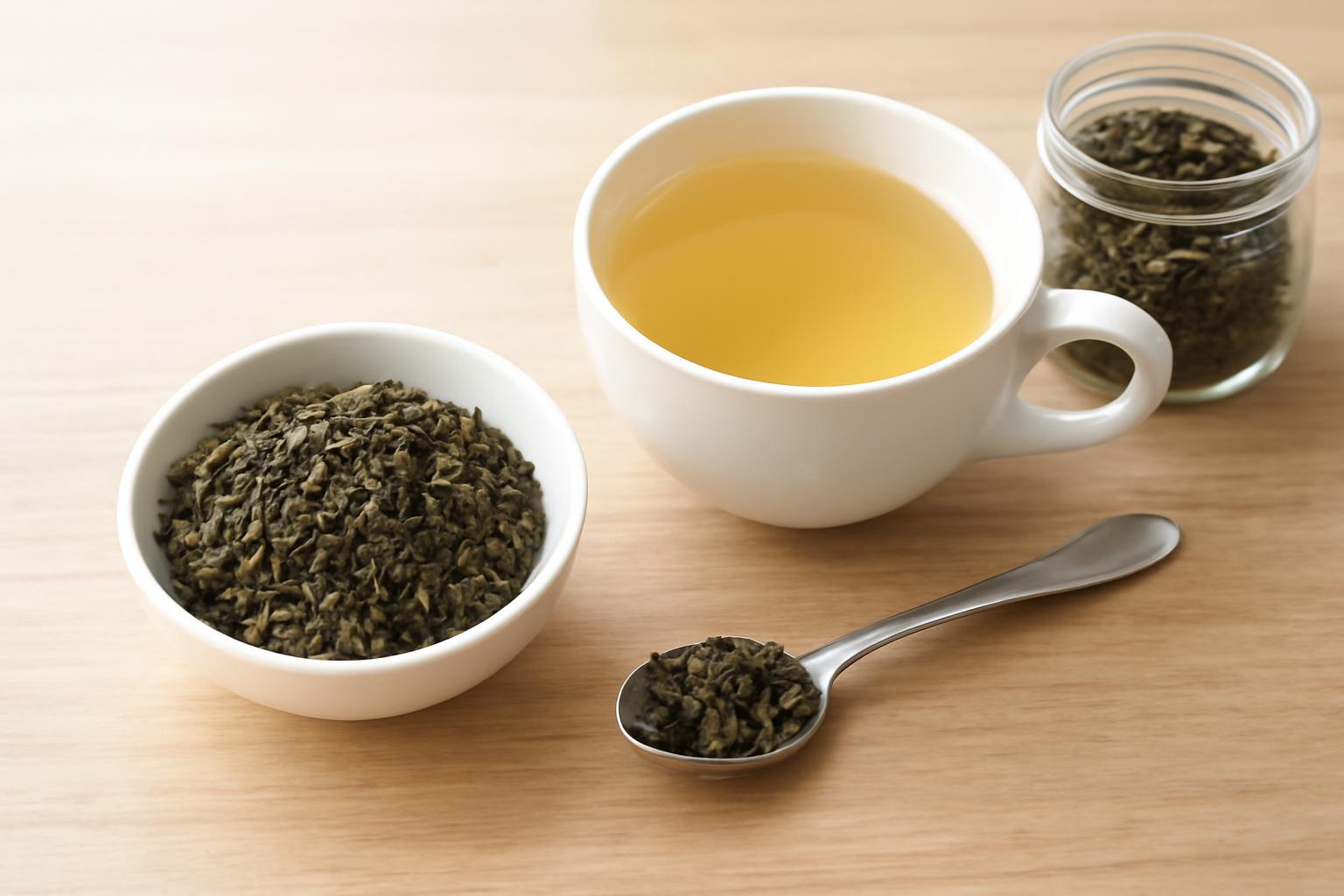
Start with 2-3 grams per 8 ounces. Since 3 grams can range from 1 teaspoon to 2 tablespoons, adjust for density and leaf style.
If you want the short answer to how much loose leaf tea per cup, a practical starting point is 2 to 3 grams per 8 ounces of water, which for many medium-density teas is roughly 1 level teaspoon per The Tea Spot. That is a useful baseline, not a universal law.
The catch is that three variables change the answer quickly: leaf density, actual vessel size, and brewing style. A 6-ounce teacup is not a 12-ounce mug. A teaspoon of rolled gunpowder green is not the same dose as a teaspoon of fluffy chamomile. And a gongfu session is not a western office-mug brew.
The point is narrower and more defensible: a repeatable tea-to-water ratio gives you a more repeatable cup. That makes your routine easier to compare from day to day, especially if you care about how strong the drink tastes, how many servings you drink, or whether one brew feels much stronger than another.
This article is therefore best read as a practical consensus synthesis from tea-brewing guides, not as a laboratory standard for nutrition data. The evidence supports dependable home-brewing baselines and adjustments. It does not support exact caffeine calculations from leaf weight alone.
Related: Masala Chai Tea Caffeine Content: mg Per Serving, Variations and Comparisons.
Why Precise Tea Ratios Matter for Nutrition Trackers
If you log food and drinks carefully, inconsistency in tea dose creates avoidable noise. “One tea” in your tracker can represent very different brews if one day you use a sparse teaspoon in a large mug and the next day you use a heaped spoon in a small cup. Even when the label in your log stays the same, the brewed result does not.
That matters most when you want a stable beverage routine. A measured baseline will not tell you the exact caffeine content of a cup, but it does make flavor and brew strength more repeatable. For tracking purposes, that is the useful part: fewer moving pieces between one cup and the next.
Volume alone is also a poor comparison tool across different teas. STEAP notes that 3 grams of loose leaf tea can occupy anywhere from 1 teaspoon to 2 tablespoons depending on tea type and leaf style, which is why “just use a teaspoon” can be fine for one tea and badly off for another in its measuring guide.
For a tracker, the practical takeaway is simple: log what you can actually repeat. That usually means recording a few basics for your regular teas:
- tea name
- grams used, or the exact spoon measure you use
- vessel size
- brew style, such as western mug, teapot, or gongfu
- whether you drank one infusion or several
That kind of routine works the same way other measured estimates do: start with a sensible default, keep inputs stable, and then adjust from observed results. It is the same estimate-and-calibrate mindset behind CaloriePages’ guide to how to calibrate your TDEE, and it is much more useful than treating one vague “cup of tea” as if it were standardized.
The Baseline Ratio: 1 Teaspoon or 2-3 Grams Per 8 Ounces
Across the source pack, the most defensible home baseline is still about 1 teaspoon per 8 ounces or about 2 to 3 grams per 8 ounces. That is why those numbers show up over and over in tea-brewing guides, even when the wording differs.
Some guides lean a little lighter or heavier. The Tea Spot pairs 1 teaspoon per 8 ounces with a weight-based recommendation of 2 to 3 grams per 8 ounces, while Nelson’s Tea uses 1.5 teaspoons per 8 ounces for most teas and still describes that as a starting point to adjust from in its home-brewing guide. Those differences are not really contradictions. They usually reflect one of two things: the guide assumes a different cup size, or the tea being discussed packs into a spoon differently.
So the most useful way to think about the baseline is this:
- 1 teaspoon is the household shortcut
- 2 to 3 grams is the more dependable tracking measure
- 8 ounces is the default water volume unless your package says otherwise
If your tea package says level teaspoon, use level. If it says heaping or rounded, follow that instead. And if your favorite mug holds 12 or 16 ounces, scale the leaf to the mug you actually use. A correct ratio for 8 ounces is still an under-dose if you pour it into a much larger vessel.
That is why the baseline matters: not because it is exact for every tea, but because it gives you a stable place to begin.
Adjustments by Tea Density: Fluffy vs Dense Leaves
Leaf density is the biggest reason teaspoon advice breaks down. A large, airy tea can need far more spoon volume to reach the same weight as a tightly rolled or fine-cut tea.
Arbor Teas states this clearly: white teas and chamomile may need as much as 1 tablespoon or more per 8-ounce cup, while dense teas such as gunpowder green may need less than 1 teaspoon in its brewing instructions. That single point explains a lot of the confusion around loose tea measuring.
In practice, it helps to think in density categories first:
- Fluffy teas: chamomile, many herbals, fruit blends, blossom-heavy teas, some white teas
- Medium-density teas: many orthodox black, green, and oolong teas
- Dense teas: rolled oolongs, gunpowder green, broken-leaf black teas, CTC-style teas, some rooibos blends
A fluffy tea often looks overfilled in the spoon even when it is not over-dosed by weight. A dense tea can look modest by volume while still making a strong cup. So when two different labels both recommend a “teaspoon,” that does not mean the actual tea mass is the same.
This is also why many tea sellers give tea-specific package directions. A bag of breakfast tea, a bag of rolled oolong, and a bag of chamomile can all brew a normal-strength cup, but they may need very different spoon volumes to get there.
For day-to-day use, the easiest rule is:
- use more spoon volume for very fluffy teas
- use less spoon volume for very dense teas
- trust teaspoons more for medium-density teas than for very bulky or very compact ones
If you use teaspoons rather than grams, density is the main adjustment that keeps you from under-dosing herbals and over-dosing compact teas.
Scaling for Cup Sizes: Teacups, Mugs, and Teapots
The second major source of confusion is vessel size. A lot of tea rules were written around smaller teacups, but many people now brew into 10-, 12-, or 16-ounce mugs. If you want consistency, measure your usual vessel once and brew to that real volume.
Cafe Brew offers a straightforward home chart: about 1.5 grams or 0.75 teaspoon for 6 ounces, about 3 grams or 1.5 teaspoons for 8 ounces, and about 4 grams or 2 teaspoons for 12 ounces in its measurement guide. That gives you a reasonable starting map for western mug brewing:
- 6-ounce teacup: about 1.5 grams or roughly 0.75 teaspoon
- 8-ounce cup: about 2 to 3 grams or roughly 1 to 1.5 teaspoons
- 12-ounce mug: about 4 grams or roughly 1.5 to 2 teaspoons
For teapots, the old shorthand still appears often: 1 teaspoon per cup plus one extra for the pot as summarized by The Tea Trolley. Treat that as a convenience rule, not a precise standard. It works best when your “cups” are actually the same size and the tea is not unusually fluffy or unusually dense.
Seven Cups uses a broader guide of 5 grams for 12 ounces and 8 grams for 16 ounces across many tea categories, which is a useful reminder that a single teaspoon in a big mug usually produces a thin brew in its brewing table.
For consistency, one simple habit solves a lot:
- Fill your normal mug with water.
- Pour it into a measuring cup once.
- Write the number down.
- Dose tea to that volume, not to the word “cup.”
That is often the difference between guessing and actually brewing the same drink twice.
Weight vs Volume: Why Grams Beat Teaspoons for Precision
If your goal is consistency, grams beat teaspoons. The reason is basic: a teaspoon measures space, but a scale measures tea mass.
That matters because tea density varies so much. STEAP’s explanation is the clearest of the group: 3 grams can equal anywhere from 1 teaspoon to 2 tablespoons, depending on leaf style and density in its portioning guide. Once you accept that, most “How many teaspoons?” arguments stop being mysterious.
Weight also explains why different guides can sound inconsistent without truly disagreeing. One brand may frame a serving as 2 grams per 8 ounces. Another may prefer 3 grams per 8 ounces. Another may give a teaspoon number that happens to land near one of those weights for its own tea. Those are different starting points, but they are all trying to produce a workable cup.
For tracking, grams are better because they remove three big variables at once:
- density differences between tea types
- level versus heaping spoon fills
- scaling errors when you brew into something larger than 8 ounces
If you do not own a scale, you can still brew consistently. The best fallback method is simple: use the same spoon, fill it the same way, and check whether the package gives a tea-specific spoon equivalent. That will not be as precise as grams, but it is much better than eyeballing a random scoop every day.
A sensible upgrade path looks like this:
- start with a level teaspoon and a known mug size
- note whether the cup tastes weak, flat, harsh, or just right
- weigh that preferred dose later if you want tighter repeatability
For most home brewers, that is enough. You do not need lab equipment. You just need a method you can actually repeat.
Tea-Type Specific Ratios and Brewing Styles
For ordinary western-style brewing, many guides keep black, green, and oolong teas around 1 to 1.5 teaspoons per 8 ounces, especially when the leaves are medium-density as Nelson’s Tea lays out in its type-based chart.
Bulky teas often start higher by volume, which is why white, fruit, and many herbal blends often need more spoon space than a typical black tea. But the bigger divider is still how the tea occupies space, not the label printed on the tin.
Where people get truly different answers is brewing style. The Tea Spot gives a typical gongfu-style example of about 1 tablespoon for 3 to 4 ounces of water, and for Japanese green tea in a kyusu it suggests about 2 teaspoons for 6 to 8 ounces in its brewing overview. Those are much leaf-heavier than a normal western mug, but that is because the method is different.
A practical way to sort the advice is:
- Western mug brewing: moderate leaf, longer steep
- Gongfu brewing: much more leaf, small vessel, short repeated steeps
- Kyusu-style Japanese green brewing: often more leaf per ounce than generic western rules
- Iced concentrate brewing: usually more leaf than hot tea because the drink is diluted
So when two experienced tea drinkers give very different ratios, the first question should not be “Who is wrong?” It should be “What style are you brewing?”
Iced Tea and Concentrates: Doubling for Cold Brews
“Iced tea needs more tea” is usually true for hot-brewed iced tea or tea concentrate. Teatulia gives a concrete example: 4 grams or 2 tablespoons per 8 ounces of hot water to yield 16 ounces of iced tea in its measuring guide. That is effectively a strong hot brew designed to hold up after chilling and dilution.
That leads to a simple working rule:
- hot tea to drink hot: use your normal baseline
- hot tea brewed for ice: use roughly double the leaf
- refrigerator cold brew: do not automatically assume the same ratio without testing
Some guides keep the starting ratio closer to ordinary hot-tea ratios and change the steeping time instead. So if you are brewing in the fridge rather than making a hot concentrate over ice, it is better to start conservatively and adjust after tasting.
One more useful principle comes from Arbor Teas: if the tea tastes weak, use more tea rather than simply steeping much longer, because over-steeping can make the cup bitter in its brewing advice. For strength problems, dose is often the cleaner fix.
Practical Tips: Tools, Packages, and Taste Calibration
Generic ratios are starting points. Package instructions should usually win when a tea gives its own brewing amount, because blends with fruit, flowers, spices, or unusual leaf shapes can make household spoon rules much less reliable. Plum Deluxe explicitly tells readers to check the packet instructions for the best result in its loose-tea guide.
You also do not need much equipment to get more consistent:
- a mug or teapot with known capacity
- a measuring spoon
- an infuser roomy enough for leaves to expand
- optionally, a small gram scale
That is enough for repeatable home brewing.
If you do not have a scale, use a simple calibration routine:
- Pick one tea you drink often.
- Brew it at a known ratio.
- Change only one variable at a time.
- Adjust dose first if strength is the issue.
- Write down the version you like.
For trackers, the most useful record is often not “tea” in the abstract, but something like: “Breakfast blend, 3 g, 10-ounce mug, western style, 1 infusion.” Or: “Chamomile blend, rounded tablespoon, 12-ounce mug.” Once you have your own repeatable numbers for regular teas, you stop depending on generic internet averages.
The best ratio is not the one that sounds most official. It is the one you can reproduce.
Bottom line: start around 2 to 3 grams per 8 ounces, scale to your actual vessel, use more spoon volume for fluffy teas and less for dense teas, and let the package override the generic rule when it gives tea-specific instructions. That will make your brewing more repeatable.
Is 1 teaspoon always 2-3 grams of loose leaf tea?
No. A teaspoon is only a rough shortcut. STEAP notes that 3 grams of loose leaf tea can range from 1 teaspoon to 2 tablespoons depending on density and leaf style, so 1 teaspoon is not always 2 to 3 grams across all teas in its measuring guidance.
How much loose leaf tea for a 12-ounce mug?
A practical starting point for a 12-ounce mug is about 4 grams or roughly 2 teaspoons, with room to go a little lower or higher depending on leaf density per Cafe Brew’s cup-size chart. Fluffy herbals may need more spoon volume; dense teas may need less.
Do herbal teas need more than black tea per cup?
Often yes by volume, though not necessarily by weight. Arbor Teas says fluffy teas such as white tea and chamomile may need as much as 1 tablespoon or more per 8-ounce cup, while dense teas such as gunpowder green may need less than 1 teaspoon in its loose-leaf brewing instructions.
Should I double tea for iced brews?
Usually yes for hot-brewed iced tea or concentrate. Teatulia’s example uses 4 grams or 2 tablespoons per 8 ounces of hot water to yield 16 ounces iced, which is effectively about double a common hot-tea starting point in its iced-tea measuring example. For refrigerator cold brew, start closer to a normal ratio and adjust after tasting.
What if my tea package says different amounts?
Follow the package first. Tea-specific directions often outperform generic rules because leaf size, blend ingredients, and density change how much tea fits in a spoon and how it brews. Plum Deluxe explicitly advises checking packet instructions for best results in its guide.