
Cashew Flour from Ground Nuts: Calorie Density, Macros, and Label Accuracy for Precise Tracking
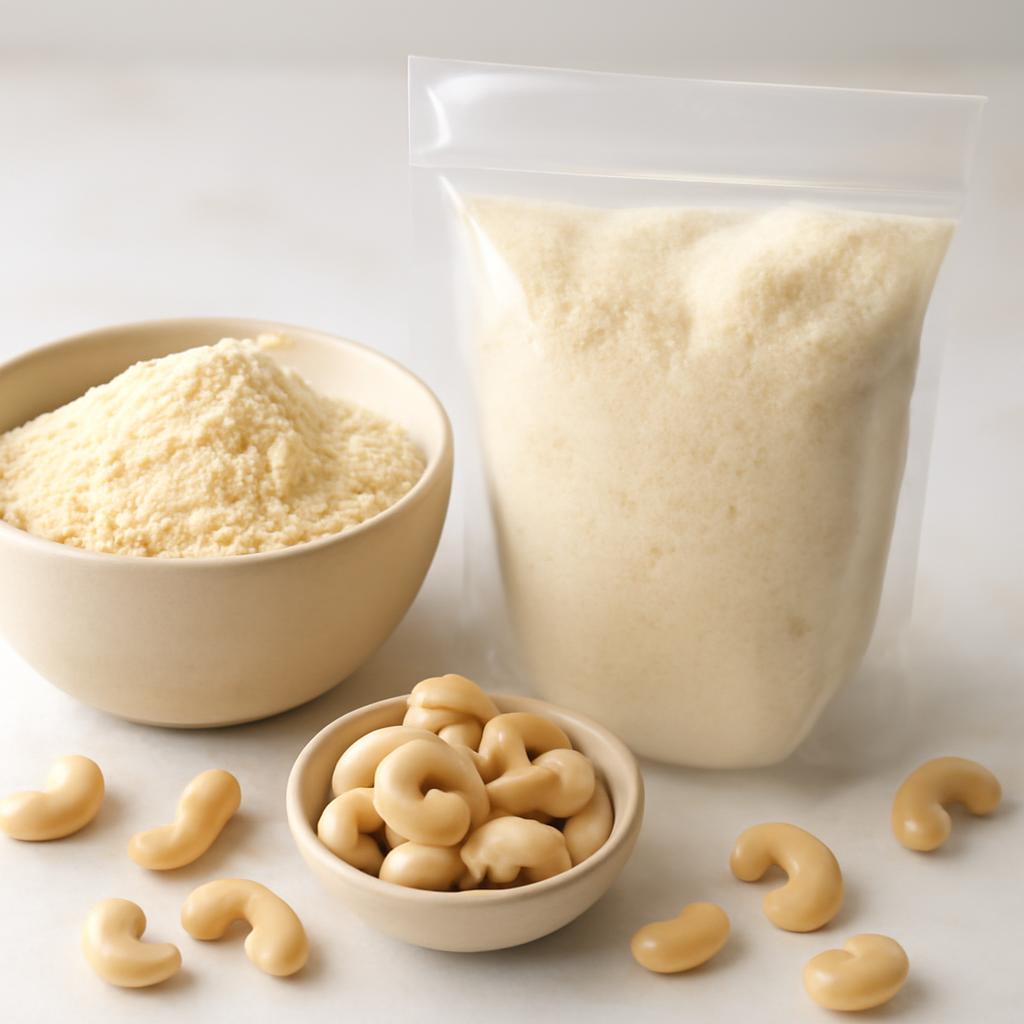
For wheat- or all-purpose-flour recipes, begin with a partial substitution rather than assuming ground cashews work cup for cup.
Short answer: yes, you can grind cashews into a flour- or meal-like ingredient, and a packaged single-ingredient cashew flour listing also exists. But the stronger nutrition evidence here is about what that ingredient is once you make or buy it: a dense, high-fat nut flour, not a wheat-flour equivalent. The clearest label in the evidence set, for Nature’s Eats cashew flour, lists 80 calories, 7 grams of fat, 5 grams of carbohydrate, and 3 grams of protein per 2 tablespoons (15 grams), which is useful for logging but easy to underestimate if you rely on loose scoops or assume it behaves like regular flour (Cashew Flour Nutrition Facts - Find Calories & Macros Per Serving).
One important caveat up front: the calorie and label discussion is relatively concrete, while much of the flour-making and substitution guidance comes from cooking and recipe sources rather than formal food-science testing. So the right level of confidence is: yes, cashews can be ground into flour; yes, people use that flour in baking; but exact substitution behavior is best treated as practical kitchen consensus, not precision engineering (Tips for Using Cashew Flour - Beyond).
Feasibility: Can Cashews Be Ground into Flour?
Yes. Across the cooking sources in this evidence set, the consistent claim is that raw cashews can be ground into a flour or meal in a blender or food processor, as long as you stop before the oils release enough to make nut butter (How To Make Nut Flour [Almond, Hazelnut, Cashew] - The Healthy Maven).
Where the sources diverge is in how dry the cashews should be before grinding. One source uses soaked, dehydrated cashews, while others describe plain raw unsalted cashews as the standard starting point (Cashew Flour (Made from Soaked Cashews) | Nouveau Raw). That disagreement is a good reason not to overstate technique rules. What does hold across sources is simpler: the final ingredient has to be dry enough to grind, and overprocessing pushes it toward paste.
It also helps to separate cashew meal from cashew flour. The distinction is not perfectly standardized, but the clearest usage here is that meal is coarser while flour is finer. The finer version is the one sources describe as better for smoother batters, more delicate baking, or thickening; the coarser version is still usable, but it will not behave quite the same.
At the ingredient level, cashew flour is gluten-free because it comes from cashews rather than wheat. Multiple cooking sources say that directly, and the commercial Nature’s Eats listing identifies the ingredient as cashew flour and the allergen as cashew, not wheat (Cashew Flour Nutrition Facts - Find Calories & Macros Per Serving).
The important limit is that “gluten-free” does not mean “similar to wheat flour” in structure or energy density. Cashews are oily enough that several sources warn they can quickly become butter if ground too far, which is exactly what you would expect from a high-fat nut product rather than a starch-heavy grain flour (How To Make Nut Flour [Almond, Hazelnut, Cashew] - The Healthy Maven).
So the feasibility answer is straightforward: yes, cashews can be ground into flour. The more useful practical answer is: yes, but what you get is a nut flour with nut-flour limitations.
Cashew Flour Nutrition Facts and Calorie Density
The strongest numeric evidence in the pack is brand-specific. A Nature’s Eats cashew flour listing reports 80 calories, 7 g fat, 5 g carbohydrate, 0 g fiber, 1 g sugar, and 3 g protein per 2 tablespoons (15 g).
That profile matters because it shows what cashew flour is not. It is not mostly starch, and it is not nutritionally close to wheat flour. Cleveland Clinic’s flour comparison lists whole-wheat flour at 200 calories, 8 g protein, 0 g fat, and 42 g carbs per 1/2 cup, versus almond flour at 340 calories, 12 g protein, 30 g fat, and 12 g carbs per 1/2 cup (The 8 Healthiest Flours To Use). Cashew flour’s label pattern fits the same broad nut-flour direction: higher fat, some protein, and lower starch-heavy carbohydrate than wheat flour.
For net-carb context, the evidence is broader than it is cashew-specific. A gluten-free flour chart based on commercial products reports that nut and legume flours tend to sit among the lowest in net carbs and highest in protein compared with starches and many grain flours. That chart does not give a direct cashew number, so it works only as category context, not as a precise cashew lookup (FLOUR CHART: How Gluten Free Flours Compare for Carbs and Protein Content | All the Love– Without the Wheat).
For tracking, the other key point is label precision. CaloriePages explains that food labels are based on the Atwater system and that calorie counts can be off by up to 20% (About · CaloriePages). That does not mean the Nature’s Eats label is wrong by 20%. It means 80 calories is a regulated estimate, not a laboratory guarantee.
That matters more with dense ingredients than with airy ones. A spoonful of cashew flour is small, but the calories are concentrated. So for practical logging:
- use the exact brand label when you have it,
- prefer weights over spoon measures when possible,
- and treat small differences in app entries as normal measurement noise before treating them as proof of a bad label.
The short version: cashew flour is trackable, but it is easy to under-measure and easy to under-appreciate calorically if you treat it like wheat flour.
Substitution Ratios: Cashew Flour vs. Wheat or Almond Flour
This is the section where the evidence needs the most caution.
Across several cooking sources, cashew flour is commonly presented as a 1:1 substitute for almond flour, or at least as one of the closest nut-flour swaps. That is a useful starting point, especially in recipes that are already built around grain-free or nut-flour structure. But it is still mainly recipe-source guidance, not technical baking validation (Cashew Flour - Highland Farm).
The guidance is more conservative for wheat or all-purpose flour. Beyond the Nut recommends starting with a partial substitution when replacing all-purpose flour, and The Kitchn suggests using cashew meal for only about 1/4 to 1/2 of the regular flour in baking rather than calling it a full cup-for-cup replacement.
That cautious framing lines up with broader flour guidance. Cleveland Clinic notes that some flour alternatives work as equal substitutes in some recipes, but many require changes for moisture, density, or structure (The 8 Healthiest Flours To Use). A comparison of almond flour and all-purpose flour makes the structural issue explicit: nut flours are denser, higher in fat, and lack gluten, so they do not produce the same lift, chew, or crumb as wheat flour.
So the most defensible version of substitution advice is:
- For almond flour recipes: a 1:1 swap is a common cooking recommendation.
- For wheat flour recipes: start with a partial substitution, not a blanket cup-for-cup assumption.
- For recipes that depend heavily on gluten structure: the evidence here does not justify promising that cashew flour will behave like wheat flour.
Texture also varies with grind size. Sources that discuss homemade versions repeatedly note that the final product can range from a finer flour to a chunkier meal depending on grinding and sifting, and that the coarser versions tend to fit rustic uses better than delicate ones (How To Make Nut Flour [Almond, Hazelnut, Cashew] - The Healthy Maven).
Reported yield is similarly variable, which is another sign not to over-precision this ingredient. Examples in the evidence include:
- 1 cup flour from 1 cup soaked/dehydrated cashews (Cashew Flour (Made from Soaked Cashews) | Nouveau Raw)
- about 1.25 to 1.5 cups flour from 1 cup raw cashews
- 2 cups flour from 2 cups raw cashews (How To Make Nut Flour [Almond, Hazelnut, Cashew] - The Healthy Maven)
The practical lesson is not that one conversion is “right.” It is that yield changes with moisture, fineness, and sifting, so recipe logging is cleaner if you track the input cashews by weight or weigh the final flour rather than trust a generic volume conversion.
Calorie Impact in Recipes and Tracking Considerations
When you replace wheat flour with cashew flour, the calorie impact shifts because you are moving from a flour that is largely carbohydrate to one that carries far more fat. That can reduce starch load, but it can also raise calorie density per spoonful or per finished serving.
That does not make cashew flour bad for tracking. It just means the tradeoff changes:
- less starch-heavy carbohydrate,
- some protein,
- much more fat,
- and usually a richer, denser result.
Protein does help explain why nut flours can feel more satisfying than refined grain flours, but the scale matters. If you want the broader mechanism, see protein satiety and TEF in nut flours. CaloriePages explains that protein has a thermic effect of about 20% to 30% of its calories, far above fat and above carbohydrate (Protein and Calorie Density: Why High-Protein Foods Fill You Up on Fewer Calories). But cashew flour still provides only 3 grams of protein per 2 tablespoons on the label cited here, so its real-world satiety benefit is likely modest relative to genuinely protein-dense foods.
Label uncertainty remains part of the picture. As noted above, calorie labels can be off by up to 20% under the Atwater-based system (About · CaloriePages). With a homemade nut flour, you also add ordinary kitchen variability: your flour may be finer or coarser than the commercial product, and your spoon measure may not match the label’s implied density.
That is why recipe calories can swing more than people expect. Even without claiming a single “correct” number for every cashew-based recipe, the broader lesson is that ingredient-dense dishes can vary a lot with portion size, fat use, and handling. For a concrete example of how much totals can move around once cashews enter a recipe, see cashew calorie examples in recipes.
For careful tracking, the cleanest workflow is:
- weigh the flour you use,
- log the exact brand if you are using packaged cashew flour,
- and if you make it at home, log the cashews that went in by weight.
That last step is especially useful because, nutritionally, the ground flour is still just the cashews in a different form.
Storage, Shelf Life, and Rancidity Risks for Trackers
Storage advice is available here, but it is mostly home-source guidance rather than standardized manufacturer instruction. The overall direction is still consistent: cashew flour should be treated like a ground high-fat nut product, not like a low-fat pantry flour (How To Make Nut Flour [Almond, Hazelnut, Cashew] - The Healthy Maven).
The reason is rancidity. Sources explicitly warn that cashews are rich in oils and that ground cashew flour is more vulnerable to oxidation and off flavors than a conventional flour. One source gives practical spoilage checks: bitterness or a loss of the usual nutty smell.
Exact shelf-life windows are not consistent across sources:
- up to 1 week at room temperature or 2 months frozen in one homemade guide
- fridge or freezer storage recommended in another
- several months refrigerated in another (How To Make Nut Flour [Almond, Hazelnut, Cashew] - The Healthy Maven)
- 6 months refrigerated or 12 months frozen in another
Because those numbers come from home and commercial-style how-to content rather than a shared standard, the safest conclusion is conservative: if you want reliable quality, refrigeration or freezing is the default best practice.
For tracking, this matters for a simple reason. A stale flour is not just a taste problem; it makes it harder to keep a repeat recipe truly repeatable. If one batch is fresh and another is oxidized, the ingredient may still be loggable, but the eating quality and actual portion behavior can change.
A practical rule set is:
- room temperature only for short-term use,
- refrigerator for routine storage,
- freezer for longer storage,
- and smell/taste checks before using older batches.
That is a more defensible takeaway than pretending the evidence supports one exact universal shelf-life number.
Cashew Flour vs. Other Flours: Macro Comparison Table
Quick comparisons are easiest to read when the servings match, so the table below normalizes the cited data to about 1/4 cup. For cashew flour, that means scaling the label from 2 tablespoons to 4 tablespoons. For almond and whole-wheat flour, that means halving the 1/2 cup values reported by Cleveland Clinic. Because these are scaled figures, minor rounding is expected.
| Flour | Common basis used here | Calories | Fat | Carbs | Protein | Gluten-free? |
|---|---|---|---|---|---|---|
| Cashew flour | 1/4 cup, scaled from label | 160 | 14 g | 10 g | 6 g | Ingredient-level yes |
| Almond flour | 1/4 cup, scaled from Cleveland Clinic | 170 | 15 g | 6 g | 6 g | Yes |
| Whole-wheat flour | 1/4 cup, scaled from Cleveland Clinic | 100 | 0 g | 21 g | 4 g | No |
The exact numbers are less important than the pattern. Nut flours cluster toward higher fat and lower carbs; wheat flour clusters toward much higher carbohydrate and much lower fat.
That can make cashew flour appealing if your goal is a lower-carb direction relative to wheat flour. But it does not make it automatically low-carb, and it definitely does not make it low-calorie. A gluten-free flour and a calorie-light flour are not the same thing.
Two practical reminders follow from that:
- Use the actual label when you have a branded product. The Nature’s Eats listing is more useful than generic assumptions because it gives a defined serving, ingredient statement, and allergen disclosure.
- Use category comparisons directionally, not as exact proxies. Nut-flour trends are real in this evidence set, but cashew flour still deserves its own label check.
Label Reading and Error Rates for Nut Flours
If you buy commercial cashew flour, the most useful label features are usually the least glamorous ones:
- the ingredient list,
- the serving size,
- the allergen statement,
- and the calorie/macronutrient line.
The clearest example in this evidence set is the Nature’s Eats entry, which lists:
- ingredient statement: Cashew Flour
- allergen: Cashew
- serving size: 2 tablespoons (15 g)
- calories: 80
That is good news for trackers because a single-ingredient flour is much easier to log than a multi-ingredient “gluten-free baking mix” that may also include starches, gums, sweeteners, or added fiber.
But even a clean label has limits. CaloriePages notes that labels are calculated under the Atwater system and can be off by up to 20%. So the practical way to read a cashew flour label is: specific enough for tracking, not precise enough for false certainty.
For gluten status, the evidence supports a careful distinction:
- cashew flour itself is naturally gluten-free at the ingredient level
- but the sources here do not establish identical manufacturing or cross-contact controls across brands
So if you need strict gluten avoidance, check the exact package rather than assume all nut flours are labeled or handled the same way.
The allergen issue is more straightforward. Cashew flour is a tree-nut ingredient, and the commercial listing explicitly identifies cashew as the allergen. If you are replacing wheat for gluten reasons, that may solve one problem while introducing another.
Practical Limits: When Cashew Flour Fits Tracking Goals
Cashew flour makes the most sense when your goal is not “make this behave exactly like wheat flour,” but rather:
- reduce starch relative to wheat flour,
- keep the ingredient itself gluten-free,
- and accept a richer, denser, higher-fat result.
That profile fits many macro trackers reasonably well, especially if they already use nut flours or want an almond-flour alternative. The evidence here supports that broader positioning better than it supports any claim of universal baking interchangeability.
It is a weaker fit if your priority is maximum protein efficiency. Protein does have meaningful satiety and thermic-effect advantages, but those general advantages do not magically turn a high-fat nut flour into a high-efficiency protein food. On the label cited here, you are still getting 3 g protein for 80 calories per 2 tablespoons.
This also matters for TDEE calibration. If you repeatedly swap lower-fat flours for higher-fat nut flours, recipe energy density can move enough that “same recipe, healthier flour” stops being a small change. For readers interested in calibrating intake with nut flour substitutions, CaloriePages explains that TDEE is not fixed and is best refined through actual intake logs plus body-weight trends over time.
A practical summary:
- Best fit: grain-free or gluten-free baking, almond-flour substitutions, lower-carb direction than wheat, richer textures.
- Reasonable fit: partial replacement in pancakes, muffins, cookies, crusts, and breading where density is acceptable.
- Poor fit: recipes that rely on wheat gluten for structure, or aggressive calorie-cutting setups where dense, high-fat ingredients make portions easy to overshoot.
So the bottom line is simple: yes, you can grind cashews in replacement of flour, but only if you treat the result as cashew flour rather than “flour, but healthier.” It is loggable. It can be useful. It is also denser, fattier, and less structurally forgiving than wheat flour, which means label reading and portion control matter more, not less.
Is cashew flour gluten-free?
At the ingredient level, yes. Cashew flour is made from cashews rather than wheat, and multiple sources here describe it as naturally gluten-free. The commercial Nature’s Eats listing also shows a cashew-only ingredient with cashew as the allergen, not wheat. If you need strict gluten avoidance, still verify the exact package because ingredient-level gluten-free status is not the same as a manufacturing guarantee.
Calories in 1/4 cup cashew flour vs. wheat flour?
Using the cited Nature’s Eats label, 2 tablespoons of cashew flour contain 80 calories, so 1/4 cup (4 tablespoons) scales to about 160 calories before label rounding differences. Cleveland Clinic lists whole-wheat flour at 200 calories per 1/2 cup, which scales to about 100 calories per 1/4 cup. So by volume, cashew flour is the more calorie-dense option in the evidence here.
Does grinding cashews change their calorie count?
Not by itself. Grinding changes the form of the food, not the fact that it is still cashew-based; the commercial product cited here is simply labeled Cashew Flour. What grinding does change is how easy the ingredient is to measure differently. And, as CaloriePages notes, food-label calories are estimates under a system that can be off by up to 20%. So the calories are not different because the cashews were ground; your measurement error can be.
Raw vs. roasted cashews for flour?
The evidence here leans toward raw unsalted cashews. One homemade guide recommends raw cashews for a lighter color, and another home source also uses raw cashews as the default material. That does not prove roasted cashews can never work, but if you want the most neutral, pale flour-like result supported by this evidence set, raw has the better backing.
Sources
- Third Party · Cashew Flour (Made from Soaked Cashews) | Nouveau Raw.
- Third Party · Easy 5-Minutes Homemade Cashew Flour.
- Third Party · Tips for Using Cashew Flour - Beyond.
- Third Party · Cashew Meal: Tips for Using This Gluten-Free Nut Flour | The Kitchn.
- Third Party · Cashew Flour - Highland Farm.
- Third Party · How To Make Nut Flour [Almond, Hazelnut, Cashew] - The Healthy Maven.
- Third Party · Making Your Own Cashew Flour - Beyond.
- Third Party · The 8 Healthiest Flours To Use.
- Third Party · FLOUR CHART: How Gluten Free Flours Compare for Carbs and Protein Content | All the Love– Without the Wheat.
- Third Party · Almond Flour vs. All-Purpose Flour: Which is Healthier? - Stephanie Kay Nutrition.
- Third Party · Cashew Flour Nutrition Facts - Find Calories & Macros Per Serving.
- First Party · About · CaloriePages.
- First Party · Protein and Calorie Density: Why High-Protein Foods Fill You Up on Fewer Calories.
- First Party · TDEE Explained: What the Number Actually Measures and How to Get It Right.