
Pink Whitney Vodka's Alcohol Content: 30% ABV Breakdown with Calories and Comparisons
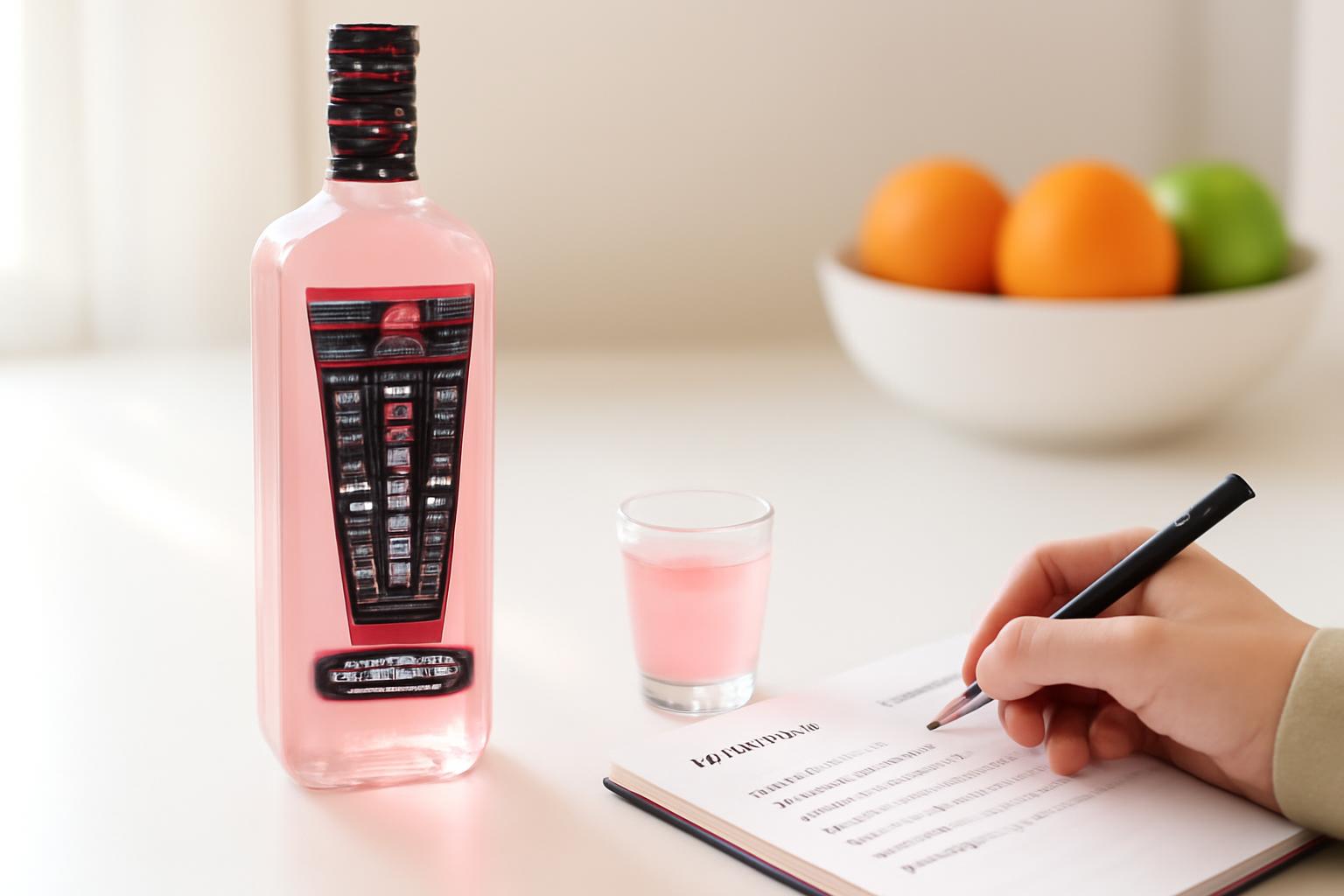
Reported at 30% ABV, it is 60 proof. A measured 1.5 oz shot works out to about 0.76 U.S. standard drinks, not a full standard drink.
Pink Whitney is easy to misread if you track drinks the way you track food. It sits with the spirits, so many people log it as regular vodka. It tastes like pink lemonade, so others log it like a sweet cocktail. Neither shortcut is ideal. For alcohol and calorie tracking, the cleaner method is to start with the bottle strength that is reported across current third-party sources, convert your pour into a serving-based estimate, and then account separately for the flavored base and anything else you mix with it.
That matters because Pink Whitney is lower-proof than the default vodka many people picture, but it is not a low-alcohol drink. The useful comparison is not “light drink” versus “hard liquor.” It is “flavored vodka at a lower strength than the 40% ABV benchmark many drinkers assume by default.”
For a tracker, that distinction fixes several common errors at once. If you log Pink Whitney as generic 80-proof vodka, you will likely overstate the alcohol per ounce. If you log it as a ready-made cocktail because it tastes sweet, you can miss the fact that it is still a bottled spirit. The right middle ground is to treat it as flavored vodka first, then adjust for your actual pour size and mixer.
What Is Pink Whitney Vodka?
Pink Whitney is a pink lemonade-flavored vodka made by New Amsterdam and tied to former NHL player Ryan Whitney through a collaboration with the Spittin’ Chiclets podcast, according to a third-party explainer that describes it as a flavored vodka rather than beer, wine, or a canned cooler (Bliss Recovery LA).
Retailer descriptions line up on the product basics: it is sold as a bright pink, tart-sweet flavored spirit, not as a neutral vodka with no added flavoring. A retailer guide describes it as a Ryan Whitney collaboration, notes pink lemonade flavor, and lists common bottle sizes including 750 ml and 1 L (Valley Wine & Liquor).
From a practical drinking standpoint, the relevant traits are the obvious ones. Pink Whitney is pink, citrusy, sweet-tart, and smoother tasting than plain vodka.
So if your goal is clean tracking, start by classifying Pink Whitney as a flavored vodka. That keeps your alcohol math anchored to the reported bottle strength instead of to the taste profile.
Pink Whitney Alcohol Percentage and Proof
Across the retailer pages and third-party explainers in this research set, Pink Whitney is consistently reported at 30% ABV, which is 60 proof, and that is the figure to use unless the label on your own bottle says otherwise (Bliss Recovery LA).
That puts it below the common 40% ABV, 80-proof benchmark associated with standard unflavored vodka. On an equal-volume basis, 30% versus 40% ABV means about 25% less alcohol per pour. That sounds substantial, and it is, but it does not make Pink Whitney weak. It is still a distilled spirit; it just carries less ethanol per ounce than the default vodka assumption many apps and drinkers use.
That is why “weaker than regular vodka” and “low alcohol” are not the same statement. A measured shot of Pink Whitney is not half-strength, and it is not just flavored mixer. It remains a 60-proof spirit.
There is also an evidence-quality point worth keeping explicit. The sources here agree on the reported 30% ABV, but they are retailer pages, rehab-center explainers, and calculator-style pages, not independent lab tests. So the precise wording should remain conservative: Pink Whitney is reported across multiple third-party sources as 30% ABV, not independently verified here.
For readers who track alcohol intake carefully, that wording matters. “Reported at 30% ABV” is strong enough for practical serving math. It is not the same as claiming manufacturer-verified precision without the supporting label or lab data in hand.
Calories and Nutrition per Serving
For a standard 1.5 oz serving, third-party estimates place Pink Whitney at roughly 93 to 100 calories per shot (Anaheim Lighthouse). That is the most useful range in this evidence set for everyday logging.
Why a range instead of a single exact number? Because flavored spirits are not just alcohol and water. Pink Whitney appears in sources as a sweetened, pink lemonade-flavored vodka, which means total calories can reflect both the alcohol itself and the nonalcohol ingredients used to build the flavor profile. Lower ABV reduces alcohol calories compared with standard vodka, but flavoring can add some of that calorie difference back.
That is also why “lower proof” does not automatically mean “much lower calories.” The alcohol portion falls when ABV falls. The total serving calories do not necessarily fall by the same percentage because flavored products are not compositionally identical to plain spirits.
For tracking purposes, the biggest variable is still the pour. If your “one drink” was a true 1.5 oz shot, the reported range of 93 to 100 calories is a reasonable estimate. If the glass actually held 2 oz, your drink was about one-third larger than the standard reference before you even count the mixer. That matters more than the difference between the low end and high end of the reported calorie range.
A practical way to think about it is by scaling the shot you already know. If 1.5 oz is about 93 to 100 calories, then 1 oz works out to roughly two-thirds of that, and 2 oz works out to roughly one-third more. You do not need a perfect database entry to improve your logging; you need a realistic serving-size assumption.
One third-party calculator page gives a cleaner internal split for the 100-calorie estimate: about 75 calories from alcohol and the remainder from sugars or carbohydrates in the drink. That is not enough evidence to assign an exact carb count, but it does support the broader point that alcohol still drives most of the calories in a standard shot-sized pour.
Even when you find a label or app entry that looks precise, remember that precision and accuracy are not the same thing. CaloriePages’ methodology page notes that food-label calorie counts can be off by as much as 20%, which is a good reason to treat any logged drink value as an estimate rather than as lab-grade truth (CaloriePages About).
So the useful order of operations is simple: measure first, estimate second, and do not let false precision from an app distract you from the much bigger variable sitting in the glass.
Pure Alcohol and Standard Drink Equivalents
The cleanest way to compare Pink Whitney with other alcohol is not by taste, color, or branding. It is by pure alcohol content. One third-party BAC calculator page reports that a 45 ml / 1.5 oz shot of Pink Whitney at 30% ABV contains about 10.7 grams of alcohol and equals about 0.76 U.S. standard drinks using the 14-gram U.S. standard drink reference (DrinkMeter).
That single comparison clears up a common misunderstanding: a “shot” and a “standard drink” are not always interchangeable. With Pink Whitney, a 1.5 oz shot is less than one U.S. standard drink.
That is useful for moderation, recovery, and ordinary tracking alike. If you count drinks by glassware instead of by alcohol content, you can easily misread what you consumed. A measured shot of Pink Whitney is still substantial, but it is not identical to a 1.5 oz pour of 80-proof vodka.
Bottle math becomes easier once you separate shot count from standard-drink count. A 750 ml bottle contains about 16.7 servings of 45 ml each, and a 1 L bottle contains about 22.2 such servings. But those are serving counts, not U.S. standard-drink counts. Using the 0.76 standard-drink estimate per 1.5 oz serving, a 750 ml bottle works out to about 12.7 U.S. standard drinks, while a 1 L bottle works out to about 16.9 U.S. standard drinks. Those totals are derived from the cited per-shot estimate, not from a manufacturer nutrition or labeling panel.
That difference is not trivial. If you are planning pours for a party, shot-equivalent count may be the useful number. If you are trying to compare your intake with moderation guidelines or with other kinds of drinks, standard-drink count is the better number.
A few scaled examples make this more concrete. Using the same 1.5 oz benchmark, a 1 oz pour of Pink Whitney is roughly 7.1 grams of alcohol and about 0.51 standard drinks. A 2 oz pour is roughly 14.3 grams of alcohol and about 1.01 standard drinks. In other words, once a Pink Whitney pour reaches 2 oz, you are very close to the alcohol content of one U.S. standard drink.
That is why measured pours matter more than branding language. “Flavored vodka” sounds softer than “straight vodka,” but standard-drink math does not care what the bottle looks like. It cares how much ethanol is in the glass.
Pink Whitney vs. Standard 40% Vodka
The simplest comparison is still the most useful one: Pink Whitney is reported at 30% ABV, while standard unflavored vodka is typically discussed as 40% ABV in the sources reviewed here. For the same volume in the same glass, Pink Whitney carries about 25% less alcohol than standard vodka.
In shot terms, that difference is meaningful. Pink Whitney’s cited 1.5 oz serving contains about 10.7 grams of alcohol. A comparable 1.5 oz pour of 40% vodka lands much closer to the 14-gram standard-drink benchmark. So when people say Pink Whitney is weaker than regular vodka, that is true on a per-ounce basis.
But lower proof should not be mistaken for protection against overdoing it. In both cases, total intake rises even though the bottle started below the 40% benchmark.
There is also an important calorie nuance. If you compare equal volumes, Pink Whitney likely has fewer alcohol calories than plain 40% vodka because it contains less alcohol by volume. But the total calorie gap may not be as large as the ABV gap suggests, because Pink Whitney is flavored and sweetened. So it can be milder in alcohol without feeling proportionally lighter on a calorie log.
That is why the “best” comparison depends on what you are trying to control:
-
If you care most about intoxication speed, Pink Whitney is weaker per ounce than standard 40% vodka.
-
If you care most about database accuracy, using the product-specific estimate is better than logging generic vodka and hoping the mismatch is small.
A useful mental check is this: Pink Whitney is not regular vodka, but it is also not a premixed low-alcohol cooler. It sits in the middle of those mistaken assumptions, and that is exactly why it gets mislogged so often.
Serving Sizes, Mixers, and Calorie Math
The standard reference serving in the sources here is 1.5 oz, and that is still the cleanest place to start. If you drink Pink Whitney straight, over ice, or in a mixed drink, think in measured 1.5 oz units first. Once you do that, scaling becomes simple: 1 oz is about two-thirds of a serving, 2 oz is about one and one-third servings, and 3 oz is two full serving-equivalents.
That helps more than searching for the perfect app entry. If you begin with a known serving size and the reported 30% ABV figure, your estimate is usually cleaner than what you get from a random database result with a familiar name.
Mixers are where calorie totals often become harder to recognize. Pink Whitney already brings a lemon-sweet profile, so adding more lemonade, juice, tonic, or syrup can push total drink calories up faster than people expect. If your goal is a longer drink with less extra sweetness, club soda is the simplest direction because it gives you dilution and volume without turning one flavored vodka into a second sweet beverage.
The same serving-size logic also applies to other low-calorie mixed drinks: measured pours matter more than branding, and mixer choice often drives the calorie total.
A practical tracker’s method looks like this:
- Measure the pour.
- Treat 1.5 oz as the standard reference unit.
- Scale the reported 93 to 100 calories and 0.76 standard drinks up or down based on your actual volume.
- Add mixer calories separately instead of assuming the bottle estimate already includes them.
- Log the finished drink conservatively if the pour was eyeballed.
This is also the section where readers sometimes ask about “net” calories and thermic effect. Thermic effect is real, but it is not the lever that makes or breaks Pink Whitney tracking. In CaloriePages’ macro explainer, carbohydrate thermic effect is described as roughly 5% to 10% of intake, which is enough to matter in broad nutrition discussions but nowhere near enough to cancel out a larger pour or a sweet mixer (CaloriePages on thermic effect of macros).
For everyday use, the big variables are still the obvious ones:
- How much you poured
- Whether you measured it
- What you mixed it with
- Whether your “one drink” actually contained more than one serving
Some practical low-complexity ways to keep the math clearer are:
- 1.5 oz Pink Whitney over ice when you want the cleanest log
- 1.5 oz Pink Whitney plus soda water when you want more volume without stacking more sweetness
- 1 oz Pink Whitney in a taller drink when you want the flavor but less alcohol per glass
- Water alongside the drink so refill pace does not silently become alcohol pace
The less you rely on free-pouring and sweetness for volume, the easier Pink Whitney is to track honestly.
Why Sweet Flavors Can Mask Alcohol Strength
One reason Pink Whitney confuses drinkers is that its tart-sweet lemonade profile can make it feel softer than its proof suggests. That same theme appears in multiple third-party explainers: sweetness changes perception, and perception changes pace.
Behaviorally, this matters more than many people realize. Neutral vodka signals itself clearly. Pink Whitney softens that signal. That is where lower proof can turn into higher total intake.
The effect is not that Pink Whitney is uniquely dangerous. The more ordinary point is that easy drinkability can blur portion awareness. A weaker drink per ounce can still deliver plenty of alcohol if the glass is larger, the refill is quicker, or the serving is not measured.
The same calculator source that gives the per-shot alcohol estimate also notes that the human body metabolizes about 5 to 7.5 grams of alcohol per hour, while emphasizing that real-world variation is substantial (DrinkMeter). That does not give you a precise personal clearance schedule, but it does explain why several quick pours can stack faster than they clear.
For Pink Whitney specifically, that stacking problem is easy to underestimate. A single 1.5 oz pour contains about 10.7 grams of alcohol. Two measured pours place you around 21.4 grams.
That is why the best advice here is behavioral rather than dramatic:
- pour measured servings instead of guessing
- eat before or while drinking
- alternate with water
- slow down more than the taste tells you to
Pink Whitney may be weaker than 40% vodka ounce for ounce, but sweetness changes perception more than it changes the underlying alcohol math.
Availability, Pricing, and Label Checking
Price is one of the most variable pieces of information online, but the broad range in this evidence set is still useful. One third-party article says a 750 ml bottle typically runs around $14.99, while also noting that retail prices vary by location and seller (Anaheim Lighthouse).
A retailer listing in the same research set prices the 1 L bottle at $17.99, which fits the general picture of Pink Whitney landing in the mid-teens for 750 ml and high teens for 1 L, before local tax and store markup differences (Elma Wine & Liquor).
When you buy a bottle, the label is still the first thing to trust over any article or app entry. In practical terms, check:
- ABV/proof: use the number on the bottle you actually bought
- bottle size: 750 ml and 1 L produce very different bottle-total calculations
- serving assumption: most online math assumes 1.5 oz
- nutrition details: if your package includes them, use those over third-party estimates
There is one more evidence caveat worth keeping front and center: none of the sources reviewed here included independent lab testing for Pink Whitney’s ABV or a manufacturer nutrition sheet. So if your local market, bottle size, or future reformulation differs from the third-party descriptions summarized here, the bottle in your hand should override the internet.
Conclusion
Pink Whitney’s reported 30% ABV makes it a milder flavored vodka option than standard 40% vodka for both alcohol tracking and calorie estimates. Using the third-party figures in this evidence set, a 1.5 oz pour lands around 93 to 100 calories and about 0.76 U.S. standard drinks. That makes it weaker than regular vodka per ounce, but not weak in any broader sense.
For practical logging, the best approach is straightforward: use the reported bottle strength, measure your pour, scale from the 1.5 oz reference serving, and count mixer calories separately. If you are comparing bottles, remember that shot count and standard-drink count are not the same number. If you are comparing app entries, remember that small database differences matter less than whether the serving size was real.
The sweet pink lemonade profile is part of why Pink Whitney is popular, but it is also why people can lose track of pace. So the most useful takeaway is not a dramatic one. It is just accurate drink math: use measured pours, treat database numbers as estimates, and let longer-term tracking trends tell you whether your logging is calibrated.
What is Pink Whitney’s ABV percentage?
Pink Whitney is reported at 30% ABV, which equals 60 proof, across multiple retailer pages and third-party explainers in this research set. Because those are not lab reports, the cautious phrasing is that it is reported at 30% ABV rather than independently verified.
How many calories in a 1.5 oz shot of Pink Whitney?
A 1.5 oz shot is commonly estimated at about 93 to 100 calories in the sources reviewed here. That is best treated as a useful tracking range, not as an exact manufacturer-certified nutrition number.
Is Pink Whitney stronger or weaker than regular vodka?
Pink Whitney is generally weaker than regular vodka by volume. The comparison used throughout this research set is 30% ABV for Pink Whitney versus 40% ABV for standard vodka, which means about 25% less alcohol per equal pour.
How many standard drinks in a Pink Whitney shot?
A measured 1.5 oz shot of Pink Whitney works out to about 0.76 U.S. standard drinks using the 14-gram standard-drink benchmark cited by the third-party calculator source summarized above.
Can the sweet taste lead to overdrinking Pink Whitney?
It can. The main issue is not that Pink Whitney is uniquely risky, but that a sweet pink lemonade flavor can make a 60-proof spirit feel softer than it is, which can encourage larger pours or faster drinking than plain vodka might.
This article is for general informational purposes only, not medical or dietary advice. For health, safety, or alcohol-use concerns, consult a qualified professional.